
On this page
Start here
Quick answer
A Viking gas oven that is not heating may have an incomplete mode or temperature selection, a delay or control state, no electrical power for the ignition and controls, a closed or unavailable gas supply, a failed ignition sequence, or a burner that lights but does not maintain heat. First identify the exact model and whether the oven is gas or dual fuel, then record whether there is a display, clicking, flame, error, or preheat response. Use only normal controls and the exact Viking use-and-care manual; do not adjust gas pressure, remove panels, or repeatedly ignite the oven. Stop immediately for gas smell, delayed ignition or a boom, abnormal flame, carbon-monoxide alarm, smoke, burning odor, sparks, or a breaker trip. A persistent no-heat condition after the model-specific start and one safe observation needs qualified Viking appliance or gas service.
Before you begin
Safety first
- This article supports ordinary-access observation and exact-manual controls only. Do not disconnect gas lines, adjust pressure or burners, remove panels, probe live circuits, keep igniting, test leaks with flame, or continue after a combustion or electrical warning.
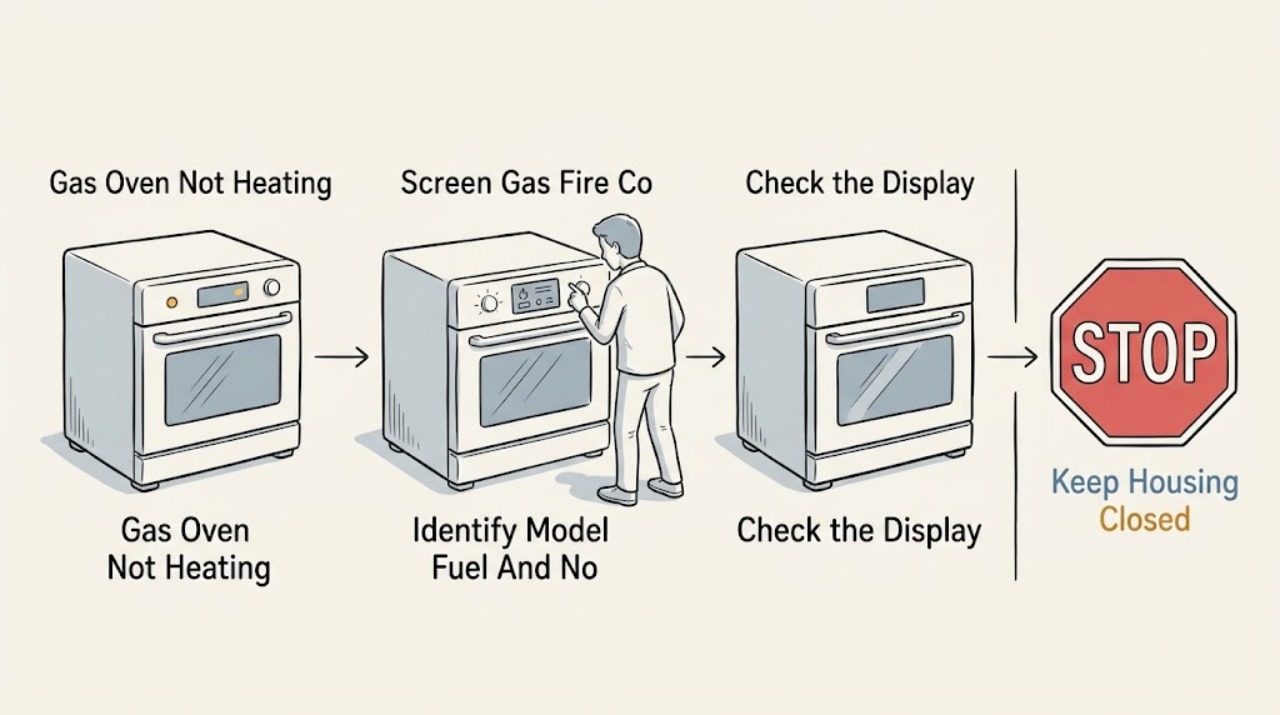
Work through in order
Diagnostic checks
Use only checks that match the exact appliance or system and its official guide.
-
Check 1
Before trying to heat the oven, look from ordinary access for gas smell, a delayed ignition or boom, abnormal flame, carbon-monoxide alarm, smoke, burning odor, sparks, hot or damaged wiring, cracked glass, or a breaker that has tripped repeatedly.
Expected result: Record whether the appliance is gas or dual fuel, whether any flame or odor is present, whether smoke or an alarm occurred, and whether the control area, cord, or breaker shows heat or damage.
Next step: Stop using the oven. If safe without touching hot or wet electrics, isolate power at the normal disconnect; for gas smell, do not ignite or operate electrical controls, leave the area, and seek appropriate help from a safe location.
Stop if: Do not relight repeatedly, touch damaged wiring or hot glass, operate switches during a gas smell, or reset a repeatedly tripping breaker.
Why this matters
Why: Fuel, combustion, fire, heat, and electrical hazards override all no-heat checks. A gas smell or combustion warning requires stopping and seeking help, not another ignition attempt.
-
Check 2
Record the Viking model, whether it is a gas range, built-in gas oven, or dual-fuel range, and whether the symptom is no display, display but no start, no ignition, flame that goes out, or slow or incomplete preheat.
Expected result: No display points first to electrical supply; a lit display with no start points to mode, timer, lock, door, or control state; no flame points to ignition or gas-supply service; a flame that cycles or goes out points to a combustion or control fault.
Next step: Use the exact model's Viking use-and-care and installation documentation before selecting a mode, interpreting an error, or checking a fuel-related condition.
Stop if: Do not continue if the door, controls, wiring, flame, or fuel condition is unsafe or if the model cannot be identified reliably.
Why this matters
Why: Viking has multiple oven families and model-specific controls, so the failed stage determines the safe next check and prevents cross-model error or ignition assumptions.
-
Check 3
For a no-display or display-but-no-start symptom with no hazard, confirm from ordinary access that the normal appliance disconnect is engaged and the household circuit is in its normal state; then check the manual's clock, mode, temperature, timer, lock, and Start sequence.
Expected result: The display may return, or the display may remain active while the oven still will not accept a valid cooking mode. A breaker that will not stay set or trips when heating is selected is a fault signal, not a reason to keep resetting it.
Next step: Correct only an obvious control state using the exact manual. Arrange qualified electrical or Viking appliance service for a dead display, persistent no-start, or any repeated trip.
Stop if: Do not open the electrical enclosure, use an extension cord, perform a live voltage test, or repeatedly reset the breaker.
Why this matters
Why: Gas ignition and controls still need electrical power, while delay, lock, incomplete mode selection, or a circuit fault can imitate a heating failure.
-
Check 4
For a confirmed gas or dual-fuel Viking appliance with no gas smell, compare the exact installation manual with the visible external gas shut-off position and note whether other gas appliances have normal supply; do not move the range or disconnect the gas line.
Expected result: A visibly closed appliance shut-off or a wider supply interruption can explain no ignition, while normal supply elsewhere with no ignition leaves an appliance ignition or control branch. Uncertainty about the valve, piping, or fuel conversion is a service boundary.
Next step: If the shut-off is clearly closed and the manual identifies it for normal user access, contact qualified gas service before restoring use; otherwise keep the appliance off and arrange Viking or gas professional diagnosis.
Stop if: Do not turn an unfamiliar valve, disconnect a gas line, adjust pressure, remove panels, or test for leaks with flame.
Why this matters
Why: Viking gas documentation requires a reachable shut-off and qualified installation or service. A user should not adjust a regulator, pressure, or gas connection to make the oven heat.
-
Check 5
Only when the model manual permits a normal start, the oven is cool, there is no gas smell or other hazard, and the door can close normally, select the documented heating mode once and observe from a safe position for the expected ignition sound and flame response.
Expected result: No clicking or no flame, clicking without ignition, a flame that lights and goes out, delayed ignition, or an abnormal flame are different observations; note them without opening the oven or repeating the start.
Next step: Stop after the one observation. Arrange qualified Viking appliance or gas service for no ignition, flame dropout, delayed ignition, or abnormal flame; do not continue testing.
Stop if: Do not keep clicking or igniting, remove the oven bottom, adjust burners, probe wiring, or continue after any boom, gas odor, smoke, abnormal flame, or CO alarm.
Why this matters
Why: The result separates control or electrical activation from ignition, gas delivery, flame-sensing, or combustion faults, but it does not identify a replaceable part for the user.
-
Check 6
If a normal flame is visible and stable with no hazard, follow the exact model manual's preheat indication and observe whether the oven progresses normally; do not judge heat by touching the door or cavity.
Expected result: A normal preheat indication and stable operation point away from a total ignition failure. A flame that cycles abnormally, does not maintain heat, produces smoke or odor, or never reaches the manual's expected state needs service rather than a longer unattended run.
Next step: Cancel the mode and keep the oven off if the result is abnormal or persistent. Arrange qualified Viking appliance service with the model, mode, and observation.
Stop if: Do not leave an abnormal flame unattended, use the oven as a room heater, touch hot surfaces, or continue after smoke, burning odor, CO alarm, or unstable combustion.
Why this matters
Why: Gas ovens may cycle their burner to regulate temperature, and Viking cooking modes differ by model. Stable flame without expected heating can involve sensing, control, burner, airflow, or other internal conditions.
-
Check 7
If the display shows an error, lock, or service indication, record the complete message, selected mode, and moment it appeared, then compare it with the exact Viking manual or documentation for that model.
Expected result: A documented user reset may clear a transient control state, while an unlisted or returning error, a lock that does not release, or a code with no heat indicates a service condition.
Next step: Follow one exact model instruction only. If the error returns or the oven remains cold, keep it off and arrange qualified Viking service.
Stop if: Do not guess an error meaning, bypass an interlock, open panels, or repeatedly cycle power.
Why this matters
Why: Viking model families use different controls and service procedures; a code from another range cannot safely explain this oven.
-
Check 8
Stop troubleshooting when the oven remains cold after the exact mode, timer, power, supply, and one safe ignition or preheat observation, or when any fuel, combustion, smoke, CO, heat, or electrical warning appears.
Expected result: Provide the model and serial information, fuel type, display and error, selected mode and temperature, power result, gas-supply observation, ignition sound and flame behavior, preheat result, and all safety symptoms.
Next step: Keep the oven unused and arrange qualified Viking appliance service; use a licensed gas professional or electrician when the evidence points to fuel or household power.
Stop if: Do not open panels, adjust gas hardware, perform live tests, keep igniting, or cook through an unresolved no-heat condition.
Why this matters
Why: This record lets a qualified technician distinguish control, electrical, gas-supply, igniter, flame-sensing, burner, airflow, temperature-control, or installation faults without unsafe user disassembly.
Use your observations
Decision map
Find the observation that best matches what you see, then follow the next safe action.
-
PATH 01Safety boundary
What you see
Gas smell, delayed ignition or boom, abnormal flame, carbon-monoxide alarm, smoke, burning odor, sparks, damaged wiring, or repeated breaker trips are present.
Do this next
Stop using the oven; avoid ignition and electrical controls during a gas smell, leave the area, and seek appropriate gas, emergency, electrical, or appliance help from a safe location.
Why this path and its safety boundary
Why it matters: This is an immediate safety stop, not a preheat diagnosis.
Safety stop: Do not relight, test with flame, operate switches during a gas smell, touch hot or damaged parts, or reset a tripping breaker.
-
PATH 02Safety boundary
What you see
The display and controls are blank and there is no immediate hazard.
Do this next
Check only the visible disconnect and household circuit state. Arrange qualified electrical or Viking service if power is absent, the breaker trips, or the display remains blank.
Why this path and its safety boundary
Why it matters: The first branch is normal external power or appliance control power.
Safety stop: Do not open the appliance or perform a live electrical test.
-
PATH 03Safety boundary
What you see
The display is lit but no heating mode starts.
Do this next
Use the exact Viking manual to clear or complete the normal start sequence once; service a persistent no-start.
Why this path and its safety boundary
Why it matters: An incomplete mode, temperature, Start command, timer, delay, lock, or control state may be preventing activation.
Safety stop: Do not bypass locks or repeatedly press random controls.
-
PATH 04Safety boundary
What you see
The confirmed gas or dual-fuel oven has a valid start command but no expected ignition or flame, with no gas smell.
Do this next
Stop after one safe model-authorized observation and arrange qualified Viking appliance or gas service; do not disassemble or keep igniting.
Why this path and its safety boundary
Why it matters: An electrical ignition, gas-supply, control, or burner-sensing fault may be involved.
Safety stop: Stop immediately for clicking without ignition, delayed ignition, odor, smoke, abnormal flame, or a CO alarm.
-
PATH 05Safety boundary
What you see
A flame lights but drops out, cycles abnormally, stays weak or unstable, or the oven remains cold after the model's normal preheat indication.
Do this next
Cancel the mode, keep the oven off, record the flame and preheat behavior, and arrange qualified Viking service.
Why this path and its safety boundary
Why it matters: A flame-sensing, burner, control, airflow, temperature, or combustion fault needs professional diagnosis.
Safety stop: Do not leave an abnormal flame unattended, adjust gas hardware, or continue cooking.
-
PATH 06Safety boundary
What you see
The visible gas shut-off or fuel supply status is uncertain, or other gas appliances also lack normal supply.
Do this next
Keep the oven off and arrange qualified gas service; do not move the range or disconnect the gas line.
Why this path and its safety boundary
Why it matters: The issue may be installation or household fuel supply rather than the oven itself.
Safety stop: Do not operate an unfamiliar valve, adjust pressure, or test for leaks with flame.
-
PATH 07Safety boundary
What you see
A complete error, lock, or service indication appears or returns.
Do this next
Record the message, follow one exact manual instruction, and arrange Viking service if it persists or heating does not return.
Why this path and its safety boundary
Why it matters: The condition is model-specific and may require service.
Safety stop: Do not generalize another Viking model's code or bypass an interlock.
-
PATH 08Safety boundary
What you see
The oven remains cold after safe power, controls, supply, and one model-authorized ignition or preheat observation.
Do this next
Keep the appliance unused and arrange qualified Viking appliance service with the recorded observations.
Why this path and its safety boundary
Why it matters: An internal ignition, burner, sensing, control, temperature, airflow, or wiring fault needs qualified diagnosis.
Safety stop: Do not open panels, perform live tests, adjust gas components, or keep retrying ignition.
Helpful context
Understand the symptom
Separate no ignition from no sustained heat
A dark, cold cavity can mean that the oven never received a valid start command, has no power for controls or ignition, has no gas supply, or failed to ignite. If a flame appears and then goes out, the symptom is different from a burner that never lights. Record the display, selected mode, temperature, ignition sound, flame behavior, and any error before choosing the next branch.
Use the exact model's start and preheat instructions
Viking offers gas, electric, and dual-fuel products with different controls and cooking modes. Confirm that the desired Bake or other heating mode and temperature were accepted, and that a delay, timer, Sabbath, or lock state is not preventing a start. A cooling or convection fan does not by itself prove that the burner is heating. Follow the model manual rather than importing a sequence from another Viking range.
Gas and ignition checks have a strict boundary
From ordinary access and only when there is no gas smell or other hazard, you may note whether the normal start sequence produces the expected ignition sound or a visible flame through the door. Do not remove the oven bottom, adjust the regulator or air shutter, test a gas line, or keep trying to ignite a burner that does not light promptly. Viking gas documentation assigns installation and service to qualified personnel.
Treat combustion and electrical symptoms as stops
A gas smell, delayed ignition, abnormal yellow or unstable flame, smoke, carbon-monoxide alarm, burning odor, sparks, or repeated breaker trip is not a normal preheat variation. Stop using the oven, avoid ignition and electrical controls when gas is suspected, leave the area when appropriate, and arrange qualified gas, electrical, emergency, or appliance help from a safe location.
When checks do not resolve it
Need a professional?
Arrange qualified Viking appliance service when the oven has no ignition, a flame drops out, preheat never completes, an error returns, or the oven remains cold after the exact model's normal controls and one safe observation. Use a licensed gas professional for uncertain fuel supply, shut-off, conversion, regulator, or combustion concerns and a qualified electrician for household power or repeated breaker trips. Request urgent help for gas smell, delayed ignition or a boom, abnormal flame, carbon-monoxide alarm, smoke, burning odor, sparks, flooding, or damaged wiring.
Safety scope: This article supports ordinary-access observation and exact-manual controls only. Do not disconnect gas lines, adjust pressure or burners, remove panels, probe live circuits, keep igniting, test leaks with flame, or continue after a combustion or electrical warning.
Common questions
FAQ
Why is my Viking gas oven not heating?
Separate no display, display-but-no-start, no ignition, flame dropout, and incomplete preheat. Check only the exact model's mode, temperature, timer, lock, power, and safe external fuel conditions; a persistent no-heat result needs qualified service.
What if my Viking gas oven clicks but does not light?
Stop after one normal model-authorized observation if there is no gas smell or other hazard. Record clicking, flame, error, and fuel observations, then arrange qualified Viking appliance or gas service. Do not keep trying to ignite or remove panels.
Can a timer or control setting make a Viking oven seem not to heat?
Yes. Mode, temperature, Start, delay, timer, lock, and model-specific control states can prevent a valid heating cycle. Use the exact Viking manual to complete or clear the state once; do not bypass a lock.
Is a cycling Viking gas-oven flame normal?
Gas ovens may cycle heat to regulate temperature, but an unstable flame, repeated dropout, delayed ignition, smoke, odor, abnormal color, or failure to preheat is not a reason to keep running the oven. Stop and arrange service.
What should I do if I smell gas while the Viking oven is not heating?
Do not attempt ignition or operate electrical switches. Leave the area and seek gas or emergency assistance from a safe location. Do not return to test the oven until qualified help says it is safe.
Read the exact guide
Official sources
- Viking Range, LLC | Support and Docs | DocumentationViking Range · Official Viking documentation portal for locating the exact use-and-care and installation manuals by product family and model.
- CPSC News Feature: Getting Ready For Cold WeatherU.S. Consumer Product Safety Commission · Government guidance for a gas smell: do not attempt ignition or operate electrical switches, leave the area, and seek appropriate help; it is not a Viking repair procedure.
- F1239Q EN.qxp:Layout 1Viking Range · Official Viking gas installation manual covering qualified installation and service, reachable gas shut-off, grounding, gas-smell response, and combustion safety; exact oven controls vary by model.
- Viking Range | High-End OvensViking Range · Official Viking page distinguishing gas and electric oven families, cooking modes, and model-specific use-and-care guidance.
Community feedback
Share a repair observation
Share a plain-text repair observation. Accepted observations are published automatically; this page may take a moment to update.