
On this page
Start here
Quick answer
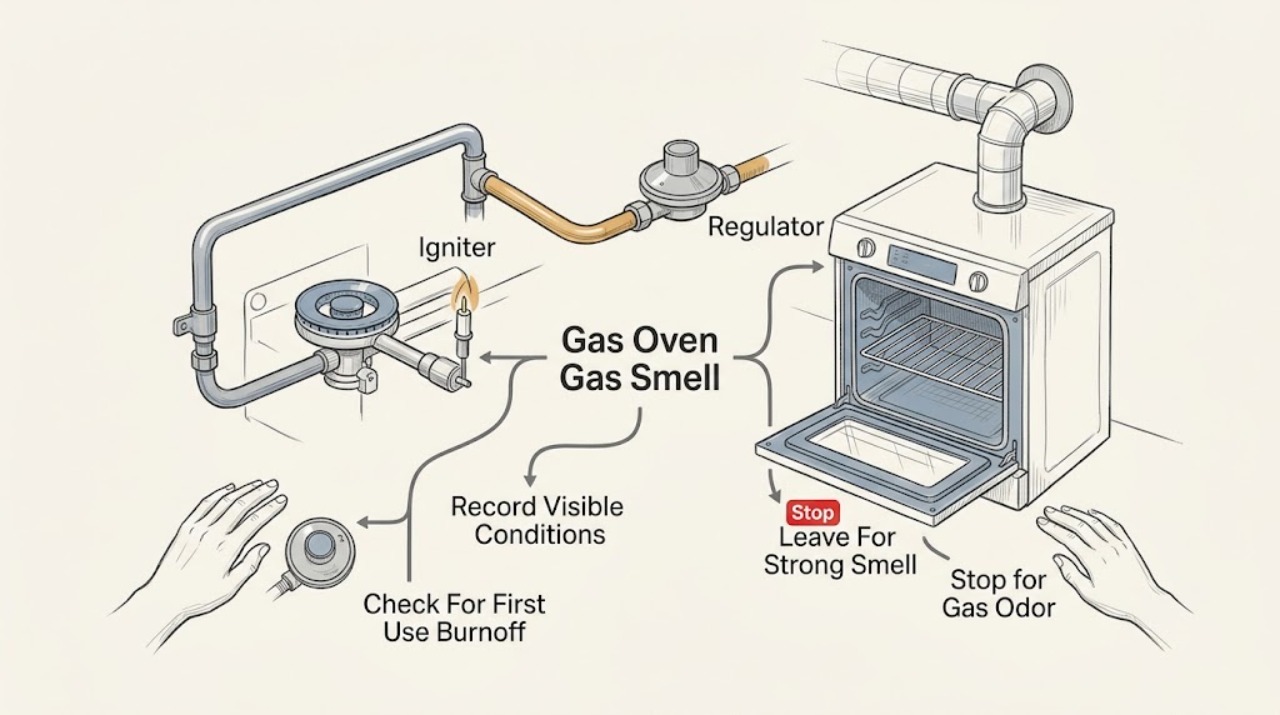
Treat a Viking gas-oven smell as a possible fuel leak until the smell is clearly absent and the appliance identity and event are understood. Do not light anything, touch light switches or appliance controls, use electronic devices near the smell, search for a leak, move the range, or relight the oven to test it. Leave the area immediately if the smell is strong or persistent, and contact the local gas utility or emergency service from a safe location. A brief smell during a documented ignition event or light first-use oil smell can have a different explanation, but Viking manuals still require the exact model and fuel configuration before any normal-use step. Smoke, soot, delayed ignition, an unstable flame, a boom, carbon-monoxide alarm or symptoms, or a smell that remains after the appliance is off requires qualified gas-appliance service before reuse.
Before you begin
Safety first
- Do not operate switches or electronics near a suspected leak, light a flame, relight repeatedly, search for leaks, move the range, open a gas path, bypass a safety device, remove covers, or reuse the oven after a gas or combustion event until cleared.
Work through in order
Diagnostic checks
Use only checks that match the exact appliance or system and its official guide.
-
Check 1
If gas odour is strong, persistent, spreading, or present while the oven is off, leave the home or affected area immediately; do not operate lights, appliance controls, switches, vehicles, matches, lighters, or other possible ignition sources.
Expected result: From a safe location, note only whether the odour clears after evacuation, whether a gas alarm or carbon-monoxide alarm sounded, and whether anyone has headache, dizziness, nausea, confusion, or breathing difficulty.
Next step: Contact the local gas utility or emergency service from safety and do not re-enter or reuse the appliance until the appropriate responder or qualified gas professional says it is safe.
Stop if: Do not re-enter to shut a valve, find the source, open windows, retrieve items, or test the oven if doing so requires approaching the odour or operating a device.
Why this matters
Why: A persistent odour or alarm is a possible fuel or combustion emergency, not a cleaning or ignition adjustment. Carbon monoxide has no reliable smell, so symptoms or an alarm require fresh air and emergency assistance even if the gas odour fades.
-
Check 2
Only when the area is declared safe, record the Viking model or product label, gas type if known, oven cavity, selected mode, whether the smell began before ignition or after a flame, whether the oven was newly installed, and any display or alarm message.
Expected result: Classify the event as ignition-only odour that cleared, first-use oil or insulation smell, food or grease smoke, electrical or plastic smell, persistent gas odour, delayed ignition, abnormal flame, or unknown.
Next step: Use the exact model documentation for any normal-use interpretation; if the classification is uncertain, leave the oven off and arrange qualified service.
Stop if: Do not return to the appliance to collect a label or photograph if odour, smoke, heat, or an alarm remains.
Why this matters
Why: The same word ‘smell’ can describe a normal first-use burn-off, a food spill, a fuel leak, or incomplete combustion. The model and event timing determine which Viking manual section applies.
-
Check 3
If the oven is newly installed and there was only light initial smoke or an oil-like smell that has fully cleared, compare the event with the exact Viking use-and-care instructions without starting another cycle until the appliance is cool and the area is clear.
Expected result: Record whether the smell and smoke lessen as documented, or become stronger, return after the first-use period, smell like gas or plastic, leave soot, or heat the cabinet unusually.
Next step: Follow only the manual-approved first-use guidance once and with safe ventilation; arrange service if the smell does not clear or any abnormal sign appears.
Stop if: Do not run self-cleaning, leave the oven unattended, or repeat a burn-off cycle after flames, thick smoke, gas odour, arcing, burning plastic, or severe heat.
Why this matters
Why: Viking describes initial burn-off of insulation and protective oils as a possible first-use cause, but worsening smoke, soot, plastic or electrical odour, gas odour, or abnormal heat is outside that limited explanation.
-
Check 4
When the oven is fully cool and there is no fuel or electrical hazard, inspect only visible cavity surfaces, racks, the door seal, and the area below the burner or element for food, grease, foil, packaging, or cleaner residue; remove only a loose cool item without force.
Expected result: Record visible residue, charring, melted material, a damaged seal, soot, a clean cavity with an unexplained smell, or any liquid near controls or electrical parts.
Next step: Use only the exact Viking manual's cool-surface cleaning method for ordinary residue; stop and arrange service for damage, soot, melted material, or an unexplained return of the smell.
Stop if: Do not scrape burners or igniters, remove covers, use flammable cleaner, mix chemicals, or clean while the oven is hot or gas odour is present.
Why this matters
Why: Food or grease can produce smoke and odour during heating, but charring, melted material, soot, exposed parts, or liquid near controls needs service rather than stronger cleaning. A clean cavity does not rule out a gas or electrical fault.
-
Check 5
Only from a safe position and only if the exact manual supports normal operation, record whether a brief odour occurred at a single ignition attempt and then disappeared, or whether there was delayed ignition, a whoosh or boom, an unstable or yellow flame, soot, or odour while the oven was off; do not relight or repeat the test.
Expected result: Classify the event as brief and fully cleared, persistent, delayed, abnormal combustion, or unrelated to an ignition attempt; note any gas alarm or carbon-monoxide symptom without re-entering an unsafe area.
Next step: For any persistent or abnormal event, leave the oven off and contact the local gas utility or emergency service from safety, then arrange qualified gas-appliance service before reuse.
Stop if: Do not search for a leak with a flame, use a spark, relight repeatedly, adjust a regulator, inspect an orifice, or move the range.
Why this matters
Why: A fully cleared brief event may be consistent with normal ignition, but delayed ignition, abnormal flame, soot, persistent odour, or an off-cycle smell indicates a gas or combustion problem requiring professional attention.
-
Check 6
From a dry, safe position, note whether the smell is electrical or plastic and whether smoke, sparks, arcing, a hot connection, abnormal cabinet heat, or a repeat breaker trip is present; do not open the range or perform energized electrical checks.
Expected result: Record a normal visible power state with an unexplained smell, a hot or scorched connection, a tripped or repeatedly tripping breaker, smoke, or a smell that begins only when a control or heating mode is selected.
Next step: Leave the appliance isolated when safe and arrange qualified service; do not restart it to compare modes.
Stop if: Stop immediately for smoke, flames, arcing, hot wiring, a scorched outlet, water near electrical parts, or repeated breaker trips.
Why this matters
Why: A burning electrical or plastic smell can indicate wiring, control, ignition, or heating damage and is not made safe by the absence of gas odour. A repeat trip or hot connection needs qualified electrical or appliance diagnosis.
-
Check 7
If the smell is persistent, unexplained, or returns after the exact manual's limited normal-use explanation, turn the oven off and provide the model, fuel type, timing, mode, smell description, flame or smoke observations, and any safe alarm or power information to qualified service.
Expected result: Record whether a qualified responder identifies a supply, connector, burner, igniter, regulator, venting, control, or installation issue and whether the appliance is cleared for reuse.
Next step: Keep the oven out of service until qualified service has corrected the cause and confirmed safe operation; follow any local utility or emergency instruction first.
Stop if: Do not remove the range, dismantle gas parts, bypass a safety device, or perform a self-repair after a gas or combustion event.
Why this matters
Why: A smell cannot identify a replacement part by itself. Gas-path, combustion, connector, and internal electrical faults require model-specific professional diagnosis.
Use your observations
Decision map
Find the observation that best matches what you see, then follow the next safe action.
-
PATH 01Next step
What you see
The gas smell is strong or persistent, appears while the oven is off, spreads through the area, or is accompanied by hissing, a boom, delayed ignition, soot, or an abnormal flame.
Do this next
Leave immediately, do not operate switches, controls, lights, electronics, or ignition sources, and contact the local gas utility or emergency service from a safe location. Do not re-enter or reuse the oven until cleared.
-
PATH 02Next step
What you see
A carbon-monoxide alarm sounds or anyone has headache, dizziness, nausea, confusion, weakness, or breathing difficulty during or after gas-oven use.
Do this next
Leave for fresh air immediately and contact emergency services from safety. Do not return to silence the alarm or operate the oven until qualified responders have assessed the appliance and building.
-
PATH 03Next step
What you see
The oven is new and there was only light initial smoke or an oil-like smell that fully clears without gas, plastic, electrical, soot, or abnormal-heat signs.
Do this next
Follow the exact Viking manual's first-use guidance once with safe ventilation and supervision. Stop and arrange service if the smell persists, worsens, or changes character.
-
PATH 04Next step
What you see
The cavity is cool, no gas or electrical hazard is present, and visible food or grease is the likely source.
Do this next
Clean only with the exact model's approved method and products, dry the area, and reassess without using self-cleaning as a smell test.
-
PATH 05Next step
What you see
A brief odour occurred during one documented ignition event and fully cleared, with no abnormal flame, delay, smoke, soot, alarm, or off-cycle smell.
Do this next
Do not repeat the ignition merely to confirm it. Record the model and event, and stop and arrange service if the odour returns or any combustion sign changes.
-
PATH 06Next step
What you see
The smell is burning electrical or plastic, or there is smoke, arcing, a hot connection, water near electrical parts, or a repeat breaker trip.
Do this next
Stop use and isolate power only from a dry safe position. Arrange qualified appliance or electrical service and do not restart the oven to compare modes.
-
PATH 07Next step
What you see
The smell has no clear source, returns after approved cleaning or first-use guidance, or remains after the appliance is off.
Do this next
Keep the oven off and arrange qualified service with the model, fuel type, timing, mode, smell description, and safe observations. Do not move or dismantle the range.
-
PATH 08Next step
What you see
The oven model, fuel configuration, or normal-use instructions are uncertain.
Do this next
Do not apply a procedure from another Viking range or oven. Keep the appliance off if a smell occurred and obtain the correct documentation or qualified service.
Helpful context
Understand the symptom
Safety comes before smell classification
If the smell is strong, persistent, spreading through the room, or accompanied by hissing, smoke, soot, delayed ignition, an abnormal flame, or symptoms, leave first. Do not stay beside the range to identify the source. Any observations can be collected later from a safe location or by a qualified professional.
A short ignition odour is not permission to keep testing
A gas appliance can have a brief odour during a normal ignition event, and Viking documentation describes first-use burn-off of insulation and protective oils. Those limited explanations apply only when the exact manual supports them and the smell fully clears without abnormal combustion. Persistent odour or delayed ignition follows the emergency stop path.
Do not move or dismantle the range
The gas connector and internal burner system are not homeowner diagnostic points. CPSC warns that even slight movement can damage an older connector, and Viking says installation and service must be performed by a qualified installer, service agency, or gas supplier. Keep the range in place and arrange professional inspection.
Only after diagnosis
Potential parts
- igniter or ignition assembly
Consider only after qualified gas-appliance diagnosis links delayed ignition, failed ignition, or abnormal burner lighting to the model-specific ignition assembly.
Match the exact Viking model, fuel configuration, and approved service information; do not replace or test a gas igniter after a leak event by guesswork. - burner, regulator, or safety-valve assembly
Consider only when qualified service confirms a burner, regulator, or safety-valve fault after the gas supply, connector, combustion, and installation are assessed.
Gas-path components require exact model matching and qualified installation; do not adjust a regulator or open the gas path. - temperature control or sensor
Consider only when qualified diagnosis connects abnormal heating, cycling, or control behavior to the model-specific sensor or control after gas-safety checks.
Confirm exact model and fuel configuration before ordering or fitting; a smell alone does not identify this part.
When checks do not resolve it
Need a professional?
Arrange qualified gas-appliance service for any persistent or unexplained gas odour, delayed ignition, abnormal flame, soot, a boom, smoke, carbon-monoxide alarm or symptoms, a smell that returns after the limited manual-approved explanation, or any need to inspect the connector, burner, regulator, valve, venting, or controls.
Safety scope: Do not operate switches or electronics near a suspected leak, light a flame, relight repeatedly, search for leaks, move the range, open a gas path, bypass a safety device, remove covers, or reuse the oven after a gas or combustion event until cleared.
Common questions
FAQ
What should I do first if my Viking gas oven smells like gas?
Leave immediately if the smell is strong or persistent. Do not light anything, operate switches or appliance controls, use electronics near the smell, search for a leak, or move the range. Contact the local gas utility or emergency service from a safe location.
Can a brief gas smell during Viking oven ignition be normal?
A brief odour that fully clears during one documented ignition event can have a different explanation, but do not repeat ignition to test it. Delayed ignition, a boom, an abnormal flame, soot, persistent odour, or any smell while the oven is off requires immediate stop and qualified service.
Is smoke from a new Viking oven always dangerous?
Viking documentation describes strong odour or smoke during the first few uses as possible burn-off of insulation and protective oils. That limited explanation does not cover gas odour, burning plastic or wiring, soot, flames, thickening smoke, abnormal heat, or a smell that persists; stop and arrange service for those signs.
When should I call a professional for a Viking gas-oven smell?
Call qualified gas-appliance service for any persistent or unexplained odour, delayed ignition, abnormal flame, soot, a boom, smoke, carbon-monoxide alarm or symptoms, a hot connection, or a smell that returns after the model-approved first-use explanation. Do not move or dismantle the range.
Read the exact guide
Official sources
- Use & CareViking Range · Viking professional range and oven operation, ignition troubleshooting, first-use odour and smoke, and heating behavior
- Smell Natural Gas? | Utah, Idaho & WyomingEnbridge Gas · Natural-gas leak signs, evacuation, ignition-source avoidance, and carbon-monoxide safety resources
- Warning and Important Safety InstructionsViking Range · Viking gas-appliance warnings, gas odour response, self-clean smoke caution, and qualified installation or service boundary
- GasU.S. Consumer Product Safety Commission · Gas-appliance connector movement warning and suspected gas-leak evacuation behavior
Community feedback
Share a repair observation
Share a plain-text repair observation. Accepted observations are published automatically; this page may take a moment to update.