
On this page
Start here
Quick answer
For a Viking VDSC3676BSS whose self-clean cycle will not lock the door, first leave the oven off and completely cool. Check from the outside that the door closes fully, the gasket and frame are not visibly displaced, and no rack or utensil is obstructing the opening. The official VDSC367-family guide says to select Self-Clean, turn the temperature control past the clean setting until it stops, and expect the automatic latch to engage within about 30 seconds. Do not pry, hold, bypass, or manually force the latch, and do not keep restarting a hot or failed self-clean cycle. If the door will not close fully, the latch does not engage on one cool supervised attempt, the door remains locked after the oven is cool, or there is a gas smell, smoke, electrical damage, or abnormal heat, stop using the range and arrange qualified Viking service; gas odor requires immediate gas-safety action.
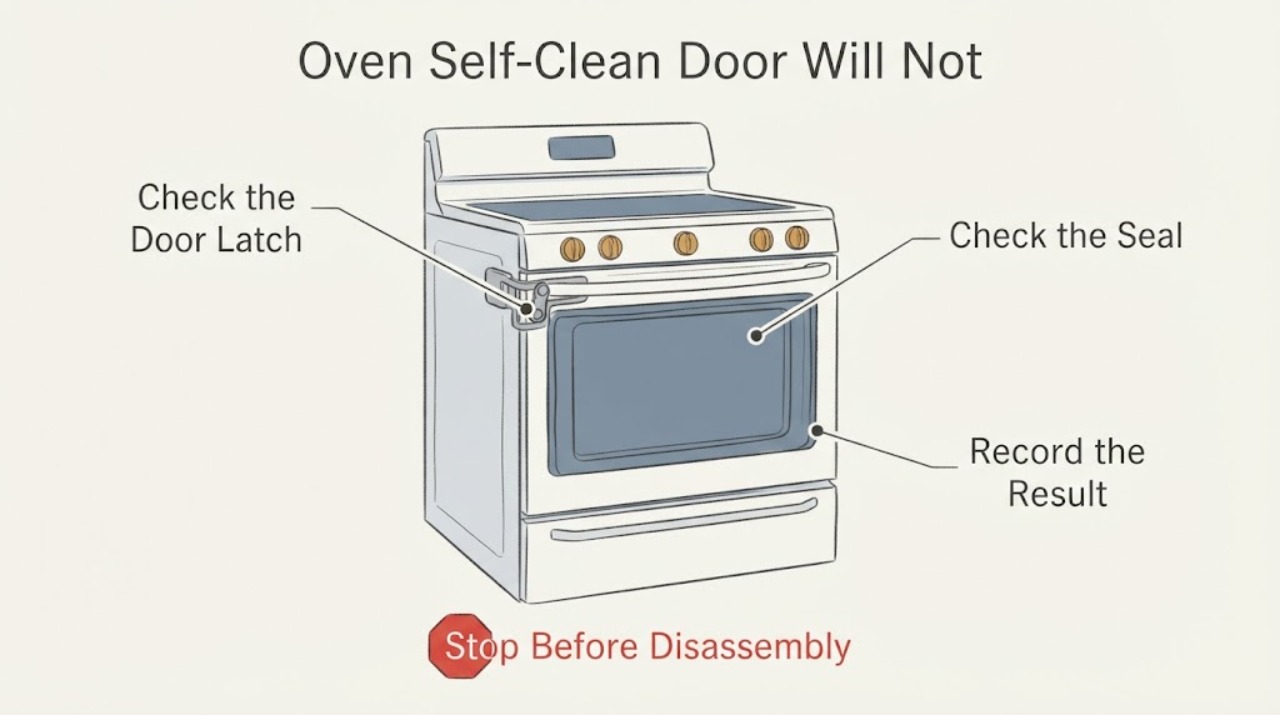
Work through in order
Diagnostic checks
Use only checks that match the exact appliance or system and its official guide.
-
Check 1
Turn the oven function and temperature controls to OFF and let the oven cool completely before touching the door area. If the door is currently locked, do not pull or pry it; keep people away from the hot range and wait for the latch to release at a safe temperature.
Expected result: The latch releases after the oven is fully cool; the door remains locked while hot; or the door, handle, frame, or surrounding range is abnormally hot, smoking, or damaged.
Next step: If the oven is hot, wait and do not test the latch. For smoke, fire, electrical damage, or a gas smell, stop using the range and follow emergency gas/fire procedures; otherwise keep the controls OFF and arrange qualified service if the latch does not release when cool.
Why this matters
Why: A locked door during or immediately after self-clean can be the intended heat-safety state. A lock that remains after complete cooling, visible damage, smoke, or abnormal heat is not a normal invitation to force the mechanism.
-
Check 2
With the oven cool and controls OFF, inspect only the visible door perimeter and frame. Confirm the door closes fully and evenly, remove only loose racks or utensils from the cavity, and look for an obstruction or visibly displaced gasket. Do not clean, bend, wet, move, or pull the gasket and do not remove the door or latch cover.
Expected result: The door closes fully with no visible obstruction; the door stops short or sits unevenly; or the gasket/frame is visibly damaged or displaced.
Next step: If the door does not close fully or the gasket/frame is damaged, do not start Self-Clean and arrange model-specific service. If the door closes normally, proceed only to the single control-sequence observation below; do not force a mechanical correction.
Why this matters
Why: Viking's troubleshooting guide identifies a door that is not shut tight enough as a reason the automatic latch cannot lock. A damaged or moved gasket/frame can affect sealing, but the observation does not identify which internal latch or hinge component is at fault.
-
Check 3
Only if the oven is cool, the door and gasket look intact, and there is no gas odor or electrical concern, make one supervised check of the published control sequence: close the door completely, turn the Oven Function selector to Self-Clean, and turn the Temperature Control knob past the clean setting until it stops. Do not open the door or reach toward the latch while it operates.
Expected result: The clean/temperature indicator responds and the automatic latch engages within about 30 seconds; the indicator responds but no latch engages; or the controls do not respond as described.
Next step: If the latch does not engage, turn both controls OFF, do not repeat the cycle, and let the oven cool before arranging qualified service. Do not bypass the interlock or substitute a latch part based on appearance.
Why this matters
Why: The first result is consistent with the VDSC367-family operating sequence, not proof that the latch is healthy under high temperature. The latter results leave an obstruction, control, latch, or related fault possible and cannot be diagnosed safely from the outside.
-
Check 4
If a self-clean attempt was interrupted by a power failure or the controls were turned OFF, leave both controls OFF and wait for the oven to cool. Record whether the door later unlocked automatically, the indicator state, the exact model/serial information, and whether the problem occurs only during Self-Clean or also during ordinary baking.
Expected result: The door unlocks after cooling; it remains locked after cooling; or the range has no power, repeated breaker trips, a damaged cord, smoke, or a gas odor.
Next step: Do not repeatedly cycle the breaker or restart Self-Clean. Keep the range out of service and provide the recorded conditions to qualified Viking appliance service; for gas odor, leave the area and contact the gas supplier or emergency service from a safe location.
Why this matters
Why: Viking states that an interrupted self-clean cycle should be allowed to unlock automatically after power is restored and that the door latch releases when a safe temperature is reached. Persistent lock, power symptoms, or gas indications require professional assessment.
Use your observations
Decision map
Find the observation that best matches what you see, then follow the next safe action.
-
PATH 01Next step
What you see
The oven is hot or has just completed/interrupted Self-Clean, and the door remains locked but there is no smoke, gas odor, or visible damage.
Do this next
Leave the controls OFF and wait for complete cooling. Do not pry, pull, or insert a tool into the latch; arrange service if it remains locked after it is safely cool.
Why this path and its safety boundary
Why it matters: The latch may still be holding the door for the high-temperature safety state described by Viking.
-
PATH 02Next step
What you see
The cool door closes fully, the correct Self-Clean control sequence is selected once, but the automatic latch does not engage within the manual's expected interval.
Do this next
Turn both controls OFF, do not repeat the high-temperature cycle, and arrange qualified Viking service with the full model and serial information.
Why this path and its safety boundary
Why it matters: The self-clean interlock sequence is not completing, but the symptom does not prove a failed motor, switch, thermostat, control, hinge, or latch assembly.
-
PATH 03Next step
What you see
The door cannot close fully, the gasket or frame is visibly damaged/displaced, or the range shows smoke, electrical damage, repeated trips, abnormal heat, or a gas odor.
Do this next
Do not operate the oven or bypass the latch. Leave the area and contact the gas supplier/emergency service for gas odor; otherwise keep the appliance off and arrange qualified appliance/electrical service.
Why this path and its safety boundary
Why it matters: This is a safety or mechanical service boundary. Continuing to run Self-Clean could expose the user to heat, gas, fire, or electrical hazards.
Helpful context
Understand the symptom
The assigned problem is a VDSC3676BSS Viking range whose self-clean door does not lock. Viking's documentation identifies the VDSC367 as a 36-inch sealed-burner dual-fuel range family and links a VDSC367 Use & Care Manual. Confirm the complete data-plate model and serial details before service, because the public manual is family-scoped and does not establish that every latch part is interchangeable across suffixes.
The manual treats the latch as a heat-safety interlock: it engages after Self-Clean is selected and keeps the door from opening at clean temperatures. The same manual says not to repair or replace a part unless specifically recommended, and to refer servicing to a qualified technician. A door that will not lock is therefore a reason to make safe external observations, not to remove the latch, bypass an interlock, or open the range cabinet.
When checks do not resolve it
Need a professional?
Arrange qualified Viking service when the VDSC3676BSS door will not close fully, the automatic latch fails to engage after one cool supervised control-sequence check, the latch remains locked after the oven is safely cool, or the range has a power, smoke, heat, or gas symptom. Provide the complete data-plate model and serial numbers and do not open the cabinet, bypass the interlock, or order a latch part without model-specific fitment confirmation.
Common questions
FAQ
Should I force the Viking oven door open if Self-Clean will not unlock?
No. Viking says the latch is intended to keep the door closed at clean temperatures and releases when the oven reaches a safe temperature. Leave the controls OFF and wait for complete cooling; if it remains locked when cool, arrange qualified service rather than prying or bypassing the latch.
What should I check before calling about a VDSC3676BSS Self-Clean latch?
When the oven is cool, check only that the door closes fully and that no loose rack or utensil obstructs it. Do not move the gasket or remove the latch. If the door closes normally, the manual's sequence is Self-Clean followed by turning the temperature control past the clean setting until it stops; make one supervised observation and stop if the latch does not engage.
Can I replace the latch or test its wiring myself?
The opened Viking guide says not to repair or replace appliance parts unless specifically recommended in the manual and directs servicing to a qualified technician. It does not provide a user procedure for latch wiring or bypassing the door interlock, so keep the range off and provide the model and serial details to service.
Read the exact guide
Official sources
- Viking Range Support and Documentation — VDSC367Viking Range, LLC · Viking VDSC3676BSS as an assigned model in the VDSC367 family; Viking official documentation identifies the VDSC367 36-inch sealed-burner dual-fuel range family and links its English Use & Care Manual.
- Viking Use & Care Manual — Freestanding Dual Fuel Self-Cleaning RangesViking Range Corporation · Viking VDSC3676BSS as an assigned model in the VDSC367 family: freestanding dual-fuel self-cleaning range operation, self-clean door latch behavior, safety, troubleshooting, and service boundaries. The manual is family-scoped and does not establish cross-suffix part fit.
Community feedback
Share a repair observation
Share a plain-text repair observation. Accepted observations are published automatically; this page may take a moment to update.