
On this page
Start here
Quick answer
Treat any unexplained gas smell from a Viking oven as a possible gas emergency, even if it started during ignition or resembles food or cleaner odor. Do not try to light or relight the oven, operate an electrical switch, use a phone inside, search for a leak, remove a panel, or run another test. Leave by a safe route and contact local emergency or gas service from outside; if a smoke or carbon-monoxide alarm sounds or anyone feels ill, move to fresh air and call emergency services. Only after qualified responders or gas professionals declare the area safe should you identify whether the oven is gas or dual fuel, review the exact Viking manual, and arrange appliance service for a short ignition odor, delayed ignition, abnormal flame, venting concern, or recurring smell. A clear food, grease, or cleaner odor can be handled as a separate cool-oven cleaning issue only after gas risk has been excluded.
Before you begin
Safety first
- Keep the oven off for gas, smoke, fire, abnormal flame, electrical odor, arcing, uncontrolled heat, or repeated breaker trips. Do not relight, search for leaks, open panels, alter gas components, perform live electrical checks, or run self-clean until qualified service clears the appliance.
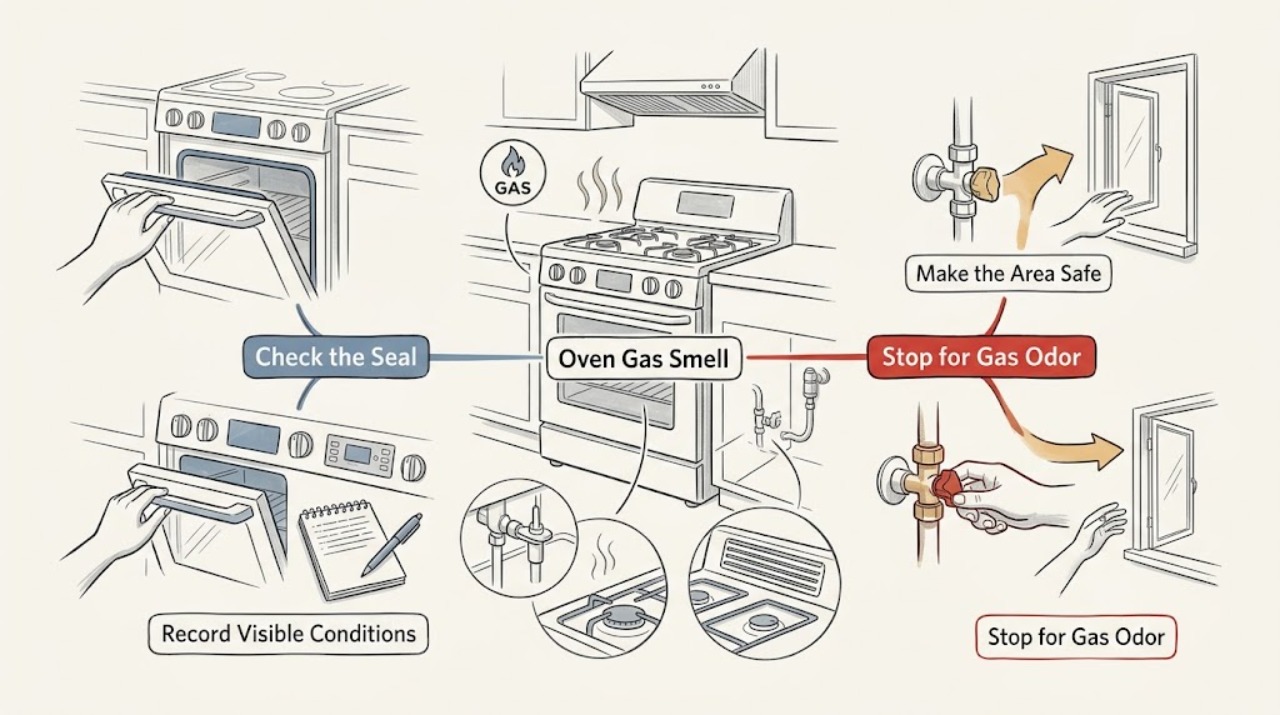
Work through in order
Diagnostic checks
Use only checks that match the exact appliance or system and its official guide.
-
Check 1
If you smell gas now, stop using the oven and do not touch its controls, nearby switches, plugs, or ignition. Do not light anything, use a phone inside, open panels, or search for the leak. Leave the building by a safe route and contact local emergency or gas service from outside.
Expected result: The odor is strong or persistent, there is hissing, anyone feels dizzy or ill, an alarm sounds, or the smell is present while the oven is off.
Next step: Stay outside or in another safe location and follow the responding gas or emergency service's instructions. Do not re-enter or relight the oven until the area and appliance are declared safe.
Stop if: Stop all troubleshooting; do not operate a switch, valve, lighter, or phone inside the building.
Why this matters
Why: These observations are consistent with a possible gas or combustion emergency and cannot be safely resolved by a homeowner test.
-
Check 2
After the area is declared safe, record the exact Viking model and whether it is gas, electric, or dual fuel. Note whether the odor started before ignition, during ignition, after a failed ignition, while the oven was off, or only when a vent or hood was operating. Do not recreate the smell to fill in a missing detail.
Expected result: The model is a gas or dual-fuel range, the smell occurred at ignition, the flame was delayed or abnormal, or the model is electric but gas odor was detected nearby.
Next step: Keep the oven off and provide the model, fuel type, timing, and observations to qualified appliance and, if relevant, gas service. Do not copy a burner or igniter procedure from another Viking model.
Why this matters
Why: Fuel type and timing determine whether the technician investigates the oven burner and igniter, a nearby gas source, or a non-gas odor; timing alone does not prove a failed component.
-
Check 3
If a qualified professional has excluded an active gas hazard and the odor is clearly food, grease, packaging, cleaner, or first-use burn-off, wait until the oven is fully cool. Inspect only the accessible cavity, racks, door edge, and vent area for residue or remaining packaging; do not touch elements or a hot gasket.
Expected result: Visible food or grease is at the odor location, packaging or foil remains, a cleaner was recently used, or the cavity is clean but the odor returns when heat is applied.
Next step: Use only the exact Viking manual's cool-oven cleaning method and keep the vent clear. Do not use commercial oven cleaner in or around a self-clean oven unless the manual explicitly allows it; stop and request service if the odor returns.
Stop if: Do not clean or run a heat cycle if gas has not been excluded, smoke appears, the smell is electrical, or the cavity is still hot.
Why this matters
Why: Residue may explain a non-gas odor, while a clean cavity with a returning heated odor needs appliance diagnosis. Viking cleaning restrictions and first-use instructions are model-specific.
-
Check 4
If the smell happened during ignition, report whether the burner lit promptly, whether there was a delayed whoosh or abnormal flame, and whether gas smell remained after the controls were turned off. Do not make another ignition attempt to compare the timing.
Expected result: Ignition was delayed, the flame was yellow, lifting, uneven, or outside the intended burner area, or unburned-gas odor remained after the failed attempt.
Next step: Keep the oven off and request qualified Viking appliance service after the gas response is complete. Tell the technician the exact ignition sequence and whether any alarm or smoke occurred.
Stop if: Stop immediately for delayed ignition, a loud pop, abnormal flame, smoke, or gas odor after the control is off.
Why this matters
Why: The ignition or combustion path requires qualified inspection; repeated attempts can accumulate unburned gas and increase risk.
-
Check 5
If a gas professional has ruled out a leak but the odor appears when the oven heats, ask qualified appliance service to assess the venting path, burner or heating system, insulation, controls, and installation. Do not block a vent, alter the range, or move a connected gas appliance to inspect behind it.
Expected result: The smell changes with the hood or room ventilation, returns across modes, comes from the control or rear area, or is accompanied by smoke, scorching, or a breaker trip.
Next step: Leave the oven out of service and arrange qualified appliance and, when needed, electrical or ventilation inspection. Keep the model manual available and report the odor location without guessing at a part.
Stop if: Stop for smoke, scorching, arcing, a hot outlet, repeated breaker trips, or any odor that returns before the oven is fully cool.
Why this matters
Why: The remaining issue may be combustion ventilation, a heating or insulation problem, or an electrical fault, none of which can be identified safely from odor alone.
-
Check 6
Prepare the service handoff with the model and fuel type, the exact odor description, mode and temperature setting if known, whether the oven was new or recently cleaned, ignition timing, flame or smoke behavior, alarm information, vent or hood state, breaker behavior, and the response from any gas or emergency professional. Do not claim that a component failed without diagnosis.
Expected result: The odor recurs after a professional safety clearance, persists while the oven is off, appears in multiple modes, or cannot be safely reproduced.
Next step: Keep the oven off and schedule qualified Viking appliance service. If the gas source has not been cleared, use gas or emergency service first; if smoke or fire occurred, obtain inspection before reuse.
Why this matters
Why: A recurring or unexplained odor needs model-specific diagnosis rather than another ignition, cleaning, or self-clean attempt.
Use your observations
Decision map
Find the observation that best matches what you see, then follow the next safe action.
-
PATH 01Next step
What you see
Gas odor is strong, persistent, present while the oven is off, or accompanied by hissing or an alarm.
Do this next
Leave without operating switches or flames and contact local gas or emergency service from a safe location. Do not return or relight until cleared.
Why this path and its safety boundary
Why it matters: Treat the condition as a possible gas emergency, not as normal preheating or cleaning odor.
-
PATH 02Next step
What you see
The smell occurred at ignition, ignition was delayed, or the flame was abnormal.
Do this next
Do not repeat the ignition. Keep the oven off and arrange qualified Viking appliance service after the gas-safety response.
Why this path and its safety boundary
Why it matters: An ignition or combustion fault is possible even if the smell stopped.
-
PATH 03Next step
What you see
A gas professional has excluded a leak and the odor is clearly food, grease, packaging, or approved first-use burn-off.
Do this next
Clean only a cool cavity as directed, ventilate as the manual permits, and stop if the smell becomes smoky, electrical, or persistent.
Why this path and its safety boundary
Why it matters: A low-risk residue or new-appliance explanation may remain, but the exact Viking manual controls the cleaning and first-use process.
-
PATH 04Next step
What you see
The smell is electrical, plastic-like, scorched, or accompanied by smoke, arcing, a hot connection, or a breaker trip.
Do this next
Stop using the oven, isolate power only from a safe location if appropriate, and arrange qualified appliance or electrical service. Evacuate for continuing smoke or fire.
Why this path and its safety boundary
Why it matters: A fire or electrical hazard is possible and cannot be safely diagnosed through more heating.
-
PATH 05Next step
What you see
The odor returns after the cavity is clean and the gas supply has been cleared, or the oven cannot be turned off normally.
Do this next
Keep the oven out of service and request model-specific qualified diagnosis; do not run self-clean or perform live measurements.
Why this path and its safety boundary
Why it matters: A heating, insulation, control, vent, or installation issue remains possible.
Helpful context
Understand the symptom
Gas odor is the first decision, not the last test
An oven smell can be described as gas, food, cleaner, hot insulation, or electrical plastic. At the moment you smell gas, you do not need to identify which one it is by operating the oven. Viking's instructions put ignition, switches, phones, and leak-finding outside the user's safe troubleshooting boundary. Leave first; the model and fuel-type investigation comes later from a safe location.
Viking oven types change the technical path
Viking makes gas, electric, and dual-fuel configurations, and an oven may share a range with gas surface burners. Do not assume an electric oven has no nearby gas hazard or that a cooktop that works proves the oven is safe. Give the technician the exact model, fuel type, when the smell occurred, and whether any alarm, flame, smoke, or ignition delay was observed.
A short ignition odor still needs a safe explanation
A brief odor during ignition is not permission to relight repeatedly. Delayed ignition, an abnormal flame, a smell while the oven is off, or an odor that returns after cooling can indicate a supply, ignition, burner, control, or ventilation problem. If a professional rules out gas and identifies food or cleaner residue instead, clean only a fully cool cavity by the exact Viking manual; do not use an unapproved commercial oven cleaner.
Safety boundary
Stop conditions
- For any gas odor, do not light or relight the oven, touch electrical switches, use a phone inside, search for a leak, remove panels, or repeat a test. Leave and contact gas or emergency service from outside.
- Stop for delayed ignition, abnormal flame, smoke, fire, arcing, a sharp electrical or melting-plastic smell, uncontrolled heating, a hot connection, or a repeated breaker trip. Do not reuse the oven until qualified inspection.
- Do not clean a hot oven, block its vent, damage or move the door gasket, use commercial oven cleaner in a self-clean oven, or run self-clean to hide an unexplained odor.
- Do not assume the oven's fuel type from appearance or from a working cooktop, and do not copy ignition, burner, wiring, or gas-valve instructions from another Viking model.
Only after diagnosis
Potential parts
- oven igniter or ignition component
Consider this only after qualified diagnosis confirms a gas-oven ignition fault and the exact model requires that component.
Ignition components vary by Viking model and fuel configuration. Do not select or install one from odor or appearance alone. - oven burner or heating component
Consider this only when qualified service identifies a damaged burner or heating component after the gas and electrical systems are made safe.
Burners and heating elements differ across gas, electric, and dual-fuel Viking models; confirm exact model fitment through qualified service. - oven control or wiring component
Consider this only when a qualified technician confirms a control or wiring fault associated with an electrical or uncontrolled-heating odor.
Control and wiring work requires exact model verification and qualified installation; the user should not open the control area.
When checks do not resolve it
Need a professional?
Request qualified Viking service for any unexplained or recurring gas smell, an odor during or after ignition, a smell while the oven is off, abnormal flame, smoke, electrical odor, uncontrolled heat, or a symptom that returns after residue is removed. Complete gas or emergency response first when gas has not been cleared.
Safety scope: Keep the oven off for gas, smoke, fire, abnormal flame, electrical odor, arcing, uncontrolled heat, or repeated breaker trips. Do not relight, search for leaks, open panels, alter gas components, perform live electrical checks, or run self-clean until qualified service clears the appliance.
Common questions
FAQ
Is a brief gas smell when my Viking oven starts normal?
Do not assume it is normal. Do not relight or repeat the ignition. Leave and follow local gas or emergency guidance if gas is suspected, then have qualified service determine whether there was delayed ignition, an abnormal flame, or a different odor source.
What should I do if my Viking oven smells like gas when it is off?
Treat it as a possible gas emergency. Do not touch switches, use a phone inside, light anything, or search for a leak. Leave by a safe route and contact gas or emergency service from outside; do not use the oven until it is cleared.
Could a Viking oven gas smell actually be food or cleaner residue?
It could be a different odor, but make that distinction only after qualified professionals exclude a gas hazard. Then wait until the oven is cool and follow the exact Viking manual's cleaning rules; do not use unapproved commercial oven cleaner in a self-clean oven.
When can I use a Viking oven again after a gas smell or fire?
Do not reuse it after gas odor, delayed ignition, abnormal flame, smoke, or fire until the appropriate gas, emergency, appliance, or electrical professional declares the area and appliance safe. NFPA also calls for professional inspection after an oven fire.
Read the exact guide
Official sources
- Educational Messages Desk ReferenceNational Fire Protection Association · General home-fire-safety guidance; follow local emergency instructions and the exact appliance manual.
- Viking Use & Care Manual: Designer Freestanding 30” Dual Fuel Self-Clean Sealed Burner RangeViking Range Corporation · Specific Viking F20648 manual for a Designer Freestanding 30-inch dual-fuel range; use the exact manual for a different model or fuel configuration.
Community feedback
Share a repair observation
Share a plain-text repair observation. Accepted observations are published automatically; this page may take a moment to update.