
On this page
Start here
Quick answer
Stop using the Viking oven until you identify what is leaking and when. A small amount of food liquid, grease, or condensation can collect in a cool cavity, while steam or water can be expected only on models and modes designed for it. Water that escapes onto the floor, from a reservoir or drip tray, through a damaged door area, or from a concealed installation connection is not a reason to keep testing. If you smell gas, hear hissing, see an abnormal flame, receive a carbon-monoxide alarm, or find water near electrical equipment, stop immediately, leave or isolate the appliance only if safe, and get qualified help. Once the oven is cool and there is no hazard, inspect only visible surfaces and the exact Viking manual; do not dismantle the door, gas components, wiring, or water system.
Before you begin
Safety first
- Keep the oven off for gas odor, fire, smoke, abnormal flame, CO alarm, electrical odor, arcing, wet electrical equipment, hot-water escape, or uncontrolled heating. Do not relight, move the oven, remove the door, dismantle gas or water components, or re-energize wet equipment before qualified inspection.
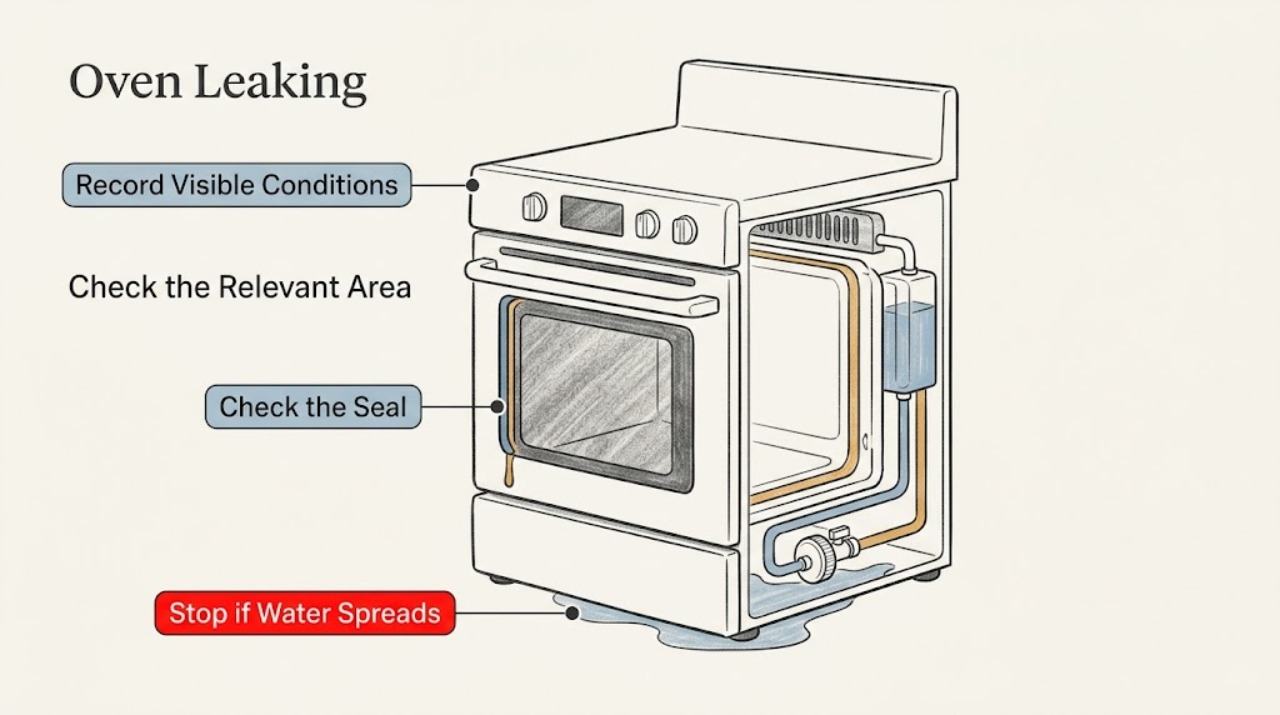
Work through in order
Diagnostic checks
Use only checks that match the exact appliance or system and its official guide.
-
Check 1
Turn the oven off and inspect from a dry, stable position. Record the first wet location, whether the liquid is inside the cavity, at the door edge, below the oven, near a drip tray or reservoir, or at an installation connection. Note smoke, gas odor, hissing, abnormal flame, an alarm, scorching, or water near electrical equipment.
Expected result: Water is actively running, the floor is pooling, the door or glass is damaged, a reservoir is cracked, gas is smelled, smoke or flame is present, or water has reached a plug, receptacle, control, or wiring.
Next step: Stop immediately. For gas odor, do not operate switches or flames; leave and contact gas or emergency service from outside. For fire or smoke, keep the door closed if safe, evacuate if it continues, and call emergency services. For water near electrics, keep clear and isolate power only from a dry safe location before qualified inspection.
Stop if: Do not touch wet electrical equipment, move the oven, open a hot door toward your face, or restart to identify the source.
Why this matters
Why: This is an active burn, gas, fire, shock, or property-damage hazard rather than a safe surface-cleaning issue.
-
Check 2
Identify the exact Viking model and whether it is conventional electric, gas, dual fuel, steam, or combi. Record the mode, temperature or steam setting, door position, and whether a water reservoir or drip tray exists. Do not infer the fuel or water system from the exterior.
Expected result: The model has a steam or water function, a gas supply, only electric heating, or no user-accessible water reservoir; the leak occurs only in one mode or regardless of mode.
Next step: Use the matching Viking manual and keep the oven off until the leak path is clear. Give service the model, fuel type, mode, and first wet location rather than copying instructions from another Viking oven.
Why this matters
Why: Steam and reservoir checks apply only to models that have those features; gas safety applies when gas is supplied or suspected; an electric-only oven can still have water damage or an electrical fault.
-
Check 3
After the cavity and accessories are fully cool and no hazard is present, inspect for a food spill, grease, cleaner residue, packaging, or foil. Wipe only visible residue with the exact Viking manual's approved method; do not scrape elements, move the door gasket, block the vent, or pour water onto a hot surface.
Expected result: The moisture is limited to a known spill or condensation inside the cool cavity, a removable tray is overfilled, or liquid returns without a new spill.
Next step: Clean only the cool, accessible surfaces permitted by the manual and monitor without deliberately adding water. Stop and request service if liquid returns, reaches the floor, or appears at the door, reservoir, or electrical area.
Stop if: Do not use commercial cleaner, a steam jet, abrasive tools, or a test cycle on an oven with unresolved leaking.
Why this matters
Why: A spill or condensation may be normal cleanup, while recurring liquid without a new spill points to a drip tray, reservoir, door, vent, or concealed service issue.
-
Check 4
For a Viking steam or combi model, when the oven is cool, inspect the accessible reservoir lid, drip tray, and cavity floor for a crack, misplacement, overflow, or pooled condensate. Do not touch hot water, open steam outlets, move the oven, or run the steam function to reproduce the leak.
Expected result: The reservoir is cracked, the drip tray is full or incorrectly seated, condensation is limited to the cavity floor, or water escapes outside the intended tray or reservoir path.
Next step: Keep the steam function off, empty or reseat an accessible cool tray only as the exact manual permits, and arrange qualified Viking service for a cracked reservoir, recurring overflow, or external leak.
Stop if: Do not operate a steam oven with a cracked leaking reservoir, touch hot drip-tray water, insert objects into steam outlets, or move the oven while water remains inside.
Why this matters
Why: Viking documents cavity condensation and tray draining for steam models, but a cracked reservoir or water escaping the intended path requires service and may create hot-water or electrical risk.
-
Check 5
For a gas or dual-fuel Viking range, if any liquid is accompanied by gas odor, hissing, delayed ignition, an abnormal flame, or a smell while the oven is off, stop without relighting. If there is no gas symptom but an electrical or burning-plastic odor, keep the oven off and inspect only accessible dry surroundings.
Expected result: Gas odor, hissing, abnormal flame, smoke, arcing, a hot connection, or a breaker trip occurs; or the liquid is clearly a food spill with no gas or electrical symptom.
Next step: For gas, leave and contact local gas or emergency service from outside; for fire or smoke, evacuate as needed; for electrical signs, arrange qualified appliance or electrical inspection. Do not remove gas components or repeat ignition.
Stop if: Never search for a gas leak, adjust gas pressure, open live wiring, or use water on a grease fire.
Why this matters
Why: Gas and electrical signs override ordinary leak diagnosis. A liquid spill can be cleaned only after the oven is cool and hazardous causes have been excluded.
-
Check 6
Prepare the service handoff with the exact model, fuel and steam features, mode, timing, liquid description, first wet location, photos from a safe dry position, door and tray state, any ceiling or cabinet damage, and gas, smoke, electrical, or alarm observations. Do not name a failed part unless qualified service confirms it.
Expected result: The leak returns after cleaning, occurs in more than one mode, continues while the oven is off, comes from behind the unit, or cannot be safely reproduced.
Next step: Keep the oven out of service and request Viking-authorized or qualified appliance service. Add a qualified electrician or gas professional when the relevant hazard was present.
Why this matters
Why: A recurring or concealed leak needs model-specific inspection of the door seal, cavity, tray or reservoir, water path, gas system when fitted, wiring, and installation.
Use your observations
Decision map
Find the observation that best matches what you see, then follow the next safe action.
-
PATH 01Next step
What you see
Liquid is a one-time food or grease spill confined to a cool cavity with no gas, smoke, electrical, or control symptom.
Do this next
Clean only as the exact Viking manual permits and stop if the liquid returns or reaches the floor, door, controls, or wiring.
Why this path and its safety boundary
Why it matters: The event may be a spill rather than an internal oven leak.
-
PATH 02Next step
What you see
Moisture appears only as expected condensation or steam in a Viking steam-capable mode and remains inside the cavity or intended tray.
Do this next
Let the oven cool, dry the cavity or empty the tray only as directed, and stop if water escapes externally or the reservoir is damaged.
Why this path and its safety boundary
Why it matters: Steam or condensation may be part of that model's operation, but hot surfaces and water still require the manual's handling procedure.
-
PATH 03Next step
What you see
A reservoir is cracked, a drip tray overflows or cannot seat, or water escapes outside the intended steam path.
Do this next
Keep the steam function off and request qualified Viking service. Do not move the unit with water inside or probe steam outlets.
Why this path and its safety boundary
Why it matters: The water system has a service condition; continuing steam operation can spread hot water or damage electrical parts.
-
PATH 04Next step
What you see
Liquid appears at the door edge, below the oven, behind the unit, or while the oven is off without a new spill.
Do this next
Stop using the oven, contain water only from a safe dry position, and arrange appliance service. Do not remove the door or pull out a built-in oven.
Why this path and its safety boundary
Why it matters: A door seal, tray, reservoir, installation connection, or concealed water path may be leaking.
-
PATH 05Next step
What you see
Gas odor, hissing, delayed ignition, abnormal flame, smoke, CO alarm, arcing, hot electrical connection, or repeated breaker trip occurs.
Do this next
Stop, leave or evacuate as appropriate, and contact the relevant emergency, gas, appliance, or electrical professional from a safe location. Do not restart or inspect internally.
Why this path and its safety boundary
Why it matters: Gas, combustion, fire, or electrical risk takes priority over leak diagnosis.
Helpful context
Understand the symptom
A liquid stain is not automatically an oven leak
Food, grease, cleaning liquid, condensation, steam, and a failed water reservoir can all leave moisture around a Viking oven. First record whether it appears during steam or water-assisted cooking, after a spill, when the door opens, during cooling, or while the oven is off. Note whether the liquid is clear, greasy, soapy, or accompanied by an odor. The trigger and first wet location are more useful than the size of the puddle.
Steam and gas require different boundaries
A Viking steam or combi model can intentionally produce steam, but that does not make water escaping onto a floor or from a cracked reservoir normal. A gas or dual-fuel range can also have a gas hazard that is unrelated to a visible liquid. Never use a smell, hiss, flame, or repeated ignition attempt as a home test. Stop first, then use the exact model manual after the area is safe.
Keep water away from heat and electricity
Do not pour cold water onto a hot glass floor or door, open a hot door with your face close to it, or touch a wet plug, control, outlet, or wiring. Do not move a built-in oven to inspect behind it. If water reaches electrical equipment, keep clear and arrange qualified electrical and appliance service.
Safety boundary
Stop conditions
- Stop immediately for gas odor, hissing, delayed ignition, abnormal flame, smoke, fire, a CO alarm, arcing, uncontrolled heating, or a hot electrical connection. Do not relight, reset, or repeat the test.
- Do not operate a steam oven with a cracked leaking reservoir, touch hot drip-tray water, insert objects into steam outlets, open a hot door toward your face, or pour cold water onto a hot glass surface.
- Do not touch wet plugs, outlets, wiring, or controls; do not move a built-in oven; and do not isolate power from a wet or unstable position. Use qualified electrical help when water has reached electrical equipment.
- Do not remove the door, dismantle gas or water components, open live wiring, block the vent, use unapproved cleaners, or keep running cycles to locate a recurring leak.
Only after diagnosis
Potential parts
- oven door gasket or seal
Consider this only if qualified inspection confirms that a damaged door gasket or frame is allowing liquid or steam to escape abnormally.
Viking door seals vary by model and oven type. Confirm the exact model and diagnosis before replacement; do not remove the door as a user leak test. - steam reservoir or drip tray
Consider this only for a Viking model with a water system when a qualified technician confirms a cracked reservoir, damaged tray, or failed seal.
Water-system parts are model-specific and may involve hot water or electrical access. Confirm exact fit and use qualified installation. - oven heating or ignition component
Consider this only when qualified diagnosis links the leak or smoke event to a damaged heating element, igniter, burner, or adjacent seal; liquid alone does not identify a component.
Components differ across electric, gas, dual-fuel, and steam-capable Viking ovens. Do not select or install one from appearance.
When checks do not resolve it
Need a professional?
Request service for a recurring or concealed leak, a cracked reservoir, an overflowing or leaking drip tray, door-area water, water near controls or wiring, a liquid leak with a gas or electrical symptom, or any leak that remains after the exact model's safe cleanup guidance.
Safety scope: Keep the oven off for gas odor, fire, smoke, abnormal flame, CO alarm, electrical odor, arcing, wet electrical equipment, hot-water escape, or uncontrolled heating. Do not relight, move the oven, remove the door, dismantle gas or water components, or re-energize wet equipment before qualified inspection.
Common questions
FAQ
Is condensation inside a Viking steam oven normal?
Some Viking steam models document condensed water inside the cavity after use, but water escaping outside the intended cavity or tray, a cracked reservoir, or recurring external leakage is not a reason to keep operating. Let the oven cool and follow the exact model manual.
What if my Viking oven leaks water from the door?
Stop using it, let it cool, and record whether the liquid came from steam, a spill, the drip tray, or the door edge. Do not remove the door or gasket yourself; request qualified service if liquid escapes externally or returns.
Can I run the oven again to find where it leaks?
Do not run repeated tests when liquid is escaping, the source is concealed, or gas, smoke, abnormal flame, or electrical water contact is present. A single safe observation from a cool, dry position is enough to report the trigger to service.
What should I do if a leaking Viking oven also smells like gas?
Treat the gas smell as the priority. Do not operate switches or flames, search for the leak, or relight the oven. Leave and contact gas or emergency service from outside, then obtain appliance service before reuse.
Read the exact guide
Official sources
- Use & Care Manual VSOC530SS Built-in Steam OvenViking Range Corporation · Specific Viking VSOC530SS steam oven manual; steam, reservoir, and tray guidance does not apply to conventional ovens without those features.
- Viking Use & Care Manual: Designer Freestanding 30” Dual Fuel Self-Clean Sealed Burner RangeViking Range Corporation · Specific Viking F20648 manual for a Designer Freestanding 30-inch dual-fuel range; use the exact manual for a different model or fuel configuration.
- Educational Messages Desk ReferenceNational Fire Protection Association · General home-fire-safety guidance; follow local emergency instructions and the exact appliance manual.
Community feedback
Share a repair observation
Share a plain-text repair observation. Accepted observations are published automatically; this page may take a moment to update.