
On this page
Start here
Quick answer
If an AEG oven is leaking, stop the programme and let the appliance cool before touching water or wiping the cavity. First note when and where water appears: during roasting, at the door when it opens, after a steam or Sous Vide programme, from the cavity floor, or beneath the appliance. AEG says roasting can create substantial condensation, especially with excess water or hot-air cooking, while steam and Sous Vide models can retain water in the cavity and collector. Once cool, dry accessible surfaces, check that the door closes and the visible gasket is clean and seated, and follow the exact model manual for any steam function. Do not use the oven if water reaches electrical controls, the door or glass is damaged, water continues from below, or the cause remains unclear; arrange authorised appliance service.
Before you begin
Safety first
- This article supports cooling, external observation, drying accessible surfaces, and normal cool-door inspection. Electrical access, door and hinge removal, glass work, internal water or steam paths, and repairs require an authorised or otherwise qualified appliance professional.
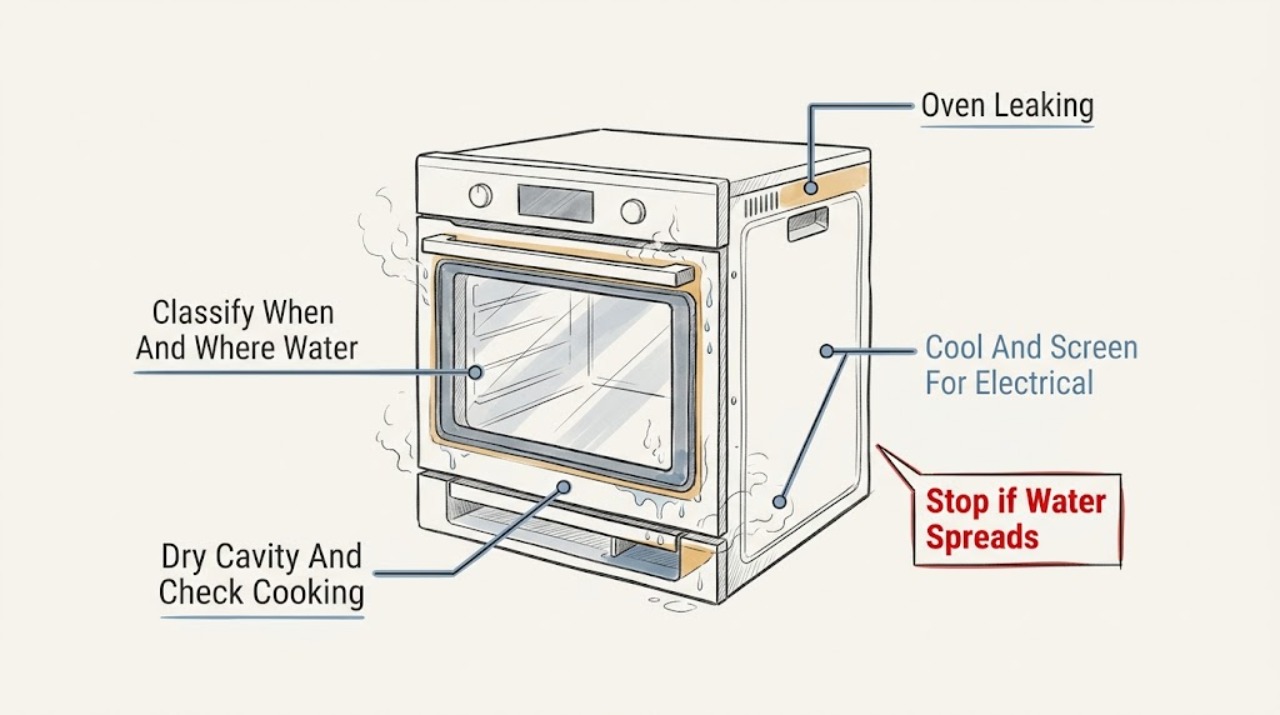
Work through in order
Diagnostic checks
Use only checks that match the exact appliance or system and its official guide.
-
Check 1
Stop the cooking programme, keep clear of escaping steam, and wait until the oven and nearby water are cool before wiping or inspecting; look from a safe position for water reaching controls, a socket, wiring, or the underside of the appliance.
Expected result: Record water limited to the cool cavity or door area, water on the floor away from electrics, water near controls or a socket, smoke or burning smell, or damaged glass or door hardware.
Next step: Keep the oven out of service and arrange authorised appliance or qualified electrical service for water near electrics, smoke, burning smell, damaged glass, or unsafe door hardware; do not touch wet controls to investigate.
Stop if: Do not open the oven while hot to catch water, operate wet controls, remove panels, handle wiring, or continue cooking with damaged glass, a loose door, smoke, or burning smell.
Why this matters
Why: A cool, contained moisture event may be condensation or residual cooking water. Water near electrical parts, smoke, burning smell, damaged glass, or an unstable door changes the problem to an appliance-safety issue.
-
Check 2
After the oven is cool, record the cooking function and the first place water appeared: cavity floor, door edge or sill, water collector, kitchen floor after opening, or beneath the appliance; do not repeat a hazardous cooking cycle just to reproduce the leak.
Expected result: Classify the event as roasting condensation, steam or Sous Vide residual water, door-edge escape, water from below, or a leak with no clear timing.
Next step: Follow the matching branch: dry and adjust only the user-level cooking setup for an explained condensation event; arrange authorised service for water from below, recurrence, or an unclear path.
Stop if: Do not tip the appliance, remove the rear cover, pull out internal tubing, or use the oven again if water reaches electrical areas.
Why this matters
Why: Roasting and hot air can create steam that condenses, while steam or Sous Vide functions can leave residual water. Water from below, an unexplained door-edge leak, or a recurring event is less consistent with ordinary residual moisture.
-
Check 3
When the oven is fully cool, dry the accessible cavity, door, sill, and collector with a soft cloth; for ordinary roasting, compare the roasting-tin size and amount of added water with the recipe and avoid adding water during cooking unless the exact recipe and manual call for it.
Expected result: Record a dry oven that stays dry, moisture that returns only after a high-moisture roast, water collecting at the door or floor, or water that appears without a food or function explanation.
Next step: Use an appropriately sized ovenproof dish or roasting tin for an explained roasting-condensation event and dry the oven after cooling; arrange authorised service if water persists or appears from below.
Stop if: Do not wipe hot surfaces, pour extra water into the cavity, block an oven vent, or operate the appliance while water remains near controls or electrical connections.
Why this matters
Why: AEG links water on the kitchen floor during roasting to condensation, excess water, and evaporation, including greater steam with hot-air cooking. A return without that context points toward door, drainage, or appliance service rather than a cooking adjustment.
-
Check 4
With the oven cold, inspect the visible door gasket, glass edges, hinges, latch alignment, and door frame for a tear, gap, loose section, crack, trapped food, or a door that does not close normally; do not remove the door or hinge parts.
Expected result: Record a clean, seated gasket and fully closing door, a visibly damaged gasket, a door that sits crooked or leaves a gap, cracked glass, or steam and water escaping at the same location each time.
Next step: Keep the oven out of service and arrange authorised AEG service for a damaged gasket, cracked glass, hinge or latch concern, or repeated door-edge leakage; only clean an accessible cool gasket as the manual allows.
Stop if: Do not pry the door, adjust hinges, remove glass, stretch or glue the gasket, or use the oven with a door that cannot close securely.
Why this matters
Why: A damaged gasket or door that does not close can direct heat, steam, or water toward the kitchen. Cracked glass or hinge misalignment is not a surface-cleaning problem and may create a burn or breakage hazard.
-
Check 5
Only if the AEG model has a steam or Sous Vide function, follow the exact manual for safely ending the programme; once cool, dry the door, visible water-drop collector, and cavity and allow them to dry fully with the door positioned as the manual permits.
Expected result: Record residual water limited to the collector or cavity after the steam function, water spilling when the door opens, a dry cavity after the prescribed cleanup, or water that returns outside the steam programme.
Next step: Use only the model-specific low-risk cleanup instruction for explained residual water; arrange authorised service for recurring water, a blocked or damaged water path, or any leak outside the expected function.
Stop if: Do not dismantle the steam system, remove internal hoses or tanks, use improvised heat, or run another steam cycle to force a suspected blockage clear.
Why this matters
Why: AEG says steam and Sous Vide cooking can leave residual water in the cavity or on vacuum bags, while water that escapes from below or returns outside that function needs a different diagnosis.
Use your observations
Decision map
Find the observation that best matches what you see, then follow the next safe action.
-
PATH 01Safety boundary
What you see
Water appears during or after ordinary roasting, especially with a moist food load or hot-air function, and is not near electrics.
Do this next
Let the oven cool, dry accessible surfaces, and use a pan or dish suited to the food and recipe; arrange service if water persists or returns without that cooking context.
Why this path and its safety boundary
Why it matters: Condensation and evaporation are plausible, particularly if excess water was used for the roast.
Safety stop: Do not add water during cooking without model- and recipe-specific direction or continue if water reaches controls.
-
PATH 02Safety boundary
What you see
Water remains in the cavity or collector, or spills when the door opens after a steam or Sous Vide function.
Do this next
After cooling, follow the exact manual's low-risk drying instruction; arrange authorised service if water escapes from below, recurs unexpectedly, or the model has no such function.
Why this path and its safety boundary
Why it matters: Residual water can be part of the steam cooking process, but the exact model instructions and the water location control what is normal.
Safety stop: Do not remove internal steam components, force a tank or hose, or open the hot door into escaping steam.
-
PATH 03Safety boundary
What you see
Water or steam repeatedly escapes at the door edge, the gasket is damaged, or the door does not close squarely.
Do this next
Stop using the oven and arrange authorised AEG service; provide the leak location and a photo of the cool visible gasket if safe.
Why this path and its safety boundary
Why it matters: The gasket, hinges, latch, glass arrangement, or door alignment may be allowing heat or moisture to escape.
Safety stop: Do not adjust hinges, remove glass, glue a gasket, or force the door closed.
-
PATH 04Safety boundary
What you see
Water comes from beneath the appliance, reaches controls or electrical connections, or is accompanied by smoke, burning smell, or damaged glass.
Do this next
Keep the oven out of service and arrange authorised appliance or qualified electrical assessment from a safe location.
Why this path and its safety boundary
Why it matters: This is not a routine condensation check; an internal leak or electrical and mechanical safety issue is possible.
Safety stop: Do not operate the controls, tip the oven, remove covers, or re-energise a wet appliance to test it.
-
PATH 05Safety boundary
What you see
Drying and the applicable cooking check do not stop the leak, or the source cannot be identified safely.
Do this next
Keep the oven out of service and arrange an authorised AEG engineer; provide the model information, function, load, water amount if relevant, timing, and leak location.
Why this path and its safety boundary
Why it matters: A hidden door, cavity, water-path, installation, or internal component issue remains possible.
Safety stop: Do not repeat cooking cycles to reproduce the event, inject cleaner or sealant, or dismantle the appliance.
Helpful context
Understand the symptom
Water around an oven is not always a failed seal
AEG describes water on the kitchen floor during roasting as potentially related to condensation and evaporation, including excess water in a large roasting tin or hot-air cooking. Steam and Sous Vide models can also retain water in the cavity or a water-drop collector. The timing, location, and cooking function decide whether drying and changing the cooking setup is reasonable or whether service is needed.
Cool first, then inspect only what is accessible
Hot water, steam, glass, racks, and door surfaces can burn. Once the appliance is cool, wipe the cavity, door, sill, and visible collector with a soft cloth as the applicable AEG guidance permits. Do not remove the door, panels, seals, water tank, or internal plumbing to find a leak, and do not operate a wet appliance near electrical controls.
A recurring leak needs more than a new cooking setting
A torn gasket, door that does not close, cracked glass, water from the underside, or water that returns after drying can allow heat, steam, or liquid to escape in an unsafe direction. AEG recommends an authorised engineer when the water problem is not explained by the cooking setup. Record the function, load, added water if relevant, and leak location for the service visit.
Safety boundary
Stop conditions
- Let the oven cool before wiping or inspecting; do not open a hot door into escaping steam or handle hot water.
- Stop use for water near controls or electrical connections, smoke, burning smell, damaged glass, an unstable door, or water from beneath the appliance.
- Do not remove covers, doors, hinges, glass, internal tanks, hoses, or steam components to find or repair a leak.
- Do not add unapproved water, block vents or water paths, use improvised heat, inject cleaner or sealant, or repeat a cooking cycle to reproduce a leak.
- Arrange authorised AEG service for recurring or unexplained leakage, damaged gasket or door, water from below, a blocked or damaged steam path, or any issue that remains after the safe checks.
Only after diagnosis
Potential parts
- oven door gasket
Consider this only when a cool inspection confirms a damaged or missing gasket and the model instructions or technician identify it as the leak path.
Confirm the exact AEG model and gasket profile before selecting a part; do not glue, stretch, or substitute a seal without model guidance.
When checks do not resolve it
Need a professional?
Arrange authorised AEG appliance service when water comes from beneath the oven, reaches electrical areas, escapes repeatedly at the door, follows a damaged gasket, glass, hinge, or latch, appears outside the applicable cooking function, or remains after the oven is cooled and dried. Use the exact model manual for steam or Sous Vide cleanup; do not dismantle the appliance or run it while wet or unsafe.
Safety scope: This article supports cooling, external observation, drying accessible surfaces, and normal cool-door inspection. Electrical access, door and hinge removal, glass work, internal water or steam paths, and repairs require an authorised or otherwise qualified appliance professional.
Common questions
FAQ
Why is my AEG oven putting water on the floor?
AEG says roasting can create condensation and excess water can evaporate, especially with hot-air cooking. Let the oven cool, identify whether water came from the door, cavity, or beneath the appliance, and arrange service for recurring or unexplained water.
Is water inside an AEG steam oven normal?
Steam or Sous Vide cooking can leave residual water in the cavity or collector. After cooling, follow the exact model manual to dry accessible areas. Water from below, water near electrics, or recurring water outside the function needs authorised service.
Can an AEG oven door gasket cause leaking?
A damaged or poorly seated gasket or a door that does not close properly can allow heat and moisture to escape at the door. Inspect only when cool and arrange authorised service for damage, misalignment, cracked glass, or repeated door-edge leakage.
How do I safely clean water from a leaking AEG oven?
Stop the programme and let the oven cool fully. Wipe accessible cool surfaces with a soft cloth as the applicable AEG guidance allows. Do not remove the door, panels, water system, or internal components, and do not operate the oven while water is near electrical areas.
When should I call an engineer for an AEG oven leak?
Arrange authorised service for water from beneath the appliance, water near controls, a recurring or unexplained leak, damaged gasket or glass, a door that will not close, an internal steam or water-path concern, or any issue that remains after cooling and the safe checks.
Read the exact guide
Official sources
- USER MANUAL DCK731110M Built-In Double OvenAEG · Official AEG user manual opened for model-specific examples of general oven moisture and service guidance; the reader must use the manual for the exact oven model.
- Water gets on the kitchen floor when using the ovenAEG · AEG support guidance for ovens and cookers used for general leak triage; the exact appliance manual controls model-specific functions and limits.
- Water pours out of the oven when the door is opened, down into the kitchen after using Sous Vide cookingAEG · AEG support guidance for steam ovens with Sous Vide; apply only when the assigned oven actually has the relevant function and follow its exact manual.
Community feedback
Share a repair observation
Share a plain-text repair observation. Accepted observations are published automatically; this page may take a moment to update.