
On this page
Start here
Quick answer
First turn the Frigidaire oven off, let it cool, and identify whether the liquid is a small amount of water from a recent Steam Clean cycle, food or grease from cooking, condensation near the vent or door, or an unexplained leak from beneath, behind, or around the controls. Frigidaire says Steam Clean uses one cup of water on the oven bottom and that some condensation or vapor near the vent or door glass can be normal; it also says to wipe the cavity and bottom after the cycle and take care when opening the door. Do not run an oven with liquid reaching wiring or controls, a damaged door or gasket, smoke, a gas odor, or a leak from the enclosure. Do not pull out a built-in oven, remove panels, pour more water into the cavity, or attempt a gas or electrical repair. If the source is not clearly an approved cleaning-cycle residue or a contained cooking spill, leave the appliance off and arrange qualified appliance service.
Before you begin
Safety first
- This article covers cool, ordinary-access observation and cleanup of a documented contained spill only. Qualified service must diagnose concealed leaks, door assemblies, wiring, controls, gas paths, heating, insulation, enclosure, and installation conditions.
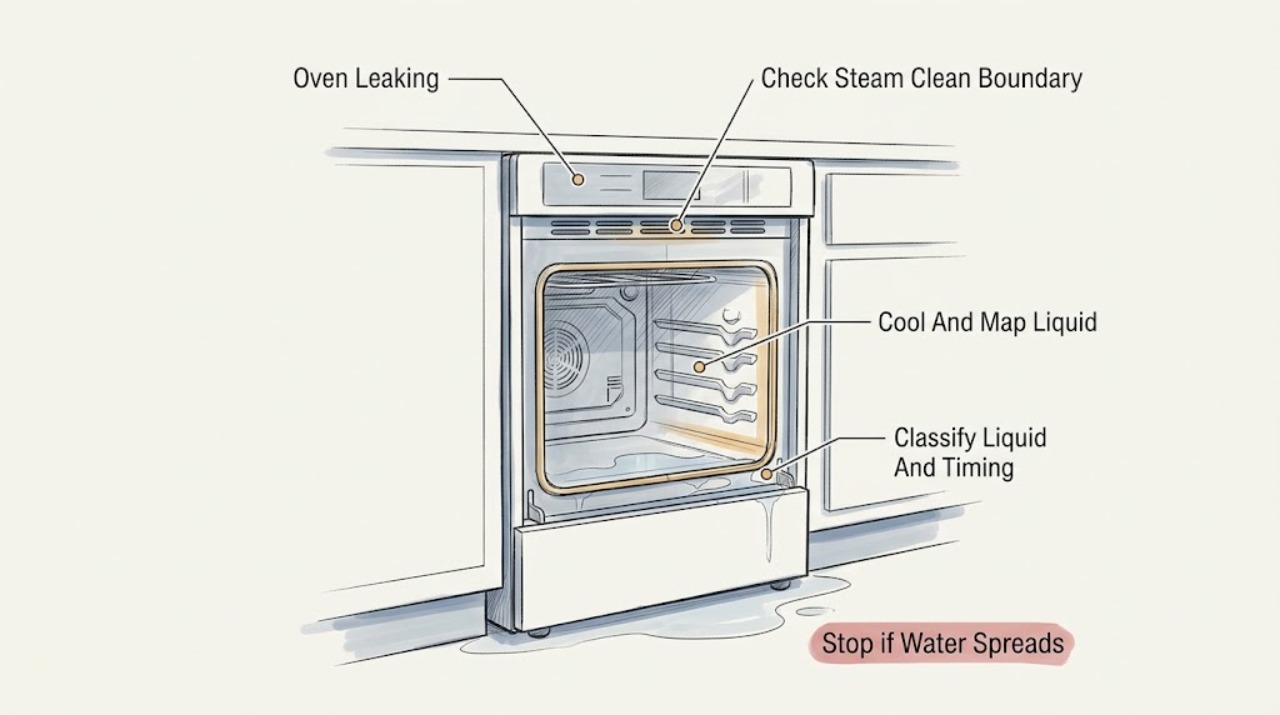
Work through in order
Diagnostic checks
Use only checks that match the exact appliance or system and its official guide.
-
Check 1
Turn the oven off, cancel any active cycle, and wait until the appliance and visible surfaces are cool; from a stable position, photograph and map where the liquid first appears without opening panels or pulling out a wall oven.
Expected result: Record whether moisture is inside the cavity, at the door glass or vent, on the front or controls, in a storage drawer, beneath the appliance, behind it, or on the floor; note whether it is present while the oven is idle or only after use.
Next step: Keep the oven off while the source is uncertain, preserve photos and the timing of the event, and continue only with cool, ordinary-access observations.
Stop if: Stop immediately for a gas odor, smoke, sparking, a hot or energized wet control, a breaker trip, a hot cabinet, or liquid entering an electrical area; use the appropriate local emergency, gas, electrical, or appliance response.
Why this matters
Why: A residue limited to the cavity or door area follows a different check from liquid escaping the enclosure or reaching controls and wiring. Location alone does not establish the failed part.
-
Check 2
Using a clean disposable cloth from a cool, de-energized surface, classify the visible residue and compare its timing with the last cooking, Steam Clean, spill, or cleaning event; do not taste, heat, or deliberately add water.
Expected result: Record whether it is clear water or condensation, greasy or food-colored residue, cleaning-product residue, or an unknown liquid, and whether it appears only after Steam Clean, after ordinary cooking, during preheat, or with no recent use.
Next step: For a clearly contained Steam Clean residue, follow the exact model manual and wipe the cavity and bottom after the cycle. For an unknown, recurring, or external liquid, leave the oven off and arrange service.
Stop if: Do not mix or apply cleaners, pour extra water into the oven, run a cleaning cycle to reproduce the leak, or wipe a surface that is still hot or electrically wet.
Why this matters
Why: Frigidaire's Steam Clean procedure intentionally uses water and can produce condensation or vapor near the vent and door glass. A non-water residue or a leak that occurs during ordinary use or while idle is not explained by that procedure alone.
-
Check 3
If Steam Clean was recently used and the model's manual confirms the feature, compare the observed moisture with Frigidaire's procedure: racks and accessories removed, water placed only on the oven bottom, door kept closed during the cycle, and the cavity wiped after completion.
Expected result: Answer yes if the moisture is limited to the expected cavity, vent, or door-glass area after the completed cycle; answer no if water is beneath or behind the oven, escapes while the door is closed, reaches controls, or the feature or amount is not confirmed for the model.
Next step: For yes, let the oven cool and wipe the cavity and bottom as the instructions direct. For no, keep the oven off and provide the timing, location, model, and photos to qualified service.
Stop if: Do not open the door during the active Steam Clean cycle, add water beyond the model instruction, or continue if water reaches the controls, floor, wiring, or an adjacent cabinet.
Why this matters
Why: A yes result supports normal steam-clean condensation or cleanup residue, while a no result is an unexplained leak and should not be treated as a cleaning adjustment.
-
Check 4
With the oven cool, inspect the door perimeter, glass edges, hinges, and visible gasket from ordinary access; do not pull, rub, remove, or stretch the gasket.
Expected result: Record whether the gasket is torn, worn, detached, missing, damp, pinched, or visibly preventing the door from closing, and whether moisture starts at the door rather than below the appliance.
Next step: Stop using the oven and arrange model-specific service when the gasket is damaged, detached, or the door does not close and seal normally; include photos and whether moisture is inside or outside the door.
Stop if: Do not pull or scrub the gasket, force the door, remove hinge parts, disassemble the door, or continue heating with a damaged seal or liquid entering the door assembly.
Why this matters
Why: Frigidaire identifies a compromised gasket as a cause of heat loss, but a gasket observation does not prove that it is the source of a liquid leak. A damaged or mis-seated door can alter the safe service boundary.
-
Check 5
From the floor and adjacent safe surfaces, inspect only the visible front, bottom edge, storage-drawer area, and nearby floor for a wet trail, corrosion, damaged trim, or a liquid source; do not move a built-in or range oven.
Expected result: Record whether the area is dry after a contained spill, whether liquid returns while the oven is idle, whether it tracks from the cavity or rear enclosure, and whether a cabinet, floor, or wall has water damage.
Next step: Keep the oven off when the source is beneath, behind, or inside the enclosure; protect the surrounding floor from further damage and arrange qualified appliance or installation service.
Stop if: Do not pull out a wall oven, remove a rear panel, reach under energized equipment, loosen gas or electrical connections, or use the oven to test whether the leak returns.
Why this matters
Why: A recurring or concealed external leak is outside ordinary cleaning guidance and may involve an enclosure, insulation, installation, or internal component. A dry area after a documented cooking spill does not prove there is no hidden recurrence.
-
Check 6
Review the display and recent use for an over-temperature alert, unusual heating, a door-lock condition, or a breaker trip, without resetting a wet or visibly damaged appliance.
Expected result: Record any code or alert exactly, whether the cavity or surrounding cabinet became unusually hot, whether the oven shut down, and whether the liquid appeared with the event.
Next step: Leave the oven off, keep the exact alert and timing, and provide them to qualified service; use the model's manual for any model-specific reset only after the appliance is dry and the safety condition is resolved.
Stop if: Do not repeatedly reset an overheat condition, run self-clean or Steam Clean to test it, operate with smoke or scorching, or touch hot liquid or surfaces.
Why this matters
Why: Frigidaire identifies F10 on standard range and wall ovens as detection of higher-than-normal temperatures and says to turn the oven off, let it cool, and seek support if it persists. An alert with liquid or overheating raises urgency beyond a simple spill.
-
Check 7
Decide whether the liquid has a documented, contained explanation that matches the model's instructions and has stopped, or whether the source is recurring, external, unknown, or associated with heat, power, or gas symptoms.
Expected result: Answer yes only when the event was an ordinary contained cooking spill or confirmed Steam Clean residue and the appliance, door, controls, and surrounding enclosure are dry and undamaged; answer no for any unexplained or recurring leak.
Next step: For no, leave the oven off and arrange qualified appliance service; provide model, fuel type, liquid description, location, timing, Steam Clean status, door/gasket condition, alert history, and photos.
Stop if: Do not open the cabinet, disconnect gas or high-voltage wiring, remove door or hinge hardware, pour water into the cavity, or replace a gasket or internal part without model-specific diagnosis.
Why this matters
Why: A yes result supports cleanup and monitoring without declaring a repair. A no result requires professional diagnosis because ordinary access cannot establish an internal leak, enclosure fault, or component failure.
Use your observations
Decision map
Find the observation that best matches what you see, then follow the next safe action.
-
PATH 01Safety boundary
What you see
The model supports Steam Clean, one documented cycle recently used the instructed water amount, and moisture is limited to the cavity, vent, or door-glass area after the cycle.
Do this next
Let the oven cool and wipe the cavity and bottom as the model instructions direct; monitor without adding water or repeating the cycle as a test.
Why this path and its safety boundary
Why it matters: Condensation or a small amount of cleanup water may be consistent with the documented feature rather than an enclosure leak.
Safety stop: Stop for water reaching controls, wiring, the floor, an adjacent cabinet, or any recurrence outside the expected area.
-
PATH 02Safety boundary
What you see
The liquid is traceable to a food or cooking spill inside the cavity and no liquid is escaping the door, vent, enclosure, controls, or floor.
Do this next
Clean the cooled cavity using the model manual and record whether moisture returns during ordinary idle conditions; arrange service if it does.
Why this path and its safety boundary
Why it matters: A contained spill can be cleaned only after the oven is cool and according to the model's care instructions; it does not explain a recurring external leak.
Safety stop: Do not use caustic or mixed cleaners, pour water into a hot oven, block the vent, or run a cleaning mode to test a leak.
-
PATH 03Safety boundary
What you see
The visible gasket is torn, detached, missing, pinched, or the door does not close and seal normally, with moisture or heat behavior near the door.
Do this next
Leave the oven off and arrange model-specific service; provide the gasket photos, door behavior, and liquid location.
Why this path and its safety boundary
Why it matters: A sealing problem is plausible, but the gasket alone does not prove the source of liquid and should not be manipulated as a test.
Safety stop: Do not pull, rub, remove, force, or substitute the gasket without exact model guidance.
-
PATH 04Safety boundary
What you see
Liquid appears beneath, behind, from the controls, around the drawer, while the oven is idle, or its composition and source are unknown.
Do this next
Keep the oven off, prevent further floor or cabinet damage, and request qualified appliance or installation assessment without moving the unit.
Why this path and its safety boundary
Why it matters: The leak is not explained by a contained spill or expected Steam Clean moisture and may involve a concealed component or installation area.
Safety stop: Do not pull out a built-in oven, remove panels, reach under energized equipment, or loosen gas or electrical connections.
-
PATH 05Safety boundary
What you see
The leak occurs with unusually high heat, a thermal alert, smoke, scorching, a breaker trip, or a door-lock or shutdown event.
Do this next
Turn the oven off, let it cool from a safe position, preserve the exact alert and event record, and arrange qualified service; use an appropriate emergency response for smoke, fire, gas, or electrical danger.
Why this path and its safety boundary
Why it matters: The appliance may have a safety or control condition in addition to the liquid and should not be operated for confirmation.
Safety stop: Do not reset repeatedly, run a cleaning mode, touch hot liquid, or continue using the oven until assessed.
Helpful context
Understand the symptom
A little water after Steam Clean is a different problem from a leak under the oven
Frigidaire's Steam Clean feature is not available on every model. On equipped models, the process intentionally puts one cup of water on the oven bottom, and the manufacturer says vapor or condensation near the vent or door glass can be normal. A damp cavity or a small amount of water while wiping after the completed cycle has a different decision path from liquid appearing under the cabinet, from behind the controls, or during ordinary baking. Do not add water or repeat the cycle to test an unexplained leak.
Locate the source from a cool, de-energized oven
After the oven is off and cool, use a dry cloth to identify the first wet point without removing trim. Record whether the liquid is clear water, greasy cooking residue, or an unknown substance; whether it appears only after Steam Clean, during preheat, after cooking, or while the oven is idle; and whether it reaches the floor, drawer, controls, or electrical connection. A door gasket that is torn, detached, or missing can also change sealing and heat behavior, but the gasket should not be pulled or rubbed.
Stop before the leak becomes an electrical, gas, or heat hazard
Liquid from beneath or behind a range or wall oven is not an ordinary wipe-up repair. Keep the appliance off when liquid can reach wiring or controls, a breaker trips, the oven overheats, the door will not close, or there is smoke or a gas odor. Frigidaire's error guidance treats unusually high temperature as a safety alert and says to turn the oven off, allow it to cool, and contact support if the condition persists. A technician must determine whether the cause is a gasket, steam-clean handling, spill path, hidden insulation or enclosure problem, installation issue, or an internal component.
Safety boundary
Stop conditions
- Turn the oven off and keep it off for liquid reaching controls, wiring, the floor from an unknown source, smoke, scorching, a hot cabinet, or a gas odor.
- Do not pull out a built-in oven, remove panels, open the door or hinge assembly, or loosen gas or electrical connections to locate a leak.
- Do not pour extra water into the cavity, run Steam Clean or Self Clean to reproduce a leak, mix cleaners, or clean a hot oven.
- Do not pull, rub, remove, force, or substitute a door gasket without exact model-specific guidance.
- Do not repeatedly reset an over-temperature or electrical alert; preserve the exact code and request qualified service.
Only after diagnosis
Potential parts
- model-specific oven door gasket
Consider this category only if inspection and qualified diagnosis confirm that the exact gasket is torn, detached, missing, or unable to seal and is relevant to the reported moisture or heat behavior.
Confirm the exact Frigidaire model, oven type, gasket design, and manufacturer fit information before ordering; do not select a gasket by appearance alone. - model-specific door or hinge assembly
Consider this category only if qualified diagnosis finds door alignment or hinge damage that prevents the door from closing or sealing and contributes to the symptom.
Confirm exact model fitment and installation procedure with qualified service; door and hinge work can create a heat and safety hazard.
When checks do not resolve it
Need a professional?
Arrange qualified Frigidaire appliance service when liquid appears beneath, behind, from the controls, around the drawer, during ordinary baking, while the oven is idle, or from an unknown source; when the door or gasket is damaged; or when moisture recurs after a documented contained spill or Steam Clean cycle. Treat smoke, fire, gas odor, visible sparking, a hot damaged connection, or liquid entering energized controls as an immediate safety issue and use the appropriate local emergency, gas, electrical, or appliance response.
Safety scope: This article covers cool, ordinary-access observation and cleanup of a documented contained spill only. Qualified service must diagnose concealed leaks, door assemblies, wiring, controls, gas paths, heating, insulation, enclosure, and installation conditions.
Common questions
FAQ
Why is my Frigidaire oven leaking water?
First identify where the liquid starts and whether Steam Clean was recently used. Frigidaire says Steam Clean uses one cup of water on the oven bottom and some condensation near the vent or door glass may be normal. Water beneath, behind, from the controls, during ordinary baking, while idle, or from an unknown source is not explained by that guidance; keep the oven off and arrange service.
Is water around the Frigidaire oven door normal?
Some condensation or vapor near the vent or door glass can be normal during Steam Clean. Let the oven cool and wipe the cavity and bottom as directed. Moisture that reaches controls, the floor, cabinets, or returns outside the documented cleaning-cycle context needs qualified assessment.
Can I pour more water into the oven to clean the leak?
No. Do not add water beyond the exact model instruction or run Steam Clean to reproduce an unexplained leak. Frigidaire's general Steam Clean guidance uses one cup on the oven bottom for equipped models; the owner's manual controls the installed appliance.
Should I replace the Frigidaire oven door gasket?
Do not choose or pull a gasket by appearance alone. Frigidaire says a torn, worn, detached, or missing gasket can cause heat loss and advises avoiding rubbing or pulling it. Photograph the condition and arrange model-specific service when the door does not seal or moisture is near the door.
When should I stop using a leaking Frigidaire oven?
Stop for liquid entering controls or wiring, a leak beneath or behind the oven, recurring unknown moisture, smoke, scorching, a gas odor, visible sparking, a hot damaged connection, a breaker trip, an over-temperature alert, or a door that will not close or seal. Leave it off and use the appropriate qualified or emergency response.
Read the exact guide
Official sources
- Oven Error Codes and Alarms GuideFrigidaire · Frigidaire's general error guidance; codes and reset behavior vary by installed model.
- Oven - Is Not Hot EnoughFrigidaire · Frigidaire support guidance for electric range and wall-oven heat loss; used here for a gasket safety boundary, not as proof of a leak source.
- Ovens - When and how do I use steam clean?Frigidaire · Frigidaire's general support guidance for models equipped with Steam Clean; the exact owner's manual controls for the installed model.
Community feedback
Share a repair observation
Share a plain-text repair observation. Accepted observations are published automatically; this page may take a moment to update.