
On this page
Start here
Quick answer
A Viking oven that is not working needs to be split into the right symptom before any repair is attempted: a completely dead display, a powered oven that will not start, no heat on an electric model, failed ignition on a gas model, a control or door state, or a model-specific fault message. Confirm the exact model and whether it is electric, gas, or dual fuel, then use its Viking manual for controls and code meanings. The Viking documentation says some models will not function without electrical power and that the clock may need to be set before other programs; it also directs service for persistent faults. If you smell gas, hear delayed ignition or a bang, see abnormal flame, smoke, arcing, overheating, or a hot/damaged electrical connection, stop using the oven and do not repeat the test.
Before you begin
Safety first
- Keep the oven off for gas odor, delayed ignition, abnormal flame, smoke, fire, arcing, hot electrical connections, moisture near electrical parts, repeated breaker trips, overheating, or uncontrolled heating. Do not open panels, test live circuits, adjust gas pressure, manually ignite, bypass a lock, or search for a leak.
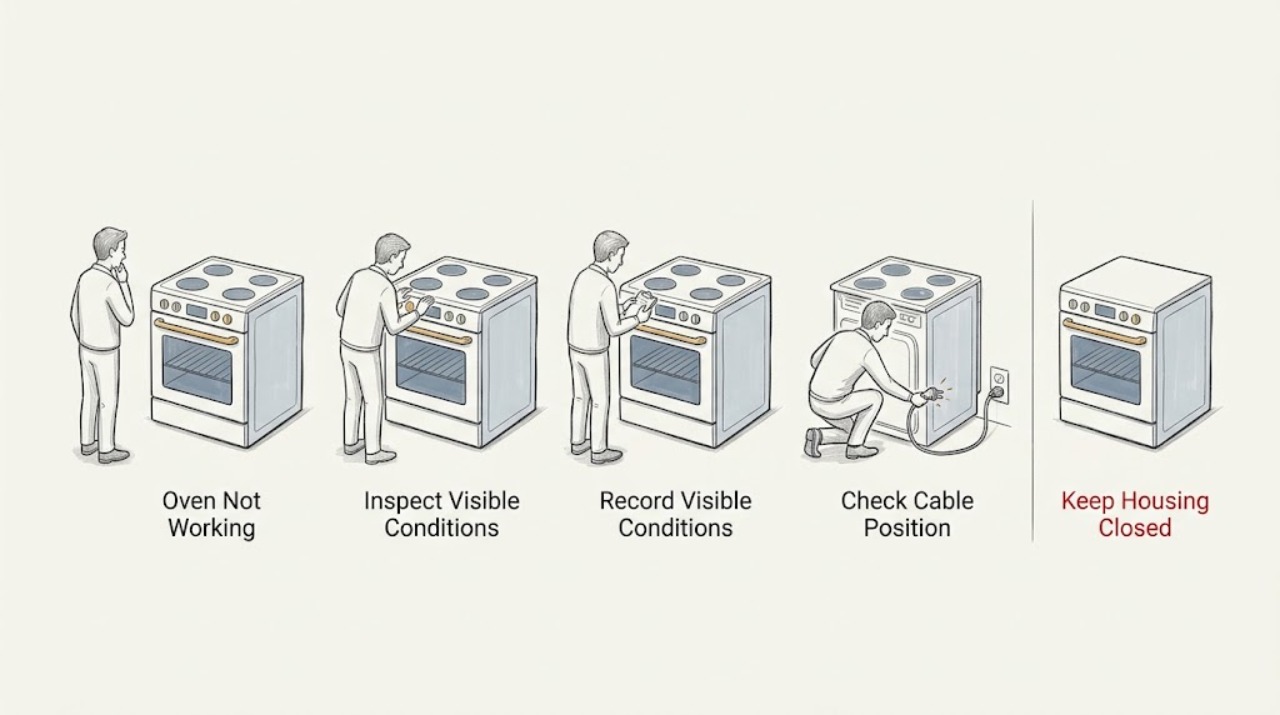
Work through in order
Diagnostic checks
Use only checks that match the exact appliance or system and its official guide.
-
Check 1
Stop the oven and observe from a safe position. Note whether there is a gas odor or hissing, smoke, flame outside the normal burner area, arcing, a hot or melting control or outlet, a repeated breaker trip, or an oven that continues heating after the controls are off.
Expected result: Any gas odor, delayed ignition or bang, abnormal flame, smoke, arcing, hot/damaged electrical connection, repeated breaker trip, or uncontrolled heating is present.
Next step: Stop immediately. For suspected gas, do not light anything, touch switches, or use a phone inside; leave by a safe route and contact local gas or emergency service from outside. For smoke or fire, leave if it continues and contact emergency services. For electrical or control symptoms, keep the oven off and arrange qualified service.
Stop if: Do not relight, reset, open panels, or repeat a heating test after a hazardous odor, smoke, flame, arcing, repeated trip, or uncontrolled heating.
Why this matters
Why: This is a gas, fire, electrical, or runaway-heat hazard, not a routine no-start symptom.
-
Check 2
Identify the exact Viking model and energy type from the rating label or owner documents, and record the display, interior light, control response, selected mode, and stage at which the problem occurs. Use the matching Viking documentation rather than a different oven family’s instructions.
Expected result: The display and light are completely dead, the display is on but a cycle will not begin, the oven starts but does not heat, a gas model clicks or fails to ignite, or a code/message appears.
Next step: Write down the full code exactly if one is shown and open the manual for that model. Do not interpret an error code from another Viking model or another fuel type.
Why this matters
Why: Each result points to a different branch: accessible power, control/timer/door state, heating circuit, gas ignition, or model-specific fault handling.
-
Check 3
From a dry, safe position, check only accessible power: whether the display or light has power, whether the plug is fully seated if the model uses a plug, and whether the oven circuit breaker or fuse is open. Do not pull out a hard-wired appliance, remove a terminal cover, or probe wiring.
Expected result: The display and light return after a single accessible breaker or fuse correction, the breaker will not stay on, the outlet or cord is hot/discolored, moisture is nearby, or there is still no power.
Next step: If power is safely restored and there are no hazard signs, continue with the control check. If the breaker trips again, the connection is hot/damaged, moisture is present, or power remains absent, leave the oven off and call a qualified electrician or appliance technician.
Stop if: Do not repeatedly reset a breaker, use an extension cord, or work on wiring or a wet appliance.
Why this matters
Why: A stable restored display may indicate an external power interruption; a repeated trip, heat, damage, moisture, or continued dead state needs electrical or appliance diagnosis.
-
Check 4
With the oven cool and powered normally, cancel an unintended timer or delayed-start state, confirm the door is fully closed, select a normal cooking mode, and set the clock if the exact manual requires it before other programs. Press the model’s documented start or enter control once and observe the response.
Expected result: The oven starts normally, remains in a timer or lock state, shows a code, gives no response while the display works, or begins a cycle but does not heat.
Next step: Follow only the exact model’s control and door instructions. If the controls remain unresponsive, the door/latch does not behave as documented, or a code returns, stop after the permitted single confirmation and arrange service.
Why this matters
Why: A timer, clock, door-latch, control-lock, mode, or programming state may have prevented the start; a cycle with no heat moves the issue to the heating or ignition branch.
-
Check 5
For an electric or dual-fuel oven whose normal cycle starts, observe without touching whether the expected heating behavior occurs and whether the cavity begins warming. Do not remove panels or test an element, sensor, relay, thermostat, or supply terminals.
Expected result: The oven warms normally, the indicator responds but the cavity stays cold, heat stops unexpectedly, or the oven overheats or continues heating after being turned off.
Next step: Keep the oven off for no heat that persists, or for overheating/continued heating, and request model-specific service. A technician must determine whether an element, sensor, relay, thermostat, wiring, or supply fault is involved.
Stop if: Do not open the oven back, measure live voltage, or keep cycling a unit that overheats or will not turn off.
Why this matters
Why: Normal warming supports a control or setting issue; no heat or intermittent heat can involve the heating circuit or control, while overheating or continued heating is an unsafe control or temperature condition.
-
Check 6
For a gas or dual-fuel model only when there is no gas odor or other hazard, observe from the normal operating position whether the documented ignition sequence occurs and whether a stable normal flame appears. Do not manually light the oven, remove burner parts, adjust gas pressure, or search for a leak.
Expected result: There is no ignition response, ignition clicks but no flame appears, ignition is delayed, the flame is abnormal or yellow, or the oven heats normally.
Next step: Stop the test for delayed ignition, a bang, abnormal flame, or any gas smell and obtain emergency/gas guidance from a safe location. For a quiet no-ignition symptom without odor, leave the appliance off and arrange qualified appliance service rather than opening the gas system.
Stop if: Never relight after unburned-gas odor, repeat ignition attempts, or bypass a safety control.
Why this matters
Why: No ignition or an abnormal flame requires model-specific gas and ignition diagnosis; delayed ignition or abnormal combustion can create a fire, explosion, or carbon-monoxide hazard.
-
Check 7
If the model manual authorizes a user reset or clearing a programming error, perform that single documented reset only after recording the model, code, mode, and safety observations. Then make one normal-use check from a cool, dry, hazard-free state.
Expected result: The oven returns to normal, the same code or no-start state returns, or a new gas, smoke, electrical, door, or heat symptom appears.
Next step: Keep the oven off and provide the technician the recorded code, model, fuel type, operating stage, power behavior, and result of the one authorized reset. Arrange Viking or qualified appliance service.
Stop if: Do not perform repeated resets, bypass a lock, force the door, or continue a test after a safety symptom.
Why this matters
Why: A successful one-time reset can clear a transient programming state; a recurring fault or new hazard needs diagnosis, not repeated resets.
Use your observations
Decision map
Find the observation that best matches what you see, then follow the next safe action.
-
PATH 01Next step
What you see
The display and interior light are both dead.
Do this next
Check the accessible plug and circuit state once from a dry, safe position. If power is absent, unstable, wet, damaged, or the breaker trips again, leave the oven off and call qualified electrical or appliance service.
Why this path and its safety boundary
Why it matters: The first branch is accessible electrical supply, not a gas-ignition or heating diagnosis.
-
PATH 02Next step
What you see
The display is on but the cycle will not start.
Do this next
Use the exact manual to set the clock if required, cancel an unintended timer, confirm the door and mode, and make one start attempt. Escalate a persistent no-response or returning code.
Why this path and its safety boundary
Why it matters: Clock, timer/delay, control lock, door/latch, mode, or programming state is more likely than a failed heating component.
-
PATH 03Next step
What you see
An electric or dual-fuel cooking cycle starts but the cavity stays cold or heat is intermittent.
Do this next
Stop repeated heating tests and request model-specific appliance service, especially if the indicator remains on without heat or a breaker trips.
Why this path and its safety boundary
Why it matters: A heating-circuit, sensor, control, wiring, or supply fault may remain; it cannot be safely identified from an external observation alone.
-
PATH 04Next step
What you see
A gas or dual-fuel oven has no ignition, clicks without flame, or shows delayed or abnormal ignition.
Do this next
For any gas odor, hissing, delayed ignition, bang, or abnormal flame, leave and contact local gas/emergency service from outside. Otherwise keep the oven off and arrange qualified appliance service without opening the gas system.
Why this path and its safety boundary
Why it matters: The gas supply and ignition path require qualified diagnosis; delayed ignition or abnormal combustion is hazardous.
-
PATH 05Next step
What you see
A code or control error returns after the model-authorized single reset, or the door/latch will not behave as documented.
Do this next
Stop using the oven and provide the exact code, model, serial information, mode, and timing to Viking or a qualified service agency; do not cross-reference another model’s code.
Why this path and its safety boundary
Why it matters: The condition is no longer a simple programming interruption and may involve a sensor, latch, control, or wiring fault.
-
PATH 06Next step
What you see
The symptom includes smoke, fire, arcing, a hot electrical connection, repeated breaker trips, uncontrolled heat, moisture near electrical equipment, or an oven that will not turn off.
Do this next
Stop operation, isolate power only if this can be done from a dry safe location, leave if the hazard continues, and obtain emergency, electrical, or appliance service as appropriate. Do not re-energize until cleared.
Why this path and its safety boundary
Why it matters: There is a fire, shock, water/electrical, or runaway-heat risk.
Helpful context
Understand the symptom
Start with the symptom and exact Viking model
“Not working” can mean no display, no response after a setting is selected, no heat, failed gas ignition, a locked door, or a code. Record the full model number, fuel type, display state, selected mode, and the point at which the oven stops. Viking publishes different manuals for different oven families; do not transfer a code, reset sequence, burner procedure, or part diagnosis from another model.
Use only accessible checks
A safe first pass is limited to the display, controls, door position, clock or timer state, the accessible plug or breaker, and what the oven does when a normal mode is selected. Do not remove a cover, pull out a hard-wired oven, probe a live circuit, open a gas path, manually light a burner, or test a suspected fault by repeated cycling.
Gas, fire, and electrical symptoms change the answer
Gas odor, hissing, delayed ignition, an abnormal flame, smoke, arcing, a hot connection, or repeated breaker trips are stop conditions. Leave a suspected gas leak without operating switches or flames and contact local emergency or gas service from a safe location. For smoke or fire, use the emergency response appropriate to the situation; do not use water on a grease fire. Keep a hot oven closed and arrange qualified service before reuse.
When to call for service
If the oven remains dead after an accessible power check, will not heat after the model-authorized control checks, will not ignite, returns a fault after one documented reset, or has an unsafe odor or electrical symptom, arrange Viking or qualified appliance service. Give the technician the model, serial information, fuel type, display code, mode, timing, and observed symptoms rather than guessing a part.
Safety boundary
Stop conditions
- Stop immediately for gas odor, hissing, delayed ignition, a bang, abnormal yellow or unstable flame, smoke, flame outside the normal burner area, or carbon-monoxide concern. Do not relight or repeat the test.
- For suspected gas, do not operate electrical switches, use a phone inside, light matches, or search for a leak. Leave by a safe route and contact local gas or emergency service from outside.
- Stop for arcing, exposed or hot wiring, a hot/discolored plug or outlet, moisture near electrical equipment, repeated breaker trips, or an oven that continues heating after the controls are off. Do not open panels or perform a live test.
- Do not touch hot elements, steam, glass, or the door until cool; do not force a locked door. Keep the oven off after smoke, fire, overheating, or an uncontrolled heating symptom and arrange qualified inspection before reuse.
Only after diagnosis
Potential parts
- heating element or ignition component
Consider only after a qualified diagnosis confirms that the oven has stable supply and the model-specific heating or ignition path is the failed stage.
Confirm the exact Viking model, fuel type, and approved fitment in the manufacturer documentation before any part is selected. - temperature sensor, thermostat, or control
Relevant only when a qualified technician identifies a sensor, thermostat, relay, or control fault after ruling out settings and supply.
Do not assume cross-model compatibility; the exact model and service documentation control the diagnosis and fit. - door latch or door switch
Consider only when the exact model reports a latch/door interlock condition or the technician confirms the door prevents a safe cycle.
Verify the exact model and approved service procedure; do not force or bypass a door interlock.
When checks do not resolve it
Need a professional?
Request Viking or qualified appliance service when the oven remains dead after an accessible power check, will not start after the model-authorized control checks, does not heat, fails to ignite, returns a code, has a door/latch fault, overheats, trips the circuit, or produces any gas, smoke, electrical, or burning-plastic symptom.
Safety scope: Keep the oven off for gas odor, delayed ignition, abnormal flame, smoke, fire, arcing, hot electrical connections, moisture near electrical parts, repeated breaker trips, overheating, or uncontrolled heating. Do not open panels, test live circuits, adjust gas pressure, manually ignite, bypass a lock, or search for a leak.
Common questions
FAQ
Why is my Viking oven completely dead?
Check only the accessible plug and circuit state from a dry, safe position and confirm whether the display and light are both out. Viking manuals identify electrical power as a cause of an oven not functioning. A breaker that trips again, a hot or damaged connection, moisture, or a continued dead state requires qualified electrical or appliance service rather than repeated resets.
What if the display works but my Viking oven will not start?
Record the exact model and message, then check the model-specific clock, timer or delay, mode, door, and control-lock instructions. Some Viking controls require the clock before other programs. If the controls remain unresponsive or a code returns after the one reset allowed by the manual, arrange service.
What should I do if a Viking gas oven will not ignite?
Do not manually light the oven, open the gas path, or keep retrying. If there is gas odor, hissing, delayed ignition, a bang, or an abnormal flame, leave and contact local gas or emergency service from outside without operating switches or flames. If there is no odor but ignition still fails, keep the oven off and arrange qualified appliance service.
What if my Viking oven starts but does not heat?
First separate electric or dual-fuel heating from gas ignition and confirm the exact model manual. Observe only whether a normal cycle starts and the cavity warms; do not open panels or test live parts. Persistent no heat, intermittent heat, overheating, or continued heating after shutoff needs model-specific appliance service.
When should I stop troubleshooting a Viking oven?
Stop for gas odor, delayed ignition or a bang, abnormal flame, smoke, fire, arcing, a hot electrical connection, moisture near electrical parts, repeated breaker trips, overheating, or an oven that will not turn off. Do not repeat the test or open panels; isolate power only from a dry safe location when appropriate and obtain emergency, electrical, or qualified appliance help.
Read the exact guide
Official sources
- Guidelines for Cleaning Safely After a DisasterCenters for Disease Control and Prevention · General household safety guidance; follow local emergency instructions and the appliance manual.
- F20813D EN: Use & Care ManualViking Range, LLC · Specific F20813 electric-oven manual family; do not apply its codes or controls to another model without confirmation.
- Viking Use & Care ManualViking Range Corporation · Specific F20516 manual family; use the exact manual for another Viking model or fuel configuration.
- Viking Range, LLC | Support and DocumentationViking Range, LLC · Use the manual matching the exact Viking model and fuel configuration; the page is a documentation index, not a universal troubleshooting procedure.
Community feedback
Share a repair observation
Share a plain-text repair observation. Accepted observations are published automatically; this page may take a moment to update.