
On this page
Start here
Quick answer
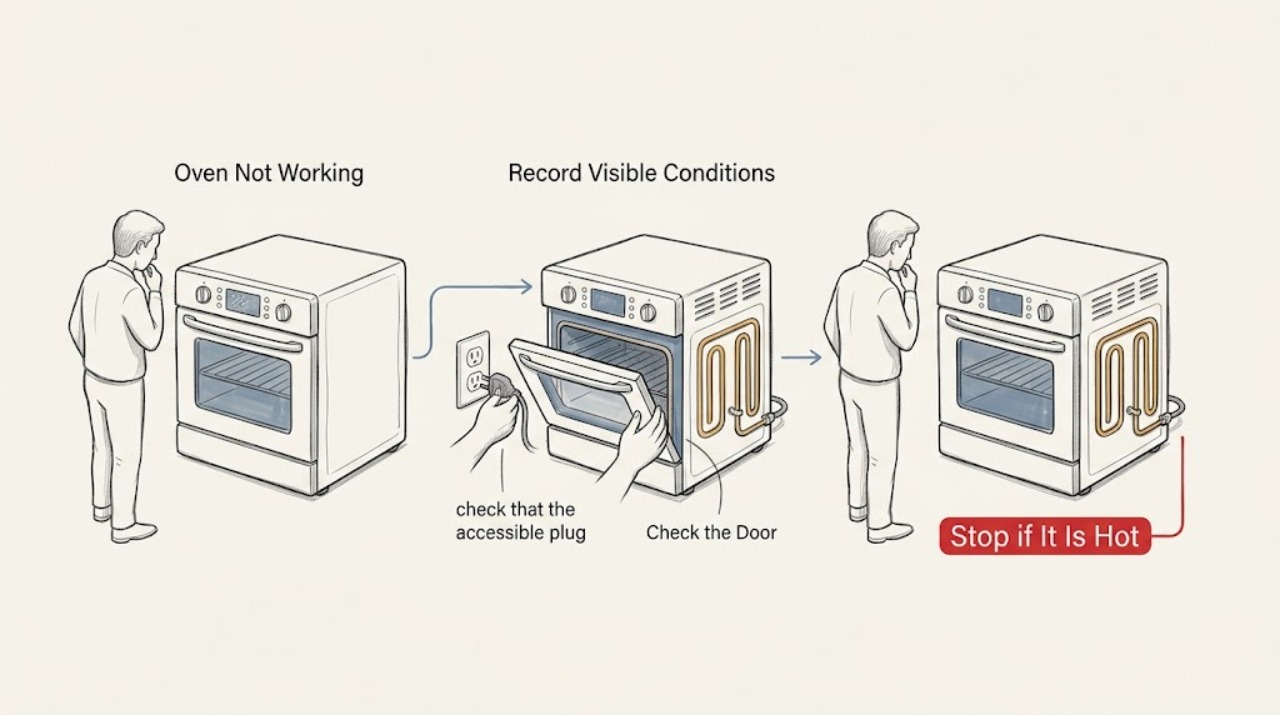
When a Bosch oven is not working, first identify whether the display is dark, the controls respond but a cooking mode will not start, the oven starts but does not heat, or an error message appears. Check the accessible plug and household breaker, confirm a mode and temperature are selected, and verify the door closes without a visible obstruction. Record any E-number before resetting. If the fault returns, the oven remains cold, the panel is unresponsive, the breaker trips, or internal electrical or heating work would be needed, turn the oven off and arrange qualified Bosch service.
Work through in order
Diagnostic checks
Use only checks that match the exact appliance or system and its official guide.
-
Check 1
Press the normal Power or On control and record what happens: note whether the display stays dark, lights up but ignores keys, responds to settings but will not begin, or starts a mode without producing heat. Copy every message, code, beep, or flashing indicator before changing settings.
Expected result: A dark display points to power or connection. A lit panel that ignores keys points to a control issue. A responsive panel with no start or no heat points to the selected mode, door, heating, or a stored fault.
Next step: Keep the exact symptom and any code with the model information, then perform the matching power and control checks below.
Why this matters
Why: The visible response narrows the safe decision path; a general not-working description does not identify one failed component.
-
Check 2
If the display is dark or the oven recently lost power, check that the accessible plug is seated and the household breaker or fuse supplying the oven has not opened. Reset only a breaker that operates normally; do not open the oven or perform live electrical tests.
Expected result: A normal display after stable power is restored supports a supply interruption. A breaker that trips again, a damaged cord, or a display that remains dark indicates an unresolved supply or appliance fault.
Next step: If power is stable, select a cooking mode and temperature. If the breaker opens again or the display remains dark, leave the oven off and arrange qualified electrical or appliance service.
Why this matters
Why: Bosch support treats household power as an early check for an oven that does not turn on or heat, while repeated power loss needs professional evaluation.
-
Check 3
With a responsive panel and no error message, choose a normal cooking mode, set a temperature appropriate for the recipe, and confirm Start according to the model instructions. Check that the door closes fully and that a delayed or special mode was not selected intentionally.
Expected result: If the oven starts after a valid mode, temperature, and door closure are supplied, the earlier issue was a control selection or visible door condition. If the panel accepts the settings but does nothing, the problem is not resolved by user settings.
Next step: Make one normal start attempt. If the oven stays cold, the door will not close, or a fault appears, stop the test and follow the service branch.
Why this matters
Why: A valid cooking command is needed before heating can begin; persistent failure after that command moves the diagnosis toward a technical fault.
-
Check 4
If an E followed by a number appears, record the complete code and whether the panel beeps or accepts keys. Press a normal key only to silence an alert when the panel responds, then follow the exact model's owner instructions for one reset.
Expected result: A code that clears and does not return is different from one that returns immediately, leaves the panel unresponsive, or continues beeping after the reset.
Next step: If the code returns, turn the oven off and arrange qualified service with the model and code. Do not guess at a board, sensor, or heating-part replacement.
Why this matters
Why: Bosch classifies an E-number as a malfunction or fault condition; clearing the alert does not establish that the underlying fault is repaired.
-
Check 5
If the oven accepts a cooking mode but remains cold, stop after one brief supervised confirmation of the selected temperature and display. Do not remove the door, control panel, heating element, or rear cover to look for the cause.
Expected result: A responsive control with no heat after a valid selection indicates a heating or technical fault. Smoke, burning odor, abnormal sparking, or a control area that becomes unusually hot is an immediate stop condition.
Next step: Leave the oven off and arrange qualified Bosch service. Provide the model, selected mode and temperature, display response, and any odor or visible symptom.
Why this matters
Why: Bosch directs suspected heating-element repairs to experts because the oven uses high-voltage electricity; the symptom alone cannot identify a safe replacement part.
-
Check 6
If the door will not close or the oven stops when the door is moved, inspect only the visible door edge and gasket area for a pan, rack, or food residue preventing closure. Do not force the hinges, defeat the interlock, or continue heating with a damaged door.
Expected result: A visible obstruction that can be removed while the oven is cool may explain the symptom. A bent hinge, damaged gasket, loose door, or repeated stop after the obstruction is gone requires service.
Next step: Remove only a harmless visible obstruction with the oven cool. If closure remains abnormal, leave the oven off and arrange qualified service.
Why this matters
Why: Bosch lists an oven door that does not close properly among common oven problems; correct closure is a safety and operating condition, not an adjustment to force.
Use your observations
Decision map
Find the observation that best matches what you see, then follow the next safe action.
-
PATH 01Next step
What you see
The display is dark, the plug is loose, or the household breaker has opened once and resets normally.
Do this next
Restore the accessible connection or breaker once and check whether the display returns. Repeated trips or a persistent dark panel require qualified service.
-
PATH 02Next step
What you see
The panel responds but no cooking mode or temperature was confirmed, or a visible door obstruction prevents closure.
Do this next
Correct the visible setting or obstruction while the oven is cool and make one normal start attempt. Do not force a damaged door.
-
PATH 03Next step
What you see
An E-number appears or returns after one model-approved reset.
Do this next
Turn the oven off, preserve the exact code, and arrange qualified Bosch service.
-
PATH 04Next step
What you see
The oven accepts a valid mode and temperature but remains cold.
Do this next
Stop user troubleshooting and arrange qualified service; do not remove panels or attempt a heating-element repair.
-
PATH 05Next step
What you see
There is smoke, a burning odor, abnormal sparking, visible damage, a control area that overheats, or a breaker that trips again.
Do this next
Stop using the oven and seek qualified appliance or electrical help. If there is an immediate fire hazard, leave the area and contact emergency help from a safe location.
Helpful context
Understand the symptom
Use the symptom to choose the next check
Not working can mean no display, no response to the controls, no heat, a door problem, or an error code. A dark display sends you toward the household supply. A lit display that accepts a mode but stays cold sends you toward heating service. An E-number is a diagnostic branch of its own. This separation prevents a user from repeatedly resetting a fault or ordering a part based only on a broad symptom.
Limit user troubleshooting to safe observations
Bosch ovens use high-voltage electrical systems. Keep checks outside the appliance: observe the display, inspect the accessible plug and breaker, select a normal mode, and check the door's visible closure. Do not remove panels, probe wiring, bypass a door interlock, or attempt to repair a heating element, control board, sensor, or power connection.
When checks do not resolve it
Need a professional?
Qualified Bosch service is appropriate when a no-working symptom persists after the external power, control, and door checks, when an error code returns, or when the suspected cause involves the heating element, control board, sensor, interlock, or wiring.
Common questions
FAQ
What should I check first when my Bosch oven is not working?
Identify whether the display is dark, the controls are unresponsive, the oven will not start a selected mode, or it starts without heat. Check the accessible plug and breaker, then confirm a mode, temperature, and normal door closure.
Why is my Bosch oven display dark?
Check the accessible plug and household breaker or fuse. Reset only a breaker that operates normally. A repeated trip or persistent dark display needs qualified electrical or appliance service.
What does an E-number mean on a Bosch oven?
Bosch treats an E followed by a number as a malfunction or fault indication. Record the complete code, follow the model's reset instruction once, and arrange service if it returns.
Can I repair a Bosch oven heating element myself?
Bosch advises leaving a suspected heating-element repair to experts because ovens use high-voltage electricity. Turn the oven off and arrange qualified service instead of removing panels or testing wiring.
Read the exact guide
Official sources
- Oven Troubleshooting: Broken heating elementBosch Home Appliances · Bosch warning that suspected heating-element repair should be left to experts because ovens use high-voltage electricity.
- Bosch Oven & Microwave Error CodesBosch Home Appliances · Bosch guidance for E-number malfunctions, beeping faults, code recording, and service escalation.
- Get Support - Ovens & Ranges | Bosch Home AppliancesBosch Home Appliances · Bosch routes oven owners to model-specific troubleshooting, error codes, owner manuals, and authorized service.
- Common Oven Problems and How to Fix ThemBosch Home Appliances · Bosch overview of common oven problems including heating, door closure, and service escalation.
Community feedback
Share a repair observation
Share a plain-text repair observation. Accepted observations are published automatically; this page may take a moment to update.