
On this page
Start here
Quick answer
Start by separating a completely dead Beko oven from an oven that powers on but will not start or heat. Check the normal user-accessible power source, then confirm that a cooking function, temperature, and—when the model requires it—a cooking time are set. A blinking clock or enabled key lock can follow a power interruption or prevent controls from responding. If the display remains dead, a breaker trips again, the oven still does not heat after those settings are correct, or there is heavy smoke, sparking, or a gas concern, stop testing and arrange authorized service.
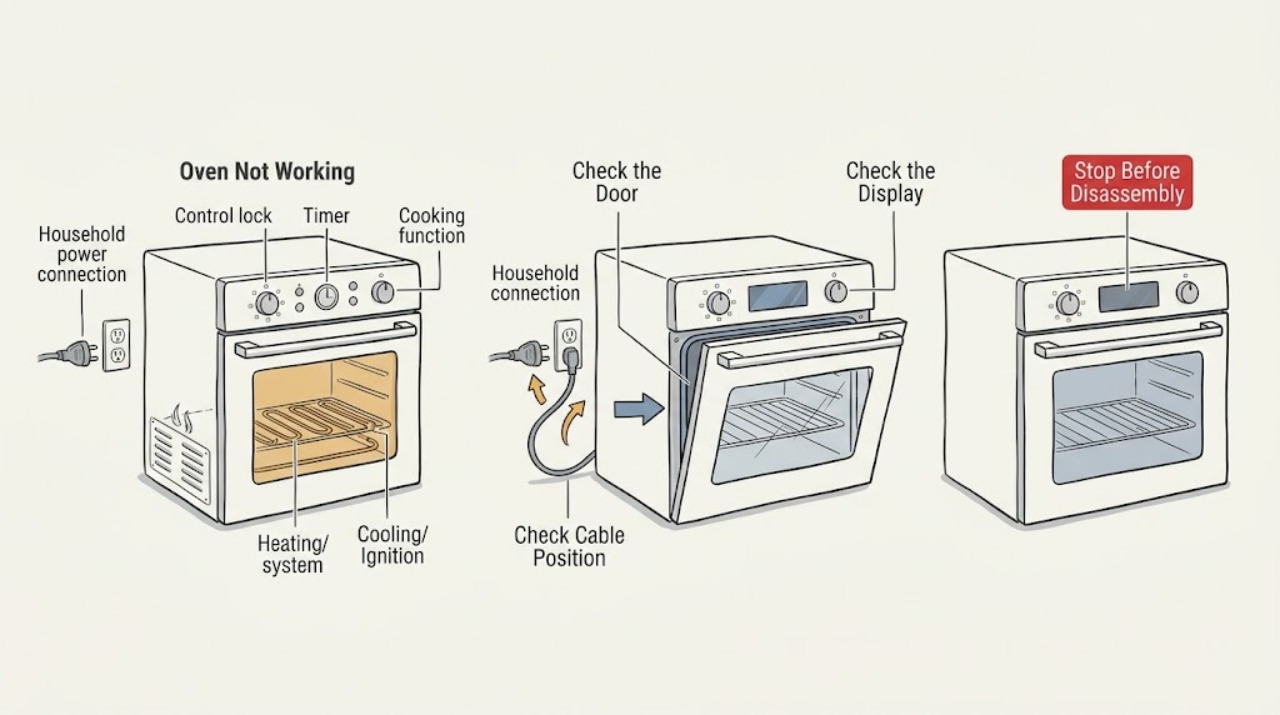
Work through in order
Diagnostic checks
Use only checks that match the exact appliance or system and its official guide.
-
Check 1
Before restarting the oven, look from the normal user position for smoke that is heavy or worsening, sparking, melted wiring, a cracked door or glass panel, an electrical burning smell, or a gas odor on a gas model. Leave the oven off and keep hands away from hot or damaged areas.
Expected result: There is heavy smoke, sparking, visible damage, an electrical burning smell, or an active gas odor.
Next step: Stop using the oven. For an active gas odor, leave and contact the gas supplier or emergency services from outside; for smoke, sparking, or electrical damage, isolate power only if it can be done without approaching danger and arrange qualified service. Do not open the appliance.
Why this matters
Why: The symptom is a safety or installation concern rather than a setting error, and repeated starts could worsen the hazard.
-
Check 2
If there is no immediate hazard and the display is blank or the whole oven is dead, check whether the normal user-accessible plug is firmly connected and whether the household fuse or circuit breaker has tripped. Reset a protection device only once if there is no visible damage and the model's instructions permit it; do not remove a cover or inspect hardwired connections.
Expected result: The display returns, the breaker trips again, the outlet has no power, or the oven remains dead with normal household power available.
Next step: If power is absent elsewhere, have the household circuit checked. If the breaker trips again or the oven remains blank, leave it off and arrange an authorized Beko service agent or qualified electrician as appropriate.
Why this matters
Why: A restored display can indicate a power interruption; a repeated trip, dead outlet, or persistent blank display points to a supply, wiring, or oven fault rather than a cooking setting.
-
Check 3
If the display is on but the oven will not accept commands, note whether the clock is blinking or a key-lock symbol is shown. Set the time and disable the key lock only through the exact model's normal controls; do not force a knob or dismantle the control panel.
Expected result: The clock was unset after a power interruption, the key lock clears and controls respond, or the panel remains locked or unresponsive.
Next step: Retry the intended cooking program once after the clock and lock state are correct. If the panel remains unresponsive, stop and arrange authorized service.
Why this matters
Why: Beko manuals associate an unset time or enabled key lock with an oven that does not operate; persistent unresponsiveness after the user-level procedure suggests a control fault.
-
Check 4
For an oven with a working display, select a normal cooking function, set a temperature, and set a cooking time if the model requires one. Confirm the start control or normal start sequence from the manual; avoid judging the oven by the light or fan alone.
Expected result: The oven starts and begins heating, the display accepts settings but no heat begins, or the controls reject the function or time.
Next step: If it heats, monitor the cycle normally. If it accepts a correct program but remains cold, continue to the heating-result check once; if settings cannot be accepted, use the control/service branch rather than repeatedly changing programs.
Why this matters
Why: Beko identifies an unset function, temperature, or required time as a user-level reason an oven may not start or heat. If all required settings are accepted but no heat follows, a technical fault becomes more likely.
-
Check 5
During one supervised cycle with no hazard, observe whether the oven actually warms after a correct function and temperature are selected. Note whether only the fan runs, a heating indicator appears without warmth, the oven heats unevenly, or the fan continues after shutdown.
Expected result: The cavity warms normally, the fan runs after shutdown, or the oven stays cold despite an accepted program and available power.
Next step: Allow normal cooling after a completed cycle. If the oven remains cold or does not operate normally during a selected program, stop user diagnosis and arrange authorized service; do not test exposed heating components.
Why this matters
Why: A post-shutdown cooling fan can be normal, while an accepted program with no heat points toward a heating, control, sensor, or supply fault. Uneven or slow cooking may require model-specific calibration or service rather than a restart.
-
Check 6
Only for a Beko gas oven and only when there is no gas odor, observe from the normal user position whether ignition occurs after the correct function and temperature are selected. Do not reach into the burner area, manually light the oven, adjust gas components, or repeat ignition attempts if the odor does not clear.
Expected result: There is no ignition, repeated clicking, a delayed or abnormal flame, or a gas odor while the control is off or ignition fails.
Next step: Turn the control off. If there is any active or unaccounted-for gas odor, leave and contact the gas supplier or emergency services from outside; otherwise keep the oven unused and arrange qualified gas-appliance service.
Why this matters
Why: Gas ignition depends on the model's igniter, controls, supply, and combustion path; Beko notes that persistent clicking can indicate moisture or a stuck ignition switch, while unresolved abnormal operation requires an authorized service agent.
-
Check 7
Stop troubleshooting when the oven remains dead after the power check, the breaker trips again, the panel stays locked or unresponsive, a correct program produces no heat, heavy smoke continues, or a gas ignition symptom persists.
Expected result: The fault remains after the applicable non-invasive checks, or any safety or installation warning is present.
Next step: Keep the oven out of service and contact an authorized Beko service agent. Provide the exact model, symptom pattern, display/clock state, breaker result, selected function and temperature, and whether gas, smoke, or unusual noise was observed.
Why this matters
Why: The remaining causes may involve internal wiring, a heating element, thermostat or sensor, control board, timer, igniter, gas valve, or supply condition that requires model-specific testing.
Use your observations
Decision map
Find the observation that best matches what you see, then follow the next safe action.
-
PATH 01Next step
What you see
Heavy or worsening smoke, sparking, visible damage, an electrical burning smell, or gas odor is present
Do this next
Stop immediately. Use the gas-supplier/emergency route from outside for an active gas odor; for smoke, sparking, or electrical damage, keep the oven off and arrange qualified service without opening it.
-
PATH 02Next step
What you see
The display is blank or the entire oven is dead
Do this next
Check the normal plug, outlet, fuse, or breaker once without opening the appliance. A repeated trip or persistent blank display requires authorized service or a qualified electrician.
-
PATH 03Next step
What you see
The display is on but the clock is blinking or a key lock is enabled
Do this next
Set the time and disable the lock using the exact model's controls. If the panel remains unresponsive, stop and arrange service.
-
PATH 04Next step
What you see
The oven accepts controls but does not start or heat
Do this next
Confirm a cooking function and temperature, plus a cooking time where required. If a correct program is accepted but the cavity remains cold, treat it as a technical fault and contact authorized service.
-
PATH 05Next step
What you see
The fan continues briefly after the oven is switched off, with no other abnormal symptom
Do this next
Allow the cooling cycle to finish; Beko describes this as normal cooling of the oven and electrical controls. Seek service only if the appliance does not operate normally or the fan behavior is accompanied by smoke or damage.
-
PATH 06Next step
What you see
A gas Beko oven fails to ignite, clicks continuously, has a delayed/abnormal flame, or produces gas odor
Do this next
Turn the control off and do not manually light or adjust gas parts. Leave and call the gas supplier or emergency services for an active odor; otherwise arrange qualified gas-appliance service.
-
PATH 07Next step
What you see
A small amount of smoke occurs only during first use or from known residue and is not heavy
Do this next
Follow the exact manual's first-use and cleaning guidance. If smoke is heavy or does not improve, turn the oven off and contact an authorized service agent.
Helpful context
Understand the symptom
Identify what “not working” means
Record whether the display is blank, the clock is flashing, the controls do not respond, the oven starts but stays cold, or it heats and then stops. Also note whether the fan continues after switching off; Beko says a cooling fan can run for a while after use to cool the oven and its electrical controls. That sound alone is not proof of a failed oven.
Use the model manual before changing a control
Beko ovens differ in timer, key-lock, gas, and cooking-function controls. Locate the exact model from the oven frame or the appliance's documentation and use its manual for symbols and settings. Beko's manual support identifies built-in oven model information behind the door on the bottom of the inside frame; do not remove panels to find it.
Treat smoke and internal repair as a boundary
A small amount of smoke can occur during first use or from grease or cleaning residue, but Beko says heavy smoke that does not improve requires immediate shutdown and authorized service. Do not open the rear cover, bypass a lock or thermostat, test live wiring, or attempt gas or high-temperature component repair.
Only after diagnosis
Potential parts
- heating element or thermal limiter
Consider only after an authorized technician confirms power and control commands reach the heating circuit but the element or limiter does not heat; a cold cavity alone does not identify the part.
Confirm the exact Beko model, element position, electrical rating, and approved fit information before ordering or installing. - temperature sensor or thermostat
Consider only when qualified testing links incorrect temperature control, premature shutoff, or no-heat behavior to the sensor or thermostat.
Sensor and thermostat specifications are model-specific; do not substitute based on appearance or a similar oven. - electronic control or timer assembly
Consider only when power is present but the display, timer, lock, or function command remains faulty after the manual control procedure and technician diagnosis.
Match the exact model and revision, and have electrical diagnosis and installation performed by an authorized technician. - gas igniter or gas safety valve
Consider only for a gas model after qualified testing distinguishes an igniter, valve, supply, or combustion fault; failure to ignite does not prove which component is defective.
Gas parts must match the exact model and fuel configuration and require qualified installation and safety testing.
When checks do not resolve it
Need a professional?
Arrange authorized Beko service when the oven stays dead after the normal power check, a breaker trips again, the display or key lock remains unresponsive, a correctly programmed cycle produces no heat, or a gas oven has persistent ignition or flame problems. Stop immediately for heavy smoke, sparking, visible electrical damage, a cracked hot surface, or gas odor; use the applicable emergency, gas-supplier, or electrical safety route and do not test further.
Common questions
FAQ
Why is my Beko oven on but not heating?
Confirm that a cooking function and temperature are selected and that a required cooking time is set. If the display accepts a correct program but the oven remains cold, Beko treats the continuing symptom as a possible technical problem requiring an authorized service agent.
What does a blinking clock mean on a Beko oven?
A blinking clock can follow a power interruption. Set the time using the model's normal controls, then retry the cooking program. If the panel remains locked or unresponsive, arrange service rather than forcing the controls.
Is it normal for a Beko oven fan to keep running after shutdown?
Beko says a cooling fan may run for a while after the oven is switched off to cool the oven and its electrical controls. If the fan is accompanied by smoke, sparking, or abnormal operation, keep the oven off and seek service.
What should I do if my Beko gas oven keeps clicking?
If there is no gas odor, note whether the ignition area may be damp and retry only according to the exact manual. If clicking continues, the ignition switch or another gas component may need service. Turn the control off and use the gas-safety branch for any odor, delayed ignition, or abnormal flame; do not manually light or adjust parts.
Can smoke make a Beko oven seem like it is not working?
First-use residue, grease, or cleaning-agent residue can produce some smoke, but Beko says heavy smoke that does not improve requires immediate shutdown and authorized service. Smoke with sparking or an electrical burning smell is a stop condition, not a cleaning test.
Read the exact guide
Official sources
- User ManualBeko · Opened official Beko manual for a specific range model; use only as general troubleshooting context and verify the user's exact model manual.
- Help Center ResultBeko · Official Beko US range/oven help center; apply gas and model-control information only when relevant to the appliance.
- TroubleshootingBeko · Official Beko troubleshooting document; model-specific controls and regional instructions may differ.
- My oven produces smoke when working. Should I be worried?Beko · Official Beko range/oven support for smoke during operation; heavy smoke, damage, and safety symptoms override normal-residue explanations.
- How to fix a range or an oven that does not heatBeko · Official Beko US support article for range/oven symptoms; exact model manual and local installation requirements take precedence.
Community feedback
Share a repair observation
Share a plain-text repair observation. Accepted observations are published automatically; this page may take a moment to update.