
On this page
Start here
Quick answer
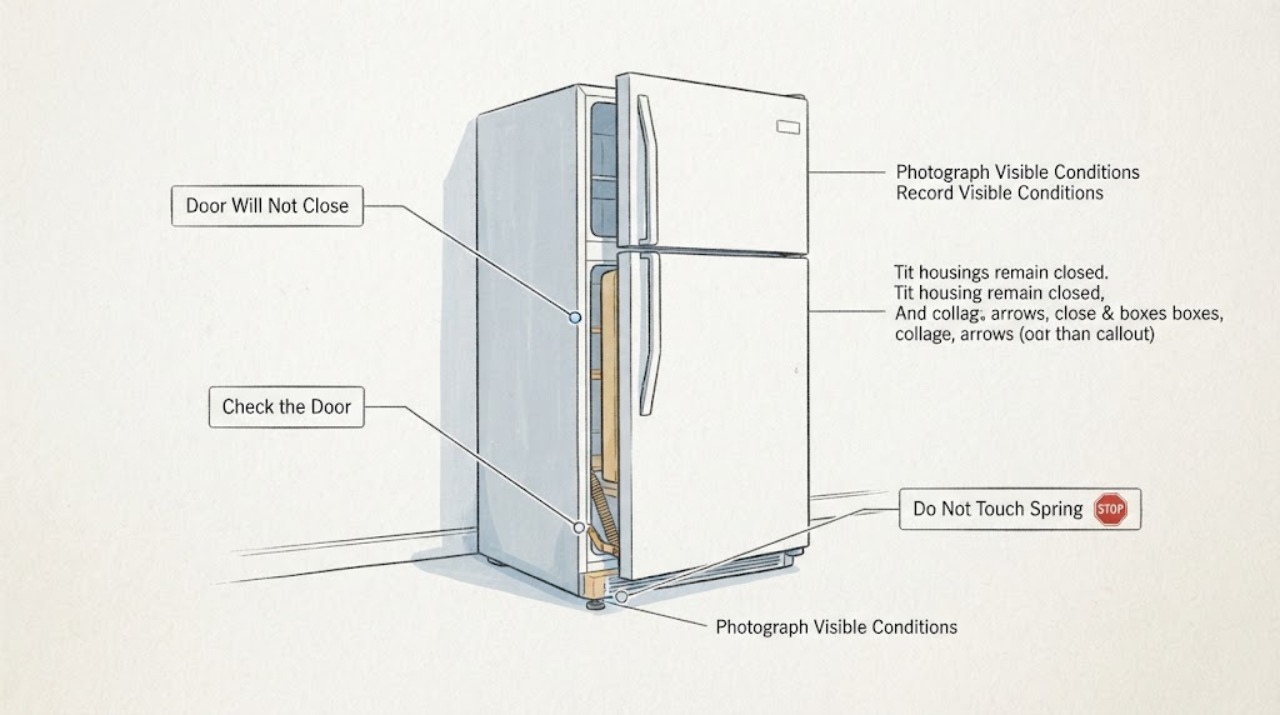
Do not lift, unhook, clamp, or adjust the spring rod while the door is loaded. The exact Reddit lead describes a VCSB5483SS12 side-by-side door whose spring linkage catches behind the upper plate of an adjustable foot, but the lead could not be opened in this research session, so it is treated as the reported symptom rather than proof of a failed part. Viking's official VCSB5483 installation guide identifies the VCSB5483 side-by-side family, warns that the appliance is top-heavy, requires all four leveling legs to support and stabilize it, and says the unit must be secured against tipping. From the front, keep the door closed if it is unstable, photograph the interference without putting hands near the spring, check for rocking or an obvious foot/trim contact, and arrange an authorized or qualified technician for leveling, hinge, spring, or door removal. Do not roll the refrigerator out, remove anti-tip hardware, loosen hinge or spring fasteners, or change the foot height as a trial; the door and appliance can move or tip and the spring is under tension.
Work through in order
Diagnostic checks
Use only checks that match the exact appliance or system and its official guide.
-
Check 1
Read the rating label and photograph the complete model and serial information without removing panels; confirm that the unit is the Viking VCSB5483SS12 side-by-side refrigerator described in the task.
Expected result: The label confirms VCSB5483SS12, or the label is different/incomplete.
Next step: If the label differs, stop using this article's model-specific family references and give the exact identity to Viking support; do not substitute a similar refrigerator manual.
Why this matters
Why: The official Viking documentation page groups the installation and use-and-care documents under VCSB5483, but a different label could require a different hinge, foot, or door procedure.
-
Check 2
From the front, check whether the cabinet visibly rocks, leans, or has a gap at any accessible leveling foot; do not turn the foot or place a hand under the door.
Expected result: The unit rocks/leans or a foot appears not to contact the floor, or the cabinet is stable but the rod still meets the foot plate.
Next step: Do not continue testing a rocking or leaning appliance. Arrange qualified service for leveling and anti-tip inspection; if stable, continue only with visual documentation and the service boundary.
Why this matters
Why: Viking's installation guide requires all four leveling legs to contact the floor to support and stabilize the full weight. Stability does not prove which hinge or spring part is wrong, and lack of stability makes adjustment more hazardous.
-
Check 3
With hands away from the mechanism, use a flashlight or camera to record the door position at the moment it rebounds and the location of the spring linkage relative to the adjustable-foot plate.
Expected result: The linkage visibly catches or the door rebounds before the gasket seats, or the contact cannot be safely seen without opening the door farther or moving the unit.
Next step: Keep the door closed if it can be closed without force, save the photo/video, and request authorized service. Do not lift the rod, disconnect it, or add shims/washers.
Why this matters
Why: A visible contact documents the symptom but does not identify whether the cause is leveling, hinge geometry, a bent housing, wear, or a spring/linkage problem. An inaccessible contact needs a technician rather than a guessed part.
-
Check 4
Check the door seal and cabinet alignment only from the outside after the door is at rest; note whether the seal contacts continuously and whether the refrigerator remains level in the opening.
Expected result: There is a continuous gasket gap, the door sits low/high relative to the cabinet, or the seal is even but the lower mechanism still binds.
Next step: Do not compensate by raising one front foot or loosening hinge hardware. Have the exact installation and door geometry assessed by a qualified technician.
Why this matters
Why: A gap or misalignment means the refrigerator may not be sealed or positioned correctly, but it does not distinguish hinge adjustment from foot, frame, spring, or installation damage.
-
Check 5
Stop immediately if the appliance moves, the spring or rod is visibly bent/detached, a hinge fastener is stripped/loose, the door is heavy or unsupported, the anti-tip restraint is absent, or the door cannot remain closed.
Expected result: Any movement, damaged loaded hardware, missing restraint, or unsealed door is present.
Next step: Keep people away, do not move the refrigerator or remove the door, and contact Viking authorized service or another qualified appliance technician. If the unit is actively tipping, leave the area and use local emergency help.
Why this matters
Why: The issue has crossed the safe external-observation boundary. Viking warns of serious injury from tipping and requires the unit to be secured; a loaded spring or heavy door can release energy unexpectedly.
Use your observations
Decision map
Find the observation that best matches what you see, then follow the next safe action.
-
PATH 01Next step
What you see
The VCSB5483SS12 is stable, all visible door-seal contact is even, and the obstruction can be photographed without touching the spring or moving the unit.
Do this next
Keep the door closed if possible and send the model/serial information plus the photo to Viking authorized service; do not order a spring or hinge from the symptom alone.
Why this path and its safety boundary
Why it matters: The symptom is documented, but the official sources do not establish whether the cause is a foot position, hinge geometry, bent housing, or spring/linkage wear.
-
PATH 02Next step
What you see
The cabinet rocks or one or more leveling legs visibly do not support the unit, or the anti-tip restraint cannot be confirmed.
Do this next
Stop door testing and arrange qualified service to secure, level, and inspect the appliance; do not crank the foot or pull the refrigerator forward yourself.
Why this path and its safety boundary
Why it matters: The installation is outside the required stability condition and may allow the top-heavy refrigerator or door to move unexpectedly.
-
PATH 03Next step
What you see
The spring rod is under visible tension, bent, detached, or trapped behind the adjustable-foot plate, or a hinge fastener appears damaged.
Do this next
Do not lift, clamp, unhook, or loosen the rod. Keep the door supported by its normal closed position and call authorized or qualified service.
Why this path and its safety boundary
Why it matters: This is a loaded mechanical linkage and door-support issue. The supplied Reddit report does not provide verified repair authority, and Viking's official documents do not support a homeowner release sequence.
-
PATH 04Next step
What you see
The door remains unsealed, the refrigerator warms, or the unit cannot be left safely closed while waiting for service.
Do this next
Move perishable food using safe handling practices, avoid repeated door tests, and arrange prompt appliance service. Do not remove the door or defeat the spring mechanism to keep operating it.
Why this path and its safety boundary
Why it matters: The appliance may not preserve food safely and the door mechanism remains a physical hazard.
Helpful context
Understand the symptom
Treat the spring-to-foot contact as a loaded-door and stability problem
The assigned model is VCSB5483SS12, and Viking's official documentation library lists the VCSB5483 48-inch side-by-side family with installation and use-and-care manuals. The installation guide says the appliance is top-heavy, must be secured against tipping, and needs all four leveling legs in contact with the floor. Those facts make a spring rod, lower hinge, adjustable foot, or door-height mismatch unsafe to correct by trial and error. A door that bounces back can also leave the gasket unsealed and warm the refrigerator, so keep the door closed when possible and move food only if the appliance cannot maintain safe temperature.
Use observation to document the interference, not to release the spring
With the appliance stable and the door supported by its normal position, use a flashlight or phone camera from the front or side to document where the rod, spring housing, lower hinge area, and adjustable-foot plate appear to meet. Do not put fingers or tools into the gap, lift the rod, disconnect it, remove an anti-tip board, pull the 48-inch unit forward, or loosen a hinge fastener. Viking's installation guide says to use two or more people for moving the unit and to disconnect power before removing the top grille; it also presents hinge adjustment as part of the installation procedure, not a safe spring-release recipe for a homeowner.
When checks do not resolve it
Need a professional?
Call Viking authorized service or a qualified appliance technician when the spring linkage contacts the adjustable-foot plate, the door rebounds or leaves a gasket gap, the appliance rocks, a leveling leg or anti-tip restraint is questionable, or any hinge/spring hardware is bent, loose, detached, or under tension. Do not move the 48-inch top-heavy refrigerator, remove anti-tip hardware, loosen spring or hinge fasteners, disconnect the rod, or order a replacement part from the reported geometry alone.
Common questions
FAQ
Can I disconnect the spring rod so the Viking door will close?
Do not disconnect or lift the rod as a home test. The rod is part of a loaded door mechanism, and the official Viking installation guide warns about tip-over and heavy-unit handling but does not provide a safe user spring-release procedure. Photograph the obstruction and arrange qualified service.
Should I raise or lower the adjustable foot until the rod clears it?
Do not adjust the foot by trial and error. Viking requires all four leveling legs to support and stabilize the full appliance and requires the top-heavy unit to be secured against tipping. A foot change can alter door geometry or stability and does not prove the spring or hinge is sound.
Does the VCSB5483SS12 door-spring symptom identify the failed part?
No. Contact at the adjustable-foot plate can be documented, but it does not distinguish leveling, hinge alignment, a bent housing, wear, or spring/linkage damage. Do not buy a spring, hinge, or foot from the symptom alone.
What should I do if the door cannot stay sealed?
Avoid repeated opening and closing, move perishable food safely if the refrigerator cannot maintain temperature, and arrange prompt service. Do not remove the door or defeat the spring mechanism to keep using the appliance.
Read the exact guide
Official sources
- Viking Customer Support / Authorized ServiceViking Range, LLC · Supports referral to Viking authorized service for repairs; it does not identify the failing spring, hinge, foot, or frame component.
- Viking Product Documentation — Chill / RefrigerationViking Range, LLC · Opened Viking's official documentation library. It lists VCSB5483 as a discontinued 48-inch side-by-side refrigerator/freezer and links the English installation and use-and-care documents. The task's SS12 suffix remains the assigned identity; the family mapping is used for the official manuals and not for unverified parts compatibility. The assigned task suffix is VCSB5483SS12; the page exposes the VCSB5483 family rather than a separate SS12 record, so suffix-specific parts are not inferred.
- Viking 5 Series Side-by-Side Refrigerator/Freezer Use & Care Manual — VCSB5423 / VCSB5483Viking Range, LLC · Official PDF opened by clicking the VCSB5483 English use-and-care link from Viking's documentation library. Used for door/gasket and service boundaries; it is not used to diagnose a spring or authorize door removal.
- Viking 5 Series Side-by-Side Refrigerator/Freezer Installation Guide — VCSB5423 / VCSB5483Viking Range, LLC · Official PDF opened by clicking the installation link on Viking's documentation library. It explicitly names VCSB5483 but does not document a safe homeowner spring-rod release or prove the exact SS12 suffix's individual parts. The assigned model token is VCSB5483SS12; this source covers its exposed VCSB5483 family and does not prove suffix-specific parts.
Community feedback
Share a repair observation
Share a plain-text repair observation. Accepted observations are published automatically; this page may take a moment to update.