
On this page
Start here
Quick answer
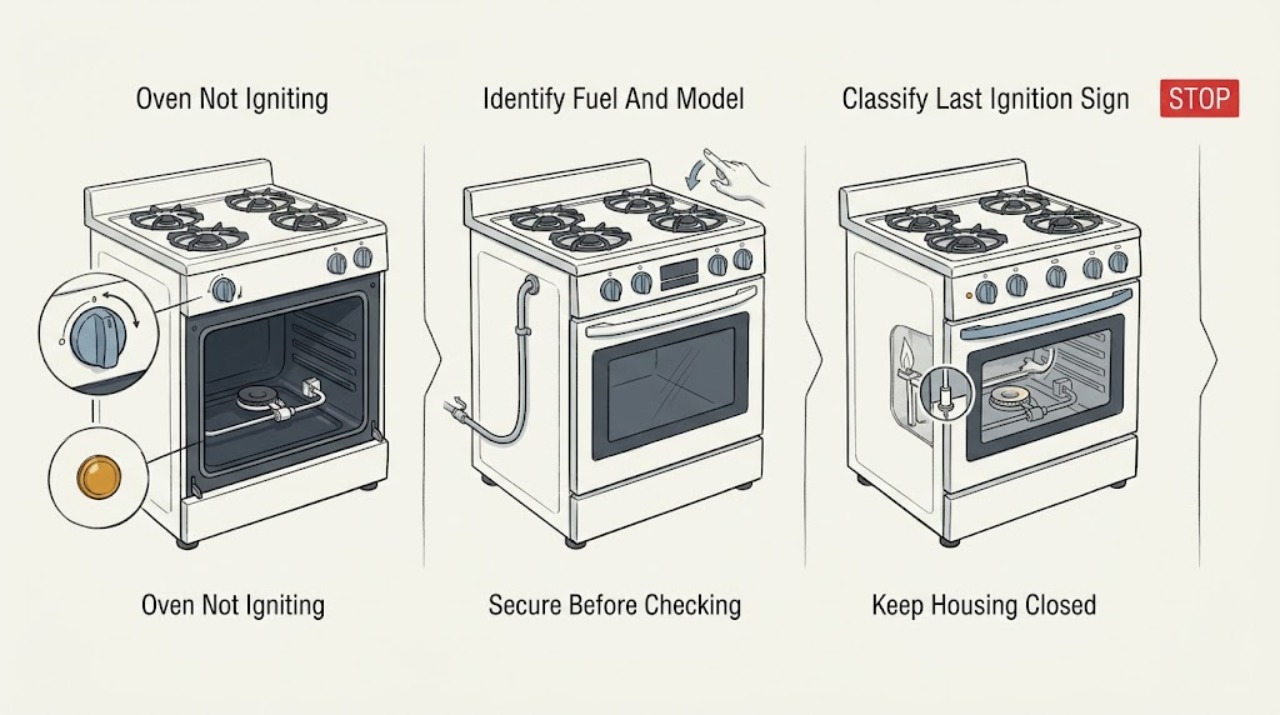
A Westinghouse oven that will not ignite can have no power to the ignition system, a wet or dirty visible ignition area, a closed gas supply, an ignition-area obstruction, a flame-sensing or control fault, or a model-specific operating condition. First identify whether the oven is gas, electric, or dual-fuel and record the exact model; do not assume that an oven that does not ignite is using the same sequence as another Westinghouse model. If the last safe observation showed no spark, repeated clicking without a stable flame, delayed ignition or a pop, abnormal flame, gas odor, smoke, carbon-monoxide alarm, or electrical arcing, turn controls Off, stop use, and do not retry. Westinghouse troubleshooting lists power, a wet or dirty spark plug, gas supply, and a blocked ignition area as possible observations, but persistent failure needs qualified model-specific service.
Before you begin
Safety first
- The reader-level scope is turning controls Off and recording external observations from a safe position. A qualified professional must inspect ignition components, burner and flame safeguard, gas supply and connector, controls, wiring, plug, socket, and internal parts. Do not move the appliance or perform gas or electrical disassembly.
Work through in order
Diagnostic checks
Use only checks that match the exact appliance or system and its official guide.
-
Check 1
Turn all oven and burner controls to Off from a safe position and stop using the appliance. If the last safe observation involved a gas odor, hissing, smoke, flame outside the burner, a pop, electrical arc, hot plug, or carbon-monoxide alarm, leave the area when appropriate and contact emergency or gas help from outside or another safe location.
Expected result: The oven is quiet with no odor, smoke, uncontrolled flame, continued spark, or electrical heat, or one of those hazards remains present.
Next step: If no hazard remains, continue with model and symptom identification without initiating another ignition attempt. If a hazard remains, keep people away and obtain the appropriate qualified help.
Stop if: Do not relight, use a match or lighter, operate switches near a gas odor, touch a wet or hot plug, or repeatedly reset a breaker.
Why this matters
Why: A quiet, hazard-free appliance permits only non-invasive documentation. A gas, fire, or electrical hazard is not an ignition troubleshooting branch and must be handled as a stop-use or emergency event.
-
Check 2
From a safe position, record whether the Westinghouse unit is gas, electric, or a combination cooker, and photograph or write down the model and serial information visible on the data plate or manual without moving the appliance or opening a panel.
Expected result: The fuel type and model are clear, or the data plate is hidden, unreadable, or reachable only by moving or disassembling the cooker.
Next step: Use the exact model manual or provide the model information to a qualified technician. If the identity cannot be obtained safely, stop at external documentation and do not apply another model's procedure.
Stop if: Do not move the cooker, remove a rear or control panel, inspect a gas connector, or expose wiring to find the data plate.
Why this matters
Why: A gas oven requires an ignition and flame-sensing path, while an electric oven has a different heating and control path. Unknown identity prevents safe assumptions about the control sequence, ignition component, or reset behavior.
-
Check 3
Using only the last safe attempt already observed, classify the symptom as no click or spark, a brief intended spark but no flame, repeated clicking or sparking with no stable flame, a delayed flame or pop, a flame that goes out, or an electrical spark outside the intended ignition area; do not make another attempt to obtain a missing observation.
Expected result: The sequence and location are known, or the sound or flash was too brief or unclear to locate safely.
Next step: Record the control position, function, spark location, flame response, odor, noise, and whether the event continued after Off. Keep the oven out of service and provide the record to qualified appliance service; use the gas-safety branch for any gas odor or delayed ignition.
Stop if: Do not hold a gas control open, use alternate ignition, clean an internal port with a wire, probe the spark path, or repeat an ignition attempt.
Why this matters
Why: No spark points toward power, ignition control, or a wet or dirty ignition area; spark without flame points toward the gas, burner, flame-sensing, or control path; delayed or abnormal ignition raises an unburned-gas and combustion risk. An electrical arc outside the intended ignition path is a separate electrical fault.
-
Check 4
Only after the oven is cool and no gas or fire hazard is present, inspect from ordinary safe access for an obvious power interruption, tripped household protective device, visible moisture or residue at the accessible ignition area, scorching, cord damage, or a hot socket; do not touch wet or damaged electrical parts.
Expected result: Power appears available and the accessible area is dry and undamaged, the ignition area appears wet or dirty, a protective device has tripped, or inspection cannot be completed without opening or moving the unit.
Next step: Leave the oven Off and give the observation to a qualified appliance or electrical professional. Follow a cleaning step only if the exact manual explicitly authorizes safe external cleaning; otherwise do not disturb the ignition area.
Stop if: Do not spray cleaner, pour liquid, remove covers, reach behind the oven, unplug a hot or damaged cord, or repeatedly reset a breaker.
Why this matters
Why: Westinghouse troubleshooting lists power and a wet or dirty spark plug as possible no-spark causes, and lists a gas supply or ignition-area blockage when an igniter works but the burner does not light. Scorching, moisture, a repeated trip, or inaccessible parts is a stop condition, not a user repair instruction.
-
Check 5
Prepare a service record with the model, fuel type, selected oven function, control position, last known click or spark, flame response, delay or pop, odor or smoke, visible damage, breaker behavior, and any recent cleaning, spill, power interruption, installation, or movement.
Expected result: The problem can be described as no spark, spark without flame, delayed or abnormal ignition, flame loss, or an electrical spark, with the model known or unknown.
Next step: Send the record and safe exterior photos to qualified Westinghouse appliance service. Keep the oven out of service until the ignition and safety systems are assessed.
Stop if: Do not order a generic igniter, adjust gas pressure, inspect a connector by moving the cooker, or perform gas or live electrical tests.
Why this matters
Why: This record lets the technician choose the correct Westinghouse procedure and separate gas delivery, ignition, flame safeguard, control, and electrical paths without guessing a part or crossing fuel-type boundaries.
Use your observations
Decision map
Find the observation that best matches what you see, then follow the next safe action.
-
PATH 01Next step
What you see
The appliance is electric, or its fuel type and ignition path cannot be confirmed safely.
Do this next
Do not use a gas-ignition procedure. Record the model and control behavior and arrange model-specific appliance service, especially for no heat, arcing, scorch marks, or repeated breaker trips.
-
PATH 02Next step
What you see
A confirmed gas model produced no click or spark during the last safe observation.
Do this next
Leave the oven Off. Provide the model, power observation, and visible moisture or residue observation to qualified service; do not expose wiring or dismantle the ignition system.
-
PATH 03Next step
What you see
The intended ignition area sparked or clicked but no stable flame appeared, or the flame went out unexpectedly.
Do this next
Turn the control Off and do not relight. Arrange qualified gas-appliance service to assess the gas, burner, ignition, flame-sensing, and control paths; treat any odor as the emergency gas branch.
-
PATH 04Next step
What you see
The flame appeared late, with a pop or whoosh, or the flame was unstable, lifting, yellow, outside the burner, or accompanied by gas odor.
Do this next
Stop immediately, do not operate electrical switches or attempt another ignition, leave for a suspected gas leak or fire risk, and contact gas or emergency help from a safe location before arranging appliance service.
-
PATH 05Next step
What you see
Sparking occurred at a plug, socket, cord, control, cavity wall, wiring, or another location outside the intended ignition path, or continued after controls were Off.
Do this next
Keep the appliance out of service and do not reset repeatedly or move it. Obtain qualified electrical and appliance assessment, particularly for smoke, scorching, heat, or a breaker trip.
Helpful context
Understand the symptom
Not every Westinghouse oven has the same ignition sequence
Westinghouse publishes gas, electric, and combination-cooker instructions. A gas oven may use electronic or piezo ignition and a flame safeguard, while an electric oven does not use a gas-burner ignition path. Begin by identifying the fuel type and model from the data plate or manual while standing safely; do not apply a gas-oven procedure to an electric oven or infer a control sequence from a similar-looking appliance.
Separate no spark, spark without flame, and delayed ignition
No click or spark, a spark with no stable flame, and a flame that appears late or with a pop are different observations. Westinghouse troubleshooting associates no spark with power or a wet or dirty spark plug, and an igniter that works without a flame with gas supply or an ignition-area blockage. Those are clues, not permission to open the appliance, hold a gas valve open, or keep trying.
Safety signs override ordinary troubleshooting
Gas odor, hissing, delayed ignition, an abnormal flame, smoke, a carbon-monoxide alarm, or a spark outside the intended ignition path is a stop-use condition. Turn the controls Off if it is safe to do so and leave for a suspected gas leak or fire risk without operating electrical switches or using a phone in the affected area. Arrange gas, emergency, electrical, or appliance help from a safe location.
The exact model determines the repair boundary
A model number determines whether a clock, control lock, ignition switch, flame sensor, burner, or electronic controller applies. It also determines which components and service instructions are compatible. Record the model and serial information without moving the cooker or removing a panel, and give the technician the exact symptom sequence rather than ordering a generic igniter.
Safety boundary
Stop conditions
- Stop immediately for gas odor, hissing, delayed ignition, popping, an abnormal flame, smoke, fire, a carbon-monoxide alarm, or a flame outside the burner; leave when appropriate and contact emergency or gas help from a safe location.
- Stop for visible electrical arcing, a hot or damaged plug or socket, scorch marks, burning insulation odor, wet controls, or a protective device that trips again. Do not repeatedly reset or test.
- Do not use a match or lighter, hold a gas control open, adjust gas pressure, move the cooker, inspect or replace a gas connector, remove panels, probe wiring, or bypass a flame safeguard.
- Do not continue using the oven when there is no stable flame, ignition is delayed, sparking persists after Off, or the fuel type and spark path are uncertain.
Only after diagnosis
Potential parts
- model-specific ignition electrode or spark component
Consider only when qualified service confirms an ignition-component fault and the exact model identifies the compatible component.
Do not infer fit from appearance or another Westinghouse model; confirm the exact model and authorized service information. - model-specific flame sensor or ignition control
Consider only after qualified diagnosis confirms repeated no-flame or flame-loss behavior is caused by the sensing or control path.
Gas safety controls require model-specific diagnosis and qualified installation; the no-ignition symptom alone does not establish a part or fit.
When checks do not resolve it
Need a professional?
Arrange qualified Westinghouse appliance service when the oven will not ignite, there is no spark, a spark produces no stable flame, the flame goes out, ignition is delayed, the model-specific manual does not resolve the issue, or the spark location is uncertain. Seek urgent gas or emergency help for odor, hissing, popping, abnormal flame, smoke, fire, or a carbon-monoxide alarm. Use qualified electrical assessment for arcing, scorching, a hot or wet electrical area, or repeated breaker trips.
Safety scope: The reader-level scope is turning controls Off and recording external observations from a safe position. A qualified professional must inspect ignition components, burner and flame safeguard, gas supply and connector, controls, wiring, plug, socket, and internal parts. Do not move the appliance or perform gas or electrical disassembly.
Have this ready
- Provide the model and serial information if safely visible, fuel type, selected function, control position, last click or spark, spark location, flame response, delay or pop, odor or smoke, visible moisture or scorching, breaker behavior, recent cleaning or spill, and safe exterior photos.
Common questions
FAQ
Why will my Westinghouse gas oven not ignite?
Possible observations include no power to the ignition system, a wet or dirty visible ignition area, a closed gas supply, an ignition-area blockage, or a flame-sensing or control fault. The exact cause depends on the model and fuel type, so do not assume a generic igniter or keep retrying.
What should I do if I hear clicking but see no flame?
Turn the control Off and stop using the oven. Do not use a match, lighter, or repeated ignition attempt. Record the model, the last safe sequence, and any odor or pop, then arrange qualified gas-appliance service.
Can I clean the igniter or burner myself?
Only follow an explicitly model-specific, safe external cleaning instruction when there is no gas or electrical hazard. Do not probe ports, open panels, hold a gas control open, or clean internal parts with a wire; ask qualified service when the area is inaccessible, wet, damaged, or still fails.
What if I smell gas while the oven will not ignite?
Treat it as an urgent gas-safety event. Turn controls Off only if safe, do not operate lights, switches, phones, or other electrical equipment in the affected area, leave immediately, and contact gas or emergency help from a safe location. Do not return to relight or find the leak yourself.
Read the exact guide
Official sources
- Certain Older Gas Connectors May Be DangerousU.S. Consumer Product Safety Commission · CPSC warns not to move a gas appliance to inspect its connector, directs qualified professionals to check connectors, and gives the emergency response for suspected gas leaks.
- User ManualsWestinghouse Australia · The official support page provides model-based manual lookup and service and repair support, supporting model-specific rather than cross-model instructions.
- USER MANUALWestinghouse Australia · Official Westinghouse troubleshooting table listing power, wet or dirty spark plug, gas supply, ignition-area blockage, repeated fuse warnings, and model and serial information.
- USER MANUALWestinghouse Australia · Official Westinghouse gas-cooker manual describing electronic ignition, oven ignition, the spark plug and flame sensor, and the warning to turn the control Off when a burner does not light promptly.
Community feedback
Share a repair observation
Share a plain-text repair observation. Accepted observations are published automatically; this page may take a moment to update.