
On this page
Start here
Quick answer
A Westinghouse oven normally has hot surfaces, warm air at the door vent, and—on selected models—a cooling fan that continues after cooking until the oven cools. Overheating means the oven stays hot beyond the selected cycle, heats the cabinet or controls abnormally, or shows smoke, a burning odor, damaged food, an error, or a tripped circuit. Check the function, temperature, timer, vent clearance, door condition, and exact model manual only from a cool, safe position. If heating continues after the controls are off, or there is smoke, an abnormal flame, carbon-monoxide concern, a burn hazard, an electrical odor, arcing, or a trip, stop using the oven and arrange qualified service.
Before you begin
Safety first
- A technician should determine whether the cause is a setting, installation, thermostat, sensor, element, cooling fan, gas ignition or valve system, wiring, control, or surrounding electrical supply before selecting a component.
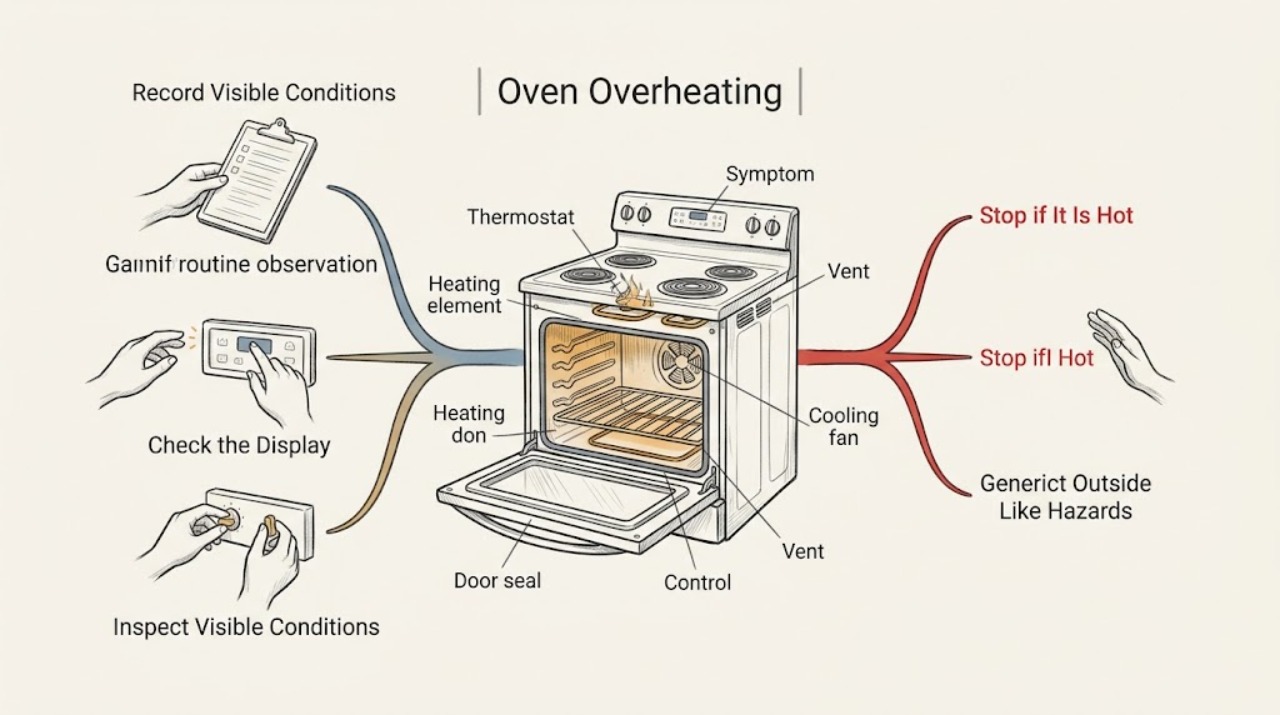
Work through in order
Diagnostic checks
Use only checks that match the exact appliance or system and its official guide.
-
Check 1
From a safe position, note what is hot and when: the cavity, door, cabinet, controls, vent air, plug or cord, or nearby cabinetry. Record the selected function, temperature, timer state, cooking stage, and any smoke, odor, discoloration, melted material, flame change, or circuit trip.
Expected result: Hot cavity surfaces and warm vent air during or shortly after cooking can be normal; a hot cabinet, control area, plug, cord, or surrounding material is a different result.
Next step: If there is smoke, a burning or electrical odor, abnormal flame, visible arcing, melting, a hot electrical connection, or a trip, stop immediately and arrange qualified service; do not touch the hot or damaged area.
Why this matters
Why: The heat location and timing separate normal residual heat from a possible thermostat, element, fan, wiring, control, installation, or fuel problem.
-
Check 2
With the oven cool enough to approach safely, check the function selector, temperature setting, timer or cooking-time setting, and any display indicator against the exact model manual. Confirm that the oven is not in grill, fast-heat, steam, pyrolytic, delayed, or another high-heat mode unless that mode was intended.
Expected result: A grill, fast-heat, steam, or self-cleaning mode can produce more intense heat and a longer cooling period than ordinary baking. An oven that keeps heating after the selected function is off is not explained by the setting alone.
Next step: Correct only an unintentional setting using the manual. If the oven continues heating with the controls off or repeats the problem on an ordinary setting, keep it out of use and request service.
Why this matters
Why: Function and timer state can explain a hot oven but cannot justify continuous heating, smoke, heat damage, or an uncontrolled flame.
-
Check 3
Observe the cooling or venting fan from outside the oven during a normal cycle and after the controls are turned off, without reaching into the vent. Compare its behavior with the model manual; selected Westinghouse models may keep the fan running while the oven cools.
Expected result: Warm air above the door and a fan that continues for a cool-down period can be normal. No fan where the manual requires one, a blocked vent, grinding, or heat that continues to build needs service assessment.
Next step: Keep the vent clear of towels and objects. Do not remove a fan cover or attempt a live fan test; request service if the fan is absent, damaged, unusually noisy, or the cabinet overheats.
Why this matters
Why: The fan protects the cabinet and helps remove heat, but fan noise alone does not prove a failed fan or control.
-
Check 4
Inspect only the visible area around the oven vent, door, seal, racks, and nearby cabinet after the oven is cool. Look for a blocked vent, a door that does not close normally, a visibly displaced seal, foil or a tray contacting the oven floor, or heat marks on adjacent materials.
Expected result: A blocked vent, poor door closure, damaged seal, incorrect accessory position, or heat mark can change heat circulation or allow heat into the cabinet; the absence of an external issue does not clear internal controls.
Next step: Remove only a loose external obstruction when the oven is fully cool. Do not force the door, remove hinges, or dismantle the seal; stop and arrange service for damage, persistent heat, or cabinet discoloration.
Why this matters
Why: Ventilation and door condition affect heat containment and airflow, while internal fan, thermostat, sensor, element, gas valve, or control faults remain professional work.
-
Check 5
Identify the oven's fuel type and exact model number from the data plate or ownership record, then read the model-specific section for temperature calibration, error messages, heating functions, and cooling behavior. Do not apply a calibration offset or gas instruction from another model.
Expected result: A calibration option, error code, gas burner, fan mode, or safety cutoff may exist only on particular models. A code that returns or a calibration change that does not correct the heat requires service.
Next step: Record the exact code and model and provide them to service. Do not open the control area, adjust a gas regulator, or test an element, sensor, thermostat, or safety cutoff yourself.
Why this matters
Why: Westinghouse product pages and manuals describe different electric and gas configurations; the model determines whether a setting or diagnostic path applies.
-
Check 6
If there is no hazard, the oven is cool, and the manual permits a user reset, perform that one model-authorized reset and note whether the symptom returns. Do not repeatedly cycle power, re-light a gas burner, or keep testing an oven that has overheated.
Expected result: A one-time reset that clears a transient display state is different from heating that continues, an error that returns, a fan that fails to cool, or a repeat temperature overshoot.
Next step: If the fault returns or the oven heats when it should be off, leave it out of use and arrange qualified appliance service with the model and full symptom record.
Why this matters
Why: A reset cannot establish that a thermostat, sensor, element, fan, valve, wiring, or control is safe or sound.
-
Check 7
For a gas model only, observe the burner behavior from the normal user position and never reach toward the flame or gas connection. Note delayed ignition, repeated clicking, an unstable or abnormal flame, a gas odor, or a flame that remains after the control is off.
Expected result: A delayed ignition, abnormal flame, persistent gas odor, or flame that does not respond normally is a fuel-safety condition, not a temperature-calibration problem.
Next step: Turn the appliance off only through a normal, safe control if immediately accessible, avoid flames and electrical switches, leave the area for a strong or persistent gas odor, and use appropriate emergency or qualified gas service from a safe location. Do not relight or repeat the test.
Why this matters
Why: Gas supply and ignition faults can create fire or carbon-monoxide risk and require qualified assessment; an electric model does not have this branch.
Use your observations
Decision map
Find the observation that best matches what you see, then follow the next safe action.
-
PATH 01Next step
What you see
The oven is hot during cooking, warm air exits the vent, and the cooling fan runs as the model manual describes.
Do this next
Keep the vent clear and allow the oven to cool. If heat continues to build after the documented cycle or damages nearby material, stop and request service.
Why this path and its safety boundary
Why it matters: Treat this as potentially normal heat management while checking the selected function, temperature, and timer.
-
PATH 02Next step
What you see
The oven heats continuously after the function is off, stays hot while idle, or overshoots on an ordinary cycle.
Do this next
Keep the oven out of use and arrange qualified service; do not compensate with a calibration setting or repeated reset.
Why this path and its safety boundary
Why it matters: Treat the condition as a possible thermostat, sensor, element, fan, valve, wiring, or control fault.
-
PATH 03Next step
What you see
A vent is blocked, the door or seal is visibly damaged, or adjacent cabinetry shows heat damage.
Do this next
If the vent, door, seal, installation, or cabinet needs adjustment or repair, use qualified service rather than forcing or dismantling it.
Why this path and its safety boundary
Why it matters: Stop heating and allow a complete cool-down; only remove an obvious loose obstruction when it is safe and external.
-
PATH 04Next step
What you see
The oven displays a code, offers calibration, or has a model-specific fan or cleaning mode.
Do this next
If the code returns or the temperature remains abnormal, stop and provide the record to service; do not borrow a procedure from another model.
Why this path and its safety boundary
Why it matters: Record the exact model, code, function, and timing, then follow only the matching Westinghouse manual.
-
PATH 05Next step
What you see
A gas oven has a gas odor, delayed ignition, abnormal flame, flame that continues after shutoff, smoke, or a carbon-monoxide concern.
Do this next
Do not relight, use flames, operate electrical switches, or investigate the gas connection. Leave for a safe location and use appropriate emergency or qualified gas support.
Why this path and its safety boundary
Why it matters: Treat it as an immediate fuel-safety stop condition.
-
PATH 06Next step
What you see
There is smoke, a burning or electrical odor, visible arcing, a hot plug or control, melting, severe heat damage, or a repeated trip.
Do this next
Use appropriate emergency help for active smoke or fire, or qualified appliance/electrical service once the area is safe. Do not open panels or repeat the test.
Why this path and its safety boundary
Why it matters: Stop using the oven and keep people away from the hazard.
Helpful context
Understand the symptom
Do not judge overheating by the door glass or warm air alone. Westinghouse manuals describe heat cycling under thermostat control and warm air from the vent as normal operation. The useful distinction is whether the oven reaches the selected setting and cycles, whether the cooling fan runs as the manual describes, and whether the heat continues or spreads to the cabinet, controls, plug, or surrounding surfaces.
The checks below are external and model-aware. A gas model needs fuel-specific safety boundaries, while an electric model has different heating and electrical risks. Do not remove panels, probe live wiring, bypass a thermostat or door lock, force a control, or test a suspected fault by repeated heating cycles.
Safety boundary
Stop conditions
- Stop immediately for smoke, flame outside the normal burner area, a burning or electrical odor, visible arcing, melting, scorch marks, or a hot plug, cord, control, or outlet.
- Stop for continuous heating after the controls are off, a cabinet that is becoming hot, heat damage to nearby materials, or an oven that remains unusually hot while idle.
- Stop for a gas odor, delayed ignition, abnormal flame, flame that continues after shutoff, or a carbon-monoxide concern; do not relight or investigate the gas path.
- Stop after a repeated electrical trip; do not keep restoring power or repeat the heating cycle.
- Do not perform live electrical tests, remove panels, bypass a thermostat or door lock, adjust a gas regulator, or dismantle a fan, element, sensor, or control.
- Do not force a hot door or touch the vent, cavity, racks, or cookware until the model's cool-down guidance has been met.
Only after diagnosis
Potential parts
- temperature sensor or thermostat
Consider only after service confirms temperature control is abnormal for the exact model and function.
Calibration and temperature-control designs vary by model and market; verify the complete model and manufacturer fit information. - cooling fan or fan control
Consider only when the manual expects cooling and service confirms a fan, airflow, or fan-control fault.
Selected models have different fan behavior and assemblies; do not infer a part from warm vent air alone. - heating element, gas ignition component, or control
Consider only after a qualified diagnosis identifies the abnormal heating, ignition, valve, or control component for the fuel type.
Electric and gas configurations are not interchangeable; confirm model, market, fuel type, and approved fitment before any replacement.
When checks do not resolve it
Need a professional?
Persistent or unexplained heat, a returning code, failed cooling, a damaged door or vent, continuous heating, or any stop condition.
Safety scope: A technician should determine whether the cause is a setting, installation, thermostat, sensor, element, cooling fan, gas ignition or valve system, wiring, control, or surrounding electrical supply before selecting a component.
Have this ready
- Complete Westinghouse model number, fuel type, function, temperature and timer, display code, stage, heat location, fan behavior, and any odor, smoke, flame, damage, leak, or electrical symptom.
Common questions
FAQ
Is a Westinghouse oven fan running after cooking normal?
On selected models, the cooling fan may continue after cooking until the oven cools. Warm air above the door can also be normal. Check the exact manual; a fan that fails to cool, becomes abnormal, or accompanies continuous heating or heat damage needs service.
Why does my Westinghouse oven keep heating after I turn it off?
A cooling fan can continue after the heating function ends, but the heating source should not continue uncontrolled. If elements remain active, a gas flame persists, the cabinet heats, or the oven stays hot while idle, stop using it and arrange qualified service.
Can a blocked vent make a Westinghouse oven overheat?
The Westinghouse manual says the oven vent is needed for air circulation and should not be blocked. Inspect only the visible vent area when the oven is cool. Do not remove covers or force the appliance; persistent heat or cabinet damage needs service.
Should I recalibrate a Westinghouse oven that runs too hot?
Only if the complete model manual provides a calibration feature and the oven has no stop condition. Do not use a calibration offset to mask continuous heating, smoke, a burning odor, abnormal flame, electrical symptoms, or heat damage; those require service.
What should I do if my Westinghouse gas oven smells like gas?
Do not relight the burner, use flames, operate electrical switches, or investigate the gas connection. For a strong or persistent odor, leave for a safe location and use appropriate emergency or qualified gas support. A delayed ignition or abnormal flame also requires immediate service attention.
Read the exact guide
Official sources
- USER MANUALWestinghouse · Westinghouse oven user manual covering functions, thermostat behavior, cooling and venting, cleaning, troubleshooting, and model safety boundaries
- POH662S | Westinghouse AustraliaWestinghouse · Westinghouse POH662S fan-forced electric oven product configuration and manual access
- POL662W | Westinghouse AustraliaWestinghouse · Westinghouse POL662W gas built-in cooking appliance product configuration and gas-model manual access
- 60cm multi-function 5 oven, stainless steel - WVES613SC-LWestinghouse · Westinghouse WVES613SC-L electric oven product configuration and model-specific manual access
Community feedback
Share a repair observation
Share a plain-text repair observation. Accepted observations are published automatically; this page may take a moment to update.