
On this page
Start here
Quick answer
If you smell gas around a Whirlpool cooktop, do not light anything, operate a switch, unplug an appliance, use a phone inside, or search for the leak. Leave the building or affected area immediately. Only if the gas shutoff is already safely reachable without passing the odor source, flame, or an electrical hazard, turn it off; never delay evacuation to find a valve. From outside or a safe distance, call the local gas supplier or emergency service and follow its instructions. Do not return or use the cooktop until the area and appliance have been cleared by the appropriate professionals. Whirlpool notes that a slight odor can occur while a burner is being used, but gas odor when the cooktop is not in use, or an odor that persists after controls are off, must be treated as a suspected leak.
Before you begin
Safety first
- Do not use a Whirlpool gas cooktop with unexplained or recurring gas odor, hissing, delayed ignition, unstable flame, smoke, fire, or continuing clicking until the local gas authority or qualified gasfitter has cleared it.
Work through in order
Diagnostic checks
Use only checks that match the exact appliance or system and its official guide.
-
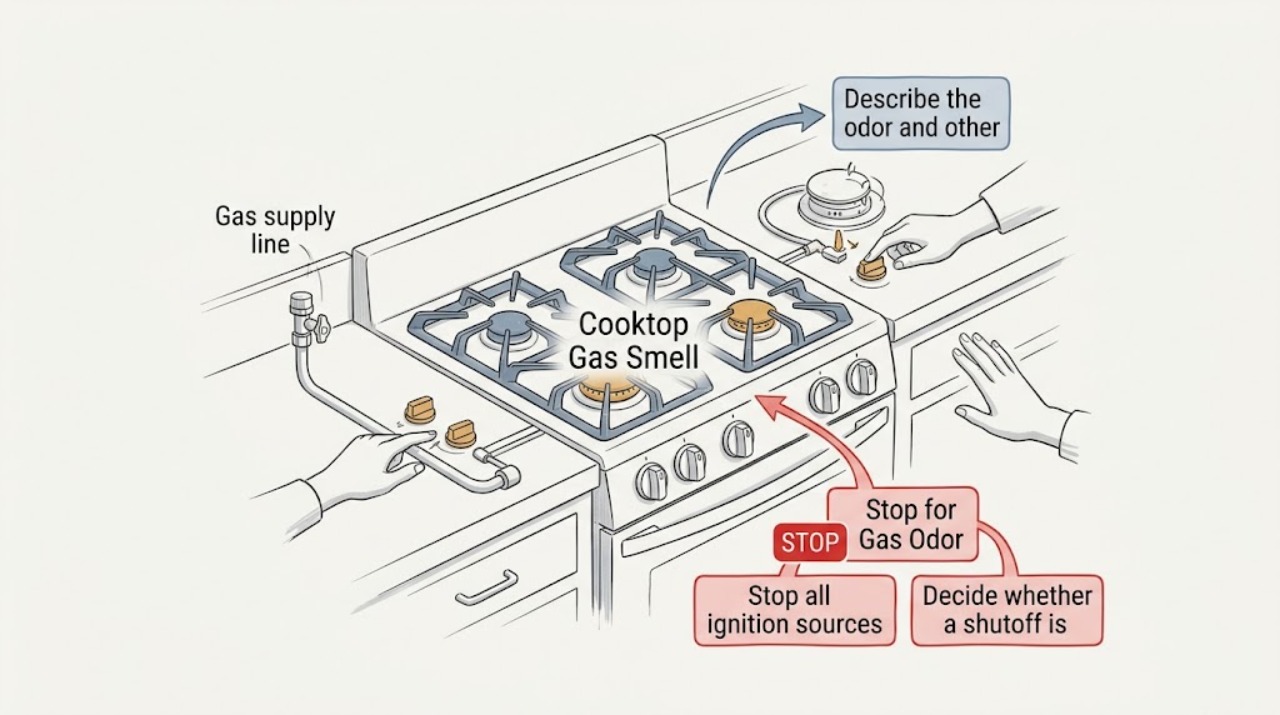
Stop all ignition sources and leave
Do not light a burner, strike a match, smoke, operate a light or other electrical switch, unplug an appliance, start a vehicle, or use a phone inside. Warn others as you leave if doing so does not delay evacuation. Move to a safe distance or an upwind location.
Expected result: Everyone is outside the affected area and no one is using a possible ignition source near the smell.
Next step: From outside or another safe location, contact the local gas supplier or emergency service and follow its instructions. Do not return until they say it is safe.
Why this matters
Why: A gas odor can indicate an unburned fuel release; a switch, flame, phone, motor, or plug can provide an ignition source. The first decision is to remove people and ignition sources, not to identify the burner.
-
Decide whether a shutoff is safely reachable
Do not search for a meter, valve, or leak. If the appliance shutoff or main gas valve is already directly and safely reachable on your exit path, with no flame, hissing gas, smoke, water, electrical hazard, or need to re-enter, turn it off only as instructed by the local gas authority. Otherwise leave it alone and evacuate.
Expected result: The valve was safely reachable and closed without delay, or reaching it would require approaching the smell, operating a switch, moving an appliance, or re-entering.
Next step: Report the suspected leak from a safe location regardless of whether a valve was closed. Do not reopen the valve or relight any appliance until the gas professional clears it.
Why this matters
Why: A safely closed valve can stop gas flow, but a valve search can expose someone to the leak or delay the emergency call. Do not move the cooktop or disturb a connection to reach a valve.
-
Describe the odor and other warning signs from safety
Once outside, tell the gas supplier or emergency service what was noticed without going back to verify it: rotten-egg or fuel odor, hissing or roaring, a burner that may have been left on, visible flame, smoke, or symptoms such as dizziness or headache. Do not rely on smell alone and do not return to look for bubbles or a source.
Expected result: There is a strong or persistent odor, hissing/roaring, visible fire, or anyone feels unwell; or the odor was brief and no other sign was noticed.
Next step: For fire, injury, or suspected uncontrolled release, request emergency assistance and keep everyone away. For any unexplained odor, follow the gas supplier's inspection instructions and do not use the cooktop until cleared.
Why this matters
Why: Strong odor, sound, visible fire, or symptoms can indicate a more urgent gas or combustion event. A brief odor still needs reporting because the absence of smell or sound does not prove the appliance or line is safe.
-
Record whether a burner was accidentally on without checking it again
From the account of someone who was already present, note whether any Whirlpool surface-burner control may have been turned on, whether a flame was visible, and whether the odor started during use or while the cooktop was idle. Do not return to the controls to confirm their position if gas odor remains.
Expected result: A burner may have been on and lit, a burner may have been on but unlit, or the cooktop was off when the odor appeared.
Next step: Give the timing and burner information to the gas supplier or technician. Do not relight, rotate controls through an ignition point, or assume that turning a knob later has made the appliance safe.
Why this matters
Why: Whirlpool says a slight odor can sometimes occur during use, but gas odor when the cooktop is not in use or after checking that no burner was accidentally on requires the leak response. An unlit burner can release gas without providing normal combustion.
-
After professional clearance, identify the fuel type and model
Only after the area is declared safe, record the Whirlpool model and whether the cooktop uses natural gas or LP gas from the rating label or installation documentation. Do not alter a regulator, supply line, conversion setting, or gas pressure.
Expected result: The model and fuel type are known, or the label and supply type remain uncertain.
Next step: Give the model and fuel information to Whirlpool support and a licensed gasfitter. If the fuel type is uncertain, leave the cooktop unused until it is confirmed.
Why this matters
Why: Whirlpool explains that natural-gas and LP configurations and their supply requirements differ; a mismatch or undocumented conversion can affect flame behavior and safety. Uncertainty is a reason for qualified inspection, not a reason to test another setting.
-
After clearance, inspect only visible burner-cap seating if instructed
If Whirlpool or the qualified technician says a user check is appropriate and there is no odor, inspect a cool, accessible surface burner for a cap that is visibly displaced, dirty, or not matched to its base. Do not remove parts near a gas smell, scrub a gas orifice, or spray cleaner into an igniter or burner opening.
Expected result: A cap is visibly misplaced or contaminated, or caps and burner bases look correctly matched and clean.
Next step: Follow only the exact Whirlpool manual's cold-cleaning and seating instructions, then have the appliance checked if odor, poor ignition, or abnormal flame returns. Do not use this check as a leak test.
Why this matters
Why: Whirlpool says correct cap placement and cleanliness help ignition and even flame behavior, but a cap issue does not explain every gas odor and cannot rule out a supply or valve leak.
-
Classify any flame or ignition symptom after clearance
If a qualified professional has declared it safe to operate for observation, record whether the flame is steady and appropriately colored, whether ignition is prompt, and whether clicking or odor continues. Stop immediately if the flame is yellow, sputtering, lifting, delayed, or accompanied by odor, smoke, or repeated clicking; do not keep trying to light it.
Expected result: The flame is stable and the ignition stops normally, or the flame is uneven/yellow, ignition is delayed, odor persists, or clicking continues.
Next step: For any abnormal flame, delay, odor, or continuing click, turn the appliance off if safe, leave it unused, and contact the gasfitter or Whirlpool support. Do not adjust pressure or remove the burner system.
Why this matters
Why: Whirlpool links excessively yellow flames, sooting, and incorrect gas supply or regulator conditions with a need to verify the installation. Queensland gas-safety guidance says an igniter that does not ignite within a few clicks or a flame that is not steady warrants a gasfitter.
-
Close the case only when the gas professional clears the appliance
Give the technician the model, fuel type, odor timing, burner-control history, valve status if safely closed, sounds, flame observations, and any photographs taken from a safe position. Do not resume use merely because the odor faded, the display looks normal, or a later burner lit.
Expected result: The gas supplier or licensed professional has inspected or cleared the supply and cooktop, or the cause remains unknown or the odor recurs.
Next step: Keep the cooktop off and arrange another qualified assessment for an unresolved or recurring odor. Follow the local authority's instructions before restoring gas or power.
Why this matters
Why: A temporary loss of odor does not prove that a valve, hose, regulator, ignition, or burner fault has been corrected. Professional clearance is the decision point for returning a gas cooktop to service.
Use your observations
Decision map
Find the observation that best matches what you see, then follow the next safe action.
-
PATH 01Safety boundary
What you see
Gas odor, hissing/roaring, visible fire, smoke, or anyone feels unwell
Do this next
Do not operate any switch, phone, flame, vehicle, or appliance in the area. Evacuate and call emergency help from outside or another safe location.
Why this path and its safety boundary
Safety stop: Do not return, search for the leak, or relight the cooktop until the authority gives an all-clear.
-
PATH 02Safety boundary
What you see
A gas shutoff is directly and safely reachable without approaching the hazard
Do this next
Close it only if this does not delay evacuation or require moving the cooktop; then report the suspected leak anyway.
Why this path and its safety boundary
Safety stop: Do not search for a valve, move appliances, or re-enter to shut gas off.
-
PATH 03Safety boundary
What you see
The odor is noticed while a burner is operating but disappears promptly after normal shutdown and a professional has found no fault
Do this next
Follow the exact Whirlpool manual and the professional's instructions; monitor only within the cleared operating boundary.
Why this path and its safety boundary
Safety stop: Treat any odor while idle, persistent odor, delayed ignition, abnormal flame, or repeated clicking as a suspected fault again.
-
PATH 04Safety boundary
What you see
A burner may have been left on or unlit when the odor began
Do this next
Report that history and keep the appliance unused until the gas supplier or licensed gasfitter confirms it is safe.
Why this path and its safety boundary
Safety stop: Do not return to rotate controls through an ignition point or attempt a relight.
-
PATH 05Safety boundary
What you see
The model or natural-gas/LP fuel type is unknown or may be mismatched
Do this next
Keep the cooktop off and have Whirlpool documentation and a licensed gasfitter confirm the model and supply configuration.
Why this path and its safety boundary
Safety stop: Do not change regulators, pressure, or conversion settings yourself.
-
PATH 06Safety boundary
What you see
After clearance, a cap is visibly displaced or contaminated but there is no odor
Do this next
Follow the exact model's cold-cleaning and cap-seating instructions; stop using the burner if ignition or flame remains abnormal.
Why this path and its safety boundary
Safety stop: Do not treat cap cleaning as a gas-leak test or perform it while an odor remains.
-
PATH 07Safety boundary
What you see
After clearance, the flame is yellow, sputtering, delayed, unstable, or the igniter keeps clicking
Do this next
Turn the burner off if safe, leave it unused, and contact a licensed gasfitter or Whirlpool support.
Why this path and its safety boundary
Safety stop: Do not adjust gas pressure, remove burner parts, or keep attempting ignition.
-
PATH 08Safety boundary
What you see
The odor recurs or its cause remains unexplained after a previous clearance
Do this next
Stop using the cooktop, evacuate if odor is present, and request another gas-supply/appliance assessment with the prior notes.
Why this path and its safety boundary
Safety stop: A fading odor or one successful start does not clear a recurring gas smell.
Helpful context
Understand the symptom
Treat an unexplained gas smell as an emergency
Whirlpool's own gas-cooktop guidance says not to try to light an appliance, touch an electrical switch, or use a phone in the building when gas is smelled and no burner has accidentally been left on. PHMSA gives the same core boundary: leave the area and call emergency help from a neighbor's house or another safe location. This article therefore starts with evacuation and reporting, not burner cleaning or leak hunting. Only shut a valve when it is already safely reachable and doing so does not delay leaving or create another hazard.
A slight odor while a burner is operating is not the same as an idle-cooktop leak
Whirlpool notes that a slight gas odor can sometimes be noticed while the cooktop is being used. That limited observation does not clear an odor when the cooktop is off, an odor that remains after all controls are off, a hissing sound, or an odor paired with an unlit burner, unusual flame, or ignition problem. Do not create a flame or turn a control on to compare smells. Let the gas supplier or qualified service professional make the safety determination.
Only inspect the burner after the area is declared safe
After the gas supplier, fire service, or qualified technician has cleared the situation, ask which appliance and supply checks are appropriate for the exact Whirlpool model and fuel type. Whirlpool's lower-risk model guidance includes correct natural-gas or LP supply information and properly seated, clean burner caps for ignition and flame quality. Gas-line pressure, regulator, valves, conversion, and internal ignition work are professional tasks; a burner cap that looks clean does not rule out a leak.
Only after diagnosis
Potential parts
- burner cap or burner head
Only relevant if professional clearance confirms a visibly damaged or incorrect burner component is causing poor ignition or an uneven flame, not an active gas leak.
Confirm the full Whirlpool model and fuel configuration before ordering; never remove or fit burner parts while gas odor is present. - gas ignition electrode or spark module
Only consider this after a qualified technician confirms an ignition fault and the gas supply, valve, cap, and burner arrangement are safe.
Model-specific identification and qualified installation are required; do not use a manual flame as a workaround. - gas valve or regulator
Only relevant if a licensed gasfitter confirms a valve or regulator fault or an approved fuel conversion issue.
Gas pressure and conversion work are professional tasks; do not order or adjust this component from the odor symptom alone.
When checks do not resolve it
Need a professional?
Report the model, fuel type, odor timing, whether a burner may have been on or unlit, sounds, flame observations, safe shutoff status, and any fire, smoke, or health symptoms. Make the call from outside or another safe location when gas is present.
Safety scope: Do not use a Whirlpool gas cooktop with unexplained or recurring gas odor, hissing, delayed ignition, unstable flame, smoke, fire, or continuing clicking until the local gas authority or qualified gasfitter has cleared it.
Common questions
FAQ
What should I do first if my Whirlpool cooktop smells like gas?
Do not light anything, operate a switch, unplug an appliance, use a phone inside, or look for the leak. Leave the area immediately. Only if a shutoff is already safely reachable without delay or hazard should you close it; call the gas supplier or emergency service from outside and do not return until cleared.
Can a slight gas smell while cooking be normal?
Whirlpool says a slight odor can sometimes be noticed while a cooktop is in use, but an odor when the cooktop is idle, after controls are off, or with hissing, delayed ignition, or an abnormal flame must be treated as a suspected leak or appliance fault.
Can I check the burner cap when I smell gas?
No. Do not return to inspect or clean a burner while gas odor is present. After the gas authority or qualified professional clears the area, Whirlpool's model instructions may allow a cold check of cap seating and cleanliness, but that does not replace a gas-leak assessment.
Why does the natural-gas or LP type matter?
Whirlpool identifies gas type, regulator, and supply conditions as relevant to flame height, color, sooting, and ignition. Do not change a regulator or conversion setting yourself; have the configuration confirmed by a licensed gasfitter using the exact model information.
Read the exact guide
Official sources
- Gas safetyPacific Gas and Electric Company · Utility natural-gas leak signs, evacuation, safe reporting, and shutoff guidance
- Range SafetyWhirlpool · Whirlpool gas-range safety warnings and qualified installation/service boundary
- Odors or SmellsWhirlpool Product Help · Whirlpool gas-cooktop odor, gas type, burner-cap, flame, and service guidance
- Recognizing and Responding to Pipeline EmergenciesU.S. Department of Transportation, Pipeline and Hazardous Materials Safety Administration · Natural-gas emergency recognition, evacuation, ignition-source avoidance, and safe reporting
Community feedback
Share a repair observation
Share a plain-text repair observation. Accepted observations are published automatically; this page may take a moment to update.