
On this page
Start here
Quick answer
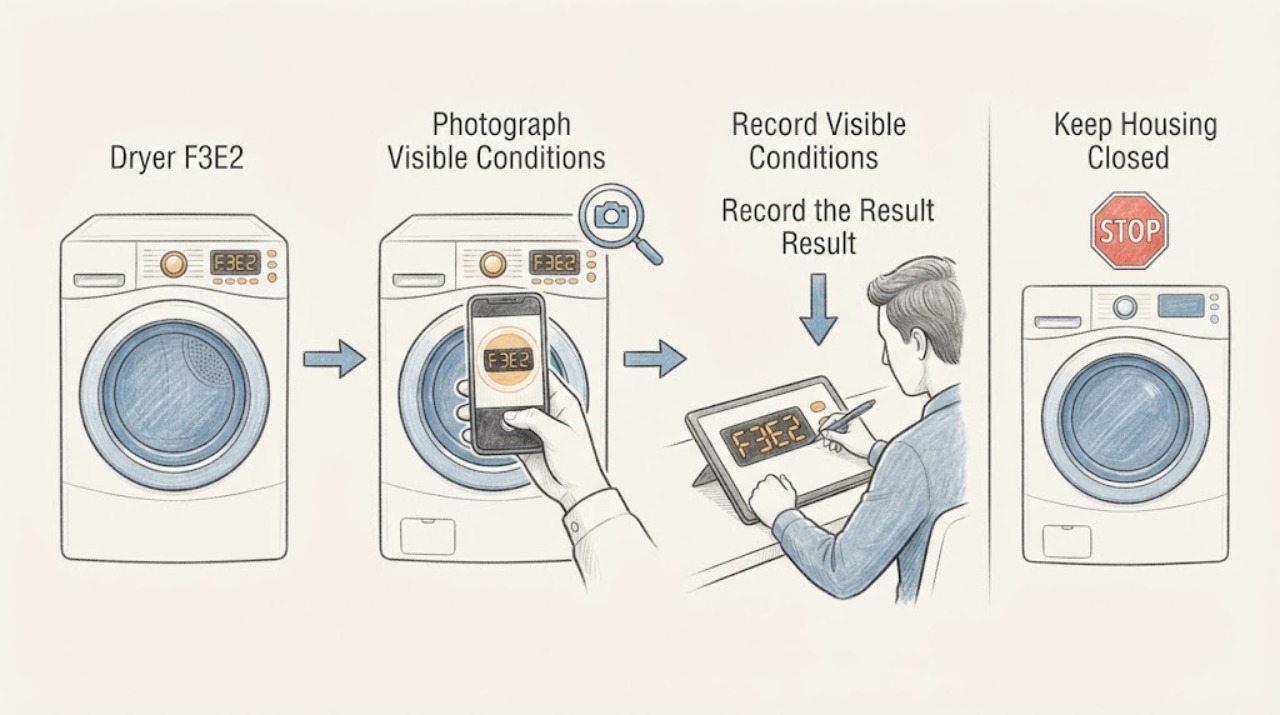
On a standalone Whirlpool dryer, F3E2 is documented as a moisture-sensor condition: five consecutive loads were dried without moisture-sensor data being registered. It is not a universal Whirlpool code, however. Whirlpool's all-in-one washer-dryer page uses F3E2 for a temperature-control sensor issue, and its stacked laundry-center washer page uses F3E2 for a pressure-sensor-switch issue. Before doing anything, confirm that the appliance is actually a standalone dryer, photograph the complete display, and record the model, market, cycle, load size, drum motion, heat behavior, and any odor or smoke. If there is smoke, a burning smell, abnormal heat, arcing, a damaged cord or outlet, or a repeated power trip, stop using the appliance and keep clear. If it is a standalone dryer with no hazard, check levelness and whether a very small or single-item load could have failed to touch the moisture sensors; use the exact model instructions. One documented Power clear or one-minute power cycle may be attempted only when safe. If F3E2 returns, stop and arrange qualified service rather than opening panels or choosing a sensor, control, or other part from the code alone.
Before you begin
Safety first
- Do not open panels, touch moisture-sensor strips or wiring, perform live measurements, bypass the door or thermal protection, run with panels removed, or repeatedly reset the dryer. Stop for smoke, burning odor, abnormal heat, sparks, damaged electrical parts, or a repeated trip.
Work through in order
Diagnostic checks
Use only checks that match the exact appliance or system and its official guide.
-
Check 1
Stop the dryer and observe from a safe position before pressing clear or restart. Photograph the complete display exactly as shown, including spaces and whether it alternates with another code. Record the full model and serial label, country or market, whether this is a standalone dryer, a washer-dryer combo, or a stacked laundry center, and whether it is gas or electric.
Expected result: The appliance is confirmed as a standalone dryer, the display is F3E2, the display is another or partial code, or the machine type/model/market cannot be confirmed.
Next step: Use only the manual or Product Help page matched to the complete model and platform. If the type or code remains uncertain, keep it off and arrange service rather than borrowing a meaning from another Whirlpool appliance.
Stop if: Do not enter diagnostics, open a console, or restore power solely to obtain a clearer code.
Why this matters
Why: Whirlpool's F3E2 meaning changes by platform. A standalone dryer page concerns moisture-sensor data, while Whirlpool's all-in-one washer-dryer and stacked washer pages attach different meanings to F3E2.
-
Check 2
With the dryer off, still, and free of any hazard, record what happened during the affected load without running another test: whether the drum turned, whether heat was present or unusually intense, whether the load was a single item or very small, which cycle was selected, and whether F3E2 appeared after several loads or immediately.
Expected result: The code followed five loads with no sensor result, a single or very small load, an Automatic cycle, a Timed Dry cycle, an inability to turn, abnormal heat, or an uncertain timing pattern.
Next step: Keep the timing and cycle record for the manual or technician. Do not repeatedly run loads to recreate the five-load condition, and do not infer a sensor or control failure from the display alone.
Stop if: Stop immediately for smoke, burning smell, sparks, abnormal cabinet or outlet heat, damaged wiring/cord, or a breaker that trips again.
Why this matters
Why: On the standalone-dryer path, the five-load history and load size are relevant to moisture-sensor contact. No drum motion, abnormal heat, or an immediate/uncertain code is not explained by the public moisture-sensor guidance and needs model-specific service.
-
Check 3
Check levelness from outside the idle dryer using a level on a stable cabinet edge or other suitable surface; do not remove panels or move a stacked unit. Also record whether the load was so small that clothes may not have contacted the moisture-sensor strips. Do not touch internal strips or wiring.
Expected result: The cabinet is visibly or measurably out of level, the unit is stacked or difficult to move safely, the load was a single item/very small, or the dryer appears level and the load was substantial.
Next step: If it is a freestanding dryer and an adjustment is plainly accessible without dismantling or lifting, follow the exact model installation instructions once. Otherwise leave leveling to service. For a standalone dryer, use a normal-size load and the exact manual's recommended cycle only if no hazard is present.
Stop if: Do not pull a stacked dryer, dismantle feet or panels, reach inside the drum housing, or perform a live sensor test.
Why this matters
Why: Whirlpool says levelness can affect clothing contact with the moisture sensors and that small loads may not make contact. A level machine with a normal load leaves the code unresolved; it does not prove a failed sensor.
-
Check 4
Only after the appliance is confirmed as a standalone Whirlpool dryer, the drum is empty or safely loaded, the floor and power connection are dry, and there is no smoke, odor, abnormal heat, spark, or repeated trip, perform the single reset documented on Whirlpool's F3E2 page: press Power once to clear, or use one safe one-minute power isolation/reconnection if the exact model permits it. If the page directs a check, use one monitored Time Dry attempt for no more than one minute.
Expected result: F3E2 clears and does not return during the one monitored attempt, F3E2 returns, another code appears, the drum does not turn, heat is abnormal, or a hazard appears.
Next step: Stop after this one attempt. Keep the dryer off if the code returns or any abnormal behavior appears, and provide the technician the model, market, cycle, load history, display photo, and reset result.
Stop if: Do not repeat resets, run unattended, operate with panels removed, bypass a door or thermal safety, or select a moisture sensor/control part from F3E2.
Why this matters
Why: A clear code after a plausible small-load or levelness issue is evidence that the operating condition may have contributed, not proof that the sensor or control is healthy. A returning code or abnormal operation requires service.
Use your observations
Decision map
Find the observation that best matches what you see, then follow the next safe action.
-
PATH 01Safety boundary
What you see
The appliance is a confirmed standalone Whirlpool dryer, F3E2 appeared after repeated loads, and there is no smoke, burning smell, abnormal heat, arcing, damaged electrical connection, or repeated trip.
Do this next
Check levelness and whether the affected loads were too small or single-item loads. Follow the exact model's load/cycle guidance and make no more than the one documented reset/check.
Why this path and its safety boundary
Why it matters: This matches Whirlpool's standalone-dryer moisture-sensor branch: the dryer did not register sensor data across five consecutive loads, but the code still does not identify a replaceable part.
Safety stop: Stop and arrange service if F3E2 returns, the dryer will not turn or heat normally, or the next step would require opening the cabinet.
-
PATH 02Safety boundary
What you see
The dryer was level with a normal load, F3E2 returns after the one permitted check, or the code appeared immediately without the documented repeated-load history.
Do this next
Keep the dryer off and arrange qualified Whirlpool appliance service. Supply the complete model, market, code photo, cycle and load history, drum/heat observations, and reset result.
Why this path and its safety boundary
Why it matters: The public guidance no longer separates a load-contact condition from an internal sensor, wiring, control, or model-specific issue. The code alone cannot select a sensor or control.
Safety stop: Do not keep running loads to reach a different result, enter service mode, make live measurements, or replace a part by elimination.
-
PATH 03Safety boundary
What you see
F3E2 is shown on a washer-dryer combination or a stacked laundry-center washer, or the product type cannot be confirmed from the label.
Do this next
Stop transferring the standalone-dryer instructions. Identify the exact model and market and use that platform's manual or Product Help page; keep the appliance off if it has abnormal heat, water, smoke, or electrical symptoms.
Why this path and its safety boundary
Why it matters: Whirlpool uses F3E2 differently outside the standalone-dryer page: its all-in-one page describes a temperature-control sensor issue and its stacked-washer page describes a pressure-sensor-switch condition.
Safety stop: Do not apply the moisture-sensor load advice, choose a dryer sensor, or use a dryer reset interval on a combo or washer platform unless its own manual says so.
-
PATH 04Safety boundary
What you see
The drum stops unexpectedly, heat is excessive or absent, smoke or burning odor appears, sparks/arcing occur, the cord or outlet is hot/damaged, or the breaker trips again.
Do this next
Stop using the dryer and keep clear. Isolate power only from a dry, safe position if that can be done without touching damaged equipment; use emergency help for active fire or dangerous smoke and qualified appliance/electrical service otherwise.
Why this path and its safety boundary
Why it matters: This is a fire or electrical safety branch, not a moisture-sensor troubleshooting opportunity.
Safety stop: No restart, unattended test, panel removal, bypass of door/thermal protection, or repeated breaker reset.
Helpful context
Understand the symptom
F3E2 is useful only after the machine type is identified. On Whirlpool's standalone dryer path, the code means that five consecutive loads produced no moisture-sensor data. The same code is not safe to copy across Whirlpool platforms: the opened all-in-one washer-dryer page describes a temperature-control sensor issue, while the stacked laundry-center page describes a pressure-sensor-switch condition. A missing model number therefore changes the first check: identify the product type and retrieve the exact manual before interpreting the display.
For a confirmed standalone dryer with no fire or electrical warning, the user-level clues are load contact and levelness, not an assumed failed sensor. Whirlpool's public dryer guidance says a very small or single-item load may not contact the moisture sensors and that an unlevel cabinet can interfere with contact. Correct only an obvious external condition, then allow one controlled reset/check. A returning code or any need to open the cabinet belongs with qualified service.
When checks do not resolve it
Need a professional?
Call qualified appliance service for a returning F3E2, abnormal drum or heat behavior, an unidentified platform/model, or any need to test the moisture-sensor circuit, control, harness, heater, motor, or internal cabinet. Use qualified electrical service when the cord, outlet, breaker, or household supply is implicated.
Safety scope: Do not open panels, touch moisture-sensor strips or wiring, perform live measurements, bypass the door or thermal protection, run with panels removed, or repeatedly reset the dryer. Stop for smoke, burning odor, abnormal heat, sparks, damaged electrical parts, or a repeated trip.
Have this ready
- Provide the complete Whirlpool model and serial label, market/country, standalone versus combo or laundry-center type, exact F3E2 display photo, whether the code was F3E2 or another spacing/order, number and size of preceding loads, selected cycle, levelness observation, drum and heat behavior, odor/smoke/power history, and the result of the one permitted reset/check.
Common questions
FAQ
Does Whirlpool dryer F3E2 mean the moisture sensor must be replaced?
No. Whirlpool describes the standalone-dryer code as five loads without moisture-sensor data and lists levelness and load contact as possible contributors. A returning code needs model-specific diagnosis; do not buy or replace a sensor or control from F3E2 alone.
Can I use the F3E2 dryer instructions on a Whirlpool washer-dryer combo?
Not automatically. Whirlpool's all-in-one washer-dryer page uses F3E2 for a temperature-control sensor issue, while its stacked laundry-center washer page uses F3E2 for a pressure-sensor-switch condition. Confirm the product type and full model first.
Why might a small load trigger F3E2?
Whirlpool says a very small load or a single item may not make enough contact with the internal moisture sensors for data to register. Treat that as a possible operating condition, not proof that the sensor is defective.
How many resets should I try?
Use at most the one reset/check documented for the exact standalone-dryer model and Whirlpool F3E2 page, and only when there is no fire, heat, electrical, or mechanical hazard. If F3E2 returns, stop instead of repeating cycles or entering diagnostics.
Read the exact guide
Official sources
- F3E2 Error Code - Product Help | WhirlpoolWhirlpool Corporation · Opened official Whirlpool stacked laundry-center washer page; used only to prevent transferring the standalone-dryer meaning to a washer platform.
- F3 E2 - Error Code - Dryer - Product Help | WhirlpoolWhirlpool Corporation · Opened official Whirlpool dryer Product Help page; it applies to the standalone-dryer path and offers United States and Canada service routes. The reader must still match the full model and market.
- F3E2 - Error Code - All-In-One Washer Dryer - Product Help | WhirlpoolWhirlpool Corporation · Opened official Whirlpool all-in-one washer-dryer page; used only to show that the same code is not transferable from a combo appliance to a standalone dryer.
- F3 E2 - Error Code - Commercial Dryer - Product Help | WhirlpoolWhirlpool Corporation · Opened official Whirlpool commercial-dryer page; it presents the same moisture-sensor and level/small-load path but is kept separate from household standalone dryers so commercial and household scope are not silently merged.
Community feedback
Share a repair observation
Share a plain-text repair observation. Accepted observations are published automatically; this page may take a moment to update.