
On this page
Start here
Quick answer
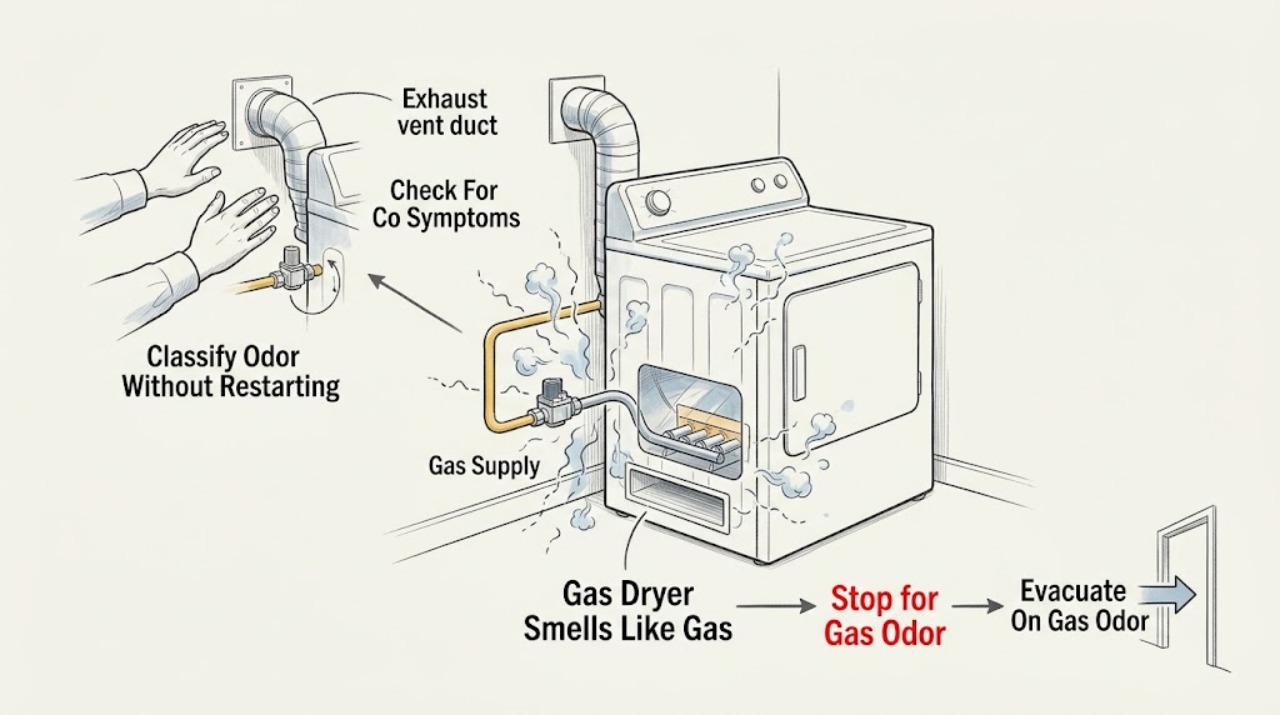
Treat a strong, persistent, or rotten-egg-like smell near a Whirlpool gas dryer as a possible gas leak or unsafe combustion event. Do not start or stop the dryer, touch light switches, use a phone inside, light a flame, or keep testing the smell. Leave the room or building with everyone, and from a safe location contact the gas supplier or emergency services; follow their instructions and do not re-enter until cleared. If the smell is actually smoke, hot lint, or a new-appliance oily odor, the dryer still stays off until the cause is identified. A qualified gas-appliance technician must inspect the dryer, gas connection, burner, and vent before reuse. A carbon-monoxide alarm, headache, dizziness, nausea, confusion, or breathing trouble is an immediate fresh-air and emergency boundary because CO has no smell.
Before you begin
Safety first
- The homeowner's role is to stop, evacuate, report, and document from a safe location. Gas-supply, connector, burner, combustion, vent, CO, and internal appliance checks require qualified personnel; the dryer stays out of service until cleared.
Work through in order
Diagnostic checks
Use only checks that match the exact appliance or system and its official guide.
-
Check 1
If the odor is strong, persistent, rotten-egg-like, present when the dryer is off, or accompanied by hissing, smoke, flame abnormality, or a gas alarm, stop and leave the area with all occupants without operating the dryer or nearby switches.
Expected result: From a safe location, record only whether the odor continues outside the appliance, whether anyone is symptomatic, and whether a gas or carbon-monoxide alarm sounded; do not go back to identify the source.
Next step: From outside or another location well away from the odor, contact the gas supplier or emergency services and follow their instructions. Keep people away and do not re-enter until cleared.
Stop if: Do not touch electrical switches, start an engine, use a phone inside, light a flame, operate the dryer, or attempt to ventilate by switching equipment while a gas odor is suspected.
Why this matters
Why: These signs are consistent with a possible gas leak, unsafe combustion, or carbon-monoxide hazard and cannot be safely differentiated by a homeowner inside the building.
-
Check 2
Once outside in fresh air, ask whether a CO alarm sounded or anyone has headache, dizziness, weakness, nausea, chest discomfort, confusion, shortness of breath, or unusual drowsiness; do not use smell to rule CO out.
Expected result: Record the alarm state and symptoms without returning indoors to inspect the dryer or reset the alarm.
Next step: Remain in fresh air and contact emergency services for an alarm or symptoms. Have the appliance and other fuel-burning equipment checked by qualified personnel before anyone uses them again.
Stop if: Do not re-enter to silence an alarm, locate its source, reset the dryer, or retrieve belongings until emergency responders give permission.
Why this matters
Why: CO is colorless and odorless, so symptoms or an alarm can indicate a life-threatening combustion hazard even when no gas odor is present.
-
Check 3
Only after the gas supplier or emergency responders have cleared the area, document when the odor was noticed and whether it was near the dryer, at the outdoor exhaust, on clothing, or throughout the room; do not restart the dryer to reproduce it.
Expected result: Classify the report as raw-fuel or rotten-egg odor, exhaust or combustion odor, burning lint or plastic, a first-use oily smell, or room fumes from recent painting, staining, or varnishing.
Next step: Give the timing, location, odor description, cycle state, and any alarm or symptom information to the gas supplier and qualified appliance technician; keep the dryer unused.
Stop if: Do not run an empty cycle, strike a match, sniff the connector or burner, spray liquid on fittings, or use a fan or switch to clear the room.
Why this matters
Why: A first-use oily odor or nearby finishing fumes can have a different source than fuel odor, but the distinction cannot justify a homeowner test while the appliance or vent is unverified. Persistent or unexplained odor remains a service condition.
-
Check 4
From a safe position and only after clearance, record the Whirlpool model and serial information, fuel type, cycle, whether the drum turned, and whether the odor appeared before ignition, during operation, at shutdown, or after the cycle.
Expected result: Note whether the dryer is definitely a gas model, whether the symptom repeats with the dryer off, and whether a display code, CO alarm, visible soot, or damaged vent is documented by responders or the technician.
Next step: Provide the identity and timeline to the gas supplier, qualified installer, or appliance service professional and follow their instructions for isolation and inspection.
Stop if: Do not pull the dryer forward, disconnect the flex connector, close or open a valve as an experiment, remove panels, or inspect the burner or flame.
Why this matters
Why: A gas model has a fuel supply and combustion system that require qualified diagnosis; timing helps the technician separate supply, burner, exhaust, and room-air causes without exposing the owner to a test.
-
Check 5
Ask qualified service to inspect the gas supply, shutoff and connector, valve and burner operation, combustion air, exhaust duct, termination, and surrounding fuel appliances before approving reuse; the homeowner should not perform this inspection.
Expected result: Record whether the professional found a supply or connection fault, abnormal combustion, a vent restriction or disconnection, a room-air source, or no fault after safe instrumented checks.
Next step: Follow the professional's written repair and clearance instructions. Do not use the dryer until all identified faults are corrected and the installation is declared safe.
Stop if: Do not adjust the gas regulator, bypass a safety control, alter the vent, use an unapproved connector, or accept a temporary odor-masking fix.
Why this matters
Why: The same odor can arise from different systems, and gas or combustion faults cannot be confirmed by visual inspection alone. A closed supply valve may explain no heat but does not explain away an odor or authorize testing.
-
Check 6
After qualified service has corrected the issue and explicitly cleared the appliance, follow the exact Whirlpool model instructions for a supervised return to service; do not make an independent test run.
Expected result: The professional should confirm the appliance, gas connection, combustion, vent discharge, and safety devices are operating normally and should state what to do if any odor, alarm, heat damage, or abnormal sound returns.
Next step: Use the dryer only as instructed, keep the vent and lint path maintained, and stop immediately if a gas odor, exhaust concern, smoke, scorching, alarm, or symptom returns.
Stop if: Do not resume use solely because the smell faded, the dryer still tumbles, or an alarm stopped; do not bypass a detector or safety device.
Why this matters
Why: A normal-looking first cycle does not prove a gas or CO hazard is resolved; clearance and documented service are the decision point.
Use your observations
Decision map
Find the observation that best matches what you see, then follow the next safe action.
-
PATH 01Safety boundary
What you see
A strong or persistent rotten-egg-like odor is present, the smell continues while the dryer is off, hissing is heard, or a gas alarm or responder identifies a leak.
Do this next
Do not operate switches or phones inside; leave with everyone and contact the gas supplier or emergency services from a safe location.
Why this path and its safety boundary
Why it matters: Treat this as a possible gas leak or fire/explosion hazard.
Safety stop: Do not light anything, start or stop the dryer, test a fitting, move the appliance, or re-enter until cleared.
-
PATH 02Safety boundary
What you see
A CO alarm sounds or anyone has headache, dizziness, weakness, nausea, confusion, shortness of breath, chest discomfort, or unusual drowsiness near the operating dryer.
Do this next
Move outside to fresh air, call emergency services, and do not re-enter or operate the dryer until responders and qualified service clear it.
Why this path and its safety boundary
Why it matters: CO may be present even without an odor and is an immediate health emergency.
Safety stop: Do not search for the CO source indoors or silence, reset, or relocate the alarm.
-
PATH 03Safety boundary
What you see
The odor is burning lint, plastic, or scorching, or clothing, cabinet, vent, or outlet is hot, smoky, or visibly damaged.
Do this next
Stop use, leave if smoke or fire is present, and arrange qualified appliance and vent inspection after the area is safe.
Why this path and its safety boundary
Why it matters: This indicates a fire or electrical/airflow hazard rather than a harmless fuel odor.
Safety stop: Do not restart, open a burning dryer, reach into the vent, or remove panels while hot or energized.
-
PATH 04Safety boundary
What you see
After the area is confirmed safe, the unit is new and the odor is a brief oily or semi-burning smell, or recent paint, stain, or varnish was used nearby without a raw-fuel odor.
Do this next
Follow the exact Whirlpool model guidance and ventilate only by safe, ordinary means after clearance; contact service if the odor persists or its identity is uncertain.
Why this path and its safety boundary
Why it matters: Whirlpool says a new dryer or nearby finishing work can produce temporary non-fuel odors, but this is not a license to ignore a gas-like, persistent, or worsening smell.
Safety stop: Do not run a test cycle when the odor might be fuel, when anyone feels unwell, or when the vent, gas connection, or appliance condition is unknown.
-
PATH 05Safety boundary
What you see
The smell is strongest at the outdoor exhaust or appears during operation, especially with soot, poor airflow, symptoms, or a blocked, disconnected, or altered vent.
Do this next
Keep the dryer off and have qualified service inspect the burner, combustion air, full exhaust path, termination, and other fuel appliances.
Why this path and its safety boundary
Why it matters: Combustion products or exhaust routing need professional assessment; smell alone cannot confirm safe operation.
Safety stop: Do not add a booster fan, change the vent, run without the approved vent, or use a homemade airflow or flame test.
Helpful context
Understand the symptom
A gas odor is not a normal dryer test result
Whirlpool gas dryers use fuel and therefore must be installed and serviced by qualified people. Its safety instructions treat a gas smell as a fire or explosion hazard: do not ignite an appliance, operate electrical switches, or use a phone in the building. Leave first and make the call from outside or another safe location. A short odor at the exhaust is not proof that the supply is safe, and a lack of odor does not rule out a leak.
Separate odor categories without running the dryer
A first-use dryer may have a temporary oily or semi-burning smell, and paint, stain, or varnish nearby can contaminate room air that the dryer pulls through the load. Those observations are different from a rotten-egg gas odor, a smell that persists when the dryer is off, a raw-fuel smell, or exhaust that makes people feel unwell. Do not use a test cycle, flame, switch, or homemade leak test to decide which category applies.
Exhaust and carbon monoxide require professional confirmation
A gas dryer must exhaust combustion products outdoors through an approved, unobstructed installation. Whirlpool warns against restricted or unsuitable venting, while CPSC explains that carbon monoxide cannot be detected by smell. If an alarm sounds or anyone has headache, dizziness, nausea, confusion, weakness, or breathing trouble, leave for fresh air and seek emergency help; do not return or restart the dryer until responders and a qualified technician say it is safe.
Do not open the gas path or burner cabinet
A technician needs to establish whether the source is the house gas supply, shutoff or connector, dryer valve or burner, combustion air, vent termination, or another fuel appliance. The homeowner should not move the dryer to reach a connector, spray a leak-check liquid, adjust a valve, remove panels, inspect a flame, or alter the vent while the odor or combustion concern is unresolved. Record observations from a safe location and keep the unit out of service.
Safety boundary
Stop conditions
- For any strong or persistent gas odor, do not operate electrical switches, use a phone inside, light a flame, start or stop the dryer, or perform a leak test; leave and call from a safe location.
- For a CO alarm or possible symptoms, move to fresh air and contact emergency services; do not re-enter or reuse the dryer until responders and qualified service give clearance.
- For smoke, fire, scorching, hot cabinet, damaged cord, arcing, or repeated electrical trips, stop use and keep away until the area and appliance are professionally assessed.
- Do not move the dryer, disconnect the gas connector, adjust valves or regulators, remove panels, inspect the burner, alter the vent, or bypass safety controls.
Only after diagnosis
Potential parts
- gas supply connector or shutoff component
Consider only when qualified service confirms a supply-side connector or shutoff fault after the area is safe.
Gas work and connector selection require the exact model, local code, and qualified installation; do not move or disconnect the dryer yourself. - gas valve, igniter, or burner assembly
Consider only after a qualified technician identifies an abnormal ignition, valve, or burner condition with safe instrumented testing.
Do not inspect flame, adjust fuel controls, or choose a component from an odor symptom alone; confirm exact model fit through service. - exhaust duct or termination component
Consider only when professional inspection finds a damaged, disconnected, blocked, or unsuitable exhaust path contributing to combustion or odor concerns.
Vent materials, routing, termination, and installation rules are model- and code-dependent; do not modify the vent as a home test. - combustion or safety-control component
Consider only when qualified service confirms a failed safety or combustion-control component after ruling out the room, supply, and vent.
Fuel-appliance safety parts require qualified diagnosis and exact model confirmation; never bypass a safety control.
When checks do not resolve it
Need a professional?
Use emergency gas or fire response for a suspected leak, alarm, or immediate danger. Use qualified appliance service after the area is cleared for any Whirlpool gas dryer odor, especially one that persists, returns, or involves exhaust, burner, connection, vent, smoke, or heat damage.
Safety scope: The homeowner's role is to stop, evacuate, report, and document from a safe location. Gas-supply, connector, burner, combustion, vent, CO, and internal appliance checks require qualified personnel; the dryer stays out of service until cleared.
Have this ready
- Provide the Whirlpool model and serial information, fuel type, exact odor description and location, whether the dryer was on or off, cycle and timing, outdoor exhaust observations, alarms or symptoms, visible soot or damage, and any responder or technician findings.
Common questions
FAQ
Is a gas smell from a Whirlpool dryer normal?
A strong, persistent, or rotten-egg-like odor is not a normal test result. Treat it as a possible leak, leave without operating switches or the dryer, and call from a safe location. Whirlpool separately describes a temporary oily or semi-burning odor on some new dryers, but uncertainty still requires service before use.
What should I do if I smell gas near my Whirlpool dryer?
Do not start or stop the dryer, touch electrical switches, use a phone inside, or light a flame. Clear the area, leave, and contact the gas supplier or emergency services from outside or another safe location. Do not re-enter until cleared.
Can I run an empty cycle to see whether the smell goes away?
No when the odor could be fuel, persists, returns, or is unexplained. A test cycle can create ignition and exposure risk. Have the gas connection, burner, combustion, and vent checked by qualified service first.
What if the smell is strongest at the dryer vent?
Keep the gas dryer off and have qualified service inspect combustion and the complete exhaust path. Do not change the vent, add a fan, run without the approved vent, or assume outdoor odor proves indoor operation is safe.
Can carbon monoxide smell like gas?
No smell can reliably detect carbon monoxide; it is colorless and odorless. If a CO alarm sounds or anyone has headache, dizziness, nausea, confusion, weakness, or breathing trouble, move outside and contact emergency services. Do not reuse the dryer until cleared and serviced.
What information should I give the technician?
Give the exact Whirlpool model, fuel type, odor description and location, whether the dryer was on or off, cycle and timing, outdoor exhaust observations, any alarm or symptoms, visible soot or heat damage, and what the gas supplier or responders observed.
Read the exact guide
Official sources
- Removing Odors or Smells - DryerWhirlpool Product Help · Whirlpool dryer odor guidance; it does not replace gas-emergency instructions for a fuel odor.
- Carbon Monoxide Poisoning BasicsCenters for Disease Control and Prevention · CDC public-health guidance for suspected CO exposure.
- Checking the Gas Supply and the Shutoff ValveWhirlpool Product Help · Whirlpool gas-dryer product assistance; users should use the exact installation instructions and qualified service for gas work.
- Recognizing and Responding to Pipeline EmergenciesU.S. Department of Transportation, Pipeline and Hazardous Materials Safety Administration · Federal natural-gas emergency guidance applicable to suspected odorized gas; local emergency and utility instructions also apply.
- Carbon Monoxide Fact SheetU.S. Consumer Product Safety Commission · CPSC consumer safety guidance for fuel-burning appliances and CO alarms.
- Dryer SafetyWhirlpool · Whirlpool dryer installation instructions; exact model instructions and local codes take precedence.
Community feedback
Share a repair observation
Share a plain-text repair observation. Accepted observations are published automatically; this page may take a moment to update.