
On this page
Start here
Quick answer
First separate a completely blank Whirlpool gas oven from one whose display works but will not start. With the oven cool, check the display, control lock, selected mode, closed door, and any visible error message using the model manual. A gas oven still needs electricity for its controls and ignition, and the oven gas supply or igniter can fail even when surface burners work. Do not move the range, manually light the oven, look for a gas leak, or open the appliance. If you smell gas, hear escaping gas, see a flame or smoke, or the breaker trips again, leave the appliance off and get qualified help.
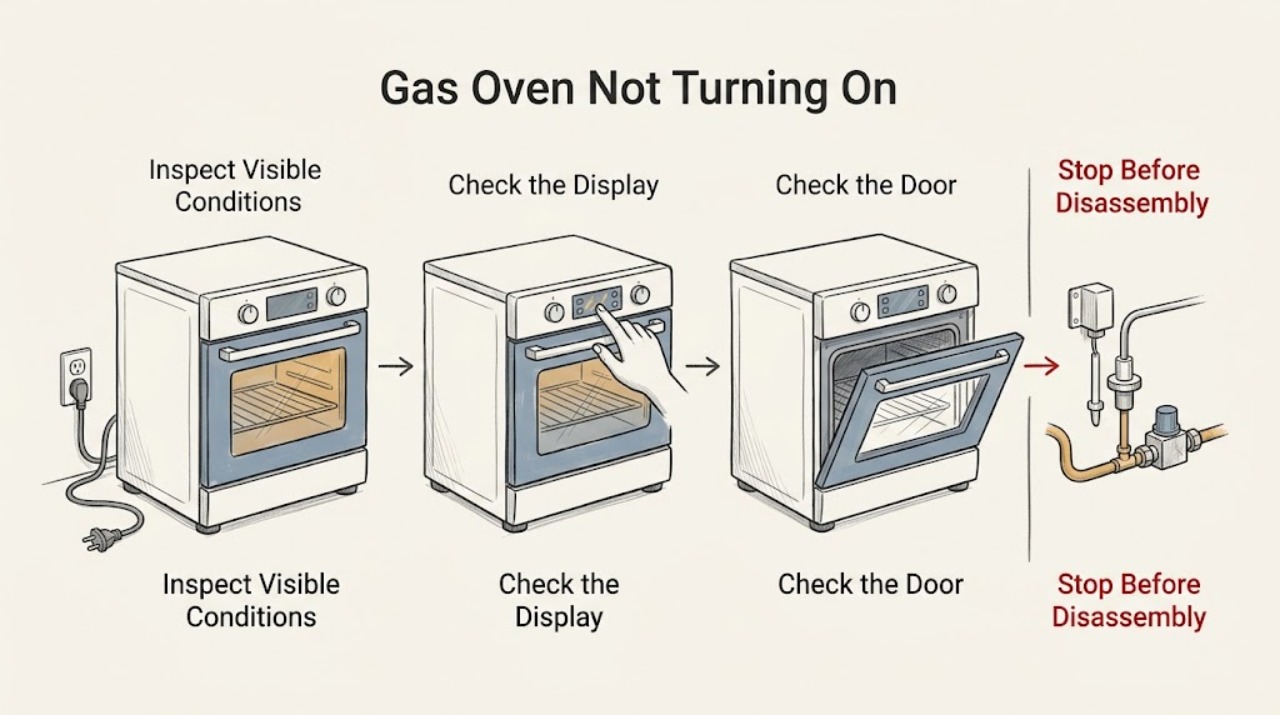
Work through in order
Diagnostic checks
Use only checks that match the exact appliance or system and its official guide.
-
Check 1
With the oven cool and no gas odor, look at the display and interior light without starting a cycle; note whether the display is blank, dim, showing a message, or responding to controls.
Expected result: Nothing lights or responds, or the display works and accepts input but the oven will not begin.
Next step: For a blank display, go to the dry, external power check. For a responsive display, record the exact message and continue with the control and door checks; do not repeatedly start the oven.
Why this matters
Why: A blank or dim display makes a power or control supply issue more likely. A responsive display moves the diagnosis toward lockout, settings, door, gas, ignition, or a model-specific fault.
-
Check 2
Read the panel for a lock indicator, delayed-start or timer state, Sabbath or other special mode, and an error message; compare the displayed state with the Whirlpool manual for the exact model.
Expected result: A lock or special mode is shown, an error returns, or the controls appear normal with no message.
Next step: If the manual confirms a normal unlock or mode-cancel action, perform that one documented control action. If an error returns or the state is unclear, preserve the code and request service instead of trying unrelated key combinations.
Why this matters
Why: A control lock can prevent keypad commands, while a delayed or special mode can make an otherwise powered oven appear not to start. A recurring error needs model-specific interpretation rather than a guessed code meaning.
-
Check 3
Confirm the selected cooking mode, temperature entry, Start command, and fully closed door from the front of the appliance; also note whether stored items or a liner could visibly interfere with the burner area without removing anything that requires disassembly.
Expected result: The oven was waiting for Start, a lock or timer was active, the door is not fully closed, or the controls and door are normal.
Next step: Correct only the plainly visible setting or close the door, then make one normal start attempt if there is no safety warning. If it still does not start, keep it off and proceed to the power and fuel-supply evidence.
Why this matters
Why: Some Whirlpool controls do not begin a function until the required command is entered, and an open door or obstruction can prevent a heating function on applicable models. Normal controls and door position make a component or supply fault more likely.
-
Check 4
From a dry position, inspect only the accessible plug, outlet face, and household breaker area for obvious loss of power or visible damage; do not touch wet, hot, discolored, sparking, or damaged electrical parts.
Expected result: The display is dead and another household event suggests lost power, the outlet or cord shows damage, the breaker has tripped, or the external power view is normal.
Next step: If everything is dry and undamaged, follow the model manual for at most one ordinary reset; if the breaker trips again, stop. If there is wetness, heat, burning odor, arcing, or damage, do not touch it and call a qualified electrician or appliance technician.
Why this matters
Why: A gas oven still needs electricity for controls and ignition. Visible damage or a breaker that will not remain on can indicate an electrical fault rather than a gas fault.
-
Check 5
Without moving the range or touching gas fittings, check whether the home's gas service is known to be available and whether a plainly visible appliance shut-off appears closed; do not change an uncertain valve position and do not test with a flame.
Expected result: The gas service is interrupted, a visible appliance shut-off appears closed, the cooktop works but the oven does not, or there is no reliable external gas evidence.
Next step: If the position is uncertain or the range would need to move, leave it alone and request a qualified appliance service visit. If gas service is interrupted, follow the utility's instructions; never manually ignite the oven to compensate.
Why this matters
Why: Whirlpool documents that some ranges have a regulator shut-off that can stop gas to the oven while surface burners still work. A normal-looking external view cannot rule out an internal valve, igniter, regulator, or pressure fault.
-
Check 6
Record the exact symptom sequence without another start attempt: display state, selected mode, whether surface burners work, clicking or silence, gas odor, error text, recent cleaning or installation, and whether the breaker has tripped.
Expected result: There is no odor or damage and the same no-start symptom remains, or there is gas odor, delayed ignition, abnormal flame, smoke, repeated clicking without ignition, or repeat breaker operation.
Next step: For the stable pattern, schedule a qualified Whirlpool appliance service visit with the model and observations. For any gas or electrical danger sign, stop immediately, leave the area if needed, and contact emergency or qualified help from a safe location.
Why this matters
Why: A stable no-start pattern needs model-specific ignition, safety-valve, control, or supply diagnosis. Odor, delayed ignition, abnormal flame, smoke, or electrical symptoms can make continued operation unsafe.
Use your observations
Decision map
Find the observation that best matches what you see, then follow the next safe action.
-
PATH 01Next step
What you see
The display and controls are completely dead.
Do this next
Use only the dry external power observations and the model manual. Stop for visible damage or a repeated breaker trip and arrange electrical or appliance service.
Why this path and its safety boundary
Why it matters: Power delivery or the oven control supply is more likely than a gas-only ignition symptom.
-
PATH 02Next step
What you see
The display is lit but shows a lock, timer, special mode, or an unresponsive control.
Do this next
Use the exact model manual for one normal unlock or mode-cancel action. A recurring error or unresponsive panel needs service.
Why this path and its safety boundary
Why it matters: The control state can block an otherwise healthy oven from starting.
-
PATH 03Next step
What you see
Surface burners operate but the oven will not start or heat.
Do this next
Do not move the range or manually light the oven. Record clicking, silence, odor, and error behavior and request qualified appliance service.
Why this path and its safety boundary
Why it matters: The oven can have a separate regulator shut-off, igniter, safety valve, or control path; working surface burners do not prove all oven conditions are normal.
-
PATH 04Next step
What you see
There is gas odor, escaping-gas sound, delayed ignition or abnormal flame, smoke, arcing, burning odor, hot or wet electrical equipment, or a repeated breaker trip.
Do this next
Do not operate switches, light a match, move the range, reset the breaker again, or search for the leak. Leave if needed and contact emergency services, the gas supplier, a qualified electrician, or qualified appliance service from a safe location.
Why this path and its safety boundary
Why it matters: Continuing to operate or investigate can create fire, explosion, shock, or carbon-monoxide risk.
Helpful context
Understand the symptom
Start by identifying what not turning on means
A blank display and a display that responds but never starts are different faults. A blank display points first to household power, the connection, or the control. A responsive display points toward the selected control state, door, gas path, ignition sequence, or a model-specific fault. If the cooktop works but the oven does not, that does not prove the oven side is receiving gas or that its igniter is healthy.
Keep gas and electrical checks external
Only observe controls and components that are plainly visible without moving the range or removing a cover. A Whirlpool gas range can have a shut-off at the regulator as well as the home's main gas valve, but the connector and gas train are not homeowner inspection or repair points. Never use a match or another flame to test ignition or a suspected leak.
When the simple branch ends
If power, controls, door position, and the documented external conditions are normal, stop troubleshooting and request appliance service. Igniter, safety-valve, wiring, control, and gas-pressure diagnosis requires model-specific procedures and qualified handling.
Safety boundary
Stop conditions
- If you smell gas, hear gas escaping, see delayed ignition or an abnormal flame, do not light anything, operate electrical switches, move the range, or try another start. Leave the area and contact emergency or gas-safety help from a safe location.
- Stop for smoke, burning odor, arcing, a hot or wet plug or outlet, visible cord damage, or a breaker that trips again. Do not repeatedly reset the breaker or touch electrical parts; use qualified help.
- Do not remove panels, reach into the burner or gas train, manually ignite the oven, use a flame to find a leak, adjust a regulator, or move the appliance to inspect its connector.
Only after diagnosis
Potential parts
- gas oven igniter
Consider this part only if a qualified diagnosis identifies an igniter fault for the exact oven model; a no-start symptom alone does not identify the part.
Confirm the model number and manufacturer fit information before ordering, and have gas or electrical replacement work handled according to the model service procedure. - oven safety valve
Consider this part only after qualified testing identifies a failed oven safety valve and rules out the control, igniter, supply, and wiring.
Do not infer compatibility from appearance; confirm the exact model and have a qualified technician handle gas-system work.
When checks do not resolve it
Need a professional?
Request qualified Whirlpool appliance service when the oven remains dead or will not start after the documented control and safe external power checks, when the cooktop works but the oven does not, when an igniter or safety-valve fault is suspected, or when an error returns. Use emergency gas or electrical help for odor, escaping gas, smoke, arcing, burning odor, wet electrical equipment, or repeated breaker operation.
Common questions
FAQ
Why does a Whirlpool gas oven need electricity if it uses gas?
The controls and ignition system still require electrical power. A blank display or loss of power can therefore prevent a gas oven from starting even when gas is available.
Why do the Whirlpool cooktop burners work while the oven does not?
The oven may have a separate regulator shut-off, igniter, safety valve, or control path. Working surface burners do not prove that the oven ignition and gas path are healthy.
Can I light the Whirlpool gas oven with a match?
Do not improvise a manual ignition. Check the exact owner manual and use qualified service; never use a flame to test a suspected gas leak or an oven that fails to ignite.
Read the exact guide
Official sources
- Oven Not Working - Cooktop Working - ClickingWhirlpool Product Help · Whirlpool range models covered by the product-help article; use the exact owner manual for model-specific controls.
- Nothing Is Working - No Power - Wall OvenWhirlpool Product Help · Whirlpool wall-oven product-help guidance used for control and power-state principles; gas-range layouts vary by model.
- What to do if your gas oven is not heatingWhirlpool · Whirlpool residential gas oven guidance; exact controls and procedures vary by model.
- Certain Older Gas Connectors May Be DangerousU.S. Consumer Product Safety Commission · General U.S. consumer gas-appliance safety; emergency procedures and local contacts vary.
- Locked, Lock or Loc - RangeWhirlpool Product Help · Whirlpool range models that display a lock message; key names and behavior vary by model.
Community feedback
Share a repair observation
Share a plain-text repair observation. Accepted observations are published automatically; this page may take a moment to update.