
On this page
Start here
Quick answer
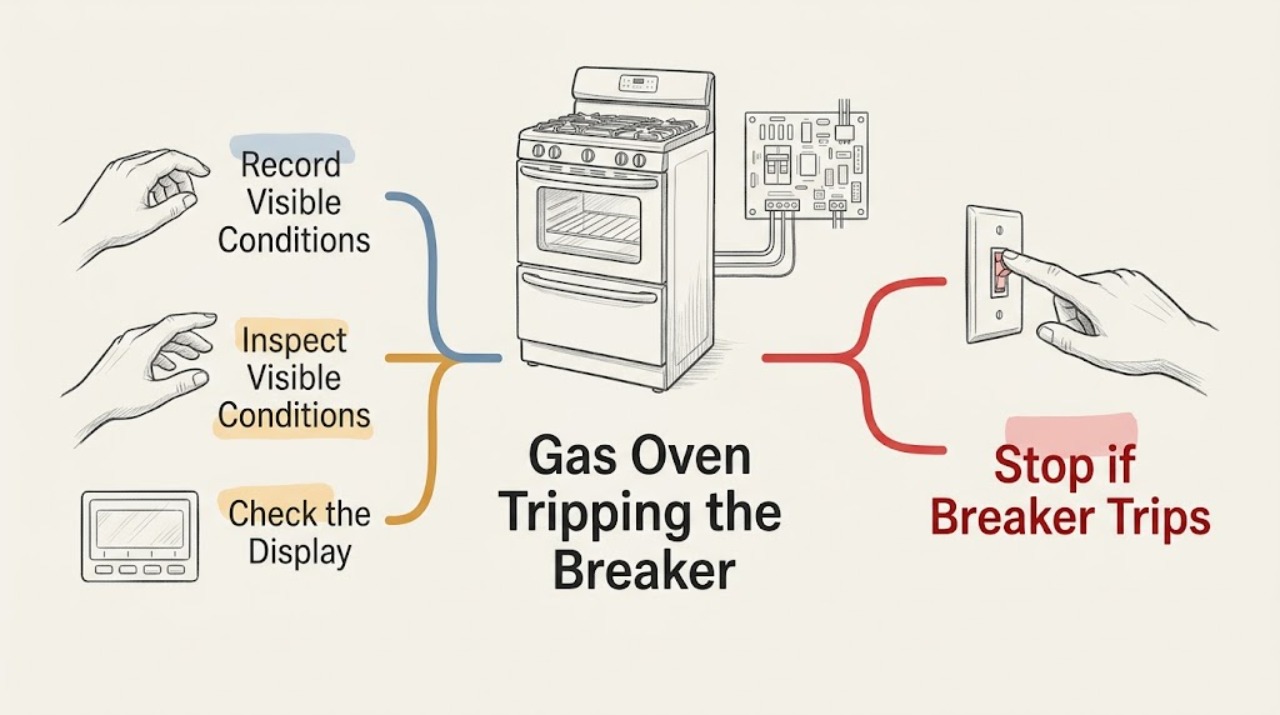
Treat a Whirlpool gas oven that trips a breaker as an electrical fault until a qualified person identifies the cause. Record whether it happens when the display wakes, when Bake or Broil starts, when an igniter clicks, or during an active cycle. Do not keep resetting the breaker, use an extension cord, open the range, or take live electrical readings. If there is smoke, a burning smell, a hot or discolored plug or outlet, water near the appliance, sparks, an unusual flame, a gas odor, or a carbon-monoxide alarm, stop using the oven immediately and follow the appropriate emergency or qualified-service path.
Work through in order
Diagnostic checks
Use only checks that match the exact appliance or system and its official guide.
-
Check 1
Stop the oven and write down exactly when the breaker trips: immediately when power is restored, when the display or controls wake, at Bake or Broil start, during ignition, after a fan begins, or after the oven has been running. Do not reset it repeatedly to collect more examples.
Expected result: The trip is immediate, tied to one cooking mode or ignition stage, or occurs only after the oven has warmed or run for a while.
Next step: Keep the range off after a repeat trip. Give the technician the exact mode, timing, display behavior, and whether the cooktop was operating at the same time.
Why this matters
Why: Timing helps a technician separate a supply or wiring event from a mode-specific control, ignition, fan, or heat-related fault, but it does not prove which part failed.
-
Check 2
From a dry position, inspect only the accessible plug, cord, receptacle, and nearby wall area without pulling the range out or removing a cover. Look for scorching, melted plastic, looseness, water, or a warm or discolored connection; do not touch a damaged connection.
Expected result: The plug, receptacle, or cord looks damaged, feels unusually warm, is wet, or appears normal from the outside.
Next step: If there is damage, heat, water, or a burning smell, leave the breaker in its safe state and obtain qualified electrical help. Do not use an adapter or extension cord and do not open the electrical panel.
Why this matters
Why: Visible or heat-related damage can indicate a supply-side defect or a poor connection and must not be tested by running the oven. A normal exterior view does not clear internal wiring or controls.
-
Check 3
Check the surrounding area for recent spill, cleaning liquid, steam, or water that could have reached the plug or controls. Keep the appliance off and do not spray cleaner into openings; do not move the range across a wet floor.
Expected result: There is moisture near the base, cord, receptacle, controls, or floor, or the area is dry and the trip has no visible environmental trigger.
Next step: For any moisture near electrical equipment, keep away from the area until it is safe and have the supply and appliance assessed. Do not restore power to see whether moisture was the cause.
Why this matters
Why: Water and electricity create a shock risk and can produce a leakage trip. Dry surroundings do not rule out an internal fault, especially when the trip repeats at a consistent oven stage.
-
Check 4
Without starting the oven, note whether there is a gas odor, an unusual flame, delayed ignition, a loud ignition event, smoke, or a carbon-monoxide alarm. Do not turn knobs, create a flame, operate electrical switches near a suspected gas leak, or inspect the gas train.
Expected result: There is no gas symptom, or there is gas odor, abnormal flame, delayed ignition, smoke, or an alarm.
Next step: For gas odor, smoke, abnormal flame, delayed ignition, or a carbon-monoxide alarm, stop using the appliance, leave the area as appropriate, and contact the local gas emergency service or fire service from a safe location. Do not return to test it.
Why this matters
Why: A breaker event plus a gas or combustion symptom is not a routine electrical reset problem. The appliance may have separate electrical and gas hazards, and the gas symptom takes priority.
-
Check 5
If there is no smoke, odor, water, visible damage, or other immediate hazard, compare the breaker event with other appliances on the same circuit without changing wiring or adding a load. Do not repeatedly reset the breaker; a single reset is only appropriate when the installation manual and local safety conditions permit it.
Expected result: The breaker trips again immediately, trips only when the oven is selected, or does not trip when the oven remains unused.
Next step: If it trips again, leave the oven disconnected from use and call a qualified electrician and appliance technician as appropriate. Do not bypass the breaker, substitute a larger protective device, use an extension cord, or open the range.
Why this matters
Why: A repeat trip indicates an unresolved electrical problem, while a mode-specific trip gives the appliance technician a useful symptom. A breaker that stays set while the oven is unused does not prove the oven is safe to operate.
Use your observations
Decision map
Find the observation that best matches what you see, then follow the next safe action.
-
PATH 01Next step
What you see
The breaker trips immediately or trips again after a reset.
Do this next
Keep the gas oven off and have a qualified electrician assess the circuit and a qualified appliance technician assess the range. Do not perform another reset test.
-
PATH 02Next step
What you see
The trip happens when Bake, Broil, ignition, a fan, or another specific oven mode starts.
Do this next
Record that stage and leave the appliance off. A mode-specific electrical, control, igniter, valve, or fan fault needs model-specific professional diagnosis; do not open the range.
-
PATH 03Next step
What you see
The outlet, plug, cord, or nearby surface is hot, wet, loose, scorched, melted, or discolored.
Do this next
Do not touch the damaged connection or pull the range out. From a dry safe position, isolate power only if that can be done without contact with the hazard, then call a qualified electrician.
-
PATH 04Next step
What you see
There is gas odor, delayed ignition, an unusual flame, smoke, a loud combustion event, or a carbon-monoxide alarm.
Do this next
Stop using the appliance and leave the area as appropriate. Avoid flames and electrical switches near a suspected leak, and contact local emergency gas or fire help from a safe location. Do not return for another test.
-
PATH 05Next step
What you see
The breaker has not tripped again, but the oven has lost its display, behaves unpredictably, or the cause remains unknown.
Do this next
Do not treat the absence of another trip as a repair. Keep the range out of use and provide the model, event timing, breaker behavior, and external observations to qualified service.
Helpful context
Understand the symptom
Why a gas oven can trip an electrical breaker
Gas provides the cooking heat, but the range may still use electricity for the display, controls, electronic ignition, valves, lights, fans, and other model-specific functions. The timing of the trip matters: a trip as soon as power returns points to the supply side or an internal short, while a trip when Bake, Broil, or ignition begins narrows the event to a stage that needs professional diagnosis. Do not infer a failed part from the timing alone.
Do not confuse a normal ignition sound with an electrical trip
A Whirlpool gas-oven manual may describe brief clicks, snaps, pops, or a whoosh during burner ignition as normal operating sounds, but a breaker trip is not a normal outcome. A gas odor, delayed ignition, an unusual flame, or a burner that does not shut down changes the situation to a gas-safety stop. Keep the door closed unless evacuation guidance requires otherwise, and do not relight or repeatedly test the appliance.
The safe boundary
The homeowner checks in this guide are limited to recording the event and looking at accessible external conditions without opening electrical covers. A breaker, outlet, power cord, control, igniter, wiring fault, or gas component can require different qualified trades. The right handoff is more useful than a sequence of resets that can hide a developing fault.
Safety boundary
Stop conditions
- Stop immediately for smoke, flames, sparks, arcing, a burning or melting smell, a hot or discolored plug or outlet, a damaged cord, or repeated breaker operation.
- Stop and leave the area as appropriate for gas odor, delayed ignition, an unusual flame, a loud combustion event, or a carbon-monoxide alarm; contact local emergency gas or fire help from a safe location.
- Do not repeatedly reset the breaker, bypass protective devices, substitute a larger breaker, use an extension cord or adapter, open the range, or take live electrical readings.
- Do not touch electrical equipment from water, pull the range across a wet floor, or restore power to test whether moisture or a gas symptom has cleared.
When checks do not resolve it
Need a professional?
Call a qualified electrician for a breaker that trips again, a hot or damaged connection, suspected wiring fault, or circuit concern. Call a qualified Whirlpool appliance technician for a mode-specific trip or an oven that remains unreliable. Treat gas odor, smoke, flame, or a carbon-monoxide alarm as an urgent safety event.
Common questions
FAQ
Why does a gas oven trip a breaker if gas supplies the heat?
The gas burner may supply heat, but the oven can still use electricity for controls, ignition, valves, lights, and fans. A breaker event should be treated as an electrical fault until a qualified person finds the cause.
Can I reset the breaker once?
Only if there is no smoke, odor, water, heat, visible damage, or other hazard and the installation guidance permits it. If it trips again, stop using the oven and do not keep resetting it; arrange qualified electrical and appliance service.
What if the breaker trip happens with a gas smell?
Stop using the oven, avoid flames and nearby electrical switches, leave the area as appropriate, and contact local emergency gas or fire help from a safe location. Do not return to relight or test the oven.
Read the exact guide
Official sources
- Oven Not Working - Cooktop Working - ClickingWhirlpool Product Help · Whirlpool gas ranges with a working cooktop and a clicking or non-working oven; exact model instructions take precedence.
- Appliance Safety TipsElectrical Safety Foundation International · General electrical safety: repeated breaker trips, damaged cords or plugs, water near electricity, and qualified repair boundaries.
- Fuse and Breaker BreakdownElectrical Safety Foundation International · General guidance that frequent breaker trips indicate a problem requiring qualified electrical inspection.
- What to Do If Your Gas Oven Is Not HeatingWhirlpool · Whirlpool residential gas ovens; electrical connection, breaker behavior, gas connection, igniter, and model-manual boundaries.
Community feedback
Share a repair observation
Share a plain-text repair observation. Accepted observations are published automatically; this page may take a moment to update.