
On this page
Start here
Quick answer
When a Whirlpool gas oven is not heating, first identify whether the display, gas supply, and ignition sequence are normal; do not assume a cold oven proves that one particular part failed. Record the exact model, cavity, mode, temperature setting, and any complete error display. With no hazard signs, make only the safe checks supported by the exact Whirlpool manual: confirm the mode and door, check accessible power and gas-supply states without moving the range, and use one documented reset only when the matching guidance permits it. Gas odor, a delayed whoosh or boom, abnormal flame, smoke, a carbon-monoxide alarm, arcing, uncontrolled heat, or repeated trips means stop immediately and use qualified gas, appliance, electrical, or emergency help.
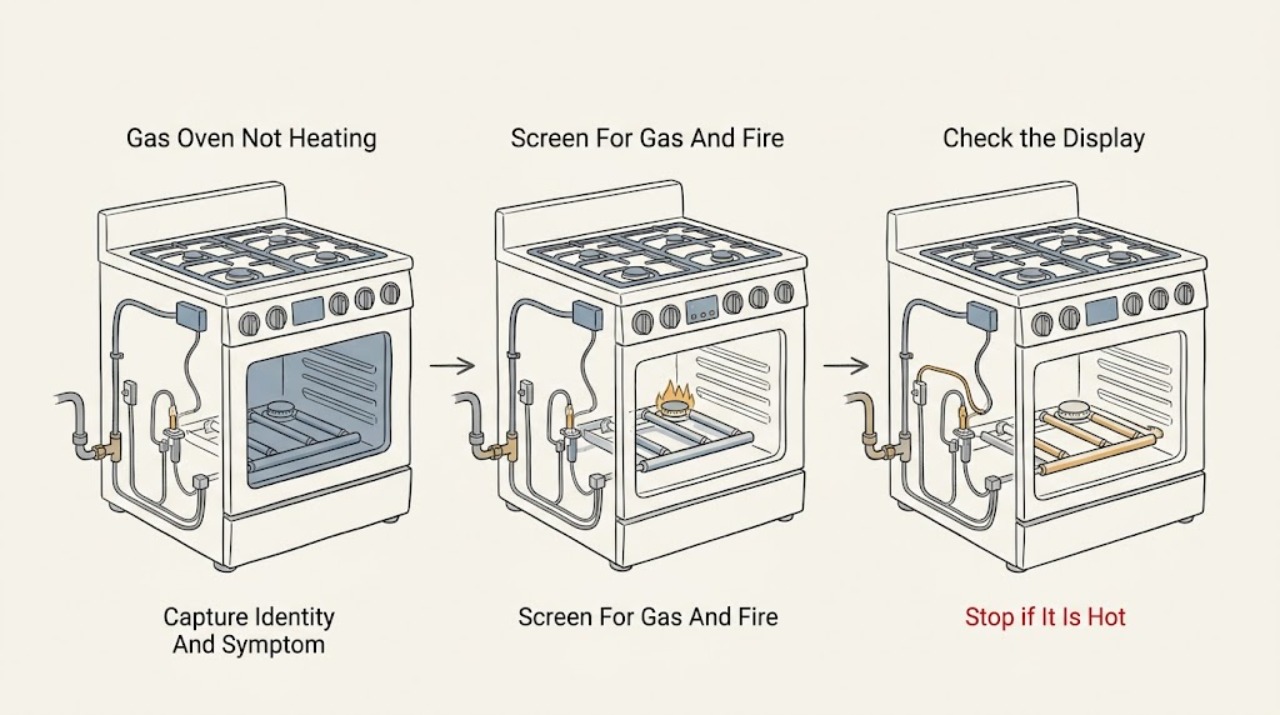
Work through in order
Diagnostic checks
Use only checks that match the exact appliance or system and its official guide.
-
Check 1
From a safe position, record the complete Whirlpool model information, oven cavity, fuel configuration, selected mode, temperature setting, exact display text, and the stage at which the oven stopped heating.
Expected result: The display is blank or clock-flashing, responds normally, shows a complete letter-number code, or shows a control message; the cooktop may or may not work.
Next step: Use the exact owner's manual and matching Whirlpool Product Help page. If the display cannot be read or the symptom was unsafe, keep the oven off and arrange qualified service rather than creating another ignition event.
Stop if: Do not start another cooking cycle solely to reproduce an unreadable code.
Why this matters
Why: These observations separate a supply or control-state problem from a gas-ignition or heating problem. Whirlpool code families are not interchangeable, so every character and the exact model matter.
-
Check 2
Before any control or reset check, note from a safe position whether there is gas odor, hissing, a delayed ignition, a whoosh or boom, an abnormal or yellow flame, soot, smoke, a carbon-monoxide alarm, burning odor, visible arcing, uncontrolled heat, or a hot cord or connection.
Expected result: One or more gas, combustion, smoke, heat, or electrical warning signs is present, or the oven is heating when it should be off.
Next step: Stop using the oven. For suspected gas danger, leave immediately without operating switches or ignition sources and contact the gas utility or emergency service from a safe location. For smoke, flame, or arcing, use the local fire and electrical emergency route.
Stop if: Do not reset, relight, look for a leak, move the range, or remain nearby to watch the burner.
Why this matters
Why: An active gas, fire, carbon-monoxide, or electrical hazard overrides normal troubleshooting. Delayed ignition can allow unburned gas to accumulate before ignition.
-
Check 3
If the oven is cool and no hazard sign exists, compare the display with the exact manual; confirm the intended Bake or other mode, temperature, clock or delay state, control lock or Sabbath setting when applicable, and that the door closes fully without forcing it.
Expected result: The oven is in a documented lock, delay, or special mode; the clock is not set after a power interruption; the door is not fully closed; or controls respond normally but the cavity stays cold.
Next step: Apply only the manual's documented control or clock action. If the door, lock, or control does not respond normally, stop and arrange qualified appliance service.
Stop if: Do not force the door, bypass a lock, or enter hidden diagnostics.
Why this matters
Why: A control state or door condition can prevent a heating cycle without proving a component failure. A normal display with no heat shifts attention to gas and ignition evidence, not to repeated key presses.
-
Check 4
Without moving the range or opening panels, check whether the display or clock shows a recent power interruption and confirm only from a safely accessible position that the appliance's main gas supply has not been intentionally shut off; leave the regulator and connector undisturbed.
Expected result: The display is blank or flashing, a breaker has tripped, the outlet or grounding is uncertain, the accessible gas valve is off, or power and gas states appear normal while the oven remains cold.
Next step: Follow the exact manual for a safe, single breaker check when appropriate. Use qualified electrical service for uncertain supply or grounding; use qualified gas-appliance service for an abnormal gas state or continued no-heat condition.
Stop if: Do not use an extension cord or adapter, move the range to inspect hardware, or perform energized electrical checks.
Why this matters
Why: Whirlpool treats electrical supply and gas supply as separate prerequisites. A powered display does not prove that the gas-ignition path is operating, and an uncertain outlet or connector needs professional assessment.
-
Check 5
With the oven off and cool, inspect only visible user-accessible conditions identified by Whirlpool: confirm the door is closed, no storage drawer load is interfering with the ignition area, and no foil or liner is blocking the oven bottom or airflow; do not remove internal burner covers or panels.
Expected result: A door or drawer condition, foil or liner, or other visible obstruction is present; or no visible obstruction explains the cold oven.
Next step: Remove only the safe, visible obstruction while the appliance is cool, then follow the manual's normal operation instructions once. If ignition is absent, delayed, or abnormal, stop and request service.
Stop if: Do not scrape, probe, adjust, or disassemble the burner or gas path.
Why this matters
Why: Whirlpool notes that an obstructed ignition or airflow path can affect operation. If the visible condition is corrected but the oven still does not heat, the remaining cause requires model-specific diagnosis.
-
Check 6
If a complete error display is present, search Whirlpool Product Help with every character and the exact model, then compare the listed guidance with the assigned gas-oven model rather than substituting a similar-looking code.
Expected result: There is a matching model-specific page, only a broader code family, or no exact match; the code may remain after a normal control action.
Next step: Use only the matching page's low-risk instruction. If there is no exact match or the code returns, keep the oven off and provide the full code and model to qualified service.
Stop if: Do not enter service diagnostics, short terminals, test a valve or igniter, or order a control from a code alone.
Why this matters
Why: Whirlpool publishes separate code families and selected code pages. An F0 E0 or F6 page cannot establish the meaning of another code, and an unmatched code is a reason to preserve the evidence, not guess a part.
-
Check 7
Only when the exact Whirlpool guidance permits it and no gas, fire, smoke, heat, or electrical hazard is present, remove power at the breaker for the documented one-minute interval, restore it, and observe the display without starting a risky test cycle.
Expected result: The display clears and stays clear, returns immediately, returns after a normal control action, or does not recover.
Next step: If the code returns or the oven remains cold, leave it off and arrange service. If it clears, record that result and use only a normal operation permitted by the exact manual.
Stop if: Do not repeat resets or restart the oven after odor, delayed ignition, smoke, arcing, uncontrolled heat, or abnormal flame.
Why this matters
Why: A one-time supported reset can clear a transient control state, but a returning code or continuing no-heat symptom points to a control, sensor, ignition, supply, or wiring condition that needs qualified diagnosis.
-
Check 8
If the display is clear and the manual permits one normal supervised operation, select the intended mode and observe from outside the hot zone whether the display remains normal, ignition is brief and stable, heat begins, and cancellation stops the cycle; do not open the door to investigate a suspected delayed flame.
Expected result: The oven heats normally, remains cold, clicks without stable ignition, produces a delayed whoosh or boom, shows an unstable flame, or continues heating after cancellation.
Next step: Stop at the first abnormal result and arrange qualified appliance or gas service. Use emergency gas or fire guidance first if odor, a boom, smoke, or a carbon-monoxide alarm occurred.
Stop if: Do not repeat ignition attempts, adjust gas or air parts, remove the oven bottom, or continue a cycle with abnormal flame or heat.
Why this matters
Why: No heat after normal controls can involve supply, ignition, burner, sensor, or control diagnosis. Delayed ignition, unstable flame, or heating that cannot be cancelled is not a condition for another test.
-
Check 9
For a returning, unexplained, or unsafe no-heat symptom, leave the oven off and prepare the exact model and serial information, complete display, cavity, fuel type, mode, timing, reset result, power and gas observations, and any sound, odor, flame, smoke, heat, or trip history for qualified service.
Expected result: The symptom is reproducible, intermittent, tied to one mode or cavity, follows a power event, or cannot be safely reproduced.
Next step: Keep the oven out of service until qualified service identifies the cause and confirms safe operation. Use the gas utility or emergency route first after a gas or combustion event.
Stop if: Do not remove panels, bypass an interlock, adjust gas pressure, or replace a component by guesswork.
Why this matters
Why: The history helps service distinguish a control, temperature sensor, igniter, burner, gas valve, wiring, door, or supply branch without asking the user to open a hazardous appliance.
Use your observations
Decision map
Find the observation that best matches what you see, then follow the next safe action.
-
PATH 01Next step
What you see
Gas odor, hissing, delayed ignition, a whoosh or boom, abnormal flame, soot, smoke, or a carbon-monoxide alarm is present.
Do this next
Stop using the oven and leave immediately for suspected gas or combustion danger without operating switches or ignition sources. Contact the gas utility or emergency service from a safe location and arrange qualified service before reuse.
-
PATH 02Next step
What you see
Smoke, visible flame outside the normal burner area, electrical crackle, arcing, burning plastic odor, a hot connection, uncontrolled heat, or repeated breaker trips is present.
Do this next
Stop use and keep clear. Isolate power only from a dry, safe position when possible, use the local fire route for smoke or flame, and arrange qualified electrical or appliance service. Do not reset and retest.
-
PATH 03Next step
What you see
The display shows a documented lock, delay, clock, Sabbath, or other control state and no hazard sign is present.
Do this next
Use the exact Whirlpool manual's documented control action. Escalate if the state persists, the door or lock does not respond, or the oven remains cold after the permitted action.
-
PATH 04Next step
What you see
The display is blank or clock-flashing, the breaker trips, or outlet or grounding status is uncertain.
Do this next
Follow the exact manual for one safe breaker check only when no hazard exists. Use qualified electrical service for uncertain supply or grounding and stop if the circuit trips again.
-
PATH 05Next step
What you see
Power and controls appear normal but the main gas supply is inaccessible, intentionally off, or otherwise abnormal.
Do this next
Do not adjust gas hardware. Use qualified gas-appliance service; use emergency gas guidance first if there is odor or suspected leakage.
-
PATH 06Next step
What you see
The oven remains cold, clicks without stable ignition, or shows a delayed or abnormal flame while controls and accessible supply states appear normal.
Do this next
Stop the ignition check and arrange qualified gas-appliance service. Do not relight repeatedly, open panels, or adjust the burner, valve, regulator, or air path.
-
PATH 07Next step
What you see
A complete error code returns after its documented reset, has no exact model-specific page, or is accompanied by continued no heat.
Do this next
Keep the oven off and give qualified service the complete code, exact model, stage, and reset result. Do not substitute an F-code definition from another model.
-
PATH 08Next step
What you see
A supported reset clears the display and one normal operation is permitted with no odor, smoke, arcing, abnormal flame, or uncontrolled heat.
Do this next
Record the result and use the oven only as directed. Stop and request service if the no-heat symptom, code, or abnormal behavior returns.
Helpful context
Understand the symptom
Start with the symptom, not a guessed part
A Whirlpool gas oven can have power and a working cooktop while the oven remains cold because the selected mode, gas supply, ignition sequence, sensor, control, or burner path is different. Write down the full model and what happens after a normal Bake selection: whether the display responds, whether ignition is attempted, whether heat begins, and whether an error returns. Do not remove panels or infer an igniter, valve, or control fault from the symptom alone.
Gas and fire symptoms change the plan
A brief normal ignition sound is not the same as a delayed whoosh, boom, persistent gas odor, unstable flame, soot, or smoke. If any gas or combustion warning is present, stop using the oven, leave for a suspected leak, and contact the gas utility or emergency service from a safe location. Never search for a leak, move the range, repeat ignition attempts, or open a hot oven to investigate.
A reset is limited evidence
Some Whirlpool range code pages describe removing power for one minute and monitoring the display, but that is not a universal fix for every code or model. Apply a reset only when the exact manual or matching Product Help page allows it and no hazard is present. If the code or no-heat symptom returns, leave the oven off and give the complete history to qualified service.
Only after diagnosis
Potential parts
- electronic oven control or display assembly
Consider only after qualified diagnosis links the exact no-heat behavior or returning code to the control or display system.
Confirm the exact Whirlpool model, control generation, and cavity before ordering; a no-heat symptom or code alone does not establish fit. - oven temperature sensor or wiring harness
Consider only when qualified, model-specific diagnosis identifies a sensor or harness issue rather than a supply, control, or ignition cause.
Match the exact model and wiring configuration. Do not perform energized checks or replace a sensor from a generic symptom list. - gas oven igniter or burner ignition assembly
Consider only for a confirmed gas model after qualified diagnosis links the no-heat result to the model-specific ignition assembly.
Gas-path and ignition work requires qualified service and exact model matching. Do not replace this part after odor or delayed ignition by guesswork.
When checks do not resolve it
Need a professional?
Contact qualified Whirlpool appliance service for no heat after safe control and supply checks, a returning or unexplained error, absent or repeated ignition, abnormal flame, door or control failure, or any model-specific condition beyond the manual. Use gas-utility or emergency assistance first for strong gas odor, delayed ignition, a boom, smoke, a carbon-monoxide alarm, or symptoms.
Have this ready
- Provide the exact model and serial information, complete display including alternating characters, cavity, fuel type, selected mode, stage, reset result, and safe notes about power, gas, flame, odor, smoke, heat, sound, and circuit trips.
Common questions
FAQ
Why does my Whirlpool gas oven have power but not heat?
A powered display does not prove that gas reaches the burner or that the model-specific ignition sequence completes. Check the selected mode and door, record any code, and use qualified service for absent, delayed, or abnormal ignition.
Can I reset a Whirlpool gas oven that is not heating?
Only use a reset when the exact Whirlpool manual or matching code page permits it and no gas, fire, smoke, heat, or electrical hazard is present. A returning code or no-heat symptom needs service rather than repeated resets.
Is clicking normal when a Whirlpool gas oven starts?
A brief ignition sequence can be normal for a gas appliance, but persistent clicking without stable heat, delayed ignition, a boom, odor, or an abnormal flame is a stop condition. Do not keep trying to ignite it.
What should I do if I smell gas while the Whirlpool oven is not heating?
Stop using the appliance and leave immediately for suspected gas danger without operating switches or ignition sources. From a safe location contact the gas utility or emergency service; do not search for a leak or move the range.
Which Whirlpool part should I replace for a cold gas oven?
Do not choose a part from the symptom alone. A qualified diagnosis may distinguish the control, sensor, ignition assembly, burner, gas supply, or wiring, and the exact model must be confirmed before any component is considered.
Read the exact guide
Official sources
- F6 - Error Code - RangeWhirlpool Corporation · Example only; use only when the exact model displays F6 and the page matches it.
- Oven Not Working - Cooktop Working - ClickingWhirlpool Corporation · Use for the documented Whirlpool gas-oven clicking symptom and confirm model-specific instructions.
- Starts with F - Product HelpWhirlpool Corporation · Use to locate the exact code page; do not treat the family index as a universal diagnosis.
- CookingU.S. Fire Administration · General cooking-fire safety, not Whirlpool-specific diagnosis.
- Appliance and Electrical Fire SafetyU.S. Fire Administration · General appliance electrical safety, not Whirlpool-specific diagnosis.
- F0 E0 - Error Code - RangeWhirlpool Corporation · Example only; use only when the exact model displays F0 E0 and the page matches it.
- Oven Not Working - GasWhirlpool Corporation · General Whirlpool gas-range Product Help; exact model instructions take precedence.
- Owners ManualWhirlpool Corporation · Use only for the documented Whirlpool range family and confirm the exact model before applying instructions.
- Gas Range Delayed Ignitions - Tests and Examinations of RangesU.S. Consumer Product Safety Commission · General safety information for gas ranges; it does not identify a Whirlpool part or model.
- Certain Older Gas Connectors May Be DangerousU.S. Consumer Product Safety Commission · General gas-appliance safety; qualified professionals should inspect connectors and users should leave for a suspected leak.
Community feedback
Share a repair observation
Share a plain-text repair observation. Accepted observations are published automatically; this page may take a moment to update.