
On this page
Start here
Quick answer
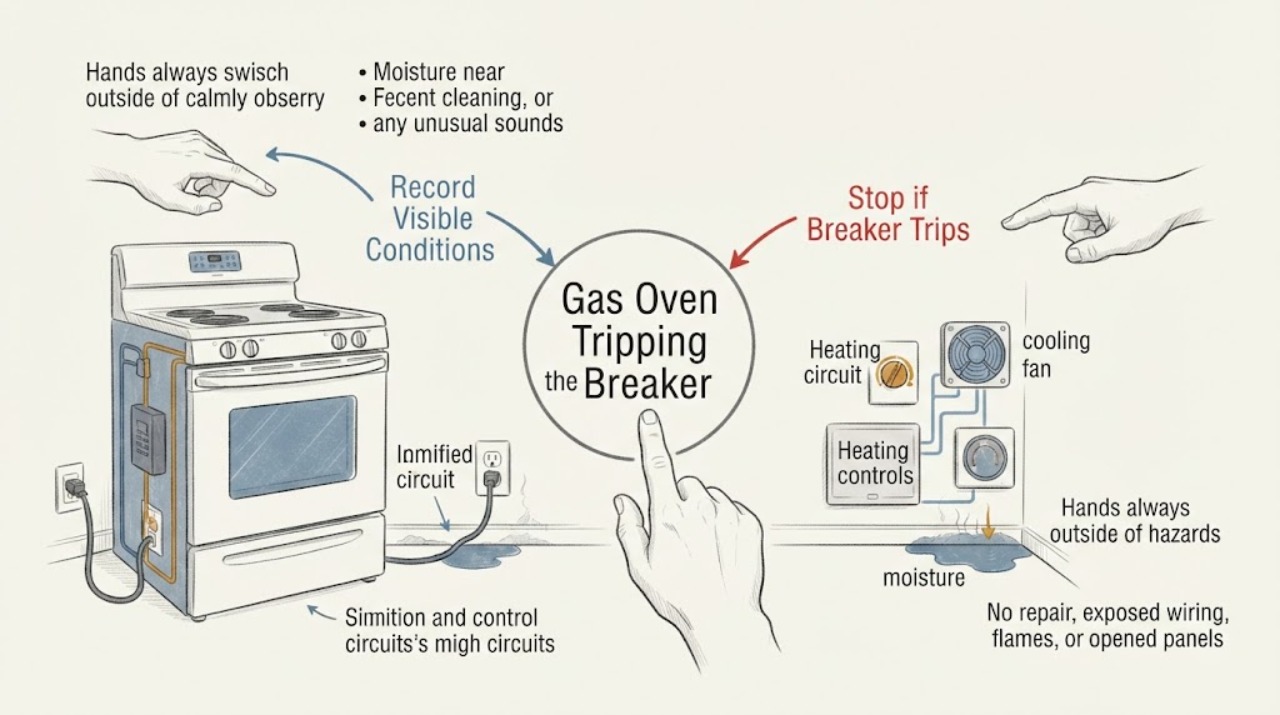
Treat a Samsung gas oven that trips a breaker as an electrical fault until a qualified person proves otherwise. Do not keep resetting the breaker, use an extension cord, bypass protection, or open the range. Record whether the trip occurs as soon as power is restored, when the display starts, when Bake or Broil ignites, when a fan starts, while the cooktop is in use, or during Self Clean. With the oven off, cool, and dry, make only external observations: check the plug and cord for heat or damage, look for water or grease near the outlet and controls, and confirm the range is connected as the model installation guide requires. If the breaker trips again, there is a burning smell, smoke, arcing, a hot outlet, water near electrics, abnormal gas or flame behavior, or the oven has been wet, leave it out of service and arrange qualified electrical or appliance service.
Work through in order
Diagnostic checks
Use only checks that match the exact appliance or system and its official guide.
-
Check 1
Stop using the range and record the exact moment the breaker opens: when the breaker is turned on, when the display or clock appears, when Bake or Broil is selected, during burner ignition, when a cooling or convection fan starts, while the cooktop is used, or during Self Clean. Note any gas odor, flame, smoke, burning smell, water, sparks, or unusual sound without restarting the oven.
Expected result: The breaker opens immediately or at one repeatable stage, or there is smoke, gas odor, a flame outside the burner area, burning smell, arcing, water, or abnormal heat.
Next step: If the breaker remains stable and there is no hazard, continue with external, unpowered observations only. If it trips again or a hazard is present, leave the range off and arrange qualified electrical or appliance service from a safe location.
Stop if: Do not reset the breaker again after a repeat trip. Stop immediately for smoke, flames, gas odor, burning smell, sparks, wet electrics, hot or damaged wiring, or uncontrolled heat.
Why this matters
Why: A repeatable stage identifies the relevant appliance circuit for service, while a hazard makes further testing unsafe. A gas oven still depends on electrical controls and ignition, so gas fuel does not make an electrical trip harmless.
-
Check 2
With the range off and the breaker left open if it has tripped, look at the accessible plug, cord, outlet face, and surrounding wall for scorching, melting, looseness, moisture, grease, or a hot-plastic smell. Do not pull the range out, remove a cover, probe the outlet, or touch a wet outlet.
Expected result: The cord or outlet is visibly damaged or warm, moisture or grease is present, the range is connected through an extension cord or adapter, or the accessible area looks dry and intact.
Next step: For damage or moisture, keep the breaker off and obtain qualified electrical help. If the connection is intact, continue to document the trip stage rather than testing the range repeatedly.
Stop if: Do not use an extension cord, improvised adapter, replacement fuse, or outlet tester on a suspect energized circuit; do not re-energize a wet or scorched connection.
Why this matters
Why: Damage, heat, moisture, or an unsuitable connection can cause shock or fire and requires an electrician or appliance professional. A normal-looking outlet does not prove the circuit or range is safe.
-
Check 3
Record the complete model number and compare the visible installation with the exact Samsung installation guide: gas ranges still require the specified electrical receptacle and circuit, and the gas supply and conversion details are model and fuel specific. Confirm only that the correct outlet type and connection are present; have a qualified electrician check the circuit rather than measuring it yourself.
Expected result: The model guide is available and the connection appears to match, the installation is new or was recently moved, or the model and circuit requirements cannot be confirmed.
Next step: If installation is new or uncertain, stop using the range and have the installer or qualified electrician verify the circuit and connection. If the installation is established, proceed only with the non-invasive stage checks.
Stop if: Do not change wiring, replace a breaker with a larger rating, alter the gas connection, or slide the range out to inspect wiring or the gas connector yourself.
Why this matters
Why: A recently installed or moved range can have a connection, grounding, circuit, or gas-installation problem. Model-specific requirements cannot be inferred from a different Samsung range.
-
Check 4
Use the recorded history, not a new test, to distinguish a trip with the range idle from a trip when the oven control wakes, a gas burner ignites, the cooktop is used, or a fan runs. Note whether the display was blank, blinking, or showing a code before the breaker opened. Do not turn on burners or start the oven to reproduce the trip.
Expected result: The trip happens only with the control powered, only during ignition or heating, only with the cooktop, only with a fan, or even while the range is idle and connected.
Next step: Give the exact sequence and code to the service professional. If the range trips while idle, leave its breaker off; if it trips during a function, do not use that function again.
Why this matters
Why: These observations help a professional separate supply or control faults from ignition, fan, heater-control, or moisture-related faults. They do not identify a replaceable part by themselves.
-
Check 5
If the trip was associated with a gas-oven start or burner ignition, record only whether the flame was present and confined to the intended burner area before the trip. Do not relight repeatedly, test gas pressure, remove burner parts, or continue if there is gas odor, hissing, delayed ignition, yellow or unstable flame, smoke, or a carbon-monoxide alarm.
Expected result: The gas odor or abnormal flame is present, the flame never appeared, ignition was delayed or loud, or the oven had normal visible operation before the electrical trip.
Next step: For any gas or combustion warning, stop using the range and use the local gas or emergency response from a safe location. Otherwise provide the ignition timing and trip history to appliance service without another ignition test.
Stop if: Do not operate switches or create ignition sources near a suspected gas leak, and do not adjust gas pressure, burner orifices, or ignition wiring.
Why this matters
Why: Gas and electrical symptoms can coexist. A gas-supply, ignition, control, or combustion fault needs qualified diagnosis; a normal-looking flame does not make a breaker trip safe to repeat.
-
Check 6
Note whether the breaker opened while a cooling or convection fan was running, after a spill or steam event, after cleaning, or during normal baking. Once the range is de-energized and cool, wipe only accessible external moisture; do not spray cleaner into vents or controls and do not use a steam cleaner.
Expected result: The trip follows a spill, cleaning, condensation, fan start, or a particular heating function, or there is no visible moisture and no function-specific pattern.
Next step: Keep the range off and let a qualified professional inspect any water-related or function-specific trip. Do not test with the back cover removed or with a disconnected fan or safety device.
Stop if: Do not use high-pressure or steam cleaning, operate a wet range, or reach through a vent to inspect internal wiring.
Why this matters
Why: Moisture and a fan or heating load can expose an insulation, motor, control, or wiring fault. Visible dryness does not clear moisture inside the appliance.
-
Check 7
Only if the range is cool, dry, free of gas odor or smoke, and the breaker has not tripped again, follow the exact Samsung guide's single power-cycle step. Observe the panel without starting a cooking or cleaning function; if the breaker opens again, leave it off.
Expected result: The panel returns and remains stable, a code returns, the breaker trips immediately again, or the range stays blank.
Next step: If stable, do not run a high-heat or gas cycle until the model guide and service assessment support it. For any returning code, blank panel, or trip, arrange qualified service and do not reset again.
Stop if: Never repeatedly reset the breaker, use an extension cord, defeat a protective device, or test live terminals.
Why this matters
Why: Samsung documents a short power cycle for minor display or control issues, not as a repair for a recurring overcurrent or ground fault. A repeat trip is evidence to stop.
-
Check 8
Arrange qualified electrical or Samsung appliance service when the breaker trips a second time, trips at a repeatable oven or ignition stage, or remains open with a blank range. Provide the model, installation history, breaker and outlet observations, exact stage, display code, gas or flame behavior, fan or heating context, moisture, and any odor or noise.
Expected result: The fault is repeatable, the circuit or outlet is damaged, the range has been wet or moved, or internal access would be needed to identify the cause.
Next step: Leave the range disconnected or its breaker off until the professional confirms safe operation. Do not substitute a part or alter gas or electrical protection based only on the symptom.
Stop if: Do not use the oven or cooktop with repeated trips, smoke, gas odor, arcing, damaged wiring, water intrusion, or a failed safety device.
Why this matters
Why: Possible causes include a circuit or connection fault, insulation or wiring damage, ignition or control equipment, a fan or heating load, or moisture. Identifying which part failed requires qualified tests with the range safely isolated.
Use your observations
Decision map
Find the observation that best matches what you see, then follow the next safe action.
-
PATH 01Next step
What you see
The breaker trips again immediately after reset or while the range is idle.
Do this next
Leave it off and arrange qualified electrical or appliance service. Do not keep resetting it or substitute a different breaker.
-
PATH 02Next step
What you see
The cord, plug, outlet, or nearby wall is hot, scorched, melted, loose, wet, or contaminated.
Do this next
Keep the circuit off and obtain qualified electrical inspection; do not touch wet electrics or move the range to inspect hidden wiring.
-
PATH 03Next step
What you see
The range was newly installed or recently moved and the trip began afterward.
Do this next
Stop use and have the installer or electrician verify the model-specific connection, circuit, grounding, and gas installation.
-
PATH 04Next step
What you see
The trip occurs when the display wakes, during a particular oven mode, when a fan starts, or during Self Clean.
Do this next
Record the exact stage and keep that function out of service. Do not reproduce the trip; provide the history to qualified appliance service.
-
PATH 05Next step
What you see
The trip is associated with burner or oven ignition and there is gas odor, delayed ignition, an abnormal flame, smoke, or a carbon-monoxide alarm.
Do this next
Stop using the range and use the appropriate local gas or emergency response from a safe location. Do not operate switches or attempt another ignition test.
-
PATH 06Next step
What you see
A single safe reset restores the panel and the breaker stays closed, with no hazard sign.
Do this next
Do not assume the fault is repaired. Confirm the model guide and arrange assessment before using the function that caused the trip; stop if it recurs.
-
PATH 07Next step
What you see
The range remains blank, shows a recurring code, or the breaker opens after one documented reset.
Do this next
Leave the breaker off and request qualified service with the code, model, trip stage, and installation history.
-
PATH 08Next step
What you see
Smoke, flame outside the intended burner area, arcing, burning smell, uncontrolled heat, water near electrical parts, or exposed wiring is present.
Do this next
Stop immediately, keep clear, and use the appropriate local emergency, gas, electrical, or appliance-service response from a safe location.
Helpful context
Understand the symptom
The trip timing matters more than the word gas
A gas range still has an electrical control and ignition supply. A breaker that opens immediately, when the display wakes, at Bake ignition, when a fan starts, or only during Self Clean points to different service evidence. Write down the exact sequence and any display code; do not reproduce the trip just to confirm it.
Keep every electrical check external
Check only an accessible plug, cord, outlet face, breaker position, dry control surface, and visible signs of liquid or heat. Do not remove the rear cover, measure live terminals, move the gas range to inspect its connector, or bridge a breaker. A gas smell, flame outside the burner area, smoke, or a wet appliance is a stop condition.
Only after diagnosis
Potential parts
- power cord, outlet, or connection
Only consider this category after a qualified electrical inspection finds heat, damage, incorrect connection, or circuit trouble rather than assuming the appliance itself failed.
Electrical connection requirements vary by model and locality; do not replace a cord, receptacle, or breaker without qualified assessment. - ignition or control component
Only consider this category when the breaker trips at ignition or oven-control operation and qualified diagnosis isolates an appliance component.
Gas ignition and control circuits are safety-related; confirm exact model fit and use qualified repair. - cooling or convection fan component
Only consider this category if a qualified inspection links the repeatable trip to a fan start and confirms the fan circuit is faulty.
Fan assemblies and wiring differ by model; do not operate with a bypassed fan or safety device.
Common questions
FAQ
Why does my Samsung gas oven trip the breaker?
A gas range still needs electricity for controls and ignition, so a breaker trip can involve the supply, outlet, wiring, ignition, fan, control, or moisture. Record the exact stage, stop resetting the breaker, and have the circuit and range assessed if the trip repeats.
Can I reset the breaker to see if the Samsung oven works?
Only once, and only when the range is cool, dry, free of gas odor or smoke, and the model guide supports a reset. If the breaker opens again, leave it off. Repeated resets can conceal an electrical fault and are not a repair.
Is a Samsung gas range supposed to be connected to electricity?
Yes. Samsung gas ranges use an electrical supply for controls and ignition, with model-specific installation requirements. Do not change wiring or the protective device yourself; use the exact installation guide and a qualified electrician.
What if the breaker trips when the Samsung oven ignites?
Do not keep trying ignition. Record whether there was a click, flame, delayed ignition, unusual sound, gas odor, or smoke, then leave the range off and request qualified appliance and electrical diagnosis. Gas and electrical faults can coexist.
Should I use an extension cord for a Samsung gas oven?
Do not improvise the range connection with an extension cord or adapter. Follow the exact Samsung installation guide and local requirements, and have a qualified professional correct a connection that is hot, loose, damaged, or uncertain.
Read the exact guide
Official sources
- Install your Samsung gas or electric rangeSamsung Support US · Samsung gas-range electrical supply, gas connection, model-specific installation, and qualified installation guidance
- Samsung oven temperature issuesSamsung Support US · Samsung gas-range ignition, gas pressure, oven heating, breaker reset, and service boundaries
- Samsung Range FAQsSamsung US · Samsung range gas and electrical types, breaker and power symptoms, one-reset guidance, and service direction
- Samsung range or wall oven panel is blank, blinking, or incorrectSamsung Support US · Samsung range and wall-oven power supply, breaker reset, blank-panel, and service guidance
- Self Clean or other buttons do not light up or respond, or panel is locked on Samsung ovenSamsung Support US · Samsung oven panel state, function conflicts, hot panel, Control Lock, power reset, and service guidance
- Samsung range or wall oven error codesSamsung Support US · Samsung range and wall-oven door, power, temperature, recurring-error, and qualified-service guidance
- How to clean your Samsung ovenSamsung Support US · Samsung oven Self Clean safety, electrical disconnection after malfunction, smoke and heat warnings, and door or accessory precautions
- Gas Ranges: How Do I Use the Self-Cleaning Oven?Samsung South Africa · Samsung gas-range Self Clean high-temperature, smoke, flame, ventilation, door-lock, and no-force safety guidance
- Samsung cooktop and range: common sounds and operational noisesSamsung Support US · Samsung gas-range ignition clicking, fan operation, relay sounds, unusual noise, and service guidance
- Ranges | Samsung Support USSamsung Support US · Samsung range model lookup, manuals, troubleshooting, warranty, and repair-support direction
Community feedback
Share a repair observation
Share a plain-text repair observation. Accepted observations are published automatically; this page may take a moment to update.