
On this page
Start here
Quick answer
A Whirlpool gas oven described as leaking needs the substance and location identified before any troubleshooting. A brief amount of moisture on the door or nearby wall can be steam from combustion or high-moisture food, while a small amount of water or cleaning residue may have another source. A rotten-egg or unexplained gas odor, hissing, dizziness, a carbon-monoxide alarm, smoke, or an abnormal flame is an emergency: stop using the appliance, do not light anything or operate electrical switches, leave from a safe route, and contact emergency or gas-safety help from outside. Never search for a gas leak, test ignition, or remove a gas component. If the area is dry and there is no gas symptom, observe where and when liquid or vapor appears, compare it with the cooking mode, and use the exact model manual or qualified appliance service.
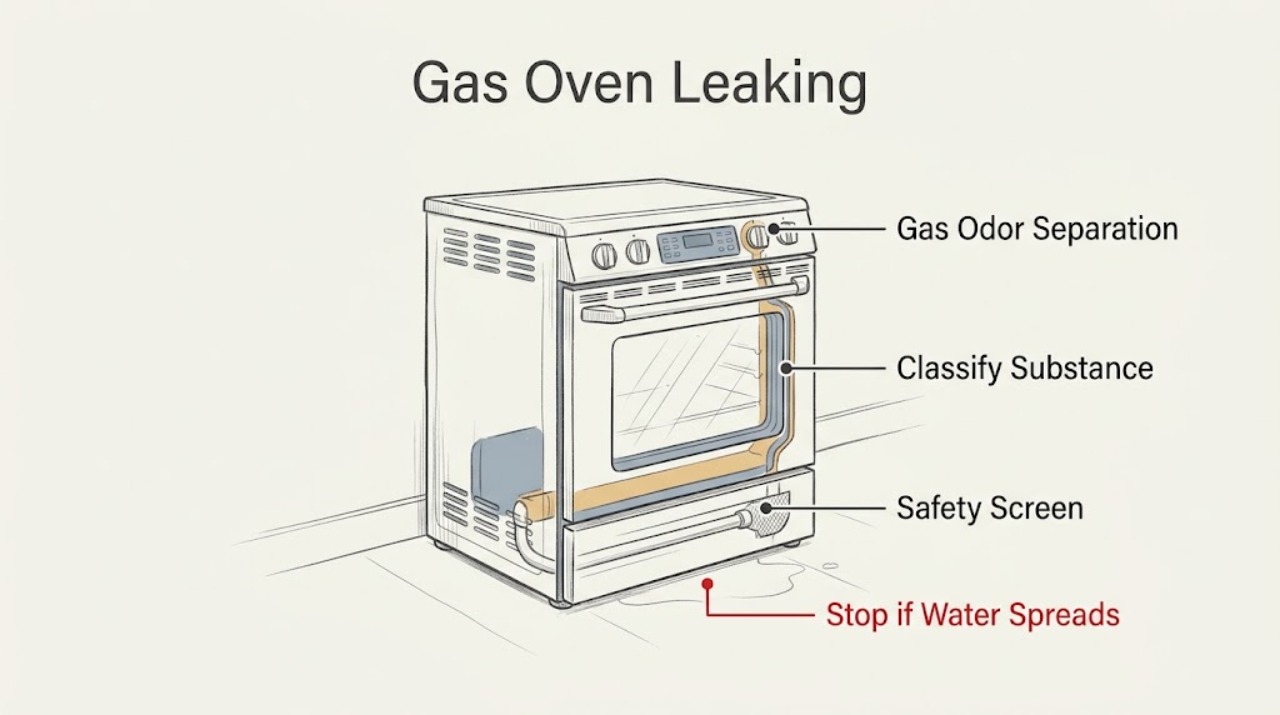
Work through in order
Diagnostic checks
Use only checks that match the exact appliance or system and its official guide.
-
Check 1
Stop cooking and observe from a safe position without touching the range, controls, liquid, or nearby electrical equipment.
Expected result: Record whether there is a rotten-egg or unexplained gas odor, hissing, smoke, an abnormal flame, a carbon-monoxide alarm, dizziness, headache, nausea, shortness of breath, a hot surface, or an active spreading liquid.
Next step: If any sign is present, leave by a safe route, keep people away, and contact appropriate emergency, gas-safety, or fire help from outside. If none is present and the area is dry, continue only with the oven off.
Stop if: Do not light a burner, operate switches, use a phone inside the suspected gas area, test for a leak, or re-run the oven to reproduce the symptom.
Why this matters
Why: These signs may indicate fire, fuel, combustion, carbon-monoxide, burn, or electrical danger; the substance cannot be safely classified by further oven testing.
-
Check 2
From outside the appliance, identify whether the report is a smell, visible liquid, dampness or droplets, steam, or warm air, and note its first visible location.
Expected result: A smell without liquid follows the gas-odor path; clear droplets on cool glass during cooking suggest condensation; liquid on the floor, under the range, or appearing while off does not match ordinary door condensation.
Next step: Write down the location, color, odor, amount, oven mode, and whether the oven was on or off. Do not reach behind, under, or inside the appliance to find a source.
Stop if: Stop if the liquid is hot, unknown, spreading, near an outlet or cord, or accompanied by gas odor, smoke, or an abnormal flame.
Why this matters
Why: The substance and first wet point determine whether this is a safety emergency, expected moisture pattern, spill or cleaning residue, or a service issue.
-
Check 3
If any gas-like odor is reported, stop the classification and compare only the timing already observed: during ignition, after switching off, or while the oven was idle.
Expected result: A brief faint odor during ignition may be described by Whirlpool as possible, but an odor that persists, returns when off, grows stronger, or occurs with hissing or symptoms is not a safe user-test condition.
Next step: For persistent, unexplained, or strong odor, leave and seek gas-safety or emergency help from outside. Do not return the appliance to service until qualified personnel clear it.
Stop if: Do not locate the leak, use a flame or spark, operate electrical controls, relight the oven, or remove a gas fitting or panel.
Why this matters
Why: A timing pattern cannot prove that an appliance is safe; persistent or unexplained odor may involve the gas line or an oven part.
-
Check 4
Without approaching a suspected leak, note any carbon-monoxide alarm, unusual combustion appearance already visible from a normal position, or symptoms among occupants.
Expected result: An alarm, headache, dizziness, nausea, shortness of breath, smoke, soot, or abnormal flame makes the appliance unsafe to operate regardless of whether liquid is also present.
Next step: Move outside to fresh air and seek emergency help; keep the oven off. Reuse requires qualified inspection after the emergency condition is resolved.
Stop if: Do not stay inside to diagnose, silence an alarm and continue, adjust air or gas settings, or service the burner yourself.
Why this matters
Why: Fuel-burning appliances can produce carbon monoxide when combustion is incomplete, and carbon monoxide cannot be reliably detected by smell.
-
Check 5
If there is no gas symptom and the oven is cool enough to approach safely, observe whether moisture is confined to the door glass during or shortly after cooking.
Expected result: Moisture on gas-oven door glass, especially with high-moisture food, can be steam condensation and may dissipate as the oven reaches temperature or cools.
Next step: Allow the oven to cool, wipe accessible moisture with a dry cloth, and record the food, mode, and whether the moisture dissipates. Use the exact model guidance if it returns or spreads.
Stop if: Do not touch hot glass, remove the door, disturb the seal, block vents, or continue if moisture reaches electrical parts or becomes an active leak.
Why this matters
Why: A repeatable, small amount of moisture on the cool door surface has a normal explanation and is different from liquid escaping onto the floor or cabinet.
-
Check 6
Record what was cooking and whether a model-specific steam feature or water reservoir was used, without adding water or opening a hot oven.
Expected result: Roasts, casseroles, and other high-moisture foods can produce temporary condensation; an applicable Steam Bake feature can leave water in its reservoir after the cycle.
Next step: After the oven is cool, follow the exact model manual for any reservoir handling and discard only accessible residual water as directed. Arrange service if water escapes the intended area.
Stop if: Do not overfill a reservoir, improvise a steam function, pour water into the cavity, or reach into a hot appliance.
Why this matters
Why: Food moisture or an authorized steam feature can account for a small, localized amount of water, but it does not explain gas odor, a floor puddle, or liquid appearing while idle.
-
Check 7
With the oven off and cool, inspect only visible, reachable surfaces around the door edge, control area, floor, and adjacent cabinet for a first wet point; do not pull the range out.
Expected result: A residue near the door may follow a spill or cleaning event; liquid under the appliance, behind it, or near a connection cannot be safely attributed to the oven from an external glance.
Next step: Keep the oven off, protect people from slips, and arrange qualified appliance service for recurring or concealed liquid. If liquid is near electricity, isolate the area without touching wet equipment.
Stop if: Do not tilt, slide, lift, remove a back panel, disconnect a hose or gas connector, or inspect beneath a wet appliance.
Why this matters
Why: The first wet point separates a user-cleanup event from a concealed appliance, plumbing, or gas-area problem, but it does not identify a repair part.
-
Check 8
Write down the exact Whirlpool model number, fuel type, cooking mode, start and stop timing, door position, and whether the symptom occurs while off, preheating, cooking, or cooling.
Expected result: A symptom tied only to preheating or high-moisture cooking differs from one that appears while idle, after shutoff, at the rear, under the range, or on every mode.
Next step: Use the model-specific Whirlpool manual or provide these observations to qualified appliance service. Keep the appliance off if the source is unexplained or recurring.
Stop if: Do not use a generic code, part list, or another model's gas instructions as a substitute for the assigned model documentation.
Why this matters
Why: Mode and timing help the manual or technician choose the applicable door, vent, ignition, combustion, or liquid-path diagnosis without guessing across Whirlpool models.
-
Check 9
After a qualified source has identified a normal condensation or spill pattern, confirm from a dry, cool position that the moisture has stopped and the surrounding cabinet and floor are dry.
Expected result: A one-time localized residue that does not return is different from liquid that reappears, spreads, damages materials, or is accompanied by odor or heat.
Next step: Follow the exact model's care instructions and monitor without deliberately reproducing the leak. Arrange service for recurrence or any unexplained change.
Stop if: Do not run repeated bake cycles to test a suspected leak, leave the oven unattended, or continue after a gas, smoke, heat, or electrical warning.
Why this matters
Why: A stopped, explained moisture event may not require a part, while recurrence or a new safety symptom requires service rather than repeated cooking tests.
-
Check 10
Prepare a service report containing the model number, fuel type, substance description, first wet point, odor, mode, timing, visible flame or smoke observation, and any alarm or symptom.
Expected result: A complete record lets a qualified technician distinguish door condensation, a spill or steam feature from a concealed liquid path, ignition or combustion fault, or gas-supply concern.
Next step: Keep the oven out of service when the cause is unexplained or any safety sign occurred, and use Whirlpool or qualified appliance service for the next decision.
Stop if: Do not order or replace a gas, ignition, seal, or valve component solely from the word leaking.
Why this matters
Why: The evidence supports a model-appropriate inspection without asking the homeowner to open a gas appliance or prove a leak.
Use your observations
Decision map
Find the observation that best matches what you see, then follow the next safe action.
-
PATH 01Safety boundary
What you see
A rotten-egg or unexplained gas odor, hissing, or persistent odor is present.
Do this next
Leave by a safe route and contact emergency or gas-safety help from outside; do not return the oven to service until qualified personnel clear it.
Why this path and its safety boundary
Why it matters: Treat this as a possible gas leak or abnormal gas appliance condition, not as liquid leakage to troubleshoot.
Safety stop: Do not operate switches, use flames, test ignition, search for the leak, or remove gas parts.
-
PATH 02Safety boundary
What you see
A carbon-monoxide alarm, headache, dizziness, nausea, shortness of breath, smoke, soot, or abnormal flame occurs.
Do this next
Move outside to fresh air, seek emergency help, and keep the appliance off until trained personnel inspect it.
Why this path and its safety boundary
Why it matters: The fuel-burning appliance may be creating a combustion or carbon-monoxide hazard.
Safety stop: Do not silence an alarm and continue, adjust the burner, or remain inside to diagnose.
-
PATH 03Safety boundary
What you see
Small moisture is limited to cool door glass during cooking and follows high-moisture food or normal heating.
Do this next
Let the oven cool, wipe accessible moisture, record the pattern, and use the exact model guidance if it does not dissipate.
Why this path and its safety boundary
Why it matters: Whirlpool identifies steam condensation from gas combustion and moist food as a possible normal explanation.
Safety stop: Stop if water reaches the floor, cabinet, electrical area, or any gas symptom appears.
-
PATH 04Safety boundary
What you see
An applicable Whirlpool steam feature was used and water remains in its designated reservoir after the oven cools.
Do this next
Follow the cool-down and reservoir instructions for the exact model; arrange service if water escapes the reservoir or cavity path.
Why this path and its safety boundary
Why it matters: Whirlpool says residual reservoir water can be normal after a Steam Bake cycle, but the exact model instructions control.
Safety stop: Do not fill beyond the model's marked limit, pour water into an unrelated area, or handle a hot reservoir.
-
PATH 05Safety boundary
What you see
The visible residue began after a spill or cleaning event and is limited to an accessible cool surface.
Do this next
Keep the oven off and cool, clean only as the model manual permits, dry the area, and monitor without deliberately repeating the event.
Why this path and its safety boundary
Why it matters: The residue may be a cleanup issue rather than an internal appliance leak, but its odor and location must remain consistent with that explanation.
Safety stop: Stop for unknown liquid, corrosive residue, gas odor, smoke, heat, or liquid near electrical equipment.
-
PATH 06Safety boundary
What you see
Liquid appears under, behind, or beside the range, or while the oven is off.
Do this next
Keep the appliance off, keep people away from the wet area, and arrange qualified appliance service; use an appropriate electrical or plumbing professional if the surrounding source points elsewhere.
Why this path and its safety boundary
Why it matters: This does not match ordinary moisture on the door glass and could involve a concealed appliance, installation, or nearby source.
Safety stop: Do not pull out or tilt the range, reach behind it, disconnect a gas connector, or touch wet electrical equipment.
-
PATH 07Safety boundary
What you see
The leak or moisture returns on more than one occasion, increases, or has no repeatable cooking-related pattern.
Do this next
Keep the oven out of service and provide the model, timing, first wet point, and substance description to qualified appliance service.
Why this path and its safety boundary
Why it matters: An unexplained recurring event needs inspection rather than more user experiments.
Safety stop: Do not keep running bake cycles to reproduce it or select a replacement part from the symptom alone.
-
PATH 08Safety boundary
What you see
The report is warm air or steam at the door or vent with no gas odor, puddle, smoke, alarm, or abnormal flame.
Do this next
Record the mode and timing, keep vents unobstructed, and consult the exact Whirlpool manual if the flow is excessive, hot in an unexpected area, or accompanied by damage.
Why this path and its safety boundary
Why it matters: A warm-air or steam path can be part of normal oven operation, but the model manual is needed to confirm the vent and door behavior.
Safety stop: Stop for burning odor, smoke, gas smell, abnormal flame, excessive heat, or nearby material damage.
-
PATH 09Safety boundary
What you see
The model number, fuel configuration, or feature identity is unknown and the symptom cannot be safely classified.
Do this next
Do not guess. Keep the oven off if the source is unexplained, locate the model information only from a safe accessible position, and use Whirlpool documentation or qualified service.
Why this path and its safety boundary
Why it matters: Whirlpool oven behavior and allowable user care vary by model; generic gas or steam instructions could be unsafe.
Safety stop: Do not remove trim, panels, the door, or a gas component to find the model or source.
-
PATH 10Safety boundary
What you see
The event was a one-time, localized, cool-surface moisture pattern that dissipated and no hazard sign occurred.
Do this next
Follow the exact model's care guidance and monitor normally; arrange service if it returns, spreads, or changes odor or appearance.
Why this path and its safety boundary
Why it matters: The pattern is consistent with condensation or a contained spill, not proof that every part of the appliance is safe.
Safety stop: Do not reproduce the event intentionally or continue using the oven after a new safety symptom.
Helpful context
Understand the symptom
First decide whether leaking means gas, water, residue, or steam
Do not assume the word leaking describes liquid. Note whether the report is a smell, a visible drop or puddle, damp glass, steam, or hot air around the door. A gas odor takes priority over every other check. If the substance is liquid, keep the oven off and identify the first safe-to-see wet point without reaching behind or underneath the range. A clean, dry observation is more useful than wiping everything away and immediately repeating a cycle.
Moisture can be normal, but it should have a predictable pattern
Whirlpool explains that gas combustion produces steam and carbon dioxide, and steam can condense on cool oven-door surfaces before the oven reaches temperature. High-moisture foods can also leave temporary moisture on or between the door glass. The pattern should be tied to cooking and should dissipate as the appliance heats. Water that appears while the oven is off, collects outside the normal door area, increases, or damages nearby materials is not explained by that normal pattern and needs service assessment.
A gas smell is not a leak-finding exercise
Whirlpool says a brief faint odor during ignition can occur, but a gas smell when the appliance is off, a persistent odor, hissing, or symptoms must be treated seriously. Do not track down the source, spray a leak detector, relight the burner, or test the oven. Leave from a safe route without operating switches or creating an ignition source and seek help from outside. A carbon-monoxide alarm or headache, dizziness, nausea, or shortness of breath also changes the situation to an immediate exit.
Only dry, external observations belong in this guide
With the oven off and the area dry, the homeowner can record the mode, timing, location, amount, door position, visible condensation, and whether the event follows a spill or a steam-enabled feature on an applicable model. The homeowner should not remove panels, inspect a gas connector, adjust a burner, remove an igniter, reach into a hot cavity, or make a repair based on a generic part description. The model number and a precise symptom record let Whirlpool documentation or a qualified technician choose the correct service path.
Safety boundary
Stop conditions
- Leave immediately for a strong, persistent, or unexplained gas odor, hissing, or suspected fuel leak; do not operate switches, use flames, or search for the source.
- Exit to fresh air for a carbon-monoxide alarm or symptoms such as headache, dizziness, nausea, or shortness of breath, and do not re-enter or reuse the appliance until cleared by qualified personnel.
- Stop for smoke, soot, abnormal flame, burning odor, arcing, melted material, unexpected heat, or a fire; keep clear and obtain emergency help as appropriate.
- Stop for liquid near an outlet, cord, control, or other electrical equipment; do not touch wet equipment, slide the range, or reach behind it.
- Do not remove panels, disconnect a gas connector, inspect a burner, adjust gas or air, test ignition, spray for a leak, or replace a part based only on the word leaking.
Only after diagnosis
Potential parts
- door gasket or seal
Consider only if a qualified diagnosis finds a model-specific door sealing or alignment fault and the moisture is escaping around the door rather than being normal condensation.
Door seals vary by complete model and revision; confirm the model fit and service instructions before any replacement. - ignition assembly
Consider only if qualified testing identifies delayed or failed ignition as the cause of abnormal combustion or odor; a brief ignition odor alone is not a parts diagnosis.
Ignition systems differ across Whirlpool gas-oven models; do not test, remove, or select an igniter from the leak symptom alone. - gas valve or regulator
Consider only after qualified gas-appliance diagnosis identifies a valve, regulator, or fuel-control fault and the appliance has been made safe.
Fuel components are model- and fuel-configuration-specific and require qualified installation; never choose one from an odor or liquid report. - vent or cavity service component
Consider only when the model manual and qualified inspection identify a damaged vent, cavity, reservoir, or related component as the source of recurring moisture.
Confirm the exact Whirlpool model and the technician's diagnosis; do not block, alter, or dismantle the combustion or vent path.
When checks do not resolve it
Need a professional?
Call qualified appliance service when liquid recurs, appears under or behind the range, occurs while the oven is off, does not fit the door-condensation pattern, or follows an unexplained control, ignition, combustion, door, or vent symptom. Use emergency or gas-safety help first for odor, hissing, smoke, abnormal flame, a carbon-monoxide alarm, or illness symptoms.
Common questions
FAQ
Is moisture on a Whirlpool gas oven door a leak?
Not always. Whirlpool says steam from gas combustion and high-moisture foods can condense on cool door glass and dissipate as the oven heats. Moisture on the floor, under the range, while the oven is off, or near electrical equipment does not match that simple pattern and needs service assessment.
What should I do if my Whirlpool gas oven smells like gas?
If the odor is persistent, unexplained, strong, or present while the oven is off, leave by a safe route and seek gas-safety or emergency help from outside. Do not operate switches, light anything, look for the leak, or relight the oven. Whirlpool notes that a brief faint ignition odor can occur, but it should not be used to justify a leak-finding test.
Can a gas oven produce water?
Gas combustion produces water vapor, and Whirlpool explains that this can condense on a cool door. Food with high water content can add to the effect. A visible puddle, recurring liquid outside the door area, or water appearing when the oven is off should be treated as an unexplained leak or nearby-source problem, not assumed to be normal vapor.
Should I pull out my Whirlpool range to find the leak?
No. Do not slide, tilt, or open the range to inspect behind or underneath it, and do not disconnect a gas connector. Record the first safe visible wet point and arrange qualified appliance service. If liquid is near electricity or a gas odor is present, keep clear and follow the applicable emergency safety path.
Can a carbon-monoxide alarm be related to an oven leak?
A carbon-monoxide alarm or symptoms such as headache, dizziness, nausea, or shortness of breath require moving outside to fresh air and seeking emergency help. Carbon monoxide has no reliable smell, and the oven should remain out of service until qualified personnel inspect the fuel-burning appliance.
Read the exact guide
Official sources
- Carbon Monoxide Fact SheetU.S. Consumer Product Safety Commission · General household fuel-burning appliance safety
- Owner's Manual W11702310Whirlpool · The manual's identified Whirlpool gas-range models; use the manual matching the installed model
- Moisture On Door - RangeWhirlpool · Whirlpool ranges with the relevant gas-oven door or steam-feature configuration; confirm the exact model
- Why Does My Oven Smell Like Gas?Whirlpool · General Whirlpool oven and range gas-odor guidance; exact model instructions control
- Whirlpool Manuals & LiteratureWhirlpool · Whirlpool appliances; the complete model number is required for applicable instructions
Community feedback
Share a repair observation
Share a plain-text repair observation. Accepted observations are published automatically; this page may take a moment to update.