
On this page
Start here
Quick answer
Do not treat repeated filling on a Whirlpool GI15NDXZS0 as proof of a failed inlet valve, pump or control. Whirlpool identifies the GI15NDXZS family as a 15-inch under-counter ice maker and its guidance ties no-ice symptoms to an unsecured drain cap, a kinked or incorrectly installed drain hose, a water-supply restriction, a blocked bin sensor or cleaning/airflow conditions. If water is actively overflowing or near electrical connections, stop the ice maker, shut off the accessible water supply and disconnect power only from a dry, safe location. Then check only the accessible supply line, drain cap, drain path and sensor described below. If those checks do not stop the repeated fill/no-ice pattern, leave the unit off and arrange Whirlpool or qualified appliance service rather than opening the cabinet or replacing a component by symptom.
Work through in order
Diagnostic checks
Use only checks that match the exact appliance or system and its official guide.
-
Check 1
If water is actively flowing, overflowing or pooling, turn the ice maker off with its normal control and close the accessible water-supply shutoff. Keep water away from the receptacle and controls; disconnect power only from a dry, safe position. Do not continue cycling the appliance to reproduce the fill.
Expected result: Water stops when the control or supply is shut off, or it continues to enter or leak after the ice maker is off.
Next step: Leave the water and ice maker off, clean standing water safely and arrange qualified appliance/plumbing service if flow continues or any electrical connection was exposed. If the flow stops, continue only with the external checks below.
Stop if: Stop immediately for water near an outlet, damaged wiring, scorching, sparking or an inaccessible shutoff.
Why this matters
Why: Stopping with the control or supply disabled separates an active fill event from a leak or supply-side problem, but it does not identify a valve or control failure. Continued water, water near electrical connections or a damaged line is a stop-use condition.
-
Check 2
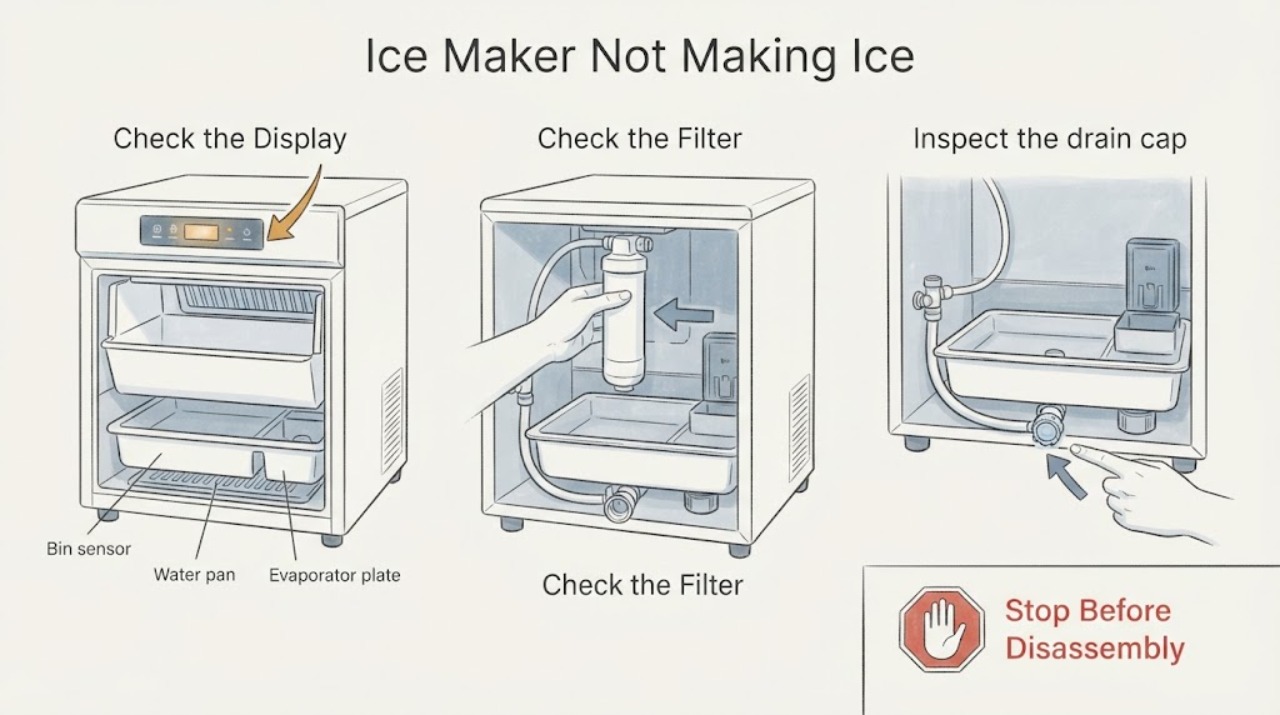
With the unit stopped, inspect only the accessible water-supply line and connection. Confirm the supply valve is fully open, the line is not kinked or pinched behind the cabinet, and any installed filter is seated and not visibly clogged. Do not loosen a pressurized fitting or pull the appliance out alone.
Expected result: The supply is closed/restricted, the line is kinked or damaged, the filter is visibly blocked or unseated, or the accessible supply path is open and intact.
Next step: Correct only an obvious valve setting or accessible kink permitted by the installation, then observe whether the unit can complete a cycle without overflow. Leave a damaged line, leaking fitting or unresolved filter issue to qualified service and do not substitute a filter or part without model confirmation.
Why this matters
Why: Whirlpool lists a kinked line, a not-fully-open valve and a clogged filter as causes of poor ice production. A clear external supply path removes those obvious restrictions but does not prove that the inlet valve or another internal component is good.
-
Check 3
Inspect the drain cap at the bottom of the water pan inside the storage bin. With the ice maker off and safe to handle, loosen the cap only as Whirlpool describes, allow the pan to drain completely, and replace the cap securely; do not remove covers or the cutter grid.
Expected result: The cap is loose, the pan drains when checked, or the cap was already secure and the no-ice/repeated-fill symptom remains.
Next step: If the cap was loose, secure it and monitor one normal cycle for a return to stable water level and ice production. If the cap is secure or water still overfills, continue to the drain-hose check and then stop for service rather than adjusting an internal control.
Why this matters
Why: Whirlpool says a loose drain cap lets water leave the pan and can cause thin or no ice, and its Product Help gives the same drain-and-replace check. This can explain no ice without proving a failed water valve or pump.
-
Check 4
From outside the cabinet, inspect the drain hose for a twist, kink, pinch or coil. The Whirlpool technical pointer specifically lists GI15NDXZS and says the drain run must not exceed 10 feet and must not be coiled or coupled; do not slide the ice maker out or alter plumbing alone.
Expected result: The hose is kinked/pinched, coiled, coupled or beyond the documented run, or it is visibly clear and correctly routed.
Next step: If the issue is an accessible routing mistake, have the installation corrected without opening the appliance. If the unit must be pulled from cabinetry, the hose is damaged, or the external path is clear but water still does not drain, leave the unit off and call qualified service.
Why this matters
Why: Whirlpool says a kinked drain hose can cause no ice and can even produce no or intermittent power; the exact-model pointer gives the model-family run limit and routing restrictions. A clear hose does not prove that the drain pump or control is functioning.
-
Check 5
If the unit has the Whirlpool-style bin sensor visible in the storage area, remove only loose ice or the scoop that is blocking it and wipe accessible mineral residue with a soft cloth and warm soapy water. Do not bend, bypass or electrically test the sensor.
Expected result: The sensor was blocked/dirty, or it was clear and the ice maker still fills without producing ice.
Next step: Restore only the visible sensor area and observe whether the unit reaches a normal ice-production state. If it still repeatedly fills or makes no ice, stop troubleshooting and provide the model, water behavior and drain observations to service.
Why this matters
Why: Whirlpool says a blocked, dirty or displaced bin sensor can cause over- or under-ice production. Clearing an accessible obstruction is different from diagnosing a failed sensor or control board.
-
Check 6
After the accessible supply, cap, drain and sensor checks, record whether the unit now maintains a normal water level and produces ice, without opening panels or ordering a component. Keep the model and serial label available for the service call.
Expected result: The unit completes a cycle and makes ice, or it continues filling, overflows, leaves water in the bin or makes no ice.
Next step: If the symptom persists or returns, leave the ice maker off and arrange Whirlpool or qualified appliance service. Do not remove the cabinet, bypass the sensor, energize loose wiring or replace an unverified part.
Stop if: Stop for any leak, electrical hazard, repeated overflow or need to move the built-in unit.
Why this matters
Why: A return to stable production supports an external water/drain/sensor condition as the immediate cause, but recurrence still needs service. A persistent pattern after these checks is outside safe user diagnosis; it does not identify the inlet valve, pump, sensor or control board by itself.
Use your observations
Decision map
Find the observation that best matches what you see, then follow the next safe action.
-
PATH 01Next step
What you see
Water stops when the normal control or water shutoff is turned off, and no water reached an electrical connection.
Do this next
Keep the appliance off while checking the accessible supply, drain cap, drain hose and bin-sensor area in that order.
Why this path and its safety boundary
Why it matters: The immediate flow is controllable, but the title does not distinguish a drain-path problem from a fill/control problem.
-
PATH 02Next step
What you see
The drain cap is loose or the drain hose is kinked, pinched, coiled or incorrectly routed.
Do this next
Correct only the accessible installation issue, then monitor a normal cycle. If correction requires moving the under-counter unit or water still does not drain, use qualified service.
Why this path and its safety boundary
Why it matters: Whirlpool documents these drain conditions as causes of thin/no ice or no ice, and the exact-model pointer gives GI15NDXZS drain-hose limits.
-
PATH 03Next step
What you see
The supply path, drain cap, drain hose and accessible sensor are clear, but the unit still fills repeatedly or never produces ice.
Do this next
Leave the ice maker off and schedule Whirlpool or qualified appliance service with the exact model/serial, whether water stops when off, where water appears and what the drain checks showed.
Why this path and its safety boundary
Why it matters: The remaining symptom needs model-specific service diagnosis; it is not enough evidence to name an inlet valve, pump, sensor or control board.
-
PATH 04Next step
What you see
Water reaches an outlet or control, the cord/wiring is damaged, the unit sparks or smells burnt, or the appliance must be pulled from cabinetry to inspect the hose.
Do this next
Stop use, shut off the water if safely accessible, disconnect power only from a dry safe location, and call qualified appliance/plumbing service. Do not open panels, bypass sensors or make live measurements.
Why this path and its safety boundary
Why it matters: This is outside a safe user-level water-path check and may create electrical, water-damage or lifting hazards.
Helpful context
Understand the symptom
What the filling symptom does and does not prove
The assigned problem is no ice, with a title describing water that keeps entering the unit. That observation does not identify the failed part. Water can be entering but not leaving through the drain path, the water pan can lose water through a loose cap, or a sensor/control condition can prevent normal production. Whirlpool's exact-model page identifies the GI15NDXZS family, while the Product Help checks below are for Whirlpool freestanding/under-counter ice makers; keep the model label available whenever a manual or service visit is needed.
Use a safe stop before inspecting water paths
Do not keep running an appliance that is overflowing, leaking toward an outlet or leaving standing water in the cabinet. Use the normal control to stop it and close the accessible water shutoff. Disconnect power only if the plug and surrounding area are dry and safe to reach; do not remove panels or make live electrical measurements. The checks below are limited to visible, user-accessible parts.
When checks do not resolve it
Need a professional?
Provide the exact model/serial, whether the flow stops with the control or water shutoff, the location and timing of water, drain-cap and hose observations, and whether the bin sensor was blocked. Request model-specific diagnosis before ordering a component.
Common questions
FAQ
Does repeated filling prove the Whirlpool ice-maker inlet valve is bad?
No. The symptom can coexist with a loose drain cap, kinked or incorrectly routed drain hose, water-supply restriction or bin-sensor condition. Whirlpool guidance does not support selecting the inlet valve from the filling report alone.
What should I check first when this under-counter ice maker makes no ice?
After stopping any active overflow safely, check the accessible water supply, the drain cap in the water pan, the visible drain-hose routing and any accessible bin-sensor obstruction. Leave the unit off and call service if water persists or the check would require moving or opening the appliance.
Can I pull the ice maker out to inspect the drain hose?
Do not pull a built-in under-counter ice maker alone or continue if the hose is inaccessible. Whirlpool warns that drain routing affects operation and the exact-model pointer gives a maximum run; have qualified service correct a concealed, damaged or incorrectly routed hose.
Read the exact guide
Official sources
- How to Install the Drain Cap - Product Help | WhirlpoolWhirlpool Corporation · The opened Whirlpool Product Help page states that the cap must fit securely on the water pan and gives the accessible drain-and-replace check; it does not establish a valve or pump diagnosis.
- GI15NDXZS | WhirlpoolWhirlpool Corporation · The opened Whirlpool Owner Center page identifies GI15NDXZS as a Gold 15-inch Ice Maker with Reversible Door, provides Product Help and service links, and lists no currently available model documents. It supports identity and escalation, not a specific failed component.
- Training Pointer - W10691113 (5ft Hose)Whirlpool Corporation · The opened Whirlpool technical pointer lists Whirlpool among the affected brands, names GI15NDXZS in the model list, and states that the drain run must not exceed 10 feet and must not be coiled or coupled. It supports installation routing only, not a replacement-part fit or internal repair.
- Whooshing Noise - Freestanding Ice Maker - Product Help | WhirlpoolWhirlpool Corporation · The opened Whirlpool Product Help page supports checking a fully opened water supply and a secure drain cap; it is used here only for those external checks, not for a noise diagnosis.
- Low Ice Production - Freestanding Ice Maker - Product Help | WhirlpoolWhirlpool Corporation · The opened Whirlpool Product Help article explicitly addresses Whirlpool ice makers and supports external checks for a no-ice symptom. It does not identify the failed component in GI15NDXZS0 or authorize internal repair.
Community feedback
Share a repair observation
Share a plain-text repair observation. Accepted observations are published automatically; this page may take a moment to update.