
On this page
Start here
Quick answer
A Whirlpool ice maker that is not turning on should first be separated into no household power, an Off switch or raised shutoff arm, an automatic stop caused by the bin or door, a jammed ejector, or a water, filter, drain, or internal fault. Check the safe power path, the model-specific On control and bin, the visible water and filter path, and—on freestanding units—the drain route. Stop for a repeated electrical trip, water leak, damaged wiring, a service light that returns, or failure after these checks.
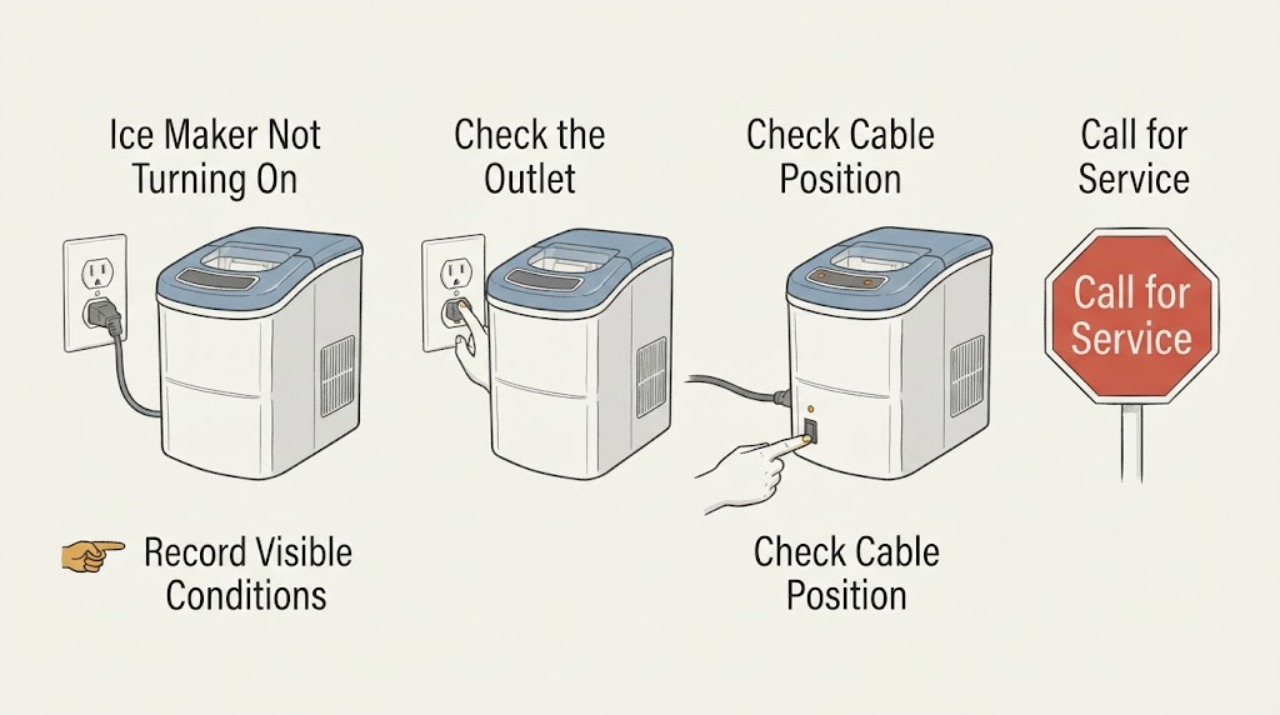
Work through in order
Diagnostic checks
Use only checks that match the exact appliance or system and its official guide.
-
Check 1
Identify the ice-maker type and what “not turning on” means: refrigerator-mounted or freestanding, no display or lights, display on but ice maker inactive, an arm or switch in Off, or no ice after a recent installation. Record the model and any service or cleaning light.
Expected result: The cabinet is dark, the ice maker has power but the control is off, the wire arm or switch is in the off position, or the machine is powered but produces no ice.
Next step: Use the exact model manual to identify the switch, arm, bin sensor, and expected first-batch timing before testing further.
Why this matters
Why: A dark unit keeps household power in scope; a powered unit may simply be switched off or automatically shut off because the bin is full, a door is open, or the bin is removed. “No ice” is not enough to identify a failed ice-maker motor.
-
Check 2
From a dry location, check that the ice maker or refrigerator plug is fully seated in the correct grounded outlet and check the accessible breaker, fuse, or GFCI. Do not use an extension cord or open an electrical cover.
Expected result: The outlet is dead, a breaker or GFCI is tripped, the cord or receptacle is damaged, or power is normal but the ice maker remains dark.
Next step: Stop for heat, moisture, damage, or a breaker that trips again and arrange qualified service. Continue only when the supply is safe and stable.
Why this matters
Why: Whirlpool troubleshooting treats power supply and household protection as first checks for a no-power condition. A repeat trip or damaged connection is an electrical fault boundary.
-
Check 3
With the ice maker door or bin access open only as the manual permits, verify that the on/off switch is On or the wire shutoff arm is fully down. Check that the storage bin is seated, the door is closed, and no ice is wedged in the ejector arm; remove only a loose jam with a plastic utensil.
Expected result: The control is Off, the arm is raised, the bin or door is not seated, the ejector is jammed, or these conditions are normal.
Next step: Correct one visible control, bin, door, or loose-ice condition and observe. Do not force the arm, use a sharp tool, or reach into a moving mechanism.
Why this matters
Why: Whirlpool states that control styles vary, automatic shutoff responds to bin or door conditions, and an ice bridge can jam the ejector. A normal control and clear ejector shifts attention to water, temperature, filter, drain, or internal service conditions.
-
Check 4
Verify the visible water shutoff is fully open and the water line is connected without a kink. If the ice maker is in a refrigerator, check whether a recently replaced filter is locked and sealed; use the exact manual for a filter-bypass or test procedure.
Expected result: The water supply is off or restricted, the line is kinked, a filter is mis-seated or overdue, or water and filter conditions are normal.
Next step: Correct only the visible supply or filter condition and allow the model’s documented production time. Arrange service if water does not return or the filter housing leaks.
Why this matters
Why: Whirlpool identifies restricted water supply and an improperly installed or clogged filter as common causes of low or absent ice production. A water condition can appear as a no-start complaint even when the control has power.
-
Check 5
For a freestanding unit, inspect the visible drain hose alignment, kink, connection, and model-approved drain configuration without pulling the appliance from a cabinet or disconnecting wet plumbing. If the ice maker has a cleaning or service light, follow the exact manual rather than entering service diagnostics.
Expected result: The hose is kinked, too high, too long, or misaligned, the drain is backed up, the condenser is visibly obstructed, or the drain and airflow path appear normal.
Next step: Correct only a safe visible routing issue and restore power once. If no operation returns, a service light reappears, or the concern persists after the exact manual checks, arrange qualified service.
Why this matters
Why: Whirlpool documents that incorrect drain routing can cause no ice and intermittent or absent power on some freestanding ice makers, while a dirty condenser can reduce capacity and stress components. A normal external path keeps an internal fault in scope.
Use your observations
Decision map
Find the observation that best matches what you see, then follow the next safe action.
-
PATH 01Next step
What you see
The outlet is dead, a protection device trips again, or the ice maker remains dark with a confirmed safe supply.
Do this next
Stop resetting the circuit, keep the unit out of service, and obtain qualified electrical or appliance service.
Why this path and its safety boundary
Why it matters: An electrical supply or appliance electrical fault is more likely than a water or ice setting.
-
PATH 02Next step
What you see
The unit has power, but the switch or arm is Off, the bin or door is not seated, or an ejector jam is visible.
Do this next
Correct the visible condition using the exact manual and observe one cycle; do not force the arm or use sharp tools.
Why this path and its safety boundary
Why it matters: A control state, automatic shutoff, or mechanical ice blockage is more likely than a failed control board.
-
PATH 03Next step
What you see
The control is On and the ejector is clear, but the water line or filter is restricted or the freestanding drain is kinked or misrouted.
Do this next
Correct the visible line, filter, or drain condition, then allow the documented production time and arrange service if operation does not return.
Why this path and its safety boundary
Why it matters: Water delivery or drain installation is more likely than a no-power fault.
-
PATH 04Next step
What you see
Power, control, bin, ejector, water, filter, and visible drain checks are normal, but the ice maker still does not operate or a service light returns.
Do this next
Leave the unit on or off as the manual directs and contact Whirlpool authorized service with the full model, symptoms, lights, and checks completed.
Why this path and its safety boundary
Why it matters: An internal motor, valve, sensor, wiring, or control fault requires model-specific diagnosis.
Helpful context
Understand the symptom
Separate no power from no ice
A dark ice maker, an ice maker that is switched off, and a powered ice maker that cannot fill are different failure paths. Whirlpool’s guidance separates control position, automatic shutoff, ice jams, water and filter restrictions, and freestanding drain routing.
Keep control and timing model-specific
Whirlpool uses several ice-maker switch and wire-arm styles, and refrigerator-mounted and freestanding units have different water and drain arrangements. Use the full model manual for the control location, reset or test sequence, and expected first-batch timing.
Only after diagnosis
Potential parts
- Whirlpool ice-maker water filter or water inlet component
Consider only after a confirmed water-flow restriction or qualified diagnosis identifies a filter or inlet component for the exact model.
Confirm the full refrigerator or ice-maker model and filter system before ordering. - Whirlpool freestanding ice-maker drain hose or pump
Consider only when the exact model uses the relevant drain configuration and a corrected visible route does not restore operation.
Drain components and limits are configuration-specific; verify the exact manual and diagnosis.
When checks do not resolve it
Need a professional?
Use Whirlpool authorized or qualified appliance service when the unit has safe power but remains inactive after control, bin, ejector, water, filter, and model-approved drain checks, or when an internal motor, valve, sensor, wiring, or control fault is suspected.
Have this ready
- Provide the full model and serial, refrigerator-mounted or freestanding type, power status, switch or arm position, bin and ejector condition, water and filter observations, drain setup, service light, and checks completed.
Common questions
FAQ
Why does the ice maker look on but make no ice?
Whirlpool says an ice maker can automatically stop when the bin is full, the door is open, or the bin is removed. Check those conditions, the water supply, freezer temperature for refrigerator-mounted units, and the exact model manual before assuming a failed part.
Can a drain hose cause a freestanding ice maker to seem powered off?
Yes, on applicable freestanding models Whirlpool states that an incorrect, kinked, or excessive drain route can contribute to no ice and intermittent or absent power. Check only the visible route and the exact installation instructions; do not disassemble wet plumbing.
Read the exact guide
Official sources
- How to Turn the Ice Maker On and Off - Product Help | WhirlpoolWhirlpool Corporation · Applies to Whirlpool refrigerator ice makers; the control location and arm or switch style differ among models.
- Not Draining - Ice Maker - Product Help | WhirlpoolWhirlpool Corporation · Applies where the assigned ice maker has a gravity or pump drain; confirm the exact model and installation before changing a drain route.
- Cleaning the Ice Maker - Product Help | WhirlpoolWhirlpool Corporation · Applies to Whirlpool freestanding ice makers with the described cleaning components; follow the exact manual for access.
- How to Troubleshoot the Freestanding Ice Maker - Product Help | WhirlpoolWhirlpool Corporation · Applies to Whirlpool freestanding ice makers; use the exact model manual for service access and drain configuration.
- Ice Maker Not Working - Troubleshooting - Product Help | WhirlpoolWhirlpool Corporation · Applies to Whirlpool refrigerator ice makers; exact switch, arm, temperature, and filter behavior varies by model.
Community feedback
Share a repair observation
Share a plain-text repair observation. Accepted observations are published automatically; this page may take a moment to update.