
On this page
Start here
Quick answer
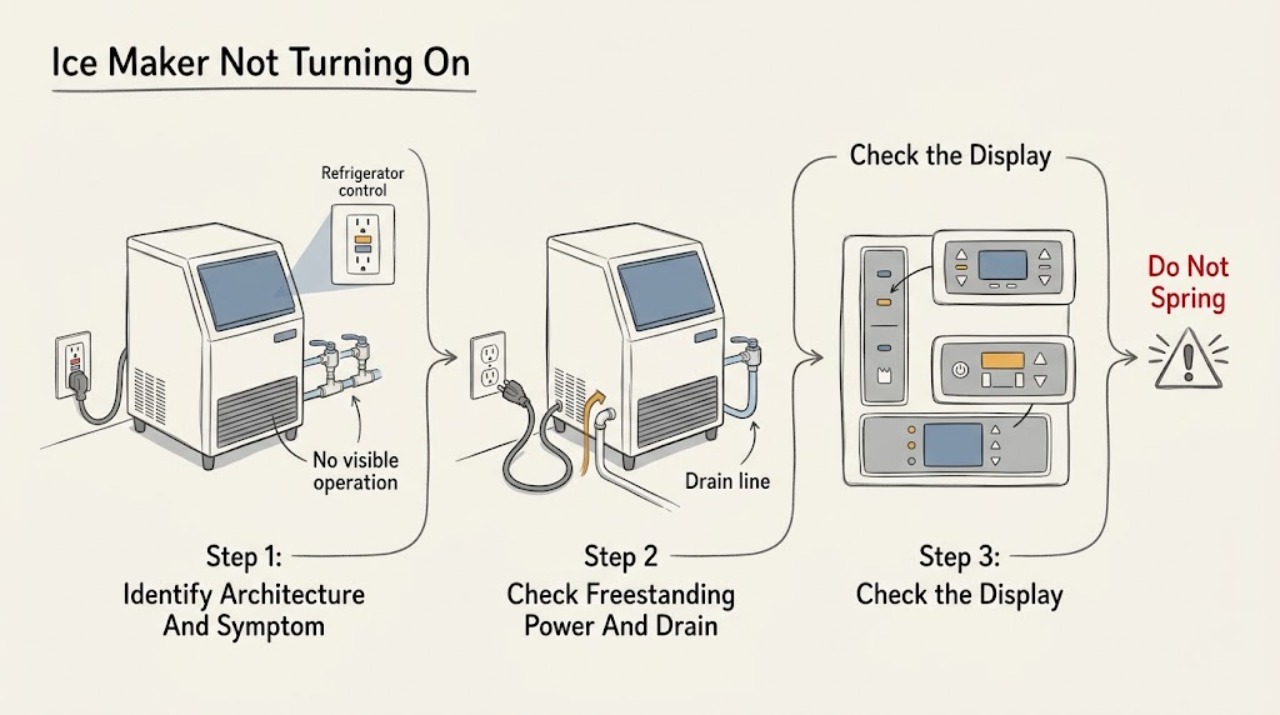
First decide which KitchenAid architecture is affected: a standalone or undercounter ice maker such as the KUIX or KUID product families, or an ice maker built into a refrigerator. If a freestanding unit has no display or operation, check the model-approved 3-prong outlet, breaker or GFCI, plug, water supply, and visible drain hose; KitchenAid specifically warns that a kinked or incorrectly routed drain hose can cause no or intermittent power on covered freestanding models. If the refrigerator itself has power but its ice maker does not start, check the exact model's ice-maker on/off control, shutoff arm or display mode, water supply, and filter state, then make only the model-approved one-minute power cycle if directed. Do not assume a refrigerator's wire-arm or digital control applies to a standalone unit, and do not open panels or perform live tests. If the outlet is dead, protection trips again, the cord or water connection is damaged, the unit remains inactive after external checks, or diagnosis requires a control, motor, valve, pump, wiring, or sealed-system access, stop and arrange qualified service.
Before you begin
Safety first
- Owner checks stop at model identification, accessible outlet and protection observation, visible plug, water and drain checks, model-approved ice-maker controls, and a single manual-approved reset when applicable. Panel removal, wiring, motor, pump, valve, heater, sensor, control, and refrigeration work require qualified service.
Work through in order
Diagnostic checks
Use only checks that match the exact appliance or system and its official guide.
-
Check 1
Read the complete KitchenAid model number and classify the appliance. For a standalone or undercounter ice maker, note whether the machine has any display, light, fan, water sound, or other operation. For a refrigerator-built-in ice maker, note whether the refrigerator display and interior lights work and whether only the ice-maker function is inactive.
Expected result: The unit is a freestanding or undercounter ice maker with no operation, a refrigerator has power but its ice maker is inactive, or the appliance type and model remain uncertain.
Next step: Follow only the matching checks below and the exact model manual. If the model label is inaccessible without removing a panel, stop and arrange qualified service.
Stop if: Stop for a damaged cord or tubing, water near electrical parts, burning odor, abnormal heat, or any need to expose wiring.
Why this matters
Why: KitchenAid documents separate freestanding and refrigerator ice-maker paths with different power and control arrangements. A completely inactive freestanding cabinet follows the supply and installation path; a powered refrigerator with no ice production may simply have an off control, water restriction, or model-specific fault.
-
Check 2
For a standalone or undercounter ice maker, inspect the plug, cord, and accessible outlet without opening the cabinet. Verify the outlet with a small lamp or other safe appliance, check a tripped breaker or GFCI once, confirm the water supply is open, and look for a kinked drain hose or an obviously incorrect visible drain arrangement. Do not use an extension cord.
Expected result: The outlet is dead, the breaker or GFCI is tripped, the plug is loose or cord damaged, water is off, the drain hose is kinked, or the unit remains completely inactive with a verified supply.
Next step: Correct only a clearly loose plug, open water valve, visible hose kink, or single tripped protective device when safe, then make one normal start attempt. If the outlet is dead, protection trips again, the cord is damaged, or the unit stays inactive, stop and arrange service or an electrician as appropriate.
Stop if: Do not repeatedly reset protection, replace a breaker with a larger rating, use an extension cord, pull a built-in unit out by its cord or hose, or perform live voltage tests.
Why this matters
Why: KitchenAid's freestanding no-power guidance connects operation to the correct grounded outlet, water and drain setup, and protective device. It specifically says a kinked or incorrect drain hose can cause no or intermittent power on the covered freestanding path; a working supply with no response makes an internal fault more likely but does not identify it.
-
Check 3
Still on the freestanding path, use the exact owner's manual to verify that the ice maker is turned on and that the visible water line and filter, if fitted, are correctly connected. Inspect only accessible areas for an ice jam at the ejector or another user-removable obstruction; use a plastic utensil only where the model guidance permits it. Do not remove the cover, cutter, pump, or control housing.
Expected result: The ice maker is off, a model-specific control responds, the water line or filter is restricted, an accessible ejector jam is present, or all external conditions are normal but the unit does not start.
Next step: Restore only the model-approved on state, clear an accessible jam without force, or correct a visible water/filter issue according to the manual, then observe one normal cycle. If the unit remains inactive, stop for service.
Stop if: Do not force an ejector, bypass a sensor or shutoff, remove internal panels, or reach into a moving or energized mechanism.
Why this matters
Why: KitchenAid's freestanding troubleshooting page lists an off control, jammed ejector, filter or water-system issue, and water-line condition as separate possibilities and says ice-maker types vary. These checks do not prove a failed motor, control, pump, or refrigeration component.
-
Check 4
For a refrigerator-built-in ice maker, verify the model-specific on state. Depending on the model, inspect the accessible wire shutoff arm, ice-maker switch, or digital control; make sure the storage bin is seated if the manual uses it as part of the control path. Check whether the refrigerator is in a special mode that disables ice making, then confirm the water supply and filter are properly installed.
Expected result: The wire arm is raised, a switch or display setting is off, the bin or control is not seated as the manual requires, a special mode is active, or the refrigerator controls are on but the ice maker remains inactive.
Next step: Use only the exact manual's control sequence to enable the ice maker, seat the bin if required, and correct a visible filter or water-supply issue. If the model's control is inaccessible or operation does not return, stop rather than opening the appliance.
Stop if: Do not force the wire arm, bypass a door or bin switch, or remove the ice-maker assembly to test it.
Why this matters
Why: KitchenAid says refrigerator ice-maker on/off methods vary by model and that accidental shutoff is a common reason for no ice. A refrigerator can therefore have normal lights and cooling while the ice-maker function is disabled; a correct on state with no operation shifts attention to water flow or service.
-
Check 5
If the refrigerator ice-maker control is on, compare the freezer temperature with the exact model guidance and check whether the water supply is open, the line is kinked, and a recently changed filter is locked and sealing correctly. If the manual provides a power cycle or reset, perform that single model-approved procedure and then wait the manual's stated time before judging the result.
Expected result: The freezer is too warm for the model, the water line or filter restricts flow, the ice maker begins after the approved reset, or the refrigerator remains powered but the ice maker still does not cycle.
Next step: Correct only visible water or filter conditions and allow the model's recovery period. If the ice maker remains inactive, arrange model-specific service and provide the technician the control, temperature, water, and reset observations.
Stop if: Do not repeatedly power-cycle, bypass the control, apply heat to a frozen line, or perform live electrical tests.
Why this matters
Why: KitchenAid identifies freezer temperature, water supply, filter condition, and the ice-maker state as refrigerator checks. A reset can clear a minor control state, but failure after correct external checks does not identify a valve, motor, heater, sensor, or control-module failure.
-
Check 6
If the matching power, water, drain, and control checks do not restore operation, record the model, appliance architecture, display or light state, breaker or GFCI history, drain and water observations, control position, and any sound or odor. Keep the appliance or ice-maker function out of service when water or electrical risk is present and arrange qualified KitchenAid service.
Expected result: The appliance starts after an external correction, remains dead with a verified supply, repeatedly loses power, has a leak or damaged connection, or needs access to a motor, pump, valve, control, wiring, sensor, or refrigeration system.
Next step: Disconnect power only when safe and provide the technician the exact model and symptom record. Let qualified service determine the architecture-specific fault and compatible repair.
Stop if: Do not open panels, bypass interlocks, bridge wiring, perform live tests, replace internal parts by guesswork, or work on sealed refrigeration components.
Why this matters
Why: The official KitchenAid material supports external supply and model-specific control checks, not symptom-based identification of an internal component. Continuing to operate through a repeated protective trip, leak, burning odor, or damaged cord can increase risk.
Use your observations
Decision map
Find the observation that best matches what you see, then follow the next safe action.
-
PATH 01Safety boundary
What you see
A standalone or undercounter KitchenAid ice maker has no display or visible operation.
Do this next
Check the accessible power, water, and drain conditions once. If a verified outlet is live and the unit remains inactive, stop and arrange service.
Why this path and its safety boundary
Why it matters: This pattern makes an external outlet, breaker or GFCI, cord, drain, water, or control-on issue more likely than a refrigerator ice-maker setting. KitchenAid specifically lists drain routing as a possible cause of no or intermittent power on the freestanding path.
Safety stop: Do not remove the cabinet, perform live tests, or repeatedly reset protection.
-
PATH 02Safety boundary
What you see
A freestanding unit starts only intermittently, loses operation after being pushed into cabinetry, or has a visible kinked or poorly routed drain hose.
Do this next
If the hose is safely accessible and the manual permits it, remove the visible kink without stressing the connection, then make one normal start attempt. If access requires moving the appliance or the symptom returns, arrange service.
Why this path and its safety boundary
Why it matters: KitchenAid's freestanding no-power guidance makes drain-hose routing a relevant installation check and says a kink can cause no or intermittent power. This is not evidence that the internal power board or pump has failed.
Safety stop: Do not pull an undercounter unit by its hose or cord, alter drain routing beyond the manual, or open the cabinet.
-
PATH 03Safety boundary
What you see
The refrigerator display and lights work, but the built-in ice maker does not start and its wire arm, switch, or digital setting is off or in a model-specific disabled mode.
Do this next
Use the exact owner's manual to enable the ice maker, seat the bin if required, and wait for the model's first cycle. If it remains inactive, continue only with external water and temperature checks before service.
Why this path and its safety boundary
Why it matters: KitchenAid says an accidentally turned-off refrigerator ice maker is a common no-ice cause and that the control location and method vary by model. Normal refrigerator power does not prove the ice-maker control is enabled.
Safety stop: Do not force the arm, bypass a switch, or remove the ice-maker assembly.
-
PATH 04Safety boundary
What you see
The refrigerator ice-maker control is on, the refrigerator has normal power, and visible water, filter, and temperature checks are correct, but the ice maker still does not cycle.
Do this next
Stop owner troubleshooting and arrange qualified KitchenAid service with the model and observations. Do not order or install a component based only on no-start behavior.
Why this path and its safety boundary
Why it matters: The symptom is no longer explained by the documented external checks. A motor, heater, valve, sensor, control, wiring, or frozen internal path may be involved, but the symptom alone cannot identify which one.
Safety stop: Do not open panels, bridge wiring, apply heat, perform live tests, or bypass the shutoff system.
Helpful context
Understand the symptom
Identify the power architecture before resetting anything
KitchenAid uses the ice-maker name for more than one product path. A KUIX or KUID-style standalone or undercounter machine has its own power cord, water inlet, drain arrangement, controls, and ice-making cabinet. A refrigerator ice maker receives its operating context from the refrigerator and may use a wire shutoff arm, a switch, or a digital menu. Record the complete model number and whether the refrigerator itself has lights and a working display. A no-power freestanding unit follows an outlet, protection, drain, and water path; a powered refrigerator with an inactive ice maker follows the model's ice-maker control and water path.
Freestanding ice-maker checks are not refrigerator checks
KitchenAid's freestanding no-power guidance includes a visible drain hose, water supply, outlet, cord, breaker or GFCI, and the correct installation arrangement. It states that a kinked or incorrect drain hose can result in no or intermittent power on the covered freestanding path. That does not mean a refrigerator ice maker has the same drain or power dependency. Do not pull an undercounter machine out of cabinetry or remove a panel just to reach a hose; stop if access is not safely external and permitted by the model instructions.
A refrigerator ice maker may be off even while the refrigerator works
On the refrigerator path, KitchenAid says the ice-maker control can be located on the ice-maker unit, inside the refrigerator, behind the bin, or in a digital display depending on the model. A raised wire shutoff arm or a disabled display setting can stop ice making without removing refrigerator power. Verify the model-specific state, water supply, filter seating, and freezer temperature. If a reset is provided for your model, use only that manual's procedure; do not use a generic button sequence.
Stop when the symptom points inside the appliance
If a verified outlet and model-approved controls do not restore operation, the symptom does not identify a failed motor, control, valve, pump, heater, wiring harness, or refrigerator component. Do not bypass a shutoff, bridge a switch, probe energized wiring, or order a part from the phrase not turning on. Keep water away from electrical parts and arrange qualified service for internal access, repeated protective-device trips, damaged cords or tubing, leaks, burning odor, or abnormal heat.
When checks do not resolve it
Need a professional?
Safety scope: Owner checks stop at model identification, accessible outlet and protection observation, visible plug, water and drain checks, model-approved ice-maker controls, and a single manual-approved reset when applicable. Panel removal, wiring, motor, pump, valve, heater, sensor, control, and refrigeration work require qualified service.
Common questions
FAQ
Why does my KitchenAid ice maker have no power?
First determine whether it is a standalone or undercounter ice maker or a refrigerator-built-in ice maker. Freestanding KitchenAid guidance includes the outlet, breaker or GFCI, water supply, and visible drain hose; a kinked or incorrectly installed drain hose can cause no or intermittent power on that path. A refrigerator ice maker can be off while the refrigerator itself still has power.
Can I use the refrigerator ice-maker wire-arm instructions on a freestanding KitchenAid ice maker?
No. KitchenAid publishes separate freestanding and refrigerator paths. Use the exact model manual for the freestanding machine's controls, water, and drain arrangement; do not assume a refrigerator shutoff arm, bin switch, or digital-menu sequence exists on an undercounter unit.
What should I check when the refrigerator has power but the KitchenAid ice maker does not start?
Check the exact model's ice-maker on/off state, wire arm or display mode, bin seating if the manual uses it, water supply, filter seating, and freezer temperature. If the model provides a reset or one-minute power cycle, use that procedure once and wait the stated recovery time. Persistent inactivity needs qualified service.
Can a kinked drain hose stop a freestanding KitchenAid ice maker from turning on?
KitchenAid's freestanding no-power guidance says a kinked or incorrectly installed drain hose can cause no or intermittent power on the covered freestanding path. Inspect only an accessible hose and follow the exact installation instructions; do not pull a built-in unit out by its hose or cord.
When should I stop troubleshooting a KitchenAid ice maker that will not turn on?
Stop for a dead outlet, a protective device that trips again, a damaged cord or water connection, a leak, burning odor, abnormal heat, water near electrical parts, or any need to open a panel. A verified supply with no operation does not identify the failed internal part, so arrange qualified KitchenAid service rather than performing live tests or bypassing controls.
Read the exact guide
Official sources
- How to Turn the Ice Maker On and OffKitchenAid Product Help · Refrigerator-built-in ice-maker path only; KitchenAid says the method varies by model.
- Not Powering On - Freestanding Ice MakerKitchenAid Product Help · Freestanding ice-maker path only; do not apply its drain or power dependency to refrigerator-built-in ice makers.
- 18-Inch 35 lb. Automatic Ice Maker with Clear Ice Technology in PrintShield® Stainless Steel PrintShield™ Stainless Finish KUID318SPSKitchenAid · Exact KUID318SPS product example only; use its drain, control, and cleaning details only when the reader's model matches.
- 15-Inch Automatic Ice Maker with Clear Ice Technology in PrintShield® Finish Stainless Steel with PrintShield™ Finish KUIX535HPSKitchenAid · Exact KUIX535HPS product example only; do not transfer its controls, drain pump, dimensions, or internal parts to another model.
- Ice Maker Not Working - TroubleshootingKitchenAid Product Help · Full-size refrigerator ice makers covered by this support path; exact controls and reset steps vary by model.
- How to Troubleshoot the Freestanding Ice MakerKitchenAid Product Help · Freestanding ice-maker troubleshooting path; the article says ice-maker types vary and directs owners to the exact manual.
- Ice MakersKitchenAid Product Help · Brand-level category identity only; use the exact model manual for controls and installation.
- Not Making Ice - Existing Installation - Built-In RefrigeratorKitchenAid Product Help · Built-in refrigerator existing-installation path; exact reset and control behavior remains model-specific.
Community feedback
Share a repair observation
Share a plain-text repair observation. Accepted observations are published automatically; this page may take a moment to update.