
On this page
Start here
Quick answer
First identify the architecture: this guide covers an ice maker built into a Bosch refrigerator or freezer, not a separate countertop ice-making appliance, which needs its own manual. Confirm that the refrigerator has power, ice production is enabled on the model's controls, the ice bin is fully inserted and not obstructing the fill-level sensor, the freezer is cold enough for the model, and the water supply and hose are connected without an obvious kink. Bosch manuals list switched-off ice production, a misinserted bin, a warm freezer, no water supply, low pressure, a kinked hose, and an ice maker without power as different causes. Make only safe, model-documented checks; do not bypass a sensor, probe wiring, remove the built-in ice maker, or use heat or sharp tools to clear ice. If the ice maker has no power, an E02 error, a recurring fault, or no response after one documented reset, leave the water and appliance safe and arrange Bosch service.
Before you begin
Safety first
- Do not remove the built-in ice-maker assembly, bypass or probe a fill-level sensor, insert tools into a fill tube, use a hair dryer or sharp object to clear ice, open refrigerator panels, or test energized wiring. Turn off the water supply for a damaged hose or leak and use Bosch service for internal faults.
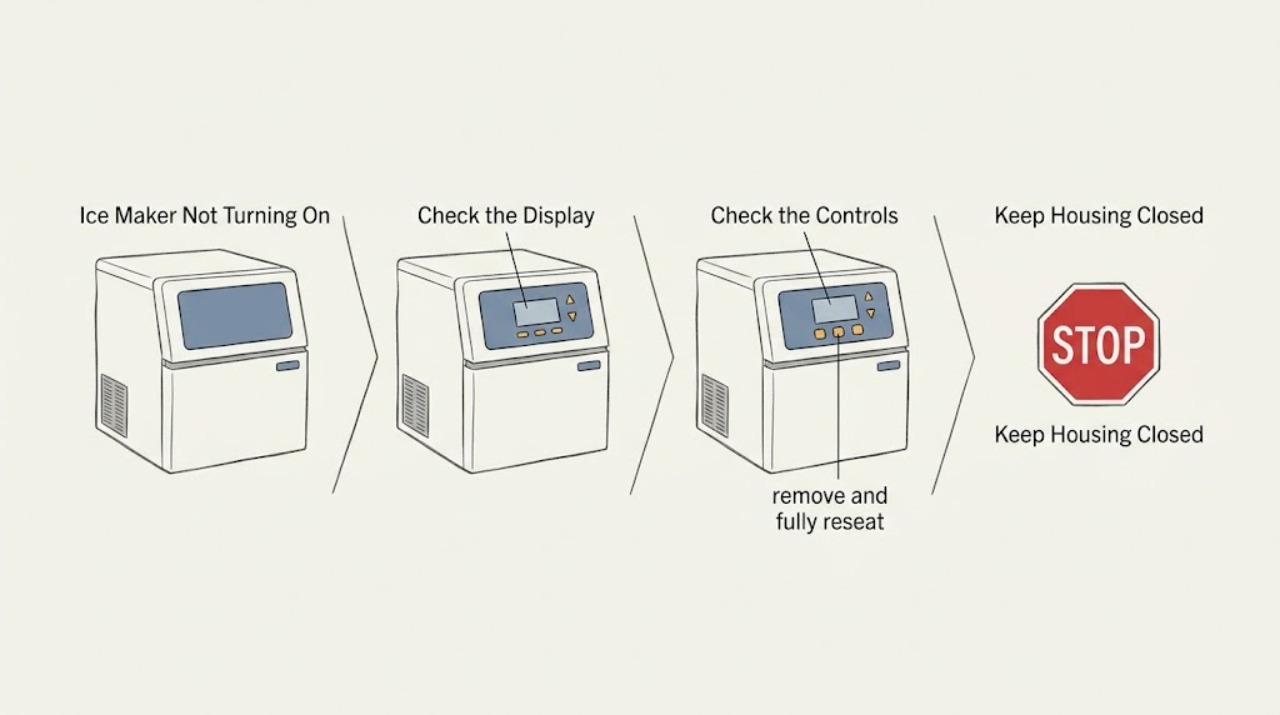
Work through in order
Diagnostic checks
Use only checks that match the exact appliance or system and its official guide.
-
Check 1
Confirm that the problem is the ice maker built into a Bosch refrigerator or freezer. Check whether the host refrigerator has interior lights or a display, and whether the complaint is no ice, no water fill, no ice-maker indicator, or no response from the ice-maker control.
Expected result: The host appliance is powered but the ice maker is inactive, or the refrigerator and ice-maker controls are both dark.
Next step: Use the integrated-ice-maker checks below only when the host appliance has power. For a dark host, check the refrigerator's supply safely and arrange Bosch service if the supply is present but controls remain dead. A separate ice-making appliance requires its own manual.
Why this matters
Why: A powered host with an inactive ice maker points to an ice-production setting, bin, temperature, or water path. A dark host suggests a refrigerator power or control problem before the ice maker can operate.
-
Check 2
Check the refrigerator display or ice-maker control for an Ice Off state, an ice-production toggle, a lock condition, or a model-specific mode that disables ice. Use only the exact manual's control sequence; do not press hidden reset holes or combine buttons based on another model.
Expected result: Ice production is visibly off or locked, or the controls show ice enabled with no ice-maker response.
Next step: Enable ice production or clear the documented lock once, then allow the model's normal production period. If the setting was already enabled or the fault returns, continue with the bin and water checks without opening the assembly.
Why this matters
Why: Bosch manuals state that ice production can be switched off. If the setting is enabled and the control still shows no response, a bin, temperature, water, sensor, or ice-maker power fault is more likely.
-
Check 3
With the refrigerator operating normally, remove and fully reseat the user-removable ice bin as the manual shows. Make sure no bottle, food, ice scoop, or clumped ice blocks the bin area or fill-level sensor; do not pry frozen parts or store food in the ice container.
Expected result: The bin was not fully inserted, the fill-level area was blocked, or the bin is correctly seated and unobstructed.
Next step: Correct only the visible bin or obstruction issue and close the freezer. If the bin is cracked, the sensor is damaged, or the maker still does not respond, stop and arrange service rather than removing the assembly.
Why this matters
Why: Bosch identifies a misinserted ice container and a blocked fill-level gauge or sensor as conditions that can stop ice production even when the refrigerator has power. A correctly seated bin shifts suspicion elsewhere.
-
Check 4
Check the freezer temperature indication and whether the freezer door closes and seals normally. Do not guess a temperature from another Bosch model; compare the setting with the exact owner's manual and keep vents clear of a tightly packed load.
Expected result: The freezer is warmer than the model's required range, the door is not sealing, or the freezer is cold enough and the door closes normally.
Next step: Correct only an obvious door obstruction or documented temperature setting, then allow the appliance to stabilize. If the freezer cannot reach its normal temperature or the ice maker remains inactive, contact Bosch service.
Why this matters
Why: Bosch manuals list a freezer that is too warm as a reason the integrated ice maker may not work. A cold, sealed freezer makes the ice-production setting, water supply, filter, or maker power more relevant.
-
Check 5
From a safe, accessible position, check that the refrigerator's water supply is on, the visible water connection is secure, the hose is not kinked, and a recently replaced water filter is fully seated according to the model manual. Turn off the water supply before correcting a visible hose issue.
Expected result: The supply is off, the hose is kinked or visibly damaged, the filter is not seated, or the visible water path is normal.
Next step: Restore an obviously closed supply or reseat an intact filter only as the manual permits. Do not move the refrigerator or open the water system; if the hose is damaged, water leaks, or ice does not return, keep the supply off and call Bosch service.
Why this matters
Why: Bosch lists no water supply, low pressure, a kinked hose, and filter conditions as causes of an integrated ice maker not functioning or making deformed ice. A normal visible path does not rule out a concealed valve, fill tube, or internal fault.
-
Check 6
Record any E02 or other ice-related error, then perform at most one reset exactly as the model manual or Bosch's refrigeration error page describes. Do not repeat breaker cycles or attempt a manual harvest, electrical test, or hidden-button procedure.
Expected result: The ice maker resumes after the documented reset, or the same error/no-response condition returns.
Next step: If the condition returns, keep the water connection safe, avoid further test cycles, and contact Bosch service with the model number, error, control state, freezer temperature, bin position, filter history, and water-path observations.
Why this matters
Why: A one-time reset can clear a transient control state, but Bosch identifies E02 as an icemaker or ice-water-controls fault and directs support when it remains. Recurrence points to a fault beyond user settings or bin placement.
Use your observations
Decision map
Find the observation that best matches what you see, then follow the next safe action.
-
PATH 01Next step
What you see
The Bosch refrigerator has power, but ice production is switched off or a documented lock is active.
Do this next
Enable ice production or clear the documented lock once using the exact model manual. If the maker remains inactive, continue with bin, temperature, and water checks.
Why this path and its safety boundary
Why it matters: A control setting is more likely than an unpowered ice-maker assembly.
-
PATH 02Next step
What you see
The ice bin is not fully inserted, the fill-level sensor is blocked, or ice or food is stored where Bosch says it can block the maker.
Do this next
Remove only the visible obstruction and fully reseat an intact bin. Do not pry, bypass the sensor, or remove the ice-maker assembly; arrange service if the condition persists.
Why this path and its safety boundary
Why it matters: A bin-position or fill-level condition can stop production while the host refrigerator remains powered.
-
PATH 03Next step
What you see
The freezer is too warm, the door does not seal, or the host refrigerator is cooling abnormally.
Do this next
Correct an obvious obstruction or documented temperature setting and allow stabilization. If the freezer remains too warm, contact Bosch refrigerator service before replacing an ice-maker part.
Why this path and its safety boundary
Why it matters: The ice maker may be inhibited by the host freezer temperature or door condition rather than failing independently.
-
PATH 04Next step
What you see
The water supply is off, the filter is not seated, or a visible hose is kinked, while the ice maker has no fill water.
Do this next
Turn off water before correcting an obvious, intact connection or kink according to the manual. Keep the supply off for a damaged hose or leak and arrange Bosch service.
Why this path and its safety boundary
Why it matters: The external water path is more likely than a no-power ice-maker fault.
-
PATH 05Next step
What you see
Ice is enabled, the bin and freezer are normal, the visible water path is sound, but the maker is unpowered, shows E02, or remains unresponsive after one documented reset.
Do this next
Keep the appliance and water connection safe, do not open panels or bypass controls, and contact Bosch service with the model number and observations. A separate countertop unit requires its own service documentation.
Why this path and its safety boundary
Why it matters: An internal ice-maker, power, valve, sensor, or ice-water-control fault is more likely and is outside safe user checks.
Helpful context
Understand the symptom
Do not mix a built-in refrigerator ice maker with a standalone unit
The Bosch documents used here describe an ice maker integrated into a refrigerator or freezer: it depends on the host appliance's power, freezer temperature, water connection, filter, and ice-bin sensor. A separate countertop or freestanding ice maker has its own tank, pump, and controls, so its troubleshooting path is different. Confirm which appliance the complaint concerns and use its exact model manual before touching any control.
No ice is not always no power
An integrated Bosch ice maker can be powered while ice production is switched off, the bin is misaligned, the freezer is too warm, or the water path is unavailable. Conversely, a dark or unresponsive ice-maker control can indicate a host-appliance or ice-maker power fault. Treat the display, bin position, temperature, and water path as separate observations instead of assuming that replacing the ice maker will solve every no-ice symptom.
Keep the ice-maker service boundary intact
The fill-level sensor, wiring, water valve, and ice-maker assembly are inside a powered, plumbed refrigerator. Do not bypass a sensor, insert a screwdriver or skewer, remove the assembly, open electrical covers, or melt a frozen fill path with a hair dryer. If a hose is damaged, water is present, or an error returns, turn off the water supply when safely accessible and contact Bosch support.
When checks do not resolve it
Need a professional?
Contact Bosch service when the integrated maker has no power, an E02 or persistent error, a damaged bin, hose, or filter connection, no ice after the documented setting and supply checks, an abnormally warm freezer, or any fault that requires removing the assembly or opening panels.
Safety scope: Do not remove the built-in ice-maker assembly, bypass or probe a fill-level sensor, insert tools into a fill tube, use a hair dryer or sharp object to clear ice, open refrigerator panels, or test energized wiring. Turn off the water supply for a damaged hose or leak and use Bosch service for internal faults.
Have this ready
- Provide the refrigerator model and serial information, whether it is an integrated or separate ice appliance, host power/display status, ice-production setting, bin and sensor condition, freezer temperature or symptoms, water and filter history, any error code, and the result of one documented reset.
Common questions
FAQ
Why is my Bosch refrigerator ice maker not turning on?
For an integrated maker, check host power, the ice-production setting, the fully seated ice bin, freezer temperature, water supply, visible hose, and filter seating. Bosch lists each as a separate possible condition. If the maker has no power or the fault persists, arrange service rather than opening the assembly.
How do I turn on a Bosch refrigerator ice maker?
Use the exact refrigerator manual or display to enable ice production; Bosch controls differ by model. Do not use a hidden reset hole or another model's button combination. After enabling it, confirm the bin is inserted and the freezer and water supply are normal.
What does E02 mean on a Bosch ice maker?
Bosch identifies E02 as an icemaker fault or an ice-water-system control communication issue. Follow the Bosch error page's limited reset instruction once; if the code remains, contact Bosch support and do not remove or bypass the ice maker.
Can I use a hair dryer or screwdriver to free a Bosch ice maker?
No. Do not apply heat, insert sharp tools, bypass the fill-level sensor, or remove the integrated assembly. Those actions can damage plastic parts, water lines, or energized components. Keep the appliance safe and arrange Bosch service for a frozen or mechanically stuck maker.
Read the exact guide
Official sources
- Contact Us | Bosch Home AppliancesBSH Home Appliances Corporation · Bosch large-appliance support and service escalation
- Bosch refrigerator ice maker issueReddit r/appliancerepair · Anecdotal integrated Bosch refrigerator ice-maker thread with conflicting model-specific reports; useful only for conditional symptom framing, not confirmed repair guidance
- Bosch Refrigerator-Freezer User ManualBosch Home Appliances · Official Bosch integrated ice-maker guidance for production settings, ice-bin placement, freezer temperature, water supply, hose condition, filter context, power, and water-connection leakage; exact controls and requirements vary by model
- Bosch Refrigerator-Freezer User ManualBosch Home Appliances · Official Bosch integrated ice-maker troubleshooting for mains connection, water connection, freezer temperature, water supply, ice-maker switch, fill-level gauge, ice bin, and power failure; exact model architecture varies
- Bosch Refrigeration Error CodesBosch Home Appliances · Official Bosch error escalation for refrigeration controls, including E02 icemaker or ice-water-control faults and a limited power reset; codes and steps vary by model
Community feedback
Share a repair observation
Share a plain-text repair observation. Accepted observations are published automatically; this page may take a moment to update.