
On this page
Start here
Quick answer
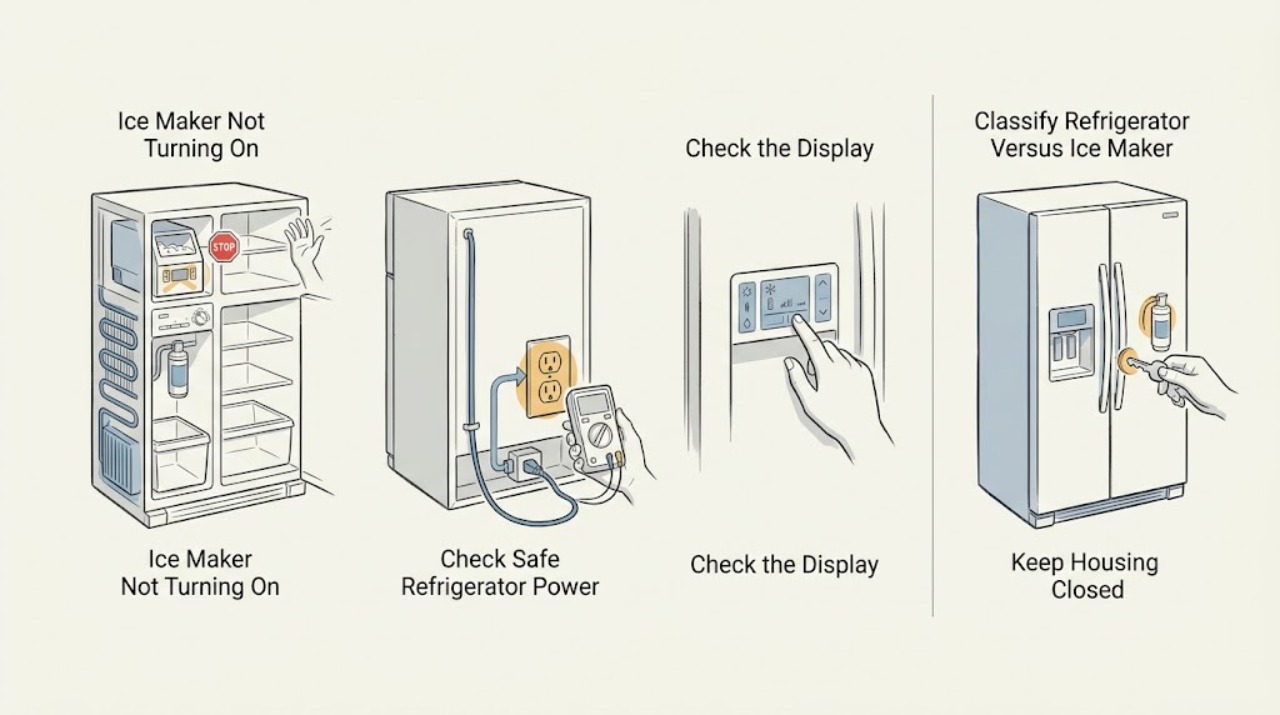
Frigidaire ice makers are integrated into refrigerator models with different control layouts. First decide whether the refrigerator itself has power and whether the ice-maker function is disabled. On a model with an electronic display, use the exact owner's manual to locate the ice-maker option and confirm its status; Frigidaire says display features vary by model. On a top-freezer model with a physical ice-maker control, use that model's guide to verify the documented ON position rather than assuming another design's switch or arm. A blank refrigerator, no interior light, or unresponsive display is a shared refrigerator power problem, not proof that the ice-maker module has failed. A powered refrigerator with the ice-maker enabled but an empty bin is a production or water/freezer-temperature diagnosis. Ice already in the bin but not delivered is a dispenser or auger diagnosis. Do not remove covers, force an ejector, bypass a door or bin sensor, perform live electrical tests, or select a replacement module without the exact model.
Before you begin
Safety first
- The user may identify the model, inspect normal controls, check an accessible dry plug or outlet and breaker, verify the model's documented ice-maker ON state, inspect visible water and filter conditions, and follow model-authorized bin or dispenser steps. Ice-maker cover removal, module or valve access, internal wiring, live tests, water-line disconnection, sensor or interlock bypass, and forced harvest cycles belong to qualified service.
Work through in order
Diagnostic checks
Use only checks that match the exact appliance or system and its official guide.
-
Check 1
Check the refrigerator through normal user-facing signs: note whether the interior light, temperature display, cooling operation, and water dispenser respond. Do not open the ice-maker cover or reach into the freezer to make it cycle.
Expected result: The whole refrigerator is dark or unresponsive; the refrigerator works and the display is lit; or ice is present in the bin but is not delivered.
Next step: For no refrigerator response, use the safe power check. For a working refrigerator, identify the ice-maker control and model. For ice in the bin with no delivery, use the dispenser branch without resetting or replacing the ice-maker module.
Stop if: Do not probe an outlet, remove a panel, defeat a door switch, or reach into moving or frozen mechanisms.
Why this matters
Why: A dark or unresponsive refrigerator points first to shared power. A working refrigerator narrows the question to ice-maker control, water or temperature, production, or dispenser behavior. Ice in the bin with no delivery is not the same as an ice maker that will not turn on.
-
Check 2
Record the complete refrigerator model and serial information from the normal label location, then use that model's owner's manual. Identify whether the ice-maker command is on a display or is a physical control in the freezer compartment. Confirm the exact ON indicator or position from that manual; do not substitute a control procedure from another Frigidaire layout.
Expected result: The model identifies a display-controlled ice-maker option, a physical freezer control, no ice maker fitted to that configuration, or an unclear or damaged control.
Next step: Use only the documented model-specific control to enable the ice maker and note its status indicator. If the control cannot be identified, stop and obtain the manual or service rather than guessing.
Stop if: Do not force a wire arm, switch, display sequence, ejector, bin sensor, or ice-maker cover, and do not use an error meaning from another model.
Why this matters
Why: The control architecture changes the safe check. A display feature may be changed through the model's options menu, while a physical freezer control must be verified in its model-specific position. A configuration without an ice maker or with an unreadable control cannot be diagnosed from the brand name alone.
-
Check 3
If the refrigerator is dark or the control is unresponsive, inspect the plug and outlet from a dry, accessible position and check the refrigerator's breaker or fuse according to household safety practice. Frigidaire recommends a properly grounded dedicated outlet for its refrigerators. Do not pull a built-in refrigerator out or handle a wet plug, damaged cord, or exposed wiring.
Expected result: The breaker is tripped, the plug or outlet is loose or dead, power returns after a safe reset, or the refrigerator has normal power while only the ice-maker function remains inactive.
Next step: Restore power only when the outlet, plug, cord, and area are dry and undamaged. If the breaker trips again, the cord is damaged, or the refrigerator remains dead, keep it off and arrange qualified service. If refrigerator power is normal, continue without opening the ice-maker housing.
Stop if: Do not repeatedly reset a tripping breaker, use an extension cord, test live wiring, or touch a wet or damaged connection.
Why this matters
Why: A shared refrigerator power problem can make an ice maker appear off. If the refrigerator is powered but the ice-maker control remains inactive, a power reset has not resolved the isolated symptom.
-
Check 4
With the refrigerator operating normally and the ice-maker control confirmed ON, check only user-accessible conditions: water-dispenser flow, water-line routing visible without moving the refrigerator, filter seating and visible damage, door closure, and the freezer-temperature setting shown by the model. If newly installed, follow the model's water-priming instructions and stabilization period; do not force an ice cycle.
Expected result: There is no water flow, a filter is loose, cracked, or frozen, a line is visibly kinked, the freezer is warmer than the model setting, the refrigerator was just installed, or water and temperature appear normal.
Next step: Correct only a visible or model-authorized condition, securely reseat or replace a model-compatible filter after confirming fit, follow documented priming steps, or have an installer correct an accessible kink. Allow stabilization before judging production. If conditions are normal but the ice maker remains unresponsive, arrange service.
Stop if: Do not disconnect water tubing, open the inlet valve, remove a filter under pressure, change a freezer setting to an unsafe temperature, or access internal wiring.
Why this matters
Why: Water supply, filter, installation air, and freezer-temperature conditions can prevent or delay ice production even when the control is enabled. These results do not prove that the ice maker itself is electrically off. Normal water and temperature with no response move the diagnosis toward model-specific service.
-
Check 5
Look at the ice bin without dismantling the ice maker. If ice is present, determine whether the issue is delivery: verify the doors are closed, the display is not locked, and the bin is seated; if the bin is empty, note that production has not been confirmed. Stop immediately for a water leak near controls, burning odor, damaged wiring, repeated breaker operation, or an unsafe cabinet condition.
Expected result: Ice is present but not dispensed; the bin is empty while the control is ON; or the refrigerator has a persistent no-response condition or safety hazard after the safe checks.
Next step: For a delivery problem, follow only the exact model's accessible dispenser guidance. For no production or no response after safe checks, keep the appliance safe and arrange qualified service with the model, control status, water result, and installation history.
Stop if: Do not rotate an auger forcefully, chip frozen ice with a sharp tool, remove the ice-maker module, bypass sensors, or restart after a safety hazard.
Why this matters
Why: Ice present with failed delivery points to a dispenser or auger path, not necessarily the ice-maker control. An enabled ice maker with no production after normal water, temperature, and stabilization conditions requires model-specific diagnosis. A hazard makes continued operation unsafe.
Use your observations
Decision map
Find the observation that best matches what you see, then follow the next safe action.
-
PATH 01Safety boundary
What you see
The refrigerator has no interior light, no display, or no response, rather than only an inactive ice-maker function.
Do this next
Check the accessible dry plug, outlet, and refrigerator breaker or fuse. Arrange service if power cannot be restored safely or the breaker trips again.
Why this path and its safety boundary
Why it matters: A shared refrigerator power or outlet condition is more likely than an isolated ice-maker control failure.
Safety stop: Do not use an extension cord, repeatedly reset a tripping breaker, pull out a built-in refrigerator, or test live wiring.
-
PATH 02Safety boundary
What you see
The refrigerator is powered, but the exact model's display option is OFF or disabled, or its physical ice-maker control is in the model's documented OFF position.
Do this next
Use the exact owner's manual to return the documented control to ON and confirm its model-specific indicator. Wait for the model's normal production or stabilization period before judging output.
Why this path and its safety boundary
Why it matters: The ice maker is being inhibited by its user control; this is different from a powered control that does not respond.
Safety stop: Do not use a control sequence or physical position copied from another Frigidaire refrigerator.
-
PATH 03Safety boundary
What you see
The refrigerator and ice-maker control are ON, but the bin is empty and production has not been confirmed; water flow, filter, installation, or freezer-temperature conditions are abnormal or not stabilized.
Do this next
Correct only the visible or model-authorized water or filter condition, prime a newly installed water system as directed, and allow stabilization. If normal conditions do not restore production, arrange service.
Why this path and its safety boundary
Why it matters: Water supply, filter, freezer temperature, or recent-installation conditions are more likely than a control that is physically off, although a model-specific fault remains possible.
Safety stop: Do not disassemble the inlet valve, ice maker, water tubing, or freezer wiring.
-
PATH 04Safety boundary
What you see
Ice is present in the bin, but the door dispenser does not deliver it, or a locked display, open door, jam, or auger alignment issue is visible.
Do this next
Follow the model-specific accessible dispenser and bin steps: confirm the door and lock state, remove and dry the bin only as the guide permits, and do not force or rotate the auger.
Why this path and its safety boundary
Why it matters: The symptom is a dispenser or ice-path problem, not evidence that the ice-maker control is off.
Safety stop: Do not chip ice with sharp tools, dismantle the auger motor, bypass the door sensor, or assume a dispenser fix will restore ice production.
-
PATH 05Safety boundary
What you see
The refrigerator has power, the exact ice-maker control is ON, water and freezer conditions are normal, and the ice maker still does not respond; or there is a leak near electrical parts, burning odor, damaged wiring, or repeated breaker operation.
Do this next
Keep the appliance off for a hazard and arrange qualified service. For a non-hazardous persistent no-response, arrange model-specific diagnosis and provide the complete model, control status, water and temperature observations, and recent installation or outage history.
Why this path and its safety boundary
Why it matters: An internal ice-maker motor, sensor, fill valve, heater, control, wiring, or refrigerator-side fault is more likely, and the exact part cannot be identified safely from this symptom alone.
Safety stop: Do not open covers, apply external power, probe connectors, bypass sensors or interlocks, or repeatedly restart the appliance.
Helpful context
Understand the symptom
Define what not turning on means
An ice maker that is not visibly cycling is not automatically an ice maker with no power. If the refrigerator has no lights, no display, or no response, start with shared refrigerator power. If the refrigerator runs and the display works, distinguish a disabled ice-maker option from a control that is enabled but has not produced ice. A full or jammed bin can prevent dispensing even when the ice maker is operating. Keep these outcomes separate so a dispenser problem is not treated as a failed ice-making module.
Controls differ by refrigerator architecture
Frigidaire support covers top-freezer, French-door, and side-by-side refrigerator contexts. Some models expose an ice-maker command on a display; some top-freezer configurations have a physical control in the freezer compartment. Use the model label and its owner's manual as the authority for the control's location, indicator, and ON procedure. Do not use a physical-control instruction on a display-controlled model or infer a hidden control from a blank display.
Power and water are separate gates
A refrigerator can have a working light or display while the ice maker still lacks an enabled command, water, or a stable freezer condition. Conversely, no refrigerator power prevents every ice function. Frigidaire directs owners to verify power, water connection, display lock, and filter installation; its ice-production guidance also mentions water flow, a kinked supply line, usage, optional model features, and freezer temperature. These checks are for a powered refrigerator and do not authorize opening the ice-maker housing.
Do not use a dispenser symptom to diagnose the ice maker
If there is ice in the bin but the door will not deliver it, Frigidaire treats that as a dispenser condition. A locked display, open door, ice jam, auger alignment issue, or the dispenser's protective shutoff can stop delivery without proving that the ice maker is off. If there is no ice in the bin and the control is enabled, the next question is production, water, temperature, or a model-specific internal fault.
Internal ice-maker work belongs to service
The ice-maker motor, sensor or thermostat, fill valve, wiring, heater, and control electronics are model-specific and may be behind a cover or inside the refrigerator cabinet. If power, the exact control, water, and freezer conditions are normal but the ice maker remains unresponsive, the evidence is not enough to name a failed part. Stop for water near electrical parts, burning smell, damaged wiring, or repeated breaker trips. Do not force a cycle or apply power to a loose connector.
Safety boundary
Stop conditions
- Do not remove the ice-maker cover or module, reach into a mechanism, force an ejector, or bypass a door, bin, or other safety sensor.
- Do not perform live electrical tests, apply external power, probe loose connectors, disconnect internal water tubing, or open the refrigerator cabinet.
- Do not chip frozen ice with sharp tools, force or rotate an auger, or use another model's switch, arm, display sequence, error meaning, or part number.
- Do not repeatedly reset a tripping breaker or operate with a damaged cord, wet plug, water near electrical parts, or an unsafe installation.
- Stop for smoke, burning odor, sparks, damaged wiring, water near controls, or repeated breaker operation and isolate power only from a dry, safe location.
When checks do not resolve it
Need a professional?
Arrange qualified service when the refrigerator has normal power and the exact ice-maker control is ON but there is still no response after model-authorized water, filter, temperature, and stabilization checks. Stop immediately for water near electrical parts, burning odor, damaged wiring or cord, repeated breaker operation, smoke, or an unsafe cabinet condition; isolate power only from a dry, safe location.
Safety scope: The user may identify the model, inspect normal controls, check an accessible dry plug or outlet and breaker, verify the model's documented ice-maker ON state, inspect visible water and filter conditions, and follow model-authorized bin or dispenser steps. Ice-maker cover removal, module or valve access, internal wiring, live tests, water-line disconnection, sensor or interlock bypass, and forced harvest cycles belong to qualified service.
Common questions
FAQ
How do I know whether my Frigidaire ice maker is off or actually not working?
First verify that the refrigerator itself has power. Then identify the exact ice-maker control for your model: a display option and a physical top-freezer control are different architectures. Confirm the model-specific ON state. If it is ON, separate an empty bin with no production from a bin that contains ice but will not dispense; those are different diagnoses.
Why is my refrigerator display on but the ice maker does not turn on?
A lit display proves that some refrigerator functions have power, not that the ice-maker option is enabled or that its internal circuit is healthy. Use the exact model manual to confirm the ice-maker setting, then check water, filter seating, freezer-temperature context, and recent installation. Do not open the ice-maker cover or test its wiring.
Does no water from the dispenser mean the ice maker is turned off?
No. Frigidaire treats water supply, display lock, and filter seating as separate prerequisites for water or ice. No water flow makes a supply or filter issue more likely, but it does not identify the ice-maker control state. Correct only an accessible, model-authorized condition and keep internal water work for service.
What if there is ice in the bin but the refrigerator will not dispense it?
That is a dispenser symptom, not proof that the ice maker is off. Frigidaire lists a locked display, an open door, a jam, prolonged paddle use, bin seating, and auger alignment as dispenser checks. Follow the exact model's accessible bin instructions and do not force or dismantle the auger.
When should I call for service on a Frigidaire ice maker?
Arrange qualified service when the refrigerator has normal power, the exact ice-maker control is ON, water and filter checks and freezer context are normal, and the ice maker still does not respond. Stop immediately for water near electrical parts, burning odor, damaged wiring or cord, repeated breaker operation, smoke, or an unsafe cabinet condition. Do not remove the module, bypass sensors, or apply live tests.
Read the exact guide
Official sources
- Where can I find my model and serial number?Frigidaire · Supports obtaining the exact refrigerator identity needed for the correct ice-maker control procedure, manual, and service diagnosis.
- Refrigerators - No WaterFrigidaire · Supports checking power, water connection, display lock, and filter seating; it does not authorize internal valve or tubing work.
- What should I do if the dispenser on my refrigerator is not dispensing water?Frigidaire · Supports using water-dispenser flow as an observation of the water and filter path, not as proof that the ice-maker control is powered.
- Refrigerators - What does it mean to ‘Prime the Water Supply System’ and why is it important for my refrigerator?Frigidaire · Supports the newly installed refrigerator branch where air in new plumbing can result in empty ice-maker cycles.
- How To Use The Ice Maker In Your Top Freezer RefrigeratorFrigidaire · Supports treating top-freezer ice-maker controls as a distinct model context; it does not establish a universal control position for every top-freezer model.
- RefrigeratorsFrigidaire · Supports the model-specific boundary by listing distinct guidance for top-freezer ice makers, display functions, no water, no ice, dispenser issues, alarms, and power.
- Refrigerators - How do I use the features and functions on my French-Door refrigerator display?Frigidaire · Supports the model-dependent nature of display features and the need to use the owner's manual; it is not a universal ice-maker procedure.
- What should I do if my ice maker is not making enough ice in my refrigerator?Frigidaire · Supports separating enabled-but-no-production from a disabled control and checking filter, water flow, line, usage, model-dependent features, and freezer-temperature context.
- What should I do if the dispenser on my refrigerator is not dispensing ice?Frigidaire · Supports distinguishing ice present but not dispensed from an ice maker that is not enabled or not producing.
- Refrigerator No PowerFrigidaire · Supports separating shared refrigerator power loss from an isolated ice-maker symptom and checking an accessible plug, outlet, breaker, and installation context.
Community feedback
Share a repair observation
Share a plain-text repair observation. Accepted observations are published automatically; this page may take a moment to update.