
On this page
Start here
Quick answer
Locate the first wet point before deciding why a Whirlpool ice maker is leaking. Whirlpool’s official guidance separates leaks at water-line connections, the drain hose, clamps, a filter, a fill cup, an ice chute, and a defrost path; the exact checks depend on whether the appliance is freestanding or built into a refrigerator.
Work through in order
Diagnostic checks
Use only checks that match the exact appliance or system and its official guide.
-
Check 1
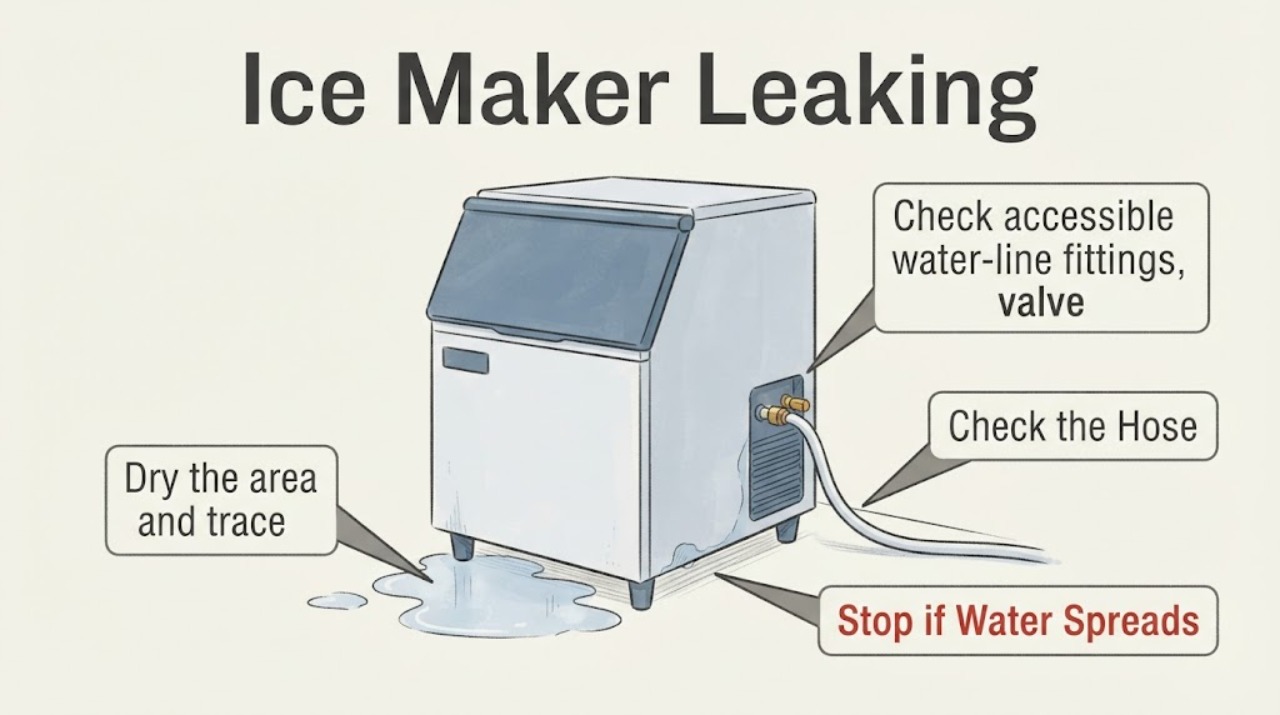
Dry the area and trace the first wet point while the ice maker is off: front or chute, inside the bin, behind the unit, under the appliance, or from a refrigerator compartment.
Expected result: Water starts at a connection, drain hose, bin or chute, or the source cannot be seen.
Next step: Take a photo and keep the unit off if water can reach electrical parts; do not guess from the puddle alone.
Why this matters
Why: The location separates a user-accessible water or drain path from an internal valve, fill, or sealed cabinet fault.
-
Check 2
Check accessible water-line fittings, valve nuts, clamps, and the supply line for looseness, cracks, or damage.
Expected result: A fitting or clamp is wet or the line is cracked, or all connections are dry.
Next step: Shut off the water supply before tightening or replacing any accessible connection, then test once for recurrence.
Why this matters
Why: Whirlpool identifies loose connections, unsecured clamps, and damaged supply lines as leak sources.
-
Check 3
For a freestanding unit, verify the drain hose is aligned with the drain and inserted as specified by the manual; for a refrigerator ice maker, inspect the filter seating and fill-cup or chute area without forcing parts.
Expected result: The drain hose is displaced, the filter is not seated, ice bridges the chute, or the path is clear.
Next step: Correct only the model-approved accessible condition and keep the area dry while monitoring.
Why this matters
Why: A displaced drain or restricted filter/fill path can redirect water; a clear path shifts suspicion toward an internal component.
-
Check 4
Check whether the ice maker or refrigerator is visibly unlevel, overfilled, or repeatedly producing overflow.
Expected result: Leveling, bin, or overflow conditions are present, or leaking continues with a normal level and clean path.
Next step: Stop the water supply and arrange service for persistent leaks, an internal valve, or an inaccessible fill problem.
Why this matters
Why: Whirlpool notes that leveling, ice clumps, and fill-cup alignment can allow meltwater or fill water to escape.
Use your observations
Decision map
Find the observation that best matches what you see, then follow the next safe action.
-
PATH 01Next step
What you see
The leak stops after securing a fitting, clamp, drain hose, filter, or visible ice obstruction.
Do this next
Monitor several fill or harvest cycles and keep the line supported as the manual requires.
Why this path and its safety boundary
Why it matters: A user-accessible water or drainage condition is more likely than an internal cabinet leak.
-
PATH 02Next step
What you see
Water reappears from inside the cabinet, the fill valve, or an inaccessible connection after the accessible checks.
Do this next
Keep the water supply off and arrange qualified Whirlpool service.
Why this path and its safety boundary
Why it matters: An internal valve, fill tube, level, or sealed connection fault is more likely.
-
PATH 03Next step
What you see
Water reaches electrical parts, the supply line is cracked, or the leak cannot be contained.
Do this next
Disconnect power only if safe, shut off water, protect the area, and obtain qualified service.
Why this path and its safety boundary
Why it matters: The appliance presents a water and electrical safety risk.
Helpful context
Understand the symptom
What to check first
Locate the first wet point before deciding why a Whirlpool ice maker is leaking. Whirlpool’s official guidance separates leaks at water-line connections, the drain hose, clamps, a filter, a fill cup, an ice chute, and a defrost path; the exact checks depend on whether the appliance is freestanding or built into a refrigerator. Record the exact model and symptom pattern before ordering a part. A user check should change the next decision; it should not be used to infer an unverified component.
When checks do not resolve it
Need a professional?
Arrange Whirlpool service when the source is inside the cabinet, a valve or fill tube is involved, the leak returns after accessible line and drain checks, or water cannot be contained.
Common questions
FAQ
Should I tighten an ice-maker connection while water is flowing?
No. Shut off the water supply first and only work on an accessible fitting the model instructions identify.
Why can a leak appear on the floor away from the ice maker?
Water can travel from a loose line, drain, filter, chute, or defrost path. Trace the first wet point rather than treating the floor location as the source.
Read the exact guide
Official sources
- Leaking from Behind - Freestanding Ice MakerWhirlpool Corporation · Leaking from Behind - Freestanding Ice Maker is official manufacturer material; model-specific details remain limited to the named product or manual.
- Ice Maker Leaking Water: Causes and FixesWhirlpool Corporation · Ice Maker Leaking Water: Causes and Fixes is official manufacturer material; model-specific details remain limited to the named product or manual.
Community feedback
Share a repair observation
Share a plain-text repair observation. Accepted observations are published automatically; this page may take a moment to update.