
On this page
Start here
Quick answer
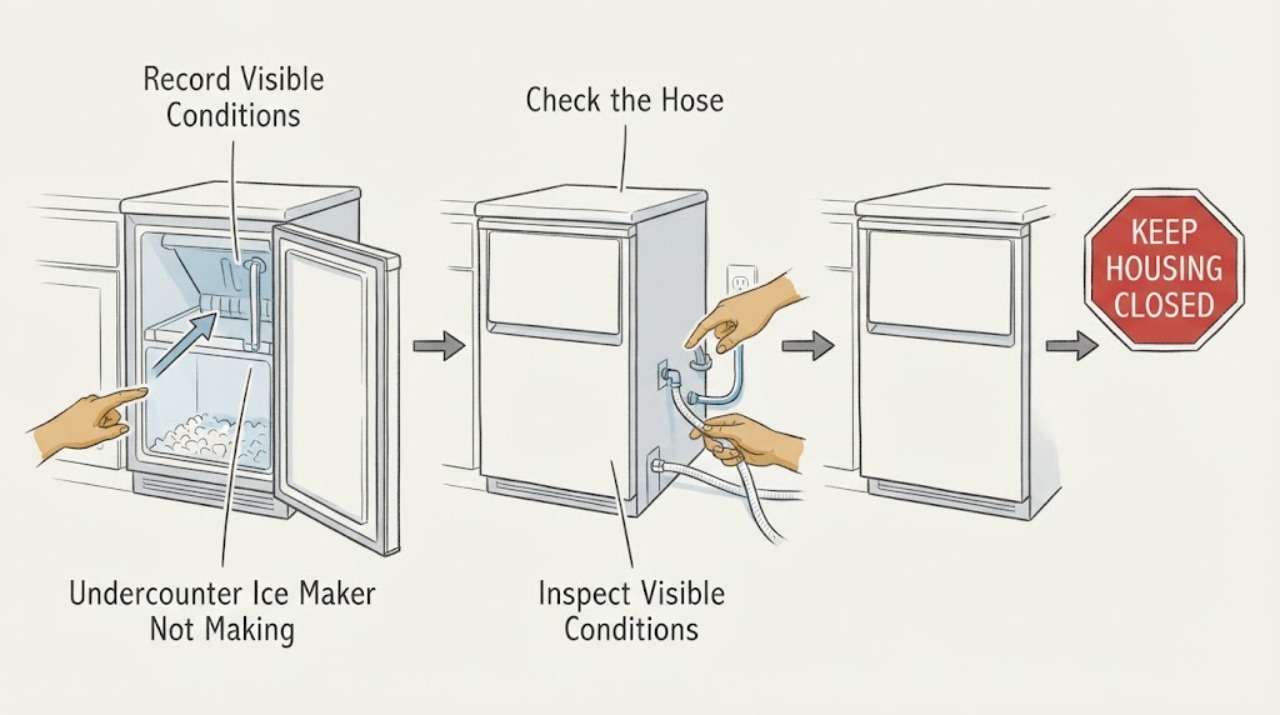
For the KitchenAid KUIX305ESS1 undercounter ice maker, first confirm that the control is ON, the water supply is connected and open, the unit is level, and the drain cap is tight with no kink or blockage in the drain path. A new start can take up to 24 hours to produce the first batch. Check the clean/status indication and the bin sensor area for an accessible obstruction, and keep the unit in a ventilated room; KitchenAid says production is reduced above 90°F (32°C) and the bin is not refrigerated. If the service indication flashes continually, the unit remains without water or ice after these external checks, or an internal access panel, sealed system or live electrical test would be needed, stop and arrange KitchenAid-qualified service. Do not infer a failed valve, pump, board or refrigerant circuit from a no-ice symptom alone.
Before you begin
Safety first
- Do not bypass the bin sensor, run exposed live diagnostics, open the cabinet, puncture or service the sealed refrigeration circuit, or continue operation if water reaches electrical parts, there is burning odor, sparking or damaged wiring.
Work through in order
Diagnostic checks
Use only checks that match the exact appliance or system and its official guide.
-
Check 1
Read the rating label and confirm that the appliance is KitchenAid KUIX305ESS1. Record whether it is a new start, a restart after cleaning, or a previously working unit that stopped, then leave the control in the normal ON position and allow the documented startup interval to pass without repeatedly cycling the machine.
Expected result: The label matches KUIX305ESS1 and the unit has been running for less than about 24 hours after startup, or it has exceeded that interval and still has no ice.
Next step: For a new start, keep the machine in its normal operating state and reassess after the documented interval. For an established no-ice condition, continue to the water and drain checks; do not transfer instructions from a different KitchenAid appliance.
Why this matters
Why: KitchenAid says the first batch can take about 24 hours. A new-start delay does not establish a failed part, while no ice after the normal interval needs the external water, drain, level and status checks below.
-
Check 2
With the machine idle and accessible, verify that the water connection is present and the supply is open. Look only at the accessible drain connection and hose: confirm the drain cap is seated, the tube is not kinked, and there is no visible blockage or water escaping where it should remain in the system. Do not remove panels or run a live valve test.
Expected result: The supply is off or disconnected, the drain cap is loose, the hose is kinked/blocked, or water is visibly leaving the intended path; or these external conditions look correct.
Next step: Restore only an accessible supply connection or cap/hose position that clearly matches the exact guide, then observe one normal cycle. If the path is correct but no water or ice appears, stop external troubleshooting and arrange model-specific service.
Stop if: Stop immediately if water reaches electrical areas, the hose or drain fitting is damaged, or correcting the connection would require opening the cabinet.
Why this matters
Why: KitchenAid's guide links an absent water connection, a loose drain cap and drain-line problems with no or thin ice. Correcting an obvious external condition can restore the intended path, but a normal-looking path does not prove that an internal valve, pump or control is working.
-
Check 3
Observe the clean/status light and inspect the accessible bin-sensor area for an ice scoop, loose item or ice obstruction. With the unit off and the area safe, clean an accessible sensor surface only as KitchenAid describes, using a soft towel and warm soapy water; do not bypass the sensor or enter a diagnostic mode.
Expected result: The status indicates cleaning/service is due, the bin sensor is visibly blocked, or the sensor area is clear and the status indication remains abnormal.
Next step: Remove only an accessible obstruction and follow the exact KUIX305ESS1 cleaning instructions if the status calls for cleaning. If the light continues to indicate service or the sensor area is clear, document the indication and use qualified service rather than bypassing it.
Why this matters
Why: KitchenAid says a blocked or dirty bin sensor can affect level detection, and its guide says cleaning is indicated when status changes or production decreases significantly. A persistent abnormal indication after an external check is not proof of a sensor or control-board failure.
-
Check 4
Check from outside that the ice maker is level and that its ventilation area is not visibly obstructed. Note the room temperature and whether the unit is in a hot bar or kitchen area; do not remove an access panel to clean an internal condenser or reach the sealed system.
Expected result: The unit is visibly out of level, ventilation is obstructed, or the room is above 90°F (32°C); or the unit is level, ventilated and in a cooler room.
Next step: Correct only an obvious external clearance or installation condition allowed by the exact guide, then monitor a normal cycle. If the environment is suitable and no ice is produced, escalate with the recorded observations instead of ordering a part by symptom.
Why this matters
Why: KitchenAid says the unit should be level and that production is reduced above 90°F (32°C); the bin is not refrigerated, so some melting can occur. These conditions can reduce output without identifying an internal fault.
-
Check 5
Stop user troubleshooting and record the model/serial, status-light behavior, water and drain observations, room conditions, cleaning history and whether the unit has ever produced a normal batch. Arrange KitchenAid-qualified service if the service indication flashes continually, no ice remains after the external checks, or inspection would require panels, live measurements or sealed-system work.
Expected result: The service indication continues, the unit remains without ice despite correct external conditions, or a repair would require internal access; or an accessible condition explains the problem and a normal cycle resumes.
Next step: For the unresolved or unsafe pattern, keep the appliance out of service as needed and provide the exact model, serial and observations to qualified service. Do not repeatedly reset, bypass the sensor, probe wiring or replace a valve, pump, board or refrigerant component based only on this symptom.
Stop if: Stop and disconnect power using the normal safe disconnect if water reaches electrical parts, there is burning odor, sparking, damaged wiring or an access panel must be removed.
Why this matters
Why: KitchenAid's guide directs service for a continually flashing service indication and does not support diagnosing a failed internal component from the no-ice symptom alone. A resumed normal cycle after an external correction is evidence of an installation/status condition, not proof that every component is healthy.
Use your observations
Decision map
Find the observation that best matches what you see, then follow the next safe action.
-
PATH 01Next step
What you see
The unit is confirmed as KUIX305ESS1 and has been running for less than the first-batch interval after a new start.
Do this next
Leave the control ON and allow the exact guide's startup period to pass, then reassess output once without repeated resets.
Why this path and its safety boundary
Why it matters: The documented startup delay can account for no ice without establishing a repair fault.
-
PATH 02Next step
What you see
The water supply is open, the drain cap is secure, the drain tube is clear and unkinked, and the unit has passed the first-batch interval but still produces no ice.
Do this next
Arrange model-specific service and provide the water/drain observations. Do not run a live valve or pump test, open the cabinet or order a part from the symptom alone.
Why this path and its safety boundary
Why it matters: The public guide's external causes have not explained the symptom; it does not identify which internal component has failed.
-
PATH 03Next step
What you see
The clean/status indication calls for cleaning or the accessible bin sensor is blocked by ice or an object.
Do this next
Use only the KUIX305ESS1 guide's approved cleaning procedure and clear accessible obstruction with power off; if the indication persists, request service.
Why this path and its safety boundary
Why it matters: A maintenance or level-detection condition may be affecting production, but it does not prove a failed sensor or control.
-
PATH 04Next step
What you see
The room exceeds 90°F (32°C), the unit is poorly ventilated or out of level, and output is reduced rather than completely absent.
Do this next
Correct only accessible environmental or leveling conditions allowed by the exact guide and monitor one normal cycle. Escalate if no ice returns or the unit shows a service indication.
Why this path and its safety boundary
Why it matters: KitchenAid identifies hot ambient conditions and installation/leveling conditions as output factors for undercounter ice makers; the bin is not refrigerated.
-
PATH 05Next step
What you see
A service light flashes continually, water reaches electrical areas, there is burning odor or sparking, or internal access would be required.
Do this next
Stop use, use the safe normal disconnect if it can be reached without contact with water or damage, and arrange KitchenAid-qualified service. Do not bypass the sensor or repeatedly restore power.
Why this path and its safety boundary
Why it matters: This exceeds an owner-level external check and may involve an electrical, water or sealed-system hazard.
Helpful context
Understand the symptom
Start with the undercounter model's normal cycle
The assigned identity is KitchenAid KUIX305ESS1, an undercounter ice maker in the KUIX305ESS family. KitchenAid's opened guide says the first batch after startup may take about 24 hours. That delay is different from a unit that has already run normally and then stops. Confirm the rating label before applying any model-specific control or cleaning instruction; the public sources do not establish the identity of an internal valve, pump, board or sealed-system part from the symptom alone.
Water and drain observations are more useful than guessing a part
The KitchenAid guide separates a unit that will not operate from one that runs but produces no ice. It calls out the ON control, water connection and supply, a secure drain cap, a clear drain tube and a drain line without a kink. A loose cap or drain problem can let water leave the system and result in thin or absent ice. These are external observations; do not open the cabinet or use a live diagnostic test to name a valve or pump.
Use the clean status, bin sensor and room conditions as separate clues
KitchenAid says the bin sensor monitors the ice level and can be cleaned with a soft towel and warm soapy water when an accessible obstruction is present; the unit must also be level. Its undercounter temperature guidance says production is reduced above 90°F (32°C), the ice bin is not refrigerated, and ventilation and room conditions matter. A clean/status indication or a high-temperature room can explain reduced production without proving an internal failure. Follow the exact KUIX305ESS1 guide for any cleaner, filter or reset sequence; do not substitute an unrelated appliance procedure.
When checks do not resolve it
Need a professional?
Arrange KitchenAid-qualified service when the service indication flashes continually, the KUIX305ESS1 remains without ice after the ON, water, drain, level, sensor and environmental checks, or any repair would require removing panels, testing live circuits, opening the sealed system or identifying a component from the symptom alone.
Safety scope: Do not bypass the bin sensor, run exposed live diagnostics, open the cabinet, puncture or service the sealed refrigeration circuit, or continue operation if water reaches electrical parts, there is burning odor, sparking or damaged wiring.
Have this ready
- Provide the complete model and serial, whether the unit is new or previously working, time since startup, status-light behavior, water-supply and drain observations, room temperature/ventilation, level condition, cleaning/filter history and photographs of any visible leak or obstruction. Do not request a valve, pump, board or sealed-system part by symptom alone.
Common questions
FAQ
How long should a KitchenAid KUIX305ESS1 take to make its first ice?
The opened KitchenAid undercounter guide says the first batch can take about 24 hours after startup. If the machine has already exceeded that interval, check the ON control, water and drain path, level, status indication and accessible sensor area before arranging service.
Can a loose drain cap cause a KitchenAid undercounter ice maker to stop making ice?
KitchenAid's guide says a loose drain cap can let water leave the system and result in thin or no ice. Check the cap and accessible drain hose only as the exact guide describes; do not open the cabinet or assume the cap is the only possible cause.
Does a blocked bin sensor prove the sensor is bad?
No. KitchenAid says the bin sensor monitors ice level and can be checked for an obstruction. Clear only an accessible obstruction with the unit safe and follow the exact guide; a persistent indication needs service rather than a sensor bypass or part guess.
Can a hot room reduce ice production?
Yes. KitchenAid says production is reduced when the room exceeds 90°F (32°C), and the ice bin is not refrigerated so some melting occurs. Improve only accessible ventilation or room conditions and request service if production remains absent or a service indication continues.
Should I remove the filter or run the valve diagnostic after cleaning?
Do not use the exact-model Reddit discussion as a repair instruction. The post reports an attempted filter change and diagnostic observation but no confirmed outcome. Use the KUIX305ESS1 guide for any filter or diagnostic procedure; if water does not enter or internal testing is required, use qualified service.
Read the exact guide
Official sources
- KUIX305ESS | KitchenAidKitchenAid · Opened official KitchenAid owner-center page for the KUIX305ESS family. It supports the product-family identity and directs owners to model-specific Product Help, manuals and service; it does not establish an internal part failure.
- How Room Temperature Affects Ice ProductionKitchenAid Product Help · Opened official KitchenAid Product Help guidance specifically discussing undercounter ice makers. It supports the ambient-temperature and non-refrigerated-bin explanation, not a component diagnosis.
- Undercounter ice maker (KUIX305ESS1) not making iceReddit r/appliancerepair · Opened exact Reddit permalink. It is used only to preserve the reported symptom sequence and model identity; commenters' suggestions and diagnostic interpretation are not treated as manufacturer instructions or confirmed outcomes.
- How to Check the Bin SensorKitchenAid Product Help · Opened official KitchenAid Product Help guidance for undercounter ice makers. It supports an accessible sensor-obstruction check and level condition, not a sensor replacement or internal diagnosis.
- KitchenAid Undercounter Ice Maker Use and Care Guide (W10340960 Rev. B)KitchenAid · Opened on KitchenAid's official kitchenaid.com document host. The PDF text identifies the undercounter ice-maker controls and troubleshooting but does not expose the full KUIX305ESS1 suffix in the extracted cover text, so suffix-specific internal construction is not inferred; model identity remains anchored to the assigned task and KitchenAid's KUIX305ESS family page.
- VIDEO: Not Making Ice - Undercounter Ice MakerKitchenAid Product Help · Opened official KitchenAid Product Help page whose title and content are specifically for an undercounter ice maker that is not making ice. It confirms the symptom/device scope and model-number lookup route; the detailed technical checks in this article come from the opened use-and-care guide.
Community feedback
Share a repair observation
Share a plain-text repair observation. Accepted observations are published automatically; this page may take a moment to update.