
On this page
Start here
Quick answer
Do not assume that a temperature display changing or a heating element cycling means the WOS51EC7AW03 has lost temperature control. Whirlpool explains that oven burners or elements cycle during normal operation and that opening the door changes the cycle. Check whether cooking results remain consistently wrong with the door closed, then use the exact model guide for any calibration menu. The opened Whirlpool Owner Center identifies the WOS51EC7AW family but does not expose a separate WOS51EC7AW03 manual, so do not guess a button sequence; arrange service if the oven remains materially off after the model-specific settings and airflow checks.
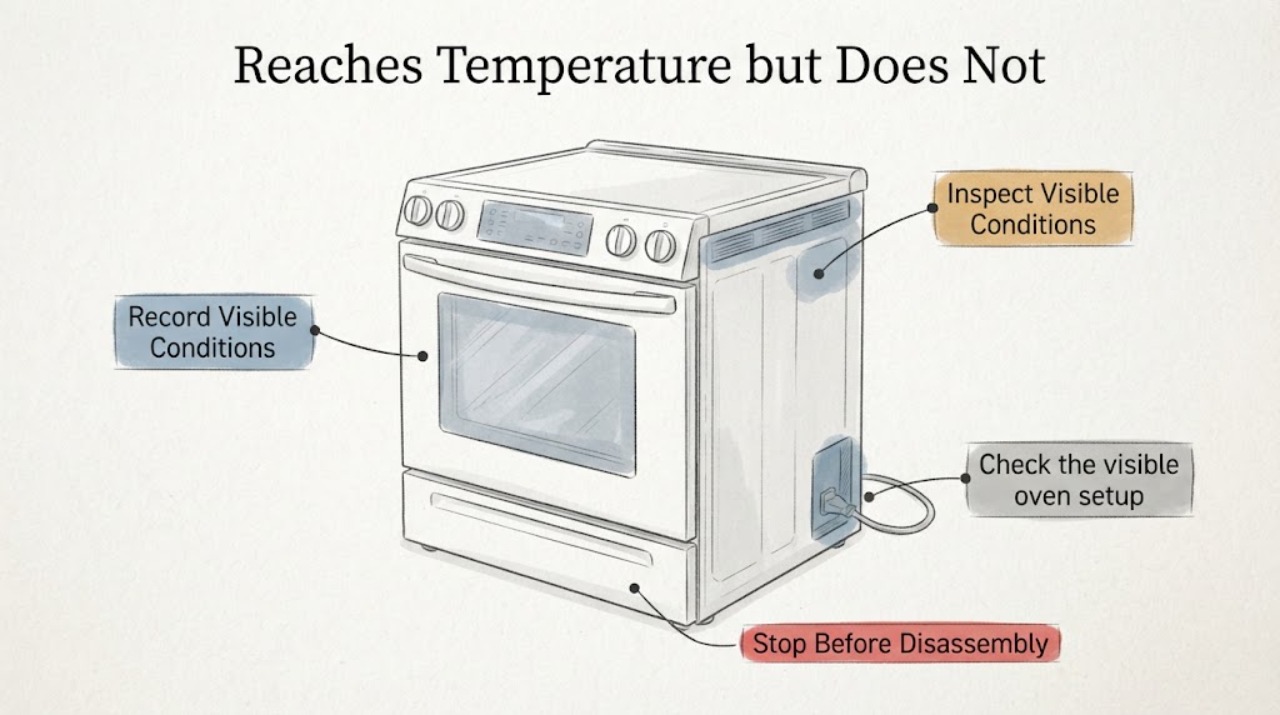
Work through in order
Diagnostic checks
Use only checks that match the exact appliance or system and its official guide.
-
Check 1
Run the same bake setting and recipe with the rack position unchanged, keep the door closed until the normal preheat signal, and record whether the food is repeatedly underdone, overdone, or unevenly browned rather than judging one instantaneous display reading.
Expected result: Results are consistent but wrong across repeat cooks, or results vary only when the door is opened or the load and rack position change.
Next step: Continue with the controlled checks and consult the exact model guide before calibration. Do not open the door repeatedly to watch the cycle.
Why this matters
Why: A repeatable result points toward a setting or temperature-accuracy question; variation tied to door opening, load, or rack position does not prove that the oven cannot hold temperature.
-
Check 2
Observe the cycle without opening the door and note whether the bake or broil heat source cycles on and off after preheating, whether the display changes normally, and whether the oven actually stops heating for unusually long periods.
Expected result: The heat source cycles and cooking remains consistent, or the oven stops heating and the cooking result stays materially wrong.
Next step: If cycling looks normal but results remain wrong, verify airflow and the calibration setting. If heating stops abnormally or an error appears, stop experimenting and arrange qualified service.
Why this matters
Why: Whirlpool describes cycling as normal temperature control; a persistent failure to maintain the expected cooking result needs the model guide or service, not a conclusion based on one cycle.
-
Check 3
Check the visible oven setup while it is off and cool: use the rack position recommended for the recipe, remove unused racks if the guide calls for it, do not line the entire rack or oven bottom with foil, and keep the oven vent unobstructed.
Expected result: Foil, an unusual rack arrangement, blocked airflow, or an overloaded cavity could change browning or heat distribution; otherwise the visible setup matches the recipe and guide.
Next step: Correct only the visible setup, repeat the same controlled bake, and escalate if the result remains consistently off.
Why this matters
Why: Whirlpool lists rack placement, bakeware, foil and airflow as factors that can make results look like a temperature problem even when the control is functioning.
-
Check 4
Use the exact WOS51EC7AW03 owner guide or Whirlpool's model lookup to identify whether the control has a Settings, Options, Tools, or temperature-calibration entry; do not try a generic five-second key combination from another model.
Expected result: The exact guide gives a calibration method, or the official model listing does not provide the needed document or the controls do not match the published method.
Next step: If the exact guide provides a calibration range, follow only that guide and make a small documented adjustment. If the guide is unavailable or the temperature is far off, arrange qualified service instead of guessing.
Why this matters
Why: Whirlpool lists several calibration methods and says the correct method depends on the specific oven. The base WOS51EC7AW Owner Center page does not establish a WOS51EC7AW03-specific key sequence.
-
Check 5
Check for non-temperature conditions that can mimic poor holding, including a door that does not close fully, an active mode that changes normal cooking behavior, or a recent installation or power event; keep the oven off if there is a damaged seal, smoke, burning odor, or electrical concern.
Expected result: A door, mode, installation, or safety condition is visible; otherwise no external condition explains the repeatable temperature result.
Next step: Correct only an authorized user setting using the exact guide. For a damaged seal, electrical symptom, error, or continued inaccurate cooking, stop and request qualified appliance service.
Why this matters
Why: A visible setup or control condition can alter the result, while a persistent error with no external explanation requires model-specific diagnosis of the sensor, control, heating system, or wiring by a professional.
-
Check 6
Prepare the service report with the full model and serial information, selected temperature and mode, rack and bakeware position, repeat cooking results, display behavior, and any visible error or safety symptom.
Expected result: The oven repeatedly fails the controlled check, is materially off after an authorized calibration, or cannot be scoped because the exact manual is unavailable.
Next step: Arrange qualified Whirlpool or appliance service and do not remove panels or test live wiring. Keep the oven out of use if there is smoke, burning odor, arcing, or a damaged cord.
Why this matters
Why: Whirlpool directs users to model-specific documentation and professional help when the published checks do not resolve inaccurate operation; a part diagnosis cannot be made from the symptom alone.
Use your observations
Decision map
Find the observation that best matches what you see, then follow the next safe action.
-
PATH 01Next step
What you see
The oven cycles heat after preheating and repeat cooking is consistent when the door stays closed and the rack and load are controlled.
Do this next
Keep the setup consistent and use the recipe's rack and bakeware guidance before considering calibration.
Why this path and its safety boundary
Why it matters: That pattern can be normal cycling or a recipe/setup effect, not proof that the oven is failing to hold a single instantaneous temperature.
-
PATH 02Next step
What you see
Repeat cooking remains consistently too hot, too cool, or uneven after controlled setup checks.
Do this next
Use only the WOS51EC7AW03 guide's calibration procedure. If the guide is unavailable or the adjustment does not help, arrange service.
Why this path and its safety boundary
Why it matters: The oven may need a documented calibration adjustment or model-specific diagnosis; the result is stronger evidence than a single thermometer reading during cycling.
-
PATH 03Next step
What you see
The exact model guide is unavailable, the controls do not match Whirlpool's listed calibration methods, or the displayed behavior is unclear.
Do this next
Do not guess the calibration menu. Ask Whirlpool or a qualified technician for the exact document and provide the controlled result log.
Why this path and its safety boundary
Why it matters: The opened Owner Center confirms the WOS51EC7AW family but does not provide a separate WOS51EC7AW03 procedure, so a borrowed key sequence would be unsupported.
-
PATH 04Next step
What you see
A damaged door seal, error message, smoke, burning odor, arcing, or damaged power connection is present.
Do this next
Stop using the oven and arrange prompt qualified service; do not remove panels or test energized parts.
Why this path and its safety boundary
Why it matters: This is a safety or service condition rather than a normal temperature-cycling question.
-
PATH 05Next step
What you see
The oven is materially off by a large amount or remains inaccurate after an authorized adjustment.
Do this next
Stop making additional offsets and schedule qualified appliance service with the model, settings, and result log.
Why this path and its safety boundary
Why it matters: Whirlpool says a large temperature error should be handled by a certified technician rather than further user calibration.
Helpful context
Understand the symptom
A wall oven does not stay at one instantaneous reading
Whirlpool says heating components cycle on and off to maintain cooking temperature, so a momentary high or low observation is not enough to diagnose a fault. Opening the door, changing racks, lining the bottom, or blocking airflow can change the result. Compare repeat cooking results with the same rack position and a closed door before changing calibration.
Scope for WOS51EC7AW03
The official Owner Center page opened for the WOS51EC7AW family shows the single-wall-oven product family, while the page reports no documents available for that listing. Whirlpool's calibration guidance says the control method is model-specific. Keep the assigned WOS51EC7AW03 identity, but use its exact Use and Care Guide or qualified service for the calibration steps rather than borrowing a sequence from another Whirlpool oven.
When checks do not resolve it
Need a professional?
Arrange qualified appliance service when the controlled result remains consistently wrong, the exact calibration procedure is unavailable, the adjustment does not help, or an error or safety symptom appears. Stop using the oven for smoke, burning odor, arcing, a damaged cord or other electrical concern.
Common questions
FAQ
Does a Whirlpool oven have to stay at exactly one temperature after preheating?
No. Whirlpool explains that the heating system cycles to maintain cooking temperature, so a momentary high or low observation is not enough to prove a fault. Judge repeat cooking results with the door closed and the setup controlled.
Can I use another Whirlpool oven's calibration button sequence on WOS51EC7AW03?
Do not assume that sequence applies. Whirlpool lists several methods and says to use the Owner's Manual for the specific model. The opened Owner Center page identifies the WOS51EC7AW family but does not expose a separate WOS51EC7AW03 procedure.
When should a temperature problem be serviced instead of recalibrated?
Use service when the oven remains materially inaccurate after controlled setup and an authorized adjustment, when the exact guide is unavailable, or when an error or safety symptom appears. A large temperature error should not be repeatedly compensated by the user.
Read the exact guide
Official sources
- How to calibrate an ovenWhirlpool · Whirlpool oven temperature accuracy, gas/electric calibration and professional boundary
- Oven Too Hot - Needs Calibration - Wall OvenWhirlpool Product Help · Whirlpool model-specific oven temperature calibration methods and service boundary
- Bake Cycle Not Working - Wall OvenWhirlpool Product Help · Whirlpool wall-oven bake controls, modes and power-event checks
- Poor Baking Results - Wall OvenWhirlpool Product Help · Whirlpool wall-oven baking-result interpretation and cycling boundary
- WOS51EC7AW | WhirlpoolWhirlpool · Whirlpool single wall oven family and model-specific Owner Center resources
- Cycle Time Different than Previous Oven - Wall OvenWhirlpool Product Help · Whirlpool wall-oven temperature cycling, door-opening effects and service context
- Oven Temperature Incorrect (Too Hot or Too Cold)Whirlpool Product Help · Whirlpool oven temperature accuracy, rack, foil, airflow and model-specific calibration context
- Long Pre-Heat Times for OvenWhirlpool Product Help · Whirlpool oven preheat, rack, door and airflow factors
- Kitchen And Laundry Appliance ManualsWhirlpool · Whirlpool model-number manual lookup
Community feedback
Share a repair observation
Share a plain-text repair observation. Accepted observations are published automatically; this page may take a moment to update.