
On this page
Start here
Quick answer
Some Whirlpool convection-fan noise is normal: the fan may run during preheating, cycle during a cooking function and continue to move air while the oven cools. First identify whether the sound follows the convection fan or the separate cooling fan by noting when it occurs and whether it changes when the oven door is opened only during a safe, cool observation. A smooth whoosh or hum that matches normal preheat or cooling behavior is less concerning than a new rattle, scraping, grinding or metal-on-metal sound. With the oven off and fully cool, inspect only the visible cavity area for loose foil, a rack, pan or debris that could be near the fan guard; do not remove the rear cover or reach toward the fan. Stop using the oven for rubbing or metal-on-metal noise, smoke, burning odor, sparks, a damaged cord or a fan that runs with the door open, and arrange qualified Whirlpool appliance service. The fan blade, motor, guard, relay or another control may require model-specific diagnosis.
Before you begin
Safety first
- This article supports only normal control observation, safe timing and sound checks, and inspection of a cold accessible cavity for loose items. Fan guards, motors, relays, sensors, door switches, controls, wiring and internal oven access require a qualified appliance technician.
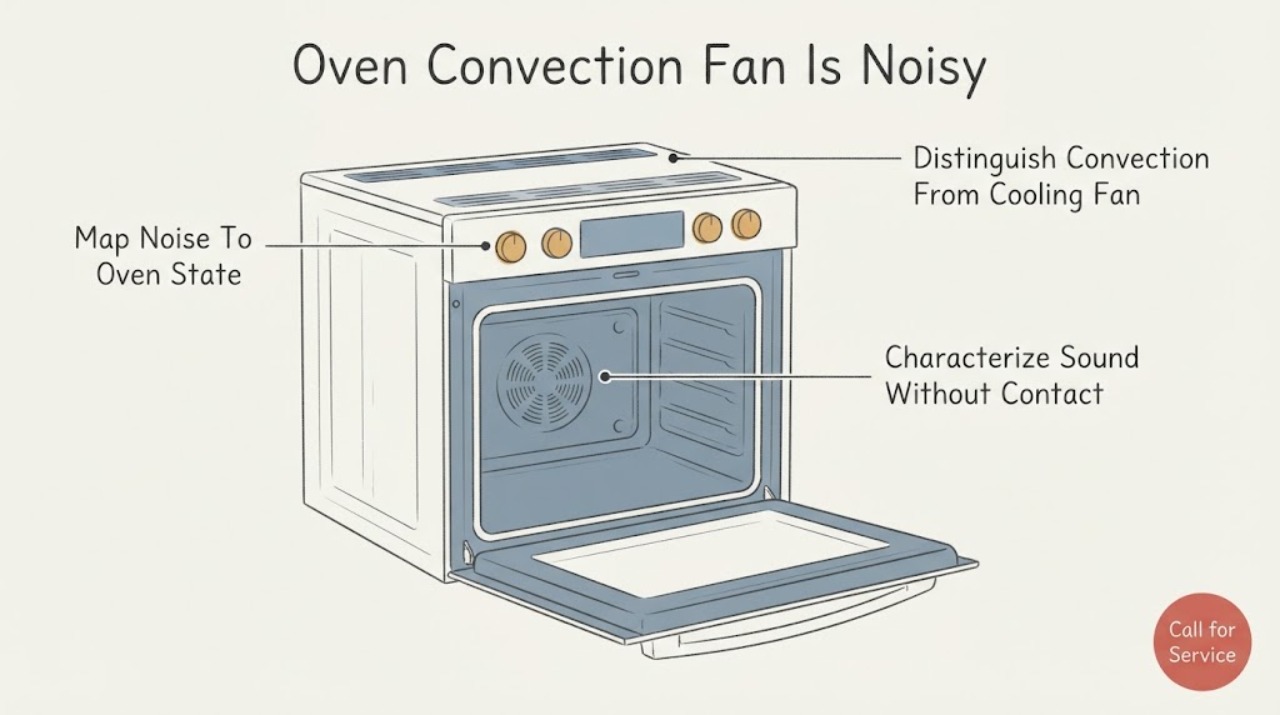
Work through in order
Diagnostic checks
Use only checks that match the exact appliance or system and its official guide.
-
Check 1
From outside the oven, note whether the noise begins during preheat, only when a convection mode is selected, during a regular bake or broil cycle, after the cycle ends, or while the oven is idle. Use normal controls and do not open panels or reach into the cavity.
Expected result: The sound occurs during preheat or convection cooking, during every cooking function, only after cooking, or when the oven is not in use.
Next step: Record the operating state, duration and whether the sound stops when the oven has cooled. Continue only if the sound is a smooth, model-consistent airflow noise; arrange service for a new or mechanical-sounding noise.
Stop if: Stop cooking for smoke, burning odor, sparks, a hot electrical smell, abnormal heat at the controls or a sharp scraping or grinding sound.
Why this matters
Why: A sound during preheat or a convection function can be normal fan operation. A sound after cooking can be the cooling fan. Noise while idle, or a new sound that occurs in every state, is less consistent with the documented normal pattern and needs service evaluation.
-
Check 2
If the oven is cool enough and you are not exposing yourself to heat, observe whether the fan or air-movement sound changes when the door is opened normally. Do not open a hot oven solely to perform this test; use the model manual or a safe normal opening instead.
Expected result: The sound stops or is reduced when the door opens, continues with the door open, or the result cannot be observed safely.
Next step: Record the result and whether the noise is airflow-like or mechanical. If the convection fan runs with the door open or the source remains unclear, stop using the affected function and arrange Whirlpool service.
Stop if: Do not open the door near hot steam, touch racks or surfaces, or put hands or tools inside to listen more closely.
Why this matters
Why: Whirlpool uses a sound that stops or reduces with the door open as a clue for the convection fan; a convection fan running with the door open is not normal. A sound that continues may be the cooling fan, but it cannot be identified confidently without model-specific context.
-
Check 3
From a safe position, characterize the noise as a smooth whoosh or hum, intermittent relay-like cycling, a rattle, vibration, scraping, grinding or metal-on-metal contact. Compare it with the oven's normal sound on the same function only if no hazard is present; do not run a cycle repeatedly to reproduce a severe sound.
Expected result: The sound is smooth and consistent, cycles briefly during preheat, or has a new rattle, vibration, scraping or metal-on-metal quality.
Next step: Stop the affected function for mechanical noise and record an audio clip from a safe distance if possible. Arrange qualified service rather than trying to straighten or lubricate the fan.
Stop if: Stop immediately for grinding that worsens, smoke, sparks, burning odor, visible damage or a fan that appears to contact a guard.
Why this matters
Why: Smooth airflow and brief model-dependent cycling can be normal. Rubbing or metal-on-metal noise is specifically outside Whirlpool's normal convection-fan description and may reflect a blade, guard, motor or loose mechanical part.
-
Check 4
After the oven is off and fully cool, inspect only the accessible cavity for foil, a rack, pan, spill residue or loose debris positioned against the rear fan guard or airflow path. Remove only a loose item that is clearly safe to lift; do not remove the guard, rear panel, racks that are supporting hot cookware or any fixed component.
Expected result: A loose item or residue is near the fan guard, the cavity is clear, the guard appears damaged or the fan area is hidden behind a panel.
Next step: Clear only the safe loose item and perform one normal observation. If noise remains or the guard is damaged, leave the oven off and arrange Whirlpool service.
Stop if: Do not touch the fan, remove the fan guard, use tools, clean inside a hidden assembly or inspect before the oven is fully cool.
Why this matters
Why: A loose cavity item can create vibration or airflow noise, but a clear cavity with scraping still points toward the fan assembly or another internal part. A damaged or loose guard needs service and should not be corrected by bending it.
-
Check 5
After a normal bake or broil cycle, observe from outside whether a steady airflow or hum continues while the oven cools. Do not interrupt a cooling cycle by opening electrical panels or switching power repeatedly; allow normal cooling if there is no abnormal sound or hazard.
Expected result: The fan runs for a period after cooking with a smooth sound, the noise is harsh or mechanical, or the fan runs with the oven cold and idle.
Next step: Record when the run-on starts and ends and arrange service for an abnormal sound or unexpected idle operation. Do not attempt to defeat the cooling fan or control its timing.
Stop if: Stop using the oven for smoke, burning odor, sparks, overheating controls or a damaged cord; seek qualified appliance or electrical help.
Why this matters
Why: Whirlpool says the automatic cooling fan can run during and after oven use to cool the cavity and controls. A harsh or mechanical sound, or operation in an unexpected idle state, is not established as normal and should be evaluated for a fan, control or sensor issue.
-
Check 6
Record the Whirlpool model and serial information from ordinary-access paperwork or labeling, the selected function, preheat or post-cycle timing, door-open observation, sound description, visible cavity condition and any cooking or temperature problem. Take a recording only from a safe distance and do not remove panels to find the model or fan.
Expected result: The noise persists after a loose item is removed, the fan runs with the door open, the sound is rubbing or metal-on-metal, cooking temperature is abnormal, or the cause remains uncertain.
Next step: Leave the oven off for abnormal noise and arrange qualified Whirlpool appliance service. Provide the exact model, sound timing and recording; do not order a fan or motor until the installed assembly is confirmed.
Stop if: Do not open the oven cabinet, test live power, remove the fan assembly, bypass a door switch or continue operating with smoke, sparks, burning odor or exposed wiring.
Why this matters
Why: These results need model-specific diagnosis of the convection blade, motor, guard, cooling fan, relay, sensor, control or another component. A normal-looking fan cycle does not make a severe mechanical sound safe to ignore.
Use your observations
Decision map
Find the observation that best matches what you see, then follow the next safe action.
-
PATH 01Safety boundary
What you see
Do this next
Use the model manual for expected operation and monitor for a change in sound. Arrange service if it becomes rattling, scraping, grinding or metal-on-metal.
Why this path and its safety boundary
Why it matters: Normal convection-fan operation is more likely than a mechanical failure, although the exact timing is model-dependent.
Safety stop: Stop for smoke, burning odor, sparks, overheating or any sharp mechanical noise.
-
PATH 02Safety boundary
What you see
Do this next
Stop using the oven and arrange qualified Whirlpool service. Do not remove the guard, straighten the blade or lubricate the motor.
Why this path and its safety boundary
Why it matters: A fan blade, guard, motor, mounting or loose internal part is more likely than normal airflow cycling.
Safety stop: Stop immediately for smoke, sparks, burning odor, visible damage or a worsening grinding sound.
-
PATH 03Safety boundary
What you see
Do this next
Allow normal cooling and monitor the sound. Arrange service if the noise is harsh, mechanical, unusually persistent or present while the oven is cold and idle.
Why this path and its safety boundary
Why it matters: The automatic cooling fan is more likely than the convection fan; Whirlpool describes run-on cooling as normal because it protects the cavity and controls.
Safety stop: Stop for smoke, burning odor, sparks, overheating controls or a damaged cord.
-
PATH 04Safety boundary
What you see
Do this next
Keep the cavity clear and perform only one normal observation after it is fully cool. Arrange service if noise remains or the guard looks damaged.
Why this path and its safety boundary
Why it matters: A loose cavity item or residue may have caused vibration or airflow noise; a remaining mechanical sound still needs service.
Safety stop: Do not bend the guard, reach behind it, use tools or remove fixed components.
-
PATH 05Safety boundary
What you see
Do this next
Leave the oven off and arrange qualified Whirlpool appliance service; seek appropriate electrical or emergency help for smoke, sparks, burning odor or exposed wiring.
Why this path and its safety boundary
Why it matters: A door switch, control, sensor, motor or electrical condition is possible, and the symptom is outside a routine normal-sound check.
Safety stop: Do not bypass the door switch, test live wiring, restart repeatedly or open the cabinet.
Helpful context
Understand the symptom
Identify which fan you are hearing
A Whirlpool oven can have a convection fan that circulates cavity air and an automatic cooling fan that protects the cavity and electronic controls. A sound during preheat or after a cycle may be normal for either system. Timing and whether the sound changes with the door interlock are more useful than loudness alone.
Separate normal cycling from mechanical noise
A smooth airflow sound or brief cycling during preheat can be expected on some models. A new scraping, rattle, grinding or metal-on-metal sound is different: it may involve the fan blade, guard, motor or a loose part. Exact timing varies by model, so use the model manual and do not infer a failed part from sound alone.
Keep a hot oven and electrical parts closed
Only inspect the cold, accessible cavity and record the sound from outside. Do not remove the convection cover, touch the blade, test wiring, open the control panel or continue a cooking cycle with a rubbing noise. A qualified technician can access and test the fan safely.
Safety boundary
Stop conditions
- Stop using the oven for rubbing or metal-on-metal noise, smoke, burning odor, sparks, a damaged cord, exposed wiring, overheating controls or a fan that runs with the door open; obtain appropriate appliance or electrical help.
- Do not remove the convection-fan cover, rear panel, control panel or guard; do not touch the blade, test live wiring, lubricate the motor or bypass a door switch.
- Do not put hands or tools into the cavity while hot, use a cooking cycle repeatedly to reproduce a severe sound, or open panels before the oven is fully cool and power is safely isolated by a qualified person.
- Do not confuse a normal cooling-fan run-on or preheat airflow with a mechanical noise; use the model manual and timing observations instead of replacing a part by sound alone.
- Arrange qualified Whirlpool appliance service when abnormal noise persists after safe removal of a loose cavity item, when the source is uncertain, or when cooking temperature or fan behavior changes.
Only after diagnosis
Potential parts
- Whirlpool oven convection fan motor or blade assembly
Consider this category only when qualified diagnosis confirms a worn motor, damaged blade or fan assembly causing abnormal noise after loose cavity items are excluded.
Fan design, motor, blade, mounting and connector vary by exact Whirlpool model; confirm the installed assembly before ordering. - Whirlpool oven convection fan guard or mounting hardware
Consider this category only when service finds a loose, damaged or misaligned guard or mounting point that is contacting the fan or vibrating.
Guard shape, fasteners and mounting differ by cavity and model; do not bend or substitute the guard by appearance. - Whirlpool oven cooling fan assembly
Consider this category only when the noise is traced to the automatic cooling fan during or after a cycle rather than the convection fan.
Cooling-fan motor, blade, bracket and airflow path are model-specific and require internal service access. - Whirlpool oven fan relay, sensor or control
Consider this category only when qualified testing shows unexpected fan timing, fan operation with the door open or a control signal fault.
Relays, sensors, door interlocks and electronic controls are model-specific; live diagnosis and replacement require qualified service.
When checks do not resolve it
Need a professional?
Arrange qualified Whirlpool appliance service for a new rattle, vibration, scraping, grinding or metal-on-metal sound; a convection fan that runs with the door open; noise while the oven is cold and idle; abnormal temperature; or noise that persists with the cavity clear. Provide the exact model and serial information if safely visible, cooking function, timing, door-open result, sound description and safe recording. Stop immediately and seek urgent appliance or electrical help for smoke, burning odor, sparks, exposed wiring, overheating controls or a damaged cord.
Safety scope: This article supports only normal control observation, safe timing and sound checks, and inspection of a cold accessible cavity for loose items. Fan guards, motors, relays, sensors, door switches, controls, wiring and internal oven access require a qualified appliance technician.
Common questions
FAQ
Is it normal for a Whirlpool oven convection fan to make noise?
A smooth airflow sound can be normal during preheat or convection cooking, and some models run or cycle the fan during other functions. A new rattle, scraping, grinding or metal-on-metal sound is not the same as normal airflow; stop the affected function and arrange service.
How do I know whether I hear the convection fan or cooling fan?
Note when the sound occurs and whether it changes when the door opens during a safe, cool observation. Whirlpool says a sound that stops or reduces with the door open points toward the convection fan, while a fan that continues after cooking may be the automatic cooling fan. Do not open a hot oven or reach inside to test it.
What does a scraping or metal-on-metal sound from a Whirlpool convection fan mean?
Whirlpool specifically describes rubbing or metal-on-metal noise with the convection fan as abnormal. A blade, guard, motor or loose mounting part may need diagnosis. Leave the oven off and arrange qualified service rather than removing the rear cover or trying to straighten the fan.
Why does the Whirlpool oven fan run during bake or after the oven is off?
Whirlpool says the convection fan may run during preheat or non-convection functions, and the automatic cooling fan may run during or after a cycle to cool the cavity and electronic controls. Timing is model-dependent. A harsh sound, unexpected idle operation or fan operation with the door open needs service.
When should I stop using a noisy Whirlpool oven?
Stop the affected function for rubbing, grinding or metal-on-metal noise, a fan that runs with the door open, smoke, burning odor, sparks, exposed wiring, overheating controls or a damaged cord. Arrange qualified appliance service and provide the model, sound timing and a safe recording.
Read the exact guide
Official sources
- Convection Fan is Running During Non Convection CyclesWhirlpool Product Help · Official Whirlpool Product Help page used to prevent misclassifying fan operation during non-convection cooking as a fault; exact timing varies by gas or electric model.
- Fan Noise - Convection - RangeWhirlpool Product Help · Official Whirlpool Product Help page used to identify the fan by door response, describe normal preheat and cooling operation, and separate normal fan noise from an abnormal condition.
- Normal Convection Fan Sounds - Wall OvenWhirlpool Product Help · Official Whirlpool Product Help page used for expected preheat and convection fan operation and the abnormal rubbing or metal-on-metal noise boundary.
- Understanding Fan or Humming Noise in OvenWhirlpool Product Help · Official Whirlpool Product Help page used for normal cooling-fan humming, convection-fan cycling and the distinction between ordinary operation and a model-specific service issue.
Community feedback
Share a repair observation
Share a plain-text repair observation. Accepted observations are published automatically; this page may take a moment to update.