
On this page
Start here
Quick answer
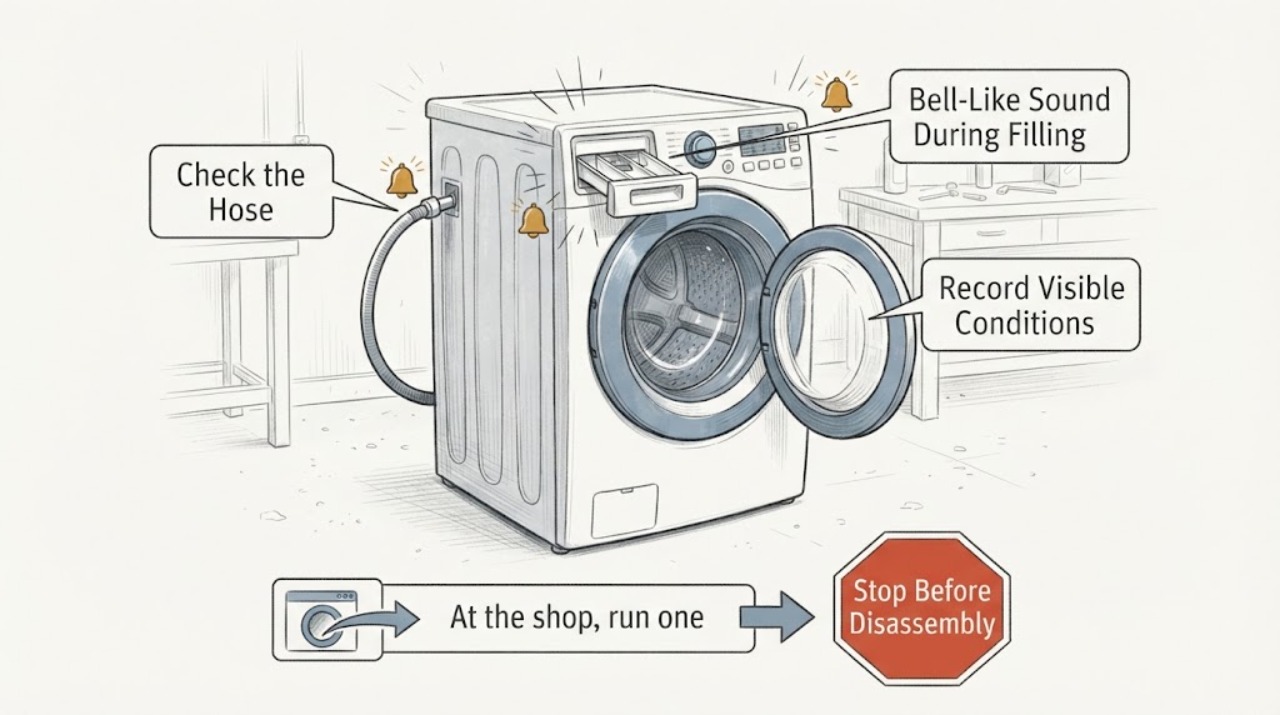
Whirlpool's official WTW8127LC1 parts list confirms the exact Chrome Shadow model, while Whirlpool's fill-noise guidance says spraying, splashing and sloshing as water enters a top-load basket can be normal. That guidance does not identify a regularly spaced bell or ding that continues after the water stops, so do not call the sound a normal fill noise or diagnose a speaker, control board, inlet valve or bearing from a recording. At the scratch-and-dent shop, run one normal cycle with the lid closed and listen from outside, record the phase where the tone starts and stops, compare another WTW8127LC-family unit only as a reference, and inspect for visible leaks or cabinet movement. If the tone remains unexplained or the machine has grinding, electrical smell, sparking, leaking or violent movement, stop the test and require model-specific service or documented resolution before accepting the unit; do not open the washer in the store.
Work through in order
Diagnostic checks
Use only checks that match the exact appliance or system and its official guide.
-
Check 1
At the shop, run one ordinary cycle with the lid closed and stand clear of the moving basket. Note whether the sound begins after sensing, overlaps water entry, continues after the inlet water stops, continues during slow prewash movement, and disappears when the wash phase begins. Do not repeat the cycle solely to reproduce a noise.
Expected result: Only ordinary water spray or splash is heard, or a regularly spaced bell-like tone continues across phases and then stops at wash; alternatively, grinding, scraping, leaking or violent movement occurs.
Next step: Record the phase pattern and use the model-specific service boundary for an unexplained tone. Stop immediately for grinding, scraping, leaks, smoke, burning smell, sparking or violent movement.
Stop if: Do not continue the cycle when there is an electrical or mechanical safety symptom.
Why this matters
Why: Whirlpool treats water spray, splash and slosh as normal fill or rinse sounds. A periodic tone with a different phase pattern is not explained by the opened guidance, while mechanical or safety symptoms require stopping the test.
-
Check 2
From outside the machine, record whether the sound is water-like, a single valve click, a repeated electronic-sounding ding, or a rubbing/grinding sound. Record a short audio or video clip only if the shop permits it and do not place a phone, hand or tool inside the washer.
Expected result: The sound matches the water spray reference, is a repeated tone unlike the reference, or is accompanied by physical vibration or scraping.
Next step: Give the clip and phase description to the shop or Whirlpool service. Do not infer a speaker, control board, water valve, bearing or drive failure from the audio category alone.
Why this matters
Why: The official pages support normal water-flow sound only; they do not identify a repeated ding or map a sound to a component. Physical vibration or scraping is a separate mechanical symptom.
-
Check 3
With the washer stopped, inspect only the visible inlet hoses, drain hose, floor and cabinet exterior for leaks, kinks, rubbing, loose routing or a cabinet that shifts abnormally. Do not disconnect hoses, remove panels or reach through the lid opening.
Expected result: The visible installation is dry and stable, or there is a leak, damaged hose, exposed wiring, loose cabinet or abnormal movement.
Next step: Stop the test for visible damage or water and ask for service or a documented disposition. If the exterior is normal, keep the unresolved tone attached to the exact unit record rather than accepting a generic explanation.
Why this matters
Why: A dry and stable exterior does not explain or clear the bell tone, but a leak or visible damage makes continued store testing unsafe. The official product documents do not authorize a store-side internal diagnosis.
-
Check 4
If the shop has another WTW8127LC-family washer available, listen to the same normal cycle from the same position and note whether the phase pattern is identical. Do not treat another unit's sound as a repair instruction or as proof that the WTW8127LC1 is safe.
Expected result: The second unit has the same water-flow sound and timing, or only the assigned unit produces the recurring bell-like tone.
Next step: Keep the exact model and serial records for any service review. If only the assigned unit produces the tone, require inspection or a documented resolution before accepting it; do not open it in the shop.
Why this matters
Why: A repeated pattern on another unit may indicate a family-level operating sound, but it still does not explain a bell tone that Whirlpool's public page does not document. A one-unit difference makes the exact unit's service history more important.
-
Check 5
Give the shop or Whirlpool-authorized service the exact WTW8127LC1 model, serial number, test cycle, tone timing, audio/video if allowed, visible-condition result and whether another unit was compared. Ask for a model-specific explanation or service record rather than a guessed component name.
Expected result: The shop can reproduce the tone and document a model-specific resolution, or it cannot explain the tone from the external test.
Next step: Arrange Whirlpool-authorized service or defer acceptance of the affected unit until the shop supplies a documented resolution. Do not perform internal repair work at the point of sale.
Why this matters
Why: The parts list provides the exact model literature path, but the opened public noise guidance does not identify this periodic bell. An unresolved repeatable tone remains a service issue, not a consumer teardown task.
Use your observations
Decision map
Find the observation that best matches what you see, then follow the next safe action.
-
PATH 01Next step
What you see
The sound is ordinary water spraying, splashing or sloshing only while the washer fills or rinses, with no repeated bell and no physical or safety symptom.
Do this next
Complete one external test and record the cycle result; do not dismantle the washer or label a normal water sound as a failed component.
Why this path and its safety boundary
Why it matters: Whirlpool identifies these water-flow sounds as normal top-load operation.
-
PATH 02Next step
What you see
A regularly spaced bell-like tone continues while water is running and after it stops, or appears during slow prewash movement but disappears at the wash phase.
Do this next
Keep the exact WTW8127LC1 unit out of internal testing, document the sound and require Whirlpool model-specific service or a documented store resolution before acceptance.
Why this path and its safety boundary
Why it matters: The opened Whirlpool fill-sound guidance does not explain this phase pattern, so the sound remains an unresolved audio symptom rather than a confirmed speaker, control, valve or drive diagnosis.
-
PATH 03Next step
What you see
Another WTW8127LC-family washer makes the same water-flow sound and phase pattern, while the assigned unit has no leak, scraping or abnormal movement.
Do this next
Preserve the exact unit's recording and serial number and ask the shop or Whirlpool service to confirm the sound; do not use comparison alone as a safety or repair determination.
Why this path and its safety boundary
Why it matters: The comparison may indicate a family-level operating sound, but it does not prove that a repeated bell tone is normal because Whirlpool's opened guidance does not document that tone.
-
PATH 04Next step
What you see
The test produces grinding, scraping, violent movement, a water leak, smoke, burning smell, sparking, exposed wiring or a damaged cord.
Do this next
Stop the cycle, keep clear of the washer and have the shop disconnect and service it safely. Do not open panels, defeat the lid lock or make live measurements.
Why this path and its safety boundary
Why it matters: This is a safety or mechanical stop condition independent of whether the original tone is normal.
Helpful context
Understand the symptom
Separate normal water sound from the reported tone
Whirlpool's official top-load guidance says water entering the basket can make spraying, splashing or sloshing sounds, and its separate page provides a normal fill-sound reference. Those pages do not say that a regularly spaced bell-like tone continuing after the water stops is normal. The reported sound therefore remains an unresolved audio symptom rather than a confirmed speaker, control, inlet-valve or mechanical fault.
The exact unit matters in a scratch-and-dent shop
The opened Whirlpool parts list identifies WTW8127LC1 as the Chrome Shadow version and names the model's owner manual, quick reference guide and tech sheet. A shop test should use the exact unit and its normal controls. A different WTW8127LC-family washer can provide only a sound comparison; it cannot prove that the tested unit is healthy or that an internal part is failing.
Do not turn a retail test into a repair
A scratch-and-dent inspection is suitable for observing a complete normal cycle from outside the cabinet, checking visible hoses and leaks, and recording when the sound appears. It is not a reason to remove the console, lift panels, access the inlet valve, defeat the lid lock or make live electrical measurements. If the tone is repeatable and unexplained, the appropriate next step is Whirlpool model-specific service or a documented store resolution.
When checks do not resolve it
Need a professional?
Use Whirlpool-authorized service when the recurring tone is reproducible and unexplained, when the shop cannot provide a model-specific resolution, or when the washer has grinding, scraping, leaks, smoke, burning smell, sparking, exposed wiring or violent movement. Do not open the washer at the shop.
Common questions
FAQ
Is a bell-like ding during filling a normal Whirlpool WTW8127LC1 sound?
The opened Whirlpool guidance confirms that water spray, splash and slosh can be normal during filling and rinsing, but it does not document a regularly spaced bell that continues after water stops. Treat that tone as unresolved until the exact unit is checked or serviced.
Could the tone be the speaker or control board?
That is only a possibility, not a verified diagnosis. The opened public sources do not map this phase pattern to a speaker or control board, so do not open the console or order an internal part from the recording.
Can a scratch-and-dent shop test the washer?
The shop can run one normal cycle with the lid closed, observe the sound from outside, inspect visible hoses and leaks, and record the exact timing. It should not dismantle the washer, defeat the lid lock or perform live electrical tests at the point of sale.
Does another WTW8127LC making the same sound prove this unit is fine?
No. A comparison can show a repeated family pattern, but it does not establish that a periodic bell is covered by Whirlpool's normal-fill guidance or rule out an issue in the exact unit. Keep the exact model and serial record and request a model-specific answer.
Read the exact guide
Official sources
- WTW8127LC | WhirlpoolWhirlpool · Opened owner-center page identifies WTW8127LC as a 5.2–5.3 cu. ft. top-load washer and exposes owner documents, service support and model-family literature. The page is not used to diagnose the periodic bell.
- Repair Parts List - W11616960 - Rev AWhirlpool Corporation · Opened PDF page 1 lines 0-4 identifies models WTW8127LW1 and WTW8127LC1, with WTW8127LC1 listed as Chrome Shadow; page 2 lines 8-14 lists the owner manual, quick reference guide, tech sheet and wiring diagram. It does not diagnose the reported bell tone or authorize store disassembly.
- Spraying or Sloshing - Noise - Product Help | WhirlpoolWhirlpool Product Help · Opened lines 132-140 say water spraying, splashing and sloshing can occur as water fills the basket and during spray rinse, and these sounds are part of normal operation. The page does not define a regularly spaced bell or ding.
- Kitchen And Laundry Appliance Manuals | WhirlpoolWhirlpool · Opened page directs owners to enter the full model number to retrieve applicable manuals and troubleshooting literature. It is a lookup route, not evidence for an unseen internal test or tone meaning.
- VIDEO: Normal Top Load Washer Fill SoundWhirlpool Product Help · Opened page lines 117-128 labels the normal top-load washer fill-sound reference and directs owners to model manuals for product literature. It does not diagnose the reported bell or authorize internal testing.
Community feedback
Share a repair observation
Share a plain-text repair observation. Accepted observations are published automatically; this page may take a moment to update.