
On this page
Start here
Quick answer
A Whirlpool washer can hum, whirl, click, or gurgle normally during sensing, agitation, spin, lid locking, or drain pump-out. A new or loud noise should be classified by sound and cycle phase before a part is suspected. Stop the cycle if the washer walks, the tub strikes the cabinet, metal scrapes continuously, smoke or a burning odor appears, the plug or outlet is hot, water reaches electrical parts, or the tub does not stop. With the washer stopped and the floor dry, check only external loose objects and hoses, load distribution, all four feet, and—on a front-load installation—the shipping hardware and pedestal or drain-pan fit. Do not open the cabinet, reach into a moving basket, or run repeated tests. Whirlpool's official guidance treats persistent abnormal noise or vibration after these model-appropriate checks as a service issue.
Before you begin
Safety first
- Keep the washer off for smoke, burning odor, sparks, overheating, leaks near electrical parts, severe vibration, cabinet impact, a tub that will not stop, or a suspected internal fault. Do not open the cabinet, reach beneath the machine, or bypass a lid or door interlock.
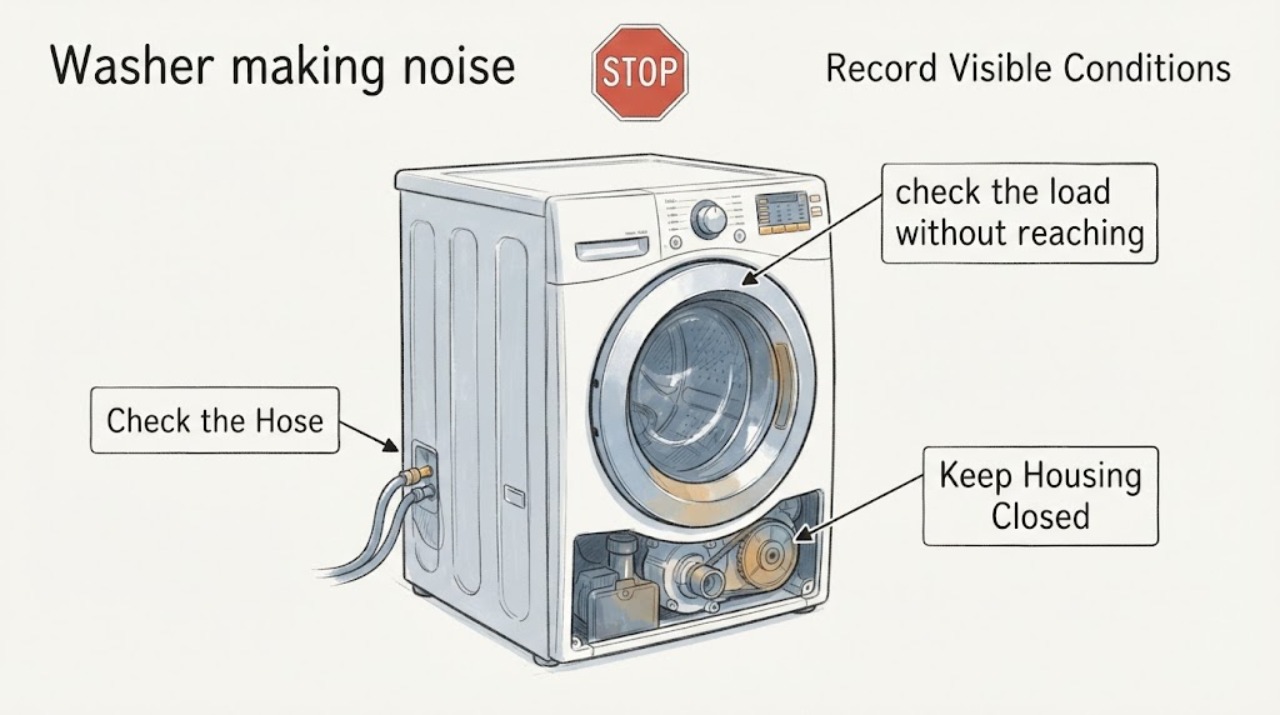
Work through in order
Diagnostic checks
Use only checks that match the exact appliance or system and its official guide.
-
Check 1
Pause or stop the washer using the normal control, keep hands out of the basket until all motion stops, and record the sound as hum, whirl, click, rattle, knock, thump, grind, rub, squeal, or another description. Note whether it occurs during fill, lid or door lock, sensing, agitation, drain, or spin.
Expected result: The sound is brief and phase-specific, continues through a phase, changes with basket speed, or is accompanied by walking, cabinet impact, smoke, heat, a leak, or a tub that does not stop.
Next step: Stop immediately for smoke, burning odor, sparks, a hot plug, water near electrical parts, violent movement, or a tub that will not stop. Otherwise continue only after motion stops and the floor is dry; do not run repeated tests to make the sound louder.
Why this matters
Why: Whirlpool maps several brief sounds to normal motor, pump, lid-lock, or direction-change behavior, while persistent sound or movement changes the risk and service path.
-
Check 2
With the washer off, inspect the outside and rear without pulling it across a wet floor. Remove loose items from the top, move leaning racks or objects away, and check whether the inlet or drain hoses are touching the cabinet or are loose; secure only as the exact model installation instructions permit.
Expected result: A coin, container, rack, broom, hose, or other external item is vibrating against the cabinet, or the exterior is clear and the sound continues.
Next step: Remove or secure only the visible external source and monitor one normal phase if no safety symptom exists. If the sound persists, becomes metallic, or comes from underneath, leave the washer off and arrange service rather than opening the cabinet.
Why this matters
Why: Whirlpool identifies loose objects and hoses touching the cabinet as common sources of clicking or knocking. A clear exterior with persistent noise makes a load, level, pump, drive, or internal component more likely.
-
Check 3
After the basket has stopped, check the load without reaching into motion: note whether a single bulky item, an overloaded basket, or clothes gathered to one side coincides with the noise or vibration. Redistribute or reduce the load only as the model manual allows; do not add water or keep running a violent cycle.
Expected result: The noise occurs mainly at spin with an uneven or bulky load, the load is suitable and evenly distributed, or the washer strikes the cabinet or walks even after the load is corrected.
Next step: Run no further cycle if the washer walks, impacts the cabinet, or produces metal scraping. If the machine is stable and the manual permits, try one correctly distributed load; stop and arrange service if the symptom returns.
Why this matters
Why: Whirlpool says an unbalanced or overloaded load can create basket movement, knocking, thumping, noise, and vibration, while persistent movement after a suitable load points to leveling, installation, suspension, or drive concerns.
-
Check 4
With the washer empty or safely unloaded and the floor dry, check whether the cabinet rocks diagonally and whether all four feet are firmly contacting the floor. For a front-load model on a pedestal or drain pan, use the manual to verify the installation and look only for visible rubbing or interference; do not place hands under a supported appliance.
Expected result: The washer rocks, a foot is not planted, lock nuts are loose, the drain pan or pedestal is rubbing, or the machine is level with no visible interference.
Next step: Use only the exact model leveling procedure on a dry stable floor and stop if moving the machine would strain hoses or the cord. If leveling does not resolve the noise, keep the washer off and arrange qualified service.
Why this matters
Why: Whirlpool links an unlevel washer and feet that do not contact the floor with excessive noise and vibration. A drain pan or pedestal can also contact the tub or alter the safe leveling arrangement on applicable front-load models.
-
Check 5
For a front-load washer installed recently or moved, check the manual and installation record for removal of all shipping materials or bolts. For any model, note whether the sound is limited to drain, fill, or lid locking and whether water is draining normally; do not remove shipping hardware or pump parts while the appliance is connected.
Expected result: Shipping hardware may remain, the sound is a normal phase-specific pump or lock sound, water drains normally, or the noise is new and not tied to a normal phase.
Next step: Follow the exact installation instructions for any shipping-hardware confirmation; do not guess or dismantle. If the sound is abnormal, worsening, or remains after documented installation checks, arrange service.
Why this matters
Why: Whirlpool says shipping materials left in a front-load installation can cause excessive noise. A phase-specific hum, gurgle, or click may be normal, while a new unexplained sound needs model-specific diagnosis.
-
Check 6
After the safe external checks, record the exact model, sound, phase, load, level, installation history, water state, and any display indication. Do not remove panels, test live wiring, reach beneath the washer, or keep repeating spin cycles to isolate a suspected pump, motor, bearing, belt, or suspension fault.
Expected result: The noise remains with a clear exterior, suitable load, stable installation, and normal water path, or a safety symptom appears at any time.
Next step: Keep the washer off and arrange qualified Whirlpool appliance service. Provide a short recording only if made from a safe distance and the model and phase details; never reproduce a hazardous sound for documentation.
Why this matters
Why: Persistent noise after external causes are excluded is more consistent with an internal component or model-specific condition that cannot be confirmed safely by ordinary observation.
Use your observations
Decision map
Find the observation that best matches what you see, then follow the next safe action.
-
PATH 01Next step
What you see
The sound is a brief click at cycle start and the lid or door locks normally, with no movement or electrical symptom.
Do this next
Allow the cycle to proceed if all other operation is normal. Stop and arrange service if the lock fails, the click becomes continuous, or the washer will not operate.
Why this path and its safety boundary
Why it matters: Whirlpool identifies a start-of-cycle click as a likely lid-lock sound on applicable models.
-
PATH 02Next step
What you see
The sound is a steady or intermittent hum or whirl during agitation, spin, or drain and the washer remains stable.
Do this next
Compare the timing with the exact model guidance and monitor without opening the machine. Request service if the sound changes to grinding, scraping, smoke, overheating, or severe vibration.
Why this path and its safety boundary
Why it matters: Whirlpool describes motor sounds during agitation or spin and pump humming during drain as normal possibilities, depending on model and phase.
-
PATH 03Next step
What you see
The sound is a rattle, click, or knock and an object or inlet or drain hose is touching the cabinet or leaning against the washer.
Do this next
Remove the loose object or secure the visible hose using the model-approved arrangement. If the sound remains with the exterior clear, continue to load and leveling checks rather than opening the cabinet.
Why this path and its safety boundary
Why it matters: A loose external object or hose can transmit vibration and imitate an internal washer fault.
-
PATH 04Next step
What you see
The noise is strongest at spin and the load is unbalanced, bulky, overloaded, or the washer rocks or walks.
Do this next
Wait until motion stops, redistribute or reduce the load, and correct leveling only by the exact model method. Stop for repeated walking, cabinet impact, or metal scraping and arrange service.
Why this path and its safety boundary
Why it matters: Whirlpool links load distribution and leveling with basket movement, cabinet impact, excessive noise, and vibration.
-
PATH 05Next step
What you see
A front-load washer was recently installed or moved and the noise began immediately, or a pedestal or drain pan visibly rubs the appliance.
Do this next
Check the exact installation instructions and stop if correction would require unsafe lifting or disassembly. Arrange qualified service when shipping hardware, pedestal, or drain-pan fit cannot be confirmed safely.
Why this path and its safety boundary
Why it matters: Shipping hardware or installation interference may be transferring vibration or contacting the tub on applicable models.
-
PATH 06Next step
What you see
The noise is a continuous metal scrape, severe grind, new roar, or repeated impact after the load and level are correct, or the sound comes from beneath the cabinet.
Do this next
Stop using the washer and arrange qualified service. Do not remove panels, reach under the tub, or continue cycles to identify the component.
Why this path and its safety boundary
Why it matters: An internal drive, pump, suspension, bearing, tub, or foreign-object condition is possible and cannot be safely confirmed through an external test.
-
PATH 07Next step
What you see
Smoke, burning odor, sparks, a hot plug or receptacle, a leak near electrical parts, violent walking, or a tub that does not stop occurs.
Do this next
Stop immediately, keep clear, close the water supply only if safely reachable, and isolate power only from a dry safe location. Do not restart or open the washer; obtain qualified or emergency help as appropriate.
Why this path and its safety boundary
Why it matters: This is a fire, electrical, water, or injury hazard rather than a normal washer sound.
Helpful context
Understand the symptom
Sound and phase are more useful than volume alone
A pump hum during drain, a lid-lock click at the start, motor whirling during agitation, and a brief gear sound during a direction change can be normal on applicable Whirlpool models. A continuous metal scrape, new rumble, repeated bang, or noise tied to severe vibration needs a different path. Record the exact sound, when it starts, whether water is present, and whether the basket is moving before changing the load or leveling the machine.
Top-load and front-load checks differ
Top-load models may transfer hose and cabinet noise or react to an unbalanced load around the agitator or wash plate. Front-load models add door, shipping-bolt, pedestal, drain-pan, and high-speed basket checks. Whirlpool's product-help pages are model- and style-specific; use the exact owner manual for leveling, shipping hardware, load limits, and any access procedure rather than borrowing a step from another washer.
Separate a loose external object from an internal sound
Coins or items resting on the cabinet, hoses touching the rear panel, and a rack or broom leaning against the washer can rattle without an internal failure. If the noise continues with the exterior clear, the load balanced, and the machine level, an internal pump, drive, suspension, bearing, or other component becomes more likely. Do not remove panels or run the washer with a guard or interlock defeated.
Noise with movement or heat is a stop condition
Stop for violent walking, cabinet impact, metal-on-metal scraping, smoke, burning odor, sparks, a hot plug or receptacle, a damaged cord, a tub that will not stop, or water near electrical parts. Keep clear and isolate power only from a dry safe location. A normal operating sound should never require the user to continue an unsafe cycle to prove its source.
Safety boundary
Stop conditions
- Stop immediately for smoke, burning odor, sparks, a hot plug or receptacle, repeated breaker trips, a leak near electrical parts, violent walking, cabinet impact, or a tub that does not stop. Keep clear and isolate power only from a dry safe location.
- Do not reach into a moving basket, place hands beneath the washer, force a lid or door, or run repeated spin cycles to reproduce grinding, scraping, or impact.
- Do not open the cabinet, remove a pump or drive guard, adjust a suspension or bearing, test energized wiring, or remove shipping hardware without the exact model instructions and safe isolation.
- Stop when a suitable load, clear exterior, and level installation do not resolve a new or continuous noise, or when the sound comes from underneath. Arrange qualified appliance service.
- Do not assume a normal hum, click, or gurgle applies to every Whirlpool model. Use the exact manual for the model, washer style, installation, and noise guidance.
Only after diagnosis
Potential parts
- drain pump or pump assembly
Consider this category only after qualified diagnosis identifies the pump as the source of a persistent drain hum, gurgle with poor drainage, or abnormal sound.
Pump assemblies and access vary by Whirlpool washer model and style. Confirm the exact model and service diagnosis before selecting a part. - suspension, shock, or leveling hardware
Consider this category only when a stable, correctly loaded washer has qualified evidence of worn suspension or installation hardware rather than a normal balance correction.
Suspension and leveling components are model-specific and can require safe cabinet or tub access. Do not select by appearance alone. - drive, bearing, or tub component
Consider this category only after qualified inspection confirms a continuous grind, rub, roar, or speed-related noise from an internal drive, bearing, or tub path.
Internal drive and tub repairs vary substantially by model and may involve heavy parts and water or electrical hazards. Confirm diagnosis and model fit first.
When checks do not resolve it
Need a professional?
Arrange qualified Whirlpool appliance service when a new or persistent noise remains after safe external, load, leveling, and model-specific installation checks; the sound is a continuous scrape or grind; the pump or drive appears implicated; the washer walks or impacts the cabinet; or a lid, door, pedestal, drain pan, or shipping-hardware issue cannot be confirmed safely. Treat smoke, burning odor, sparks, electrical overheating, leaks near electrics, repeated breaker trips, and a tub that will not stop as immediate safety issues.
Safety scope: Keep the washer off for smoke, burning odor, sparks, overheating, leaks near electrical parts, severe vibration, cabinet impact, a tub that will not stop, or a suspected internal fault. Do not open the cabinet, reach beneath the machine, or bypass a lid or door interlock.
Common questions
FAQ
Are some Whirlpool washer noises normal?
Yes. Whirlpool describes phase-specific motor hum or whirling, drain-pump humming or gurgling, a start-of-cycle lid-lock click, and some direction-change or gear sounds as normal on applicable models. Classify the sound by phase and stop for continuous scraping, smoke, burning odor, severe vibration, or electrical symptoms.
Why does my Whirlpool washer knock during spin?
An unbalanced or bulky load, an overloaded basket, an unlevel washer, loose feet, or hoses or objects striking the cabinet can cause knocking and vibration. Wait for motion to stop, correct only a visible load or leveling issue using the manual, and arrange service if the washer walks or the noise returns.
Why is my Whirlpool washer grinding or rubbing?
Some motor or gear sounds can be normal during wash or spin, but overload, an unlevel installation, or a drain pan contacting the tub can worsen grinding or rubbing. A continuous, new, or speed-related metal sound after those checks needs service; do not open the cabinet.
Could a hose or object outside the washer cause the noise?
Yes. Whirlpool identifies inlet or drain hoses touching the rear cabinet, coins or items on top, and racks or other objects leaning against the washer as possible clicking or knocking sources. Check from outside with the washer off and do not pull the machine across a wet floor.
What should I check on a new Whirlpool front-load washer that is noisy?
Use the exact installation instructions to confirm shipping materials were removed, the washer is level, all feet or pedestal parts are correctly seated, and the load is suitable. Stop if correction would require unsafe lifting or disassembly, and arrange qualified service when installation cannot be confirmed.
When should I stop using a noisy Whirlpool washer?
Stop for smoke, burning odor, sparks, a hot plug or outlet, repeated breaker trips, water near electrical parts, violent walking, cabinet impact, continuous metal scraping, or a tub that will not stop. Keep clear, isolate power only from a dry safe location, and obtain qualified or emergency help as appropriate.
Read the exact guide
Official sources
- Humming or Whirling - NoiseWhirlpool Product Help · Whirlpool top-load guidance; sound behavior varies by exact washer model and cycle.
- Grinding or Rubbing Noise - WasherWhirlpool Product Help · Whirlpool front-load guidance; front-load drive and installation details vary by exact model.
- Gurgling, Slurping or Humming Noise - Front Load WasherWhirlpool Product Help · Whirlpool front-load guidance; drain timing and hose installation vary by model.
- Clicking or Clacking - NoiseWhirlpool Product Help · Whirlpool top-load guidance; start-of-cycle behavior and external hose routing vary by model.
- Whirling or Spinning Noise - Front Load WasherWhirlpool Product Help · Whirlpool front-load guidance; follow the exact installation and owner manual for the model.
- Knocking or Thumping - NoiseWhirlpool Product Help · Whirlpool top-load guidance; use the exact model installation and loading instructions.
Community feedback
Share a repair observation
Share a plain-text repair observation. Accepted observations are published automatically; this page may take a moment to update.