
On this page
Start here
Quick answer
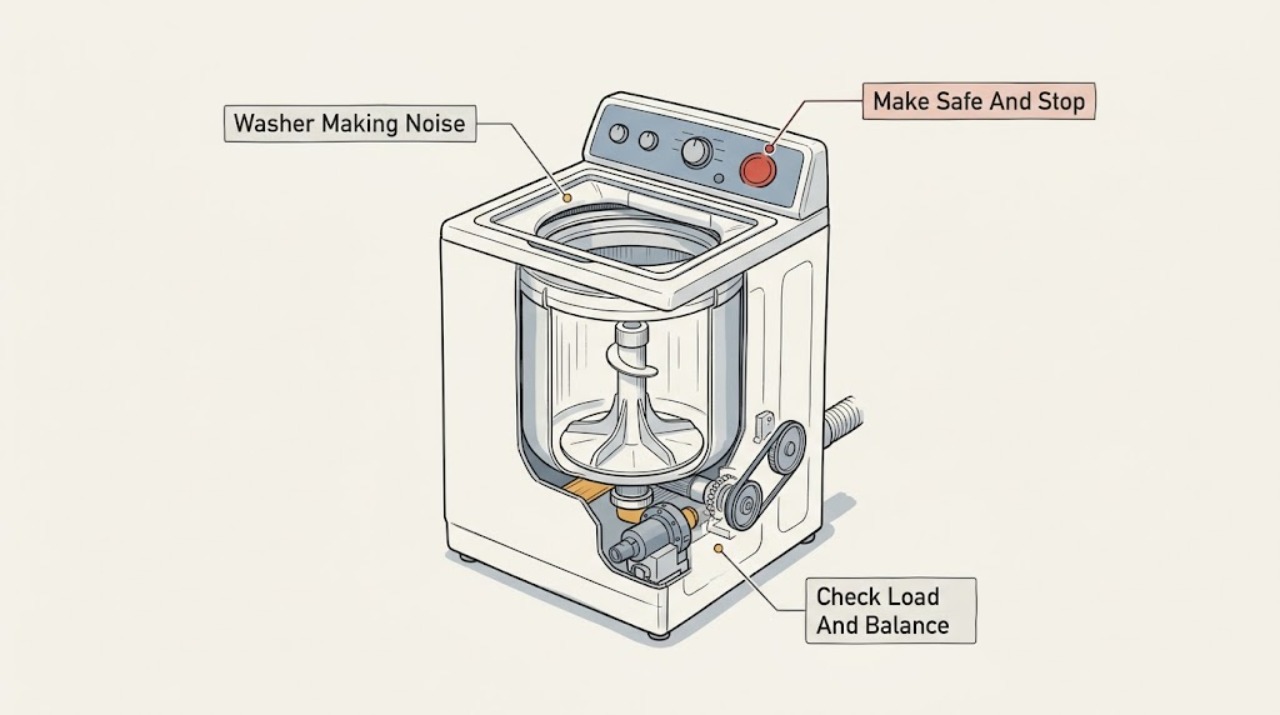
First note the Kenmore washer's sound, when it starts, and whether it changes with the load. A brief click, water sound, pump hum, or change as the cycle shifts can be normal on some models; a new bang or walking during spin often points to an unbalanced load, leveling or installation issue, or an object moving in the basket. A scraping, grinding, squealing, repeated electrical buzz, burning smell, water leak, or noise that continues with an empty tub needs the washer left off and qualified service. Check only from ordinary dry access: stop the cycle and wait for the basket to stop, redistribute a safe load if the manual permits, confirm the machine is stable without moving it, and record the sound. Do not reach into a moving tub, remove panels, test live parts, or order a motor, pump, belt, bearing, agitator, or suspension part from the sound alone.
Before you begin
Safety first
- This article supports dry ordinary-access observation, sound classification, safe load review, visible installation checks, and at most one model-permitted empty observation when no hazard exists. Do not reach into a moving tub, move or tilt the washer, open panels, test live parts, bypass locks, disconnect wet plumbing, or continue operation with a harsh noise or safety symptom.
Work through in order
Diagnostic checks
Use only checks that match the exact appliance or system and its official guide.
-
Check 1
Stop the cycle using the normal control if it is safe, wait for the tub or basket to come completely to rest, and observe from a dry position for smoke, sparks, a burning smell, a hot or damaged cord or outlet, leaking water, or severe cabinet movement.
Expected result: Record whether the sound is accompanied by smoke, electrical odor, heat, water near the power area, active leaking, repeated circuit trips, or the washer walking or striking nearby objects.
Next step: Leave the washer off and obtain qualified appliance or electrical help for smoke, sparks, burning odor, a hot or damaged connection, water near electricity, repeated trips, active flooding, or dangerous movement. Keep people away until the area is safe.
Stop if: Do not touch a wet plug, outlet, cord, or cabinet, pull a plug through pooled water, reset a breaker repeatedly, or continue a cycle to reproduce a hazardous noise.
Why this matters
Why: Smoke, electrical odor, heat, water near electricity, severe movement, or active leaking is a stop-use condition, not a noise to diagnose by repeated cycles. Without those signs, ordinary-access sound classification can continue but does not clear an internal fault.
-
Check 2
From outside the machine, identify the sound and the cycle phase in which it occurs: filling, wash motion, draining, ramping into spin, high-speed spin, or after the cycle. Note whether it repeats with each basket revolution or changes as the load moves.
Expected result: Write down click, hum, gurgle, rattle, thump, bang, scrape, grind, squeal, or buzz; record the first phase, exact location, duration, and whether the sound is new or worsening.
Next step: Use the symptom branches below, record a short audio or video only from a safe stationary position if practical, and do not place a phone, hand, or tool inside the washer.
Stop if: Stop if the sound escalates, the cabinet moves sharply, a smell or leak appears, the door or lid will not safely release, or any recording would require approaching a moving or wet machine.
Why this matters
Why: Phase and rhythm change the next check: a spin-synchronous thump suggests load or stability, a drain-only hum or rattle suggests the pump or drain path, and a scrape, grind, squeal, or electrical buzz that persists outside one transition raises the likelihood of an internal fault.
-
Check 3
After the cycle is stopped and the door or lid is safely released, compare the load with the exact Kenmore manual's loading guidance. Look for one heavy item, a bulky item, clothing packed to one side, an empty or nearly empty basket, or an item trapped between the basket and tub; redistribute only loose laundry without reaching into a moving or locked washer.
Expected result: Record whether the noise and movement occurred only with one load, whether the basket was visibly off balance, and whether the load can be spread evenly without overloading or forcing the door or lid.
Next step: If the manual permits and the area is safe, correct the load once and observe the next appropriate cycle; if the noise persists, leave the washer off and document the result for service.
Stop if: Do not overload, force a door or lid, remove a trapped object with a tool, reach into a moving tub, or keep running a washer that walks, strikes the wall, or threatens to overturn.
Why this matters
Why: A spin-only thump or walk that follows a single bulky or uneven load makes load balance more likely. Noise with ordinary balanced loads, a metallic object, scraping, or a sound that continues empty makes an internal, cabinet, or installation cause more likely.
-
Check 4
With the washer idle, dry, and not being moved, observe whether it sits evenly and whether the cabinet, hoses, drain pipe, floor, pedestal, nearby wall, or stored object could visibly contact or vibrate against it. Do not crawl under the machine or adjust feet by guesswork.
Expected result: Record rocking, an obvious gap or contact, a hose tapping the cabinet, a drain pipe striking the wall, a loose accessible object, an uneven floor, or no external contact; note whether the sound is strongest at the contact point.
Next step: Remove only a loose object that can be taken away without touching hoses, wiring, or the appliance; use the exact installation instructions or qualified service for leveling, pedestal, flooring, or hose-routing changes.
Stop if: Do not tilt, lift, drag, climb on, wedge, shim, or reach underneath the washer, and do not disturb water, drain, gas, or electrical connections to chase a noise.
Why this matters
Why: A clear external contact or unstable installation can create a rattle or bang without proving that the washer's drive is defective. A stable cabinet with an internal-sounding scrape, grind, or rumble points away from a simple placement correction.
-
Check 5
After the machine is off and fully stopped, inspect only visible ordinary-access areas: the basket or tub opening, door glass or lid rim, dispenser, accessible drain-filter cover if the model has one, and visible hose paths. Look for a coin, zipper, bra wire, button, loose trim, residue, or a filter cap that appears not seated; do not disassemble the washer.
Expected result: Record whether a foreign object or loose visible item is present, whether the sound is linked to draining, and whether there is water left in the tub, a blocked-looking drain path, or a leak at an access cover.
Next step: Remove only a loose item that is plainly reachable without force and only as the exact manual permits; otherwise photograph the location and request service, especially for standing water or an underneath source.
Stop if: Do not insert tools, fingers, or a hand into a hidden gap, open panels, force a filter or cap, drain residual water onto a wet electrical area, or operate with a damaged seal or cover.
Why this matters
Why: A visible object can explain a localized rattle or scrape, while a drain-only noise with standing water can involve the pump or drain path. An object that is inaccessible, a loose internal piece, or a leak at the filter or underneath needs service rather than probing.
-
Check 6
Only when the washer is stable, the floor and power area are dry, no leak or electrical warning is present, and the exact model manual permits it, run one empty, short observation from a safe stationary position; do not repeat it merely to make the sound appear.
Expected result: Record whether the noise occurs with an empty tub, the phase and rhythm, whether the cabinet moves, and whether any water, heat, smell, code, or unusual vibration appears.
Next step: Stop after one observation. Leave the washer off and arrange qualified service for noise that persists empty, becomes harsh, or accompanies any other abnormal behavior; document a load-related result for future monitoring only when the manual permits continued use.
Stop if: Do not run this test with water near electricity, an active leak, a damaged cord or hose, repeated circuit trips, severe movement, smoke, burning odor, or an inaccessible underneath or internal source.
Why this matters
Why: Noise with an empty tub makes load imbalance less likely and increases concern for a pump, drive, bearing, suspension, motor, cabinet, or control-related fault. No noise empty makes a load, object, or installation condition more likely but does not rule out an intermittent failure.
-
Check 7
Gather the exact Kenmore model and serial information if safely visible, the sound description and timing, load details, installation observations, photos or a safe recording, and any leak, error, heat, or movement before requesting repair support.
Expected result: Confirm whether the sound is new, worsening, repeatable, load-dependent, empty-tub dependent, or accompanied by water, poor draining, vibration, a circuit trip, or a smell.
Next step: Use Kenmore's model manual and customer-care repair route for a persistent, worsening, internal, or unsafe noise; arrange plumbing or electrical help when the evidence points outside the washer or to a wet or tripping circuit.
Stop if: Do not order a part solely from a sound description, test energized wiring, bypass a lid or door lock, remove a panel, or continue using a washer with an unresolved harsh noise or safety symptom.
Why this matters
Why: This record helps separate normal model-specific sounds and load or placement issues from pump, suspension, tub, motor, bearing, control, or cabinet faults without guessing a component from volume alone.
Use your observations
Decision map
Find the observation that best matches what you see, then follow the next safe action.
-
PATH 01Next step
What you see
The washer thumps, bangs, or walks mainly as it ramps into or reaches spin, the sound changes with load placement, and there is no scraping, burning smell, leak, or electrical warning.
Do this next
Stop, wait for the basket to stop, check the load against the exact manual, and observe stability and external contact without moving the machine. If the washer still bangs or walks with a balanced load, leave it off and arrange service for leveling, suspension, tub, or drive diagnosis.
-
PATH 02Next step
What you see
The sound is brief and occurs at filling, a change in wash motion, draining, or the transition into spin; the washer remains stable, drains, and shows no leak, heat, or harsh repeated noise.
Do this next
Compare the sound and timing with the exact model manual and monitor it without opening the cabinet. Request service if the sound becomes louder, lasts beyond the transition, appears empty, or is accompanied by another fault.
-
PATH 03Next step
What you see
The noise is a hum, rattle, or grinding sound mainly during draining, especially with standing water, slow drain, a visible object, or a filter-access leak.
Do this next
Leave the washer off if draining is poor, water remains, or the sound is harsh. Use only the exact manual's safe, ordinary-access filter procedure; otherwise arrange appliance service and plumbing assessment if the household drain backs up.
-
PATH 04Next step
What you see
A scrape, squeal, growl, metallic grind, or repeated harsh sound remains with an empty tub, follows each revolution, or persists after a balanced-load and external-contact check.
Do this next
Stop using the washer and request qualified appliance service. The source may be an inaccessible object, tub, bearing, suspension, motor, pump, drive, or cabinet component; do not identify or replace a part by sound alone.
-
PATH 05Next step
What you see
The noise is accompanied by smoke, sparks, a burning or electrical smell, a hot or damaged cord, water near electricity, active leaking, severe movement, a repeated circuit trip, or a door or lid problem.
Do this next
Treat it as an immediate stop-use condition. Keep the washer off, do not touch a wet or hot electrical area, keep people away, and obtain qualified appliance, electrical, plumbing, or emergency help from a safe location as appropriate.
Helpful context
Understand the symptom
Describe the sound before trying to quiet it
Record whether the sound is a click, hum, rattle, thump, squeal, scrape, grind, buzz, or bang; whether it occurs while filling, agitating or tumbling, draining, or spinning; and whether it is at the front, rear, top, bottom, or inside the basket. A repeating sound tied to a load position has a different decision from a harsh sound that continues with no clothes. Kenmore has both front-load and top-load families, so do not apply a top-loader assumption to a front-loader or vice versa.
Separate a load or installation issue from an internal fault
A washer can thump or move when a bulky or single heavy item shifts, when the load is packed unevenly, or when the cabinet is not stable. If the sound is new, metallic, scraping, grinding, electrical, or present with an empty tub, the load is less likely to be the whole explanation. Kenmore's model pages mention vibration-control or quiet features on some models, but those features do not make every model silent and do not justify opening the cabinet.
The cycle phase points toward the next check
A short sound at a change in water flow or cycle motion may be part of a normal transition on a particular model. A noise only while draining points toward the pump, filter path, hose, or a foreign object; a noise only during high-speed spin points toward load balance, leveling, suspension, tub, or drive components. A rattle from the rear can be an external hose or installation contact, while an underneath noise with leaking or grinding needs service rather than more testing.
One controlled observation is enough
After the washer has stopped, inspect ordinary-access areas and correct only a clearly safe load or visible placement issue allowed by the exact manual. If the area is dry, the washer is stable, and there is no electrical, leak, or severe-movement warning, one empty observation may show whether the noise follows the washer rather than the clothes. Stop immediately for a harsh or escalating sound, water, smoke, sparks, heat, or a machine that walks.
Safety boundary
Stop conditions
- Smoke, sparks, burning or electrical odor, a hot or damaged cord or outlet, or a repeated breaker or GFCI trip.
- Water near an electrical connection, active flooding, a leak from underneath or an unknown source, or a floor that cannot be safely kept dry.
- The washer walks, strikes nearby objects, rocks severely, or becomes unstable during a cycle.
- A harsh scrape, grind, squeal, metallic bang, or abnormal sound persists with a balanced or empty tub or becomes rapidly louder.
- Standing water, poor draining, wastewater backflow, a drain-filter or hose leak, or any need to reach behind or underneath the appliance.
- A door or lid will not safely release, the tub is moving or hot, or an interlock would need to be bypassed.
- Any need to open the cabinet, test live electrical parts, move or tilt the washer, or use a tool to retrieve an inaccessible object.
- The sound returns after one safe load or model-permitted empty observation, or is accompanied by an error, heat, smell, leak, or other operating fault.
Only after diagnosis
Potential parts
- suspension, leveling, or tub-support component
Consider only when repeated spin thumping or walking remains with a properly distributed load and stable external installation, and service diagnosis confirms a washer-side support fault.
Verify the full model, washer type, revision, and installation procedure; do not change feet or suspension parts from noise alone. - drain pump or pump filter housing
Consider only when a drain-phase hum, rattle, grind, standing-water symptom, or localized filter-area leak is confirmed and the drain path has been separated from household plumbing.
Confirm exact model fit and safe residual-water procedure; pump-area access may expose water and electrical parts and may require professional service. - drive motor, coupling, belt, or gearcase
Consider only after a technician confirms that noise persists empty or follows wash or spin motion after load, stability, drain, and external-contact causes are excluded.
These are model- and design-specific service components; verify the complete model and diagnosis before ordering or opening the cabinet. - tub bearing or tub seal
Consider only when a technician confirms a persistent revolution-synchronous rumble, grind, or leak consistent with a tub or bearing fault.
Do not infer a bearing or seal from volume alone; confirm the exact model, repair scope, and compatible assembly before disassembly. - inlet or cabinet component
Consider only when the sound is tied to filling or a verified cabinet or valve-area vibration and ordinary hose or external-contact checks do not resolve it.
Verify the model-specific component and water and electrical isolation procedure; a supply or plumbing source may be outside the washer.
When checks do not resolve it
Need a professional?
Arrange qualified Kenmore or appliance service when a harsh, new, worsening, empty-tub, internal, or persistent noise remains after a safe load and external-contact check, or when noise accompanies poor draining, standing water, leaking, severe vibration, a code, heat, a door or lid problem, or a circuit trip. Request plumbing help for drain backflow and electrical help for a wet, hot, damaged, or repeatedly tripping power connection. Treat smoke, sparks, burning odor, active flooding, or dangerous movement as urgent stop-use conditions.
Safety scope: This article supports dry ordinary-access observation, sound classification, safe load review, visible installation checks, and at most one model-permitted empty observation when no hazard exists. Do not reach into a moving tub, move or tilt the washer, open panels, test live parts, bypass locks, disconnect wet plumbing, or continue operation with a harsh noise or safety symptom.
Common questions
FAQ
Why is my Kenmore washer banging during spin?
A spin-only bang or walk can follow a bulky, single, or uneven load, or an unstable installation. Stop the cycle, wait for the basket to stop, check the exact manual's loading guidance, and leave the machine off if it still bangs with a balanced load or strikes nearby objects.
Is a clicking or humming sound normal on a Kenmore washer?
Some brief sounds during filling, draining, or a change in cycle motion may be model-specific, but loudness alone is not enough to call a sound normal. Compare the timing with the exact Kenmore manual and request service if the sound is new, harsh, persistent, empty-tub, or accompanied by another fault.
Why does my Kenmore washer grind or scrape when it spins?
A revolution-synchronous scrape or grind that remains with an empty tub is less consistent with a load-only imbalance and can involve an inaccessible object, tub, bearing, suspension, drive, motor, or cabinet component. Stop using it and arrange qualified service rather than reaching inside or ordering a part by sound.
What if the noise happens only while the washer drains?
A drain-only hum or rattle can involve the pump, filter path, hose, or a foreign object, especially when water remains or draining is slow. Use only the exact manual's safe access procedure; keep the washer off for standing water, a leak, a harsh grind, or a backed-up household drain.
Can an uneven floor make a Kenmore washer noisy?
Yes, an unstable cabinet or contact with a wall, hose, drain pipe, pedestal, or nearby object can amplify vibration or create a rattle. Observe from dry ordinary access and use the exact installation instructions; do not tilt, drag, shim, or reach under the appliance as a test.
When should I stop using a noisy Kenmore washer?
Stop for a harsh or worsening scrape, grind, squeal, metallic bang, noise with an empty tub, severe movement, leaking, standing water, smoke, sparks, burning or electrical odor, a hot or damaged cord, a circuit trip, or any need to open the cabinet or reach a moving or wet area.
Read the exact guide
Official sources
- Washers | Laundry | KenmoreKenmore · Confirms Kenmore has front-load and top-load washer families; it is not a model-specific noise diagnosis.
- Customer Care & Support | Kenmore AppliancesKenmore · Use for Kenmore manuals, safety and compliance, recalls, parts, and repair routing; it is not a substitute for an exact-model diagnosis.
- 3.9 cu. ft. Front-Load Washer - White | KenmoreKenmore · This is a specific Kenmore front-load product page, used only to illustrate that a particular model advertises Vibration Guard and quiet operation; its feature claims must not be generalized to every Kenmore washer.
- Find Your Manual | Kenmore Appliance Manuals & GuidesKenmore · The exact owner's manual controls normal-sound descriptions, load and installation checks, access limits, and any service procedure; this lookup page does not diagnose every model.
Community feedback
Share a repair observation
Share a plain-text repair observation. Accepted observations are published automatically; this page may take a moment to update.