
On this page
Start here
Quick answer
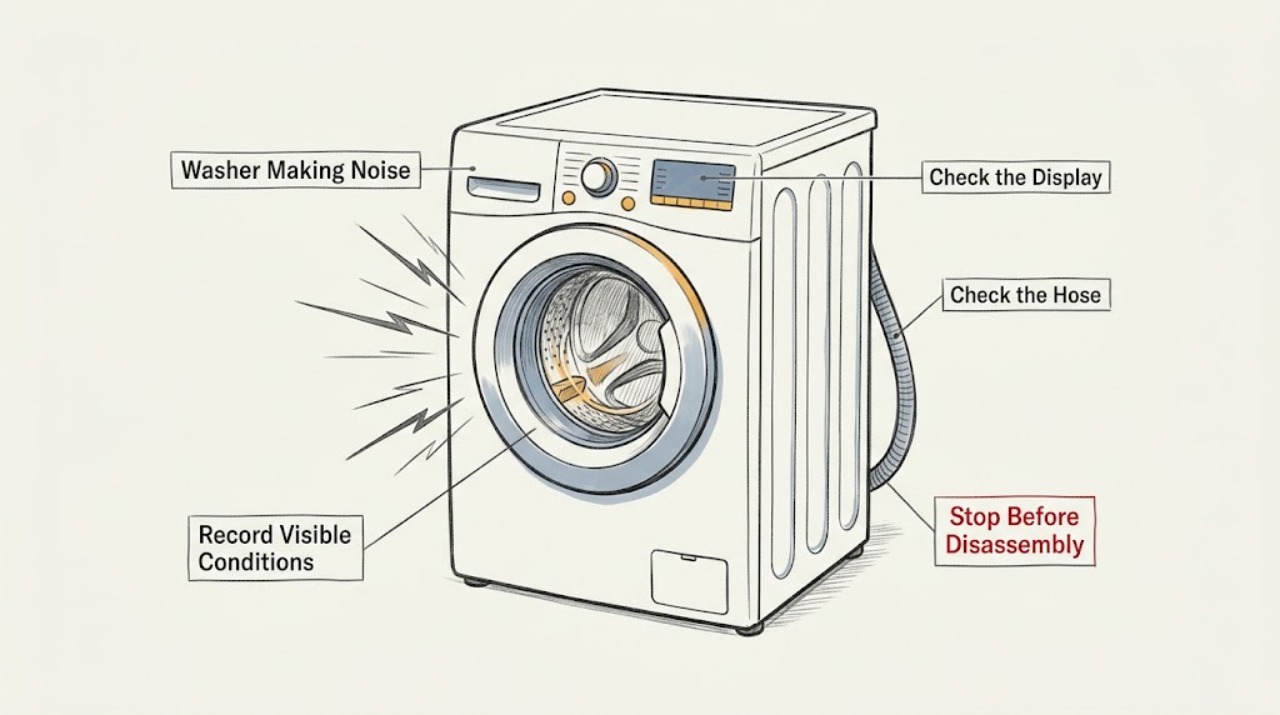
First identify the sound and when it occurs. A hum during sensing, agitation, or draining, a clunk as the drive changes direction, or water moving through the pump can be normal on an Amana washer. Rattling at the cabinet often comes from hoses or objects outside the machine; thumping, grinding, and cabinet movement are more often linked to an unbalanced load, an unlevel washer, a drain pan, or a foreign object. Stop the washer if noise is severe, the cabinet walks, a hot-rubber or burning smell appears, water leaks, the cord or outlet is damaged, or a metal object may be trapped inside. Check the load and external hoses only when the basket is stopped, then arrange qualified service for a persistent grinding, scraping, metallic, or abnormal noise.
Work through in order
Diagnostic checks
Use only checks that match the exact appliance or system and its official guide.
-
Check 1
Describe the noise from a safe position without touching the washer: rattling or tapping, thumping or banging, grinding or rubbing, humming or whirling, clicking, clunking, scraping, or a hot-rubber or burning smell. Record whether it occurs during fill, sensing, wash/agitation, drain, or spin, and whether the cabinet moves, leaks, or shows a code.
Expected result: The sound is a brief click or clunk at a documented transition, a steady hum during sensing or drain, a rattle at the rear, thumping during spin, or persistent grinding, scraping, metallic noise, odor, or severe vibration.
Next step: Keep the washer closed while the basket moves and follow the matching external check. Stop the washer for severe or worsening noise, movement, leak, burning smell, smoke, sparking, or damaged electrical parts.
Why this matters
Why: Amana documents several motor, pump, lock, and drive sounds as normal, while the phase and accompanying symptoms make imbalance, external contact, foreign objects, or internal failure more likely.
-
Check 2
When the washer is stopped, check around and on top of it for coins, hangers, tools, detergent containers, a wall, cabinet, or other object touching the cabinet. Inspect the visible drain and inlet hoses where they pass behind the machine; if they can knock against the cabinet, secure them using the model-supplied restraint or the manual-approved method without pulling on connections.
Expected result: An object is leaning against the washer, a hose contacts the rear cabinet, the area is clear, or the noise continues with no external contact.
Next step: Remove only the external object or correct visible hose contact, then monitor one cycle. If the noise is metallic, scraping, or still present, do not open the cabinet; continue with the load and level checks or request service.
Why this matters
Why: Amana says hoses and ordinary household objects can create rattling or tapping that is transmitted through the cabinet. If the exterior is clear and the sound persists, the source is more likely load, leveling, drain, drive, or another internal condition.
-
Check 3
If the noise is thumping, banging, or strongest during spin, pause through the normal control and wait until the basket stops. Redistribute clothing in loose heaps, remove some items from an overloaded load, and avoid washing one bulky item alone unless the cycle guide provides a balancing method. Do not add water or reach into a moving basket.
Expected result: The load is bunched, tightly packed, a single blanket or heavy item is present, the washer repeatedly adds water and rotates to rebalance, or the load is evenly distributed but banging continues.
Next step: Correct the load once and monitor. If the machine still bangs, walks, or aborts spin, stop using it and arrange qualified service rather than forcing a high-speed cycle.
Why this matters
Why: Amana says an unbalanced load can cause movement, noise, vibration, longer cycles, and a correction process that adds water and agitation. A balanced load that still bangs makes leveling, suspension, drive, or another mechanical issue more likely.
-
Check 4
With the washer empty or safely stopped, check whether it rocks diagonally and whether all four feet are firmly on the floor. Look for a flexing floor or a drain pan that could rub the tub bottom. Use the installation instructions for any leveling adjustment; do not place hands beneath a running washer or remove the drain pan while the machine is operating.
Expected result: The cabinet rocks, one foot is not in contact, the floor flexes, a drain pan is present and may contact the tub, or the washer is stable with no pan contact.
Next step: Correct an accessible leveling issue only as described in the installation instructions, then run a small monitored load. If the washer cannot be leveled, the pan is damaged, or abnormal noise remains, request service.
Why this matters
Why: Amana says an unlevel washer or a drain pan rubbing the tub can worsen grinding, rubbing, vibration, and off-balance noise. Stability with no pan contact makes a load or external-source explanation less likely if the noise continues.
-
Check 5
For clicking, clanking, scraping, or metallic noise, stop the washer and check the empty visible basket for a coin, button, zipper, or other loose object. Empty pockets before the next load and do not fish between the basket and tub or reach into the pump; if the sound comes from underneath or the object cannot be removed without disassembly, leave the washer off.
Expected result: A loose object is visible and removable from the basket, no object is visible but the metallic noise persists, the sound changes with the pump or drain phase, or a suspected object may be between the basket and tub.
Next step: Remove only a clearly accessible object when the washer is stopped. For a hidden object, persistent scraping, or pump-related noise, stop using the appliance and arrange qualified repair.
Why this matters
Why: Amana says loose objects can rattle in the tub or fall into and block the pump, and that service may be necessary to remove them. A drain-phase metallic sound may be a pump obstruction rather than a leveling problem.
-
Check 6
If the sound is humming or whirling, compare it with the normal phase: motor hum during sensing or agitation, a pump hum during drain, or a brief lid-lock click can be expected. Do not deliberately run repeated cycles to reproduce a loud or unsafe sound. Record whether water drains, the basket turns, and the sound stops when the phase ends.
Expected result: The hum or click occurs only in the documented phase and ends normally, the pump hums while water remains, the motor hums without basket movement, or the sound becomes grinding, hot, loud, or continuous.
Next step: If the phase completes normally, monitor with a correctly loaded washer. If water remains, the basket does not move, the sound is loud or abnormal, or a code appears, stop and request service.
Why this matters
Why: Amana describes phase-specific motor, pump, and lock sounds as normal, but a hum without expected movement or draining, or a transition to grinding or overheating, points to a blocked pump, drive, motor, or control issue.
-
Check 7
Use the exact Amana model manual to compare the recorded sound and phase with its normal-sounds and troubleshooting sections. Before any repair or replacement work, disconnect power using the normal accessible disconnect only when there is no immediate danger; do not open panels, test live wiring, or attempt to repair a motor, pump, suspension, bearing, or drive system from the sound alone.
Expected result: The manual identifies a normal sound or accessible correction, the sound is not listed, the same noise returns after the correction, or the washer has a leak, burning odor, smoke, sparking, severe vibration, or damaged cord.
Next step: Keep the washer out of service and arrange qualified appliance repair. Give the technician the model, sound description, phase, load, location, and all external checks already completed.
Why this matters
Why: Amana layouts and operating sounds vary by model. A recurring or unlisted noise with a safety or performance symptom has reached the professional boundary and cannot be assigned to one part from audio alone.
Use your observations
Decision map
Find the observation that best matches what you see, then follow the next safe action.
-
PATH 01Next step
What you see
The sound is a brief click or clunk during a documented lock or drive transition, or a hum during sensing, agitation, spin, or drain that ends when the phase ends.
Do this next
This pattern is consistent with normal Amana operation rather than a fault, provided there is no leak, odor, code, severe vibration, or loss of performance.
-
PATH 02Next step
What you see
Rattling or knocking comes from the rear or outside and a hose or household object contacts the cabinet.
Do this next
External contact is more likely than an internal drive fault.
-
PATH 03Next step
What you see
Thumping, banging, cabinet movement, or spin interruption occurs with a large, single, shifted, or tightly packed load, or the washer rocks.
Do this next
An unbalanced load or unlevel installation is more likely; Amana's correction process may add water and agitation while it attempts to rebalance.
-
PATH 04Next step
What you see
Grinding or rubbing is strongest during wash or spin with a drain pan underneath, or a metallic sound occurs during drain with water or a hidden object suspected.
Do this next
A pan contacting the tub, a drain-path obstruction, or pump issue is more likely than a normal motor hum.
-
PATH 05Next step
What you see
The washer makes a louder grinding sound with a tightly packed load, or clicking/clanking persists after pockets and the visible basket are checked.
Do this next
Overload or a foreign object may be causing the sound, but a hidden object can fall between the basket and tub or block the pump.
-
PATH 06Next step
What you see
Noise remains after external, load, and leveling checks, or is accompanied by a leak, burning or hot-rubber odor, smoke, sparking, severe vibration, damaged cord, code, or loss of spin/drain performance.
Do this next
A mechanical, electrical, pump, motor, suspension, drive, or control fault is more likely and has reached the professional boundary.
Helpful context
Understand the symptom
Some Amana washer sounds are part of the cycle
A brief click at the start of spin may be a lid-lock self-test; a hum can be motor sensing, agitation, or the drain pump; and a clunk can occur as the drive changes between agitation and spin. The same sound becomes more concerning when it is new, grows louder, occurs with cabinet movement, or is paired with a wet load, leak, odor, or code. Note the phase and sound before interrupting the washer.
Keep the first checks outside the cabinet
Hoses, loose items leaning against the machine, load distribution, level, and a drain pan can be checked without accessing internal parts. Amana's owner information says an object can fall between the basket and tub or block the pump, in which case service may be required. Do not reach beneath a moving basket, remove panels, or run the washer with a suspected trapped object, damaged cord, leak, or burning odor.
Safety boundary
Stop conditions
- Stop the washer for severe or worsening noise, cabinet movement, a leak, burning or hot-rubber odor, smoke, sparking, unusual heat, a damaged cord or outlet, or a recurring error.
- Never reach into a moving basket, fish between the basket and tub, remove panels, test live wiring, or keep running the washer with a suspected trapped object.
- Stop and arrange service if metallic, grinding, scraping, or pump-related noise persists after one safe external check, or if load and leveling corrections do not resolve it.
- Disconnect power before any repair or replacement work, using only a normal accessible disconnect when safe; do not use a reset or smaller load to mask an unsafe fault.
Only after diagnosis
Potential parts
- drain or inlet hose restraint or replacement hose
Consider only when a qualified diagnosis confirms a damaged hose or a hose-contact issue that cannot be corrected using the existing installation.
Confirm the complete Amana model and installation requirements; do not alter hose connections while pressurized. - leveling foot or drain pan support
Consider only if the installation inspection confirms a damaged foot, pan, or support that causes rubbing or instability.
Use model-specific installation instructions and fitment; do not place hands under a running washer. - drain pump or pump filter component
Consider only if a drain-phase metallic or humming noise and poor draining lead a qualified technician to diagnose a pump or drain-path fault.
A wet load or noise alone does not prove pump failure; verify the exact model and service diagnosis. - drive, motor, suspension, or bearing component
Consider only after load, leveling, external-contact, and foreign-object checks are clear and a technician confirms an internal mechanical fault.
These internal parts require model-specific diagnosis and qualified installation; do not select one from the sound alone.
When checks do not resolve it
Need a professional?
Arrange qualified appliance repair when an Amana washer's noise is persistent, metallic, grinding, scraping, or accompanied by a leak, burning odor, smoke, sparking, severe vibration, an error, or poor draining or spinning. Request service as well if a suspected object is between the basket and tub, the pump, motor, suspension, drive, or leveling system cannot be checked without disassembly, or the washer cannot be made safe. Provide the full model number, sound description, phase, load, location, and external checks performed.
Common questions
FAQ
Is a humming or clicking sound normal on an Amana washer?
Often, yes. Amana describes humming during sensing, agitation, spin, or drain and clicking or clunking during some lock or drive transitions as normal. It becomes a service concern when the sound is new, loud, continuous, metallic, or accompanied by leaks, odors, codes, severe vibration, or poor performance.
Why does my Amana washer bang during spin?
A large, single, shifted, or tightly packed load can be unbalanced, and an unlevel washer can worsen the movement. Wait for the basket to stop, redistribute or reduce the load, and check stability from outside. If banging, walking, or spin interruption continues, arrange service.
What causes rattling at the back of an Amana washer?
Amana says inlet or drain hoses can knock against the rear cabinet, and objects leaning against the washer can rattle. Remove the outside object or secure a visible hose using the model-approved restraint when the washer is stopped. Persistent metallic noise may indicate a hidden object and needs service.
Why does my Amana washer make a grinding or rubbing noise?
Some motor or gear sounds can be normal, but overload, an unlevel washer, or a drain pan rubbing the tub can make grinding louder. Correct the load and accessible leveling once; if rubbing persists, the pan is damaged, or the sound is severe, stop and request repair.
What if a coin or other object may be inside the washer?
Stop the washer and check only the empty visible basket for an easily removable object. Amana notes that coins or other items can fall between the basket and tub or block the pump. Do not reach between components; arrange qualified service if the object is hidden or the metallic noise continues.
Read the exact guide
Official sources
- Owner's ManualAmana · Amana washer installation, balance, leveling, foreign-object, drain-pump, and normal-noise troubleshooting
- Knocking or Thumping - Noise - WasherAmana · Amana top-load washer hose, external-object, load-balance, leveling, and cycle-correction noise guidance
- Troubleshooting Washer NoisesAmana · Amana washer rattling, thumping, grinding, leveling, hose, and professional repair guidance
- Grinding or Rubbing Noise - WasherAmana · Amana front-load washer grinding, rubbing, overload, leveling, drain-pan, and service guidance
- Humming or Whirling - NoiseAmana · Amana top-load washer normal motor, sensing, agitation, spin, and drain-pump sound guidance
Community feedback
Share a repair observation
Share a plain-text repair observation. Accepted observations are published automatically; this page may take a moment to update.