
On this page
Start here
Quick answer
Identify the sound and the cycle stage before assuming a failed part. A Hotpoint washer can normally click while the lid or mode mechanism engages, hum while filling or draining, gurgle at the end of drain, or make a gentle-cycle click from the clutch; the opened GE Appliances support article specifically says that gentle-cycle clicking is normal on GE and Hotpoint washers. A new thump, scrape, squeal, metallic rattle, or noise with rocking, leaking, burning smell, poor draining, or a failed spin needs a safe check of load balance, level, shipping material, visible hoses, and accessible foreign objects. Keep hands out of a moving basket, stop for smoke, scorching, sparking, a damaged cord, water near electrical parts, or a rapidly worsening noise, and arrange model-specific service when the sound persists or requires panels, live electrical access, pump, suspension, motor, clutch, bearing, or transmission work.
Before you begin
Safety first
- This article supports sound classification and ordinary-access load, leveling, visible hose, installation, and foreign-object checks only. It does not authorize panel removal, live electrical testing, pump or suspension access, pressurized plumbing work, lid-lock bypass, appliance lifting, or operation after a fire, water, or electrical hazard.
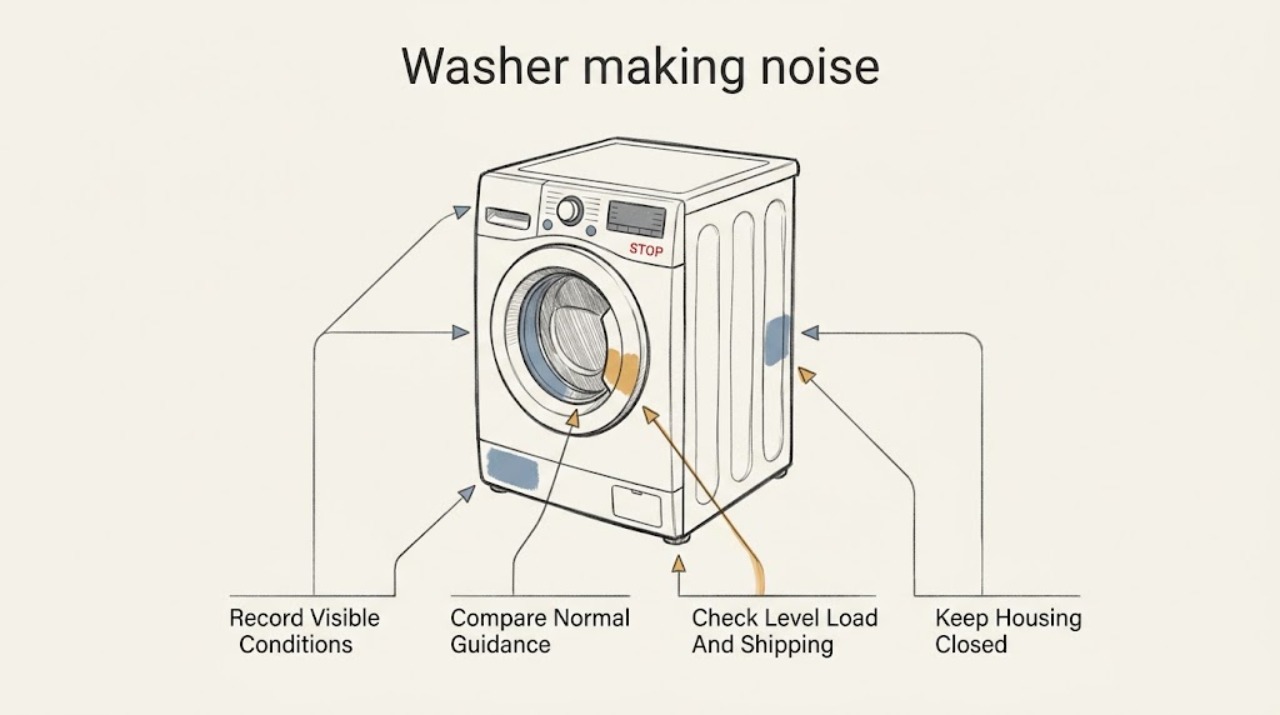
Work through in order
Diagnostic checks
Use only checks that match the exact appliance or system and its official guide.
-
Check 1
With the washer stopped and safe to approach, record the sound in plain language and note exactly when it occurs: lid lock or sensing, fill, agitation, transition to spin, spin, drain, or coast-down.
Expected result: Classify the sound as click, hum, waterfall, gurgle, thump, bang, rattle, squeal, scrape, grinding, or another pattern; note whether it is brief and repeatable, continuous, newly louder, or linked to rocking, leaking, smoke, or a wet load.
Next step: Photograph the model label and note the load, cycle, and sound timing; use the relevant branch without repeatedly running a noisy cycle to reproduce it.
Stop if: Stop immediately for smoke, burning or hot electrical odor, sparking, a damaged cord, water near electrical parts, a violent bang, or a basket that is rubbing or moving abnormally.
Why this matters
Why: Timing separates potentially normal platform sounds from load, installation, water-flow, drain, or mechanical symptoms. A sound outside the exact Hotpoint model's normal-sound description cannot be cleared by its sound name alone.
-
Check 2
Compare the recorded timing with the exact Hotpoint manual and the official manufacturer guidance for a gentle-cycle click, lid or drive engagement, fill hum, drain hum or gurgle, and spin ramp or coast-down; do not apply a sound table from an unrelated model as a diagnosis.
Expected result: Record whether the sound matches the named normal pattern in timing and operation, or whether it is new, rougher, louder, continuous, or accompanied by another symptom.
Next step: If the sound matches the exact guidance and the washer operates normally, monitor it; otherwise continue with the visible checks and arrange service if it persists.
Stop if: Do not dismiss grinding, scraping, repeated banging, or a new sound merely because a different Hotpoint or GE model lists a similar normal noise.
Why this matters
Why: A brief sound matching the model's documented mechanism may be normal. A change from the expected pattern, a sound present when the machine is empty, or a noise accompanied by poor operation shifts the concern to diagnosis and service.
-
Check 3
For thumping, rocking, drumming, banging, or rattling during agitation or spin, check from outside that the washer sits firmly and level, the load is not tightly packed or gathered to one side, and model-specific shipping material was removed after installation or moving.
Expected result: Record cabinet rocking, a leg that does not sit firmly, an uneven or overloaded load, missing installation information, or a sound that remains with the basket empty and the washer stable.
Next step: Use the exact Hotpoint installation instructions for any accessible leveling or load correction; stop and request service when the washer remains unstable, the sound is present empty, or correction would require lifting or moving the appliance.
Stop if: Do not place hands under the washer, defeat a lid lock, lift the machine alone, or continue high-speed operation while it rocks violently or strikes the cabinet.
Why this matters
Why: Official manufacturer guidance links thumps, bumps, bangs, and rocking to leveling, shipping material, and load conditions on applicable top-load platforms. A persistent empty-load noise makes a mechanical or suspension issue more likely.
-
Check 4
If the noise occurs only while filling or draining, listen from a dry position and inspect visible water hoses and the drain hose for kinks, loose routing, or contact with the cabinet without disconnecting plumbing.
Expected result: Record a squeal or whistle that changes with water flow, a bang from household pipes, a hum with water moving, a gurgle at the end of drain, a drain hose striking the cabinet, slow drainage, or water that does not leave the washer.
Next step: Follow the exact model installation guidance for visible hose routing and ask a plumber about household pipe noise; request appliance service for a persistent pump or valve noise, slow draining, leaks, or any internal access.
Stop if: Do not disconnect a hose under pressure, reach into the pump, pour chemicals into a blocked drain, or continue when water is near the outlet, cord, controls, or wiring.
Why this matters
Why: Water-flow pressure or plumbing can cause fill noise, and pump or drain-hose operation can make a normal hum or gurgle. A hose that strikes the cabinet, a blocked drain, or a persistent noise with poor draining needs an installation or service path rather than a drive-part guess.
-
Check 5
With power off and the basket fully stopped, inspect only ordinary-access areas for coins, fasteners, bra wire, zippers, or other loose objects in the basket, lid or door area, and visible drain or hose openings; remove an object only if it is loose and reachable without disassembly.
Expected result: Record whether the sound follows a particular garment or load, whether an object is visibly caught, whether the basket spins freely by the model-approved manual method, or whether the sound occurs with no visible object.
Next step: Remove only the loose object, rerun an appropriate empty or light cycle once if the manual permits and no safety symptom exists, and arrange service for a trapped object, persistent scrape, or any need to access the cabinet or pump.
Stop if: Do not reach into a moving basket, pry an object from a seal or pump, remove panels, or use tools near wiring or a locked lid or door.
Why this matters
Why: A sound tied to one load or a loose visible object is more likely a loading or foreign-object issue. A scrape or grind with no visible object can involve the basket, tub, pump, motor, bearing, clutch, or suspension and is not a safe do-it-yourself diagnosis.
-
Check 6
If the sound is a new squeal, scrape, grinding noise, or metallic rattle, note whether it changes with basket speed, agitation direction, load weight, or drain operation, without opening the washer or deliberately stressing the drive.
Expected result: Record a sound that is speed-related, agitation-only, drain-only, present empty, or accompanied by vibration, poor spin, a wet load, leaking, heat, smoke, or a belt-like odor.
Next step: Stop repeated testing and provide the recording, model, stage, and associated operation symptoms to qualified Hotpoint service; do not order a mechanical part from the sound alone.
Stop if: Stop use for scraping that worsens, metal-on-metal sound, smoke, burning smell, abnormal heat, violent movement, water leakage, or a damaged cord.
Why this matters
Why: A squeak during agitation may need service, while speed-related or empty-load grinding can point beyond a simple balance correction. The sound pattern can guide a technician but cannot confirm a clutch, belt, bearing, pump, motor, or transmission part for an unspecified model.
-
Check 7
After one safe visible correction, preserve a short audio or video record from a safe distance and document whether the sound is gone, unchanged, or returning on the same stage or load.
Expected result: Classify the result as normal matching sound, corrected load or installation noise, persistent noise with normal operation, or noise with failed spin, poor draining, leaking, heat, smoke, or electrical symptoms.
Next step: Request model-specific service and provide the model, sound description, cycle stage, load condition, installation history, photos, and recording; contact a plumber when the sound is household pipe or water-pressure related.
Stop if: Keep the washer out of service for a safety symptom, violent movement, water at electrical parts, smoke, sparking, or a worsening mechanical sound.
Why this matters
Why: A stable correction supports load, leveling, shipping, hose, or normal-operation noise. Persistence or an operation failure makes a component, installation, plumbing, or safety diagnosis more likely and should not be masked by repeated cycles.
Use your observations
Decision map
Find the observation that best matches what you see, then follow the next safe action.
-
PATH 01Safety boundary
What you see
The sound is a brief click, fill or drain hum, end-of-drain gurgle, or gentle-cycle click that matches the exact model's timing and the washer otherwise fills, agitates, spins, and drains normally.
Do this next
Monitor without changing parts; if the sound becomes louder, continuous, rough, or linked to poor operation, return to diagnosis and service.
Why this path and its safety boundary
Why it matters: The sound may be normal operation. The official Hotpoint-specific guidance identifies gentle-cycle clicking as clutch operation, while other manufacturer pages describe normal sound patterns only for named washer platforms.
Safety stop: Do not rely on the normal-sound comparison if smoke, heat, leak, violent movement, or an operation failure is present.
-
PATH 02Safety boundary
What you see
Thumping, drumming, banging, or rocking appears mainly during agitation or spin, especially after a move, new installation, uneven load, or visible instability.
Do this next
Stop the cycle, redistribute the load and verify visible leveling or installation points using the exact Hotpoint manual; service the washer if it remains unstable or noisy empty.
Why this path and its safety boundary
Why it matters: Load distribution, leveling, shipping material, or a hose striking the cabinet is more likely than an immediately failed drive part on applicable platforms.
Safety stop: Do not lift or brace the machine while operating, reach under it, bypass the lid lock, or continue violent rocking.
-
PATH 03Safety boundary
What you see
The noise occurs only while water enters or leaves: squeal or whistle during fill, pipe bang, hum with water movement, drain gurgle, or hose impact at the rear.
Do this next
Check only visible hose routing and the model's installation guidance; use a plumber for household pipe or pressure noise and appliance service for persistent pump, valve, drain, leak, or internal symptoms.
Why this path and its safety boundary
Why it matters: Water pressure, household plumbing, inlet valve flow, pump operation, drain hose routing, or a blockage becomes more likely than a basket or suspension fault.
Safety stop: Do not disconnect pressurized hoses, access a pump, seal a drain, or continue with water near electrical parts.
-
PATH 04Safety boundary
What you see
Rattle or scrape follows a garment or particular load, or a loose visible object is found while the washer is stopped and accessible.
Do this next
Remove only a loose reachable item, use the exact manual's loading guidance, and arrange service if the object is trapped, the basket is damaged, or the sound remains.
Why this path and its safety boundary
Why it matters: A foreign object or loading interaction is plausible, but a trapped object or damage to the basket, tub, seal, or pump cannot be ruled out from outside.
Safety stop: Do not pry inside the pump, reach into a moving basket, remove panels, or run the washer with a scraping object.
-
PATH 05Safety boundary
What you see
A new squeal, scrape, grinding, or metallic rattle persists with a balanced, stable, empty washer, or occurs with poor spin, wet loads, leaks, heat, smoke, or electrical symptoms.
Do this next
Stop repeated testing, keep the washer out of service, and request qualified Hotpoint diagnosis with the recording, model, stage, and associated symptoms.
Why this path and its safety boundary
Why it matters: A mechanical, pump, motor, clutch, bearing, suspension, tub, control, or electrical fault is more likely and cannot be safely identified by sound alone.
Safety stop: Do not open panels, test live circuits, replace a drive part by guesswork, or restart after smoke, sparking, burning smell, abnormal heat, water at electrical parts, or violent movement.
Helpful context
Understand the symptom
Describe the noise by timing and movement
Write down whether the sound occurs during lid lock or sensing, water fill, agitation, transition to spin, high-speed spin, draining, or only when the basket stops. Note whether it is a click, hum, gurgle, thump, bang, scrape, squeal, or grinding sound, and whether the cabinet rocks or the load stays wet. A sound that is normal on one Hotpoint model can still require service on another, so keep the model number with the description.
Separate normal operating sounds from a change
The manufacturer describes several normal sounds on selected washer platforms: a gentle-cycle click from the clutch, a hum with incoming or draining water, gurgling as the pump removes the last water, and brief clicks as the drive or lid mechanism changes state. The comparison is useful only when the sound has the same timing and behavior as the matching model guidance. A new, louder, continuous, or mechanically rough sound should be treated as a symptom.
Start with low-risk installation and load checks
An unlevel washer, leftover shipping material after installation or moving, a loose drain hose, a foreign object in the basket, or an uneven load can create noise without proving a failed drive part. Check only visible, ordinary-access items with the washer stopped. Do not remove cabinet panels, reach below a moving basket, or test electrical components to find a noise.
Safety boundary
Stop conditions
- Stop using the washer for smoke, sparking, burning or hot electrical odor, abnormal heat, a damaged cord, water near the outlet, controls, or wiring, or repeated breaker operation.
- Do not reach into a moving or locked basket, bypass a lid or door lock, place hands under the cabinet, lift the machine alone, or operate through violent rocking.
- Do not open panels, test live voltage, access a pump, remove a trapped object with tools, or replace a clutch, bearing, motor, suspension, belt, or transmission without qualified service.
- Do not disconnect hot or pressurized water hoses, seal the drain hose, pour chemicals into a blocked drain, or continue repeated cycles to reproduce a worsening noise.
- Treat a normal-sound comparison as model-specific; a new, continuous, rough, or operation-affecting sound needs service even if another Hotpoint or GE model describes a similar sound as normal.
Only after diagnosis
Potential parts
- drain hose or inlet valve
Consider this category only when the noise is limited to fill or drain and inspection or service confirms a damaged hose, restricted valve, or failed flow component after visible routing checks.
Confirm the full Hotpoint model, hose routing, valve configuration, and manufacturer fit information; do not disconnect pressurized plumbing to test it. - lid lock or door-lock assembly
Consider this category only when a model-specific diagnosis links repeated locking clicks, failure to start, or abnormal engagement noise to a defective lock rather than normal sensing operation.
Match the exact model and lock design; never bypass the lock or order a part from a click sound alone. - drive, clutch, belt, or motor assembly
Consider this category only when persistent speed-related, agitation, or transition noise remains after load, leveling, shipping, and visible-object checks and a technician identifies the failed drive component.
Confirm the full Hotpoint model, drive revision, and service diagnosis; these parts are not interchangeable across all washer platforms. - tub bearing or suspension component
Consider this category only when an empty stable washer has persistent rumble, scrape, excessive movement, or speed-related noise and qualified diagnosis confirms bearing, tub, or suspension wear.
Verify exact model and assembly design before ordering; installation typically requires qualified service and must not be inferred from a floor vibration alone.
When checks do not resolve it
Need a professional?
Arrange qualified Hotpoint appliance service when the noise persists after one safe load, leveling, shipping-material, hose, or visible-object check; occurs with an empty stable basket; or is accompanied by poor spin, wet loads, draining failure, leaks, abnormal heat, smoke, sparking, or a damaged cord. Use a plumber for household pipe or water-pressure noise. Service is required for any diagnosis involving panels, pump, motor, clutch, belt, bearing, suspension, transmission, wiring, or a trapped foreign object.
Safety scope: This article supports sound classification and ordinary-access load, leveling, visible hose, installation, and foreign-object checks only. It does not authorize panel removal, live electrical testing, pump or suspension access, pressurized plumbing work, lid-lock bypass, appliance lifting, or operation after a fire, water, or electrical hazard.
Common questions
FAQ
Is clicking normal on a Hotpoint washer?
It can be. The official manufacturer says a ticking or clicking sound during the Gentle Wash cycle is caused by the clutch and is normal on GE and Hotpoint washers. Apply that only when the timing and cycle match; a new, rough, or operation-affecting click needs diagnosis.
Why does my Hotpoint washer thump or rock during spin?
Check the load distribution, visible leveling, and model-specific shipping material after an installation or move. Official manufacturer guidance links thumping, drumming, rocking, and banging on applicable top-load platforms to these conditions. Stop violent movement and arrange service if the washer remains unstable or noisy empty.
Is a humming or gurgling noise from a Hotpoint washer normal?
A hum with water flow and a brief gurgle at the end of drain can be normal pump operation on the matching platform. A new continuous hum, noise with slow draining, or a hose striking the cabinet needs visible drain-routing checks and possibly service.
What should I do about a Hotpoint washer squealing or grinding?
Record whether it occurs during fill, agitation, spin, or drain and whether it changes with speed or load. A squeak that develops during agitation may need service; persistent grinding, scraping, metal-on-metal sound, smoke, heat, leaks, or violent motion is a stop-use condition.
When should I stop using a noisy Hotpoint washer?
Stop for smoke, scorching, sparking, hot electrical odor, water near electrical parts, a damaged cord, violent rocking, metal-on-metal scraping, a leak, abnormal heat, or a worsening mechanical noise. Do not open panels or test live circuits; arrange qualified appliance service.
Read the exact guide
Official sources
- Washer - Making a Squeaking NoiseGE Appliances · GE Appliances support article for top-load and front-load washers; a developed agitation squeak may need service, and the exact Hotpoint model controls diagnosis.
- Top Load Washer - Noises Heard During AgitationGE Appliances · GE Appliances guidance for named top-load platforms, used only as a comparison framework; Hotpoint's exact model manual controls whether a pattern is normal on a particular Hotpoint washer.
- Washer - Clicking Noise During the Gentle CycleGE Appliances · GE Appliances support article explicitly covering both GE and Hotpoint brands; it applies only to the named gentle-cycle clicking pattern, not every Hotpoint noise.
- Washer - Noise Heard When Filling with WaterGE Appliances · GE Appliances washer fill-noise guidance used for comparison; the exact Hotpoint model and household plumbing determine the remedy.
- User Manual & Care for HTW240ASKWS | GE AppliancesGE Appliances · Official GE Appliances Owner Center page for a Hotpoint top-load washer; used to establish that model-specific manual guidance controls other Hotpoint platforms.
- Washer - Normal Noise When DrainingGE Appliances · GE Appliances drain-noise guidance used for timing comparison; the Hotpoint installation instructions control the specific drain-hose setup.
- Top Load Washer - Normal SoundsGE Appliances · GE Appliances guidance for specified GTW model families, not a universal Hotpoint sound chart; use the exact Hotpoint manual for model decisions.
Community feedback
Share a repair observation
Share a plain-text repair observation. Accepted observations are published automatically; this page may take a moment to update.