
On this page
Start here
Quick answer
First identify whether the sound is a normal wash sound, a rattling or clicking sound during washing, a thump or walking movement during spin, or a persistent grinding, scraping, or roaring sound. LG says zippers, buttons, and the sound of laundry falling can be normal, while spin noise is often related to an uneven load, foreign object, unlevel washer, or shipping hardware left after installation. Pause the washer before touching laundry, empty pockets, spread a suitable load evenly, check that the washer is stable, and verify that installation packing has been removed. Do not reach into a moving tub, dismantle the cabinet, or keep running a machine that smokes, smells electrically, leaks, strikes the cabinet, or makes continuous bottom grinding. If the noise remains with an empty drum or after safe load and leveling checks, arrange qualified LG service.
Before you begin
Safety first
- Keep the washer off for persistent grinding or scraping, severe movement, leaks near electrical parts, smoke, burning or electrical odor, arcing, a hot plug or outlet, or a tub that will not stop. Do not open the cabinet, bypass safety devices, or repeat spin tests.
Work through in order
Diagnostic checks
Use only checks that match the exact appliance or system and its official guide.
-
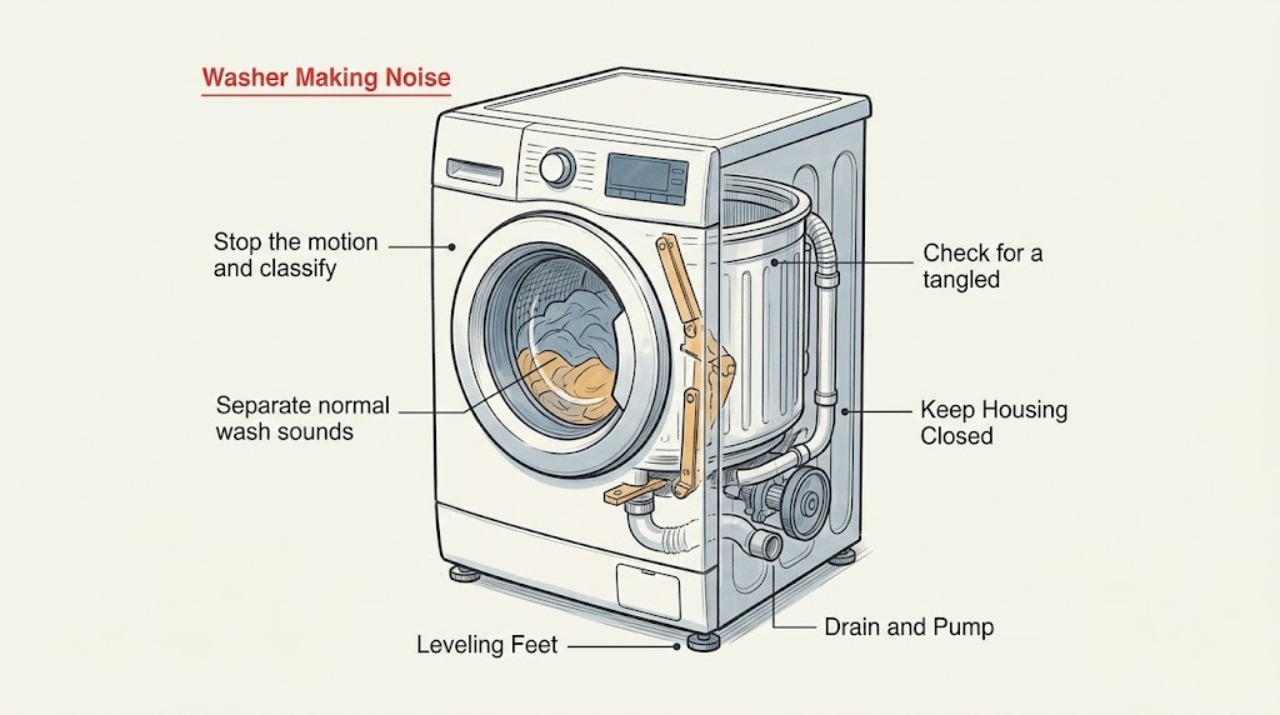
Stop the motion and classify the sound
Press Pause or Power and wait until the drum or tub is completely still before touching laundry. Record whether the noise occurs during filling, washing, acceleration, high-speed spin, draining, or stopping, and describe it as clicking, splashing, rattling, thumping, squealing, scraping, grinding, or roaring. From a safe position, look for smoke, burning odor, a hot plug, arcing, a water leak, or a washer that walks into the wall.
Expected result: The tub does not stop, the washer strikes the cabinet or walks violently, smoke or an electrical odor appears, a connection is hot, water reaches electrical equipment, or the breaker trips repeatedly.
Next step: Stop immediately, keep clear, and isolate power only from a safe, dry location. Close the water supply only if it is safely reachable; arrange qualified appliance or electrical service, and use emergency help for smoke or fire.
Stop if: Do not restart the washer, reach into the tub, or move it across connected hoses and power leads.
Why this matters
Why: This is an injury, fire, electrical, or water event rather than an ordinary noise check.
-
Separate normal wash sounds from new or persistent noise
If the sound is only a soft falling or splashing sound during wash, or a light click from zippers and buttons, pause and check pockets, fasten closures, and use the exact model's normal-operation guidance. If the sound is new, loud, metallic, or present from the bottom of the product, keep the washer off while you continue only the safe external checks.
Expected result: The sound matches clothing falling or fasteners tapping during wash and disappears with a suitable load, or it is persistent rattling, grinding, scraping, or roaring from the bottom.
Next step: For a normal, repeatable sound with no other symptom, use suitable loads and secure fasteners. For continuous bottom noise, stop using the washer and request professional service.
Stop if: Do not keep running cycles to see whether a persistent grinding or scraping noise clears.
Why this matters
Why: LG describes the first pattern as potentially normal operation. Persistent bottom rattling or grinding can indicate a motor-part abnormality and is not safely identified by sound alone.
-
Check for a tangled or unsuitable load
After the tub stops, remove or spread laundry evenly around the drum. Look for a single bulky item, a blanket or rug, waterproof fabric, a very small load, or an overloaded drum that can collect on one side. Empty pockets and fasten zippers and buttons before the next suitable load; do not reach under a moving tub or add weight as a blind fix.
Expected result: Laundry is gathered on one side, the load is bulky or waterproof, clothing was overloaded, or the load is evenly distributed but the same noise remains.
Next step: Run at most one supervised cycle with a suitable, evenly distributed load if the washer is stable and there is no safety symptom. Stop for repeated imbalance, impact, or persistent noise.
Stop if: Do not wash waterproof items or continue a cycle that causes violent movement or cabinet impact.
Why this matters
Why: A load that cannot balance can cause pounding, rattling, prolonged spin, or walking. A balanced, appropriate load with the same sound makes a floor, foreign-object, installation, drain, or mechanical path more likely.
-
Check the washer for rocking and an unstable floor
With the washer off and empty or safely unloaded, press opposing diagonal corners to see whether the cabinet rocks. Check that all feet contact a solid, level floor and that the washer has not shifted away from its installed position. Use only the model-documented leveling procedure; do not drag the washer while hoses or the power lead are connected.
Expected result: The cabinet rocks, one foot is loose or off the floor, the floor is soft or damaged, the washer was recently moved, or the cabinet is stable but noise remains.
Next step: Correct leveling only as the exact model instructions allow, tighten any model-specified foot lock, and verify all feet remain in firm contact. If the floor or feet cannot be made stable safely, arrange service or installation help.
Stop if: Do not compensate for a damaged floor, broken foot, or heavy movement by placing loose objects under the washer.
Why this matters
Why: LG links an unlevel or unstable installation to rocking sound and spin vibration. Stability with continuing noise makes a load-independent or mechanical issue more likely.
-
Verify shipping bolts and packing after installation or moving
If the noise began after delivery, installation, or a move, compare the rear of the washer with the exact LG installation instructions to confirm that all shipping bolts and packing materials were removed. For an applicable front-load model, the empty tub should have the movement described by LG when checked safely through the open door. Do not force a bolt, tilt a heavy washer alone, or remove hardware that is inaccessible.
Expected result: Shipping hardware or packing is still present, the empty tub does not move as the model guidance describes, or the hardware was removed but excessive noise continues.
Next step: Keep the washer off and have the installer or qualified service remove retained shipping hardware safely. If hardware is confirmed removed, continue only the load and level checks once; request service if the noise remains.
Stop if: Do not operate the washer with shipping bolts or packing materials still installed.
Why this matters
Why: Retained shipping hardware can hold the tub and cause excessive noise and vibration. Persistent noise after correct installation points to load, leveling, foreign-object, drain, or mechanical diagnosis.
-
Inspect the empty drum for foreign objects
When the washer is off, unplugged only from a safe, dry location, and fully stopped, remove laundry and look inside the drum for coins, keys, wires, buttons, or other loose objects. For an empty front-load drum, rotate it gently by hand only if the exact LG guidance permits and there is no damaged seal or electrical concern. Do not reach into gaps, remove panels, or use a tool where an object is trapped beyond the user-accessible opening.
Expected result: A loose object is visible and can be removed without force, the drum makes the same noise while empty, or an object is trapped in a gap or pump area.
Next step: Remove only a loose, visible object without forcing it. If the object is trapped, the drum scrapes, or the empty drum still rattles or grinds, leave the washer off and arrange service.
Stop if: Do not dismantle the tub, pump, cabinet, or drive system to retrieve an object.
Why this matters
Why: Fasteners and foreign objects can rattle against the tub; noise that continues with an empty drum or an inaccessible object needs service diagnosis.
-
Check drain and fill noise only at visible connections
If the sound occurs only while filling or draining, listen from a safe distance and inspect the visible inlet and drain hoses for rubbing against the cabinet, a kink, loose support, or a hose striking the washer. Confirm that the hose routing matches the exact installation instructions. Do not loosen a pressurized water connection or put a hand into a pump or drain opening.
Expected result: A hose visibly strikes the cabinet, is kinked or unsupported, the household drain backs up, or the hose path is correct but a loud clicking, grinding, or repeated noise continues.
Next step: Correct only a safe, visible routing or support issue documented for the model. Stop for a leak, backup, loud grinding, or a returning code and arrange appliance or plumbing service as appropriate.
Stop if: Do not open the pump or cabinet to identify a drain or motor noise.
Why this matters
Why: A hose can transmit a filling or draining vibration to the cabinet, while a persistent internal pump or motor sound cannot be diagnosed safely by listening alone.
-
Use one supervised test only after safe checks
After the load, level, installation, and visible foreign-object checks are complete, and only if the floor and electrical area are dry, run one model-appropriate rinse or spin test while staying nearby. Watch for renewed walking, impact, abnormal sound, leaks, a code, or failure to drain. Stop the test immediately if any of these occurs.
Expected result: The washer is quiet and stable with a suitable load, the sound returns with an empty or balanced drum, or the washer vibrates, strikes, leaks, shows a code, or makes continuous bottom grinding.
Next step: If the test is normal, use the suitable load and installation settings. If the sound returns or any abnormal symptom appears, leave the washer off and give service the exact sound, cycle stage, model, and test result.
Stop if: Do not repeat spin tests or increase the spin speed to provoke the noise.
Why this matters
Why: A quiet test after a load or leveling correction supports an installation or load cause. A noise that is load-independent or returns with abnormal movement needs qualified diagnosis.
Use your observations
Decision map
Find the observation that best matches what you see, then follow the next safe action.
-
PATH 01Next step
What you see
The sound is a soft splashing, clothing-fall sound, or occasional zipper or button click during wash, with no walking, impact, leak, or change in operation.
Do this next
Empty pockets, fasten closures, and use an appropriate load. Request service if the sound becomes continuous, metallic, much louder, or appears with another symptom.
Why this path and its safety boundary
Why it matters: LG describes these sounds as possible normal operation caused by the wash motion or garment fasteners.
-
PATH 02Next step
What you see
Pounding or rattling begins during acceleration or spin, and clothing is gathered on one side, bulky, waterproof, overloaded, or otherwise difficult to balance.
Do this next
Wait for the tub to stop, redistribute or reduce the load according to the model guidance, and try one supervised cycle only if the washer is level and stable. Stop for repeated walking or impact.
Why this path and its safety boundary
Why it matters: An unbalanced or unsuitable load is more likely than a failed drive component.
-
PATH 03Next step
What you see
The cabinet rocks, a foot is not firmly on the floor, the floor is unstable, or the noise started after the washer was moved.
Do this next
Use the exact LG leveling procedure and verify all feet contact the floor. Arrange installation help if moving connected services or correcting the floor would be unsafe.
Why this path and its safety boundary
Why it matters: Leveling or installation has a stronger connection to the vibration than the laundry itself.
-
PATH 04Next step
What you see
The noise began after delivery or installation, the empty tub does not move as the model guidance describes, or shipping bolts or packing remain.
Do this next
Keep the washer off and have the installer or qualified service remove the hardware safely. Do not operate it until the installation is corrected.
Why this path and its safety boundary
Why it matters: Retained shipping hardware may be restraining the tub and causing excessive noise or vibration.
-
PATH 05Next step
What you see
A rattling sound is tied to a pocket item or loose object, disappears after removing a visible object, or continues with the drum empty.
Do this next
Remove only a loose accessible object. If the drum still makes the sound, an object is trapped, or scraping is present, stop and request service.
Why this path and its safety boundary
Why it matters: A loose fastener may explain intermittent tapping, but a load-independent rattle or grind raises concern for an object in an inaccessible area or a mechanical fault.
-
PATH 06Next step
What you see
A loud click occurs only while filling, or a drain or fill hose visibly strikes the cabinet, while the drum and cabinet are otherwise stable.
Do this next
Correct only visible hose routing or support under the exact installation instructions. Stop for a leak, backup, or continuing loud noise and arrange service.
Why this path and its safety boundary
Why it matters: Hose movement or water-flow vibration is more likely than a tub or drive failure.
-
PATH 07Next step
What you see
Continuous grinding, scraping, or roaring comes from the bottom or returns with an empty, balanced, level washer; or the sound is accompanied by a leak, code, smoke, heat, or electrical odor.
Do this next
Leave the washer off and arrange qualified LG service. Keep clear and isolate power only from a safe, dry location for smoke, heat, arcing, a hot connection, or water near electrical equipment.
Why this path and its safety boundary
Why it matters: LG identifies persistent bottom rattling or grinding as a possible motor-part abnormality, while the combined symptoms require professional diagnosis and a safety stop.
Helpful context
Understand the symptom
The cycle stage and sound pattern change the diagnosis
A soft splat as clothing falls in a front-load drum, or clicking from zippers and buttons, can be normal. A pounding or rattling sound that begins as the tub accelerates points more toward load balance, floor level, or a foreign object. A metallic scrape or grinding sound that remains with the drum empty is not a load-adjustment problem; stop and arrange service.
Recent installation is an important clue
LG uses shipping bolts and packing materials to hold the tub during transport. If those materials were not removed, the washer can make excessive noise and vibrate. A washer that was recently installed or moved deserves an installation check before repeated spin testing. Use the exact model instructions, and have service or the installer handle hardware that cannot be safely removed.
Do not confuse vibration with a confirmed failed part
An unlevel floor, loose leveling foot, tangled load, bulky item, waterproof fabric, or fastener in a pocket can all create noise without proving a motor or bearing failure. Conversely, continuous rattling or grinding from the bottom, noise with an empty drum, or noise accompanied by a fault code or leaking water needs professional diagnosis rather than a guessed replacement part.
Safety boundary
Stop conditions
- Stop immediately for smoke, burning or electrical odor, arcing, a hot plug or outlet, water near electrical equipment, a tub that will not stop, violent walking, cabinet impact, or repeated breaker trips. Keep clear and isolate power only from a safe, dry location.
- Do not reach into a moving tub, operate with shipping bolts or packing installed, open the cabinet, bypass a lid or door interlock, or dismantle the pump, motor, belt, suspension, or tub.
- Do not continue spin tests for persistent grinding, scraping, roaring, an empty-drum noise, a returning fault code, or a noise accompanied by a leak.
- Use the exact LG model instructions for shipping hardware, leveling, cycle selection, and any access panel; do not treat one LG series or washer style as universal.
Only after diagnosis
Potential parts
- leveling foot or installation hardware
Consider this only when the exact installation diagnosis confirms a damaged leveling foot or retained or missing shipping hardware is causing the noise.
Installation hardware and foot designs vary by LG model. Confirm the exact model and professional or manual diagnosis before selecting a component. - drain pump or foreign-object filter component
Consider this only when a qualified diagnosis links a persistent drain-stage noise to a damaged pump or filter after accessible foreign objects and hose routing are ruled out.
Pump and filter access and fit vary by front-load, top-load, and combination models. Confirm the exact model and diagnosis first. - suspension, bearing, or drive component
Consider this only when a stable, balanced, correctly installed washer has load-independent noise and qualified inspection identifies the relevant internal component.
Internal drive and suspension components are model-specific and may require professional installation. Do not order by sound alone.
When checks do not resolve it
Need a professional?
Request service for persistent bottom grinding, scraping, roaring, an empty-drum noise, a trapped foreign object, retained or damaged shipping hardware, severe vibration, a returning code, a leak, or any smoke, heat, electrical odor, or repeated breaker trip.
Safety scope: Keep the washer off for persistent grinding or scraping, severe movement, leaks near electrical parts, smoke, burning or electrical odor, arcing, a hot plug or outlet, or a tub that will not stop. Do not open the cabinet, bypass safety devices, or repeat spin tests.
Common questions
FAQ
What noises are normal for an LG washer?
LG says front-load washers can make a sound as laundry rises and falls, and zippers or buttons can click against the tub. Those sounds should not be confused with continuous bottom grinding, metal scraping, violent movement, or a new loud noise that persists with an empty drum.
Why does my LG washer bang or rattle during spin?
LG identifies an uneven or unsuitable load, a washer that is not level, foreign objects, and retained shipping hardware as distinct possibilities. Wait for the tub to stop, redistribute a suitable load, check stability, and verify installation. Stop for repeated walking or impact.
Can shipping bolts make an LG washer noisy?
Yes. LG says shipping bolts hold the tub during transport and can cause excessive noise and vibration if they remain after installation. If the washer is new or was moved, compare its rear installation with the exact model instructions and have the installer or qualified service handle hardware that cannot be removed safely.
What should I do if an LG washer rattles when it is empty?
With the washer off and safely isolated, look for a loose visible object and follow the exact LG guidance for an empty-drum check. If the object is trapped, the drum scrapes, or rattling or grinding continues with no laundry, leave the washer off and request service rather than opening the cabinet.
When should an LG washer noise be serviced?
Arrange service for continuous bottom rattling or grinding, noise with an empty or balanced drum, retained shipping hardware, a trapped object, severe vibration, a returning code, or a leak. Stop immediately for smoke, electrical odor, a hot connection, water near electrics, a tub that will not stop, or violent cabinet impact.
Read the exact guide
Official sources
- LG Washer: How to Install and Setup Your LG Washing MachineLG USA · LG installation overview for front-load and top-load washers; model-specific installation instructions control.
- LG Washer - Common Noises During the Washer CycleLG USA · LG support guide covering general washer operation; exact model sounds can differ.
- [LG washing machine noises] A rattling noise occurs during washing.LG USA · LG support guide created for all models; images and content may differ by model.
- LG Washer - Troubleshooting Noises During the CycleLG USA · LG support guide covering front-load and top-load washer branches; exact model content may differ.
- LG Washer – Troubleshooting Vibration Issues on an LG Washing MachineLG USA · LG USA guidance for applicable front-load and top-load washer installations; use the exact model instructions.
- [PS Guide] LG Washer - My Washing Machine Makes a Rattling Noise and the Tub Does Not SpinLG USA · LG support guide created for all models; error and access details may differ.
Community feedback
Share a repair observation
Share a plain-text repair observation. Accepted observations are published automatically; this page may take a moment to update.