
On this page
Start here
Quick answer
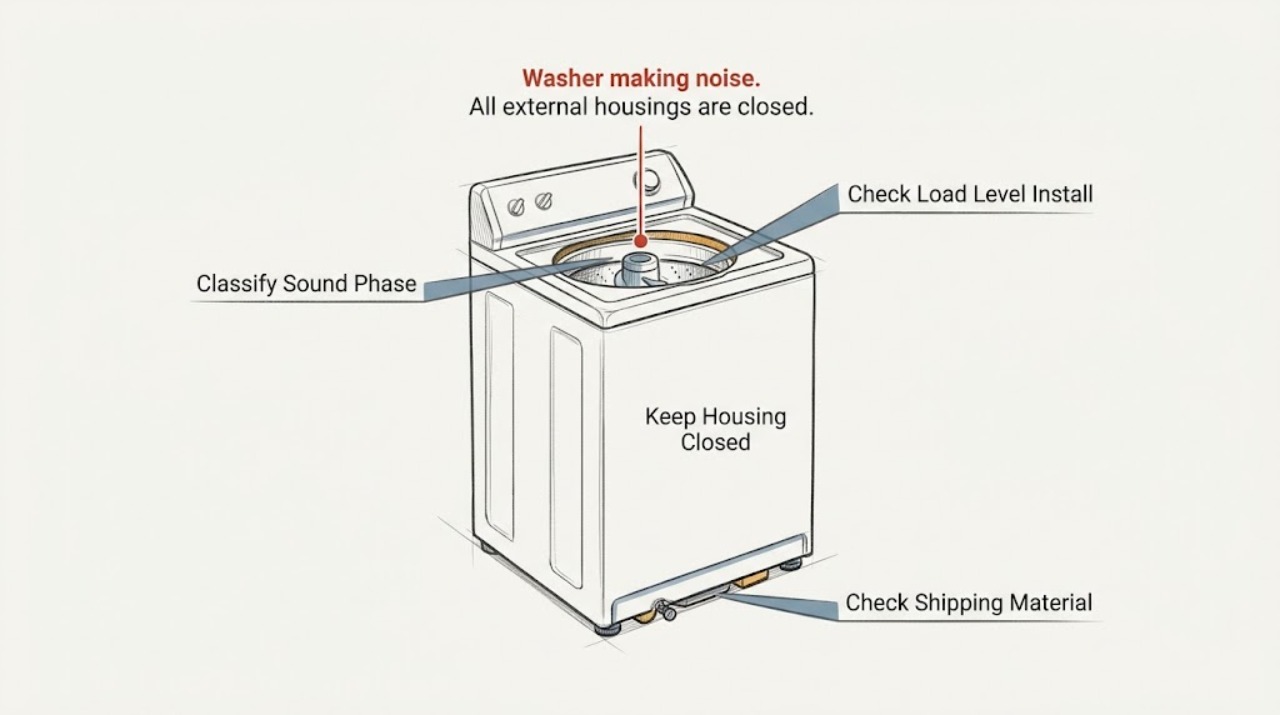
A GE washer can make normal clicks, water sounds, humming, short grinding or pulsing during fill, agitation, drain, or spin, but a new or worsening noise must be matched to its phase, sound, and model. Record whether the noise is a click, gurgle, bang, squeak, scrape, roar, or electrical sound; check that the load is not badly unbalanced, the washer is level, shipping material was removed after installation or moving, and accessible hoses are secured. GE says a drain hose can bang against the cabinet during drain or spin, while loose plumbing can bang during fill. Do not reach into a moving basket, remove panels, run with smoke or burning odor, or keep testing a washer that walks, leaks, trips a breaker, or makes a harsh grinding or scraping noise. Normal-sound descriptions are model-specific, so use the exact GE manual and arrange service when the noise persists or the cause is not clear.
Before you begin
Safety first
- This article supports phase and sound classification plus ordinary-access checks only. Do not reach into moving parts, tip or slide the washer, loosen pressurized hoses, open panels, bypass safety controls, or test live electrical components.
Work through in order
Diagnostic checks
Use only checks that match the exact appliance or system and its official guide.
-
Check 1
From outside the GE washer, identify the noise and record the exact cycle phase: lid lock/sensing, fill, agitation, drain, spin, or coast-down.
Expected result: Describe the sound as click, waterfall, hum, pulse, gurgle, thump, bang, rattle, squeak, scrape, roar, or electrical buzz; note whether it is new, intermittent, louder than before, or paired with a leak, odor, error, or movement.
Next step: Photograph the model label and record a short safe audio/video clip; continue only if the washer is stable, dry, and free of heat or electrical warning signs.
Stop if: Stop for smoke, burning or electrical odor, sparking, a hot plug, water near electrical parts, violent movement, or a harsh scrape or metal-on-metal sound.
Why this matters
Why: A sound that matches a listed phase and model may be normal. A noise outside its phase, a new or worsening noise, or a noise with a safety symptom needs a different check or service.
-
Check 2
With the washer stopped, check from outside that the load is not bunched to one side, the machine stands firmly on all feet, and it is level according to the exact GE installation instructions.
Expected result: Record whether the washer rocks when gently observed from a safe position, the tub is visibly off-center, the load is one heavy item or tightly wrapped, or the noise appears only as spin speed rises.
Next step: Redistribute or reduce the load only when the lid or door is safely open and the machine is stopped; correct leveling only by the model installation procedure, then use one supervised verification.
Stop if: Do not reach into a moving basket, climb on the washer, slide or tip it, or continue if it walks or strikes nearby objects.
Why this matters
Why: GE links thumping, drumming, rocking, and banging during spin to an unbalanced load or an unlevel washer. If the sound persists with a stable load and properly installed machine, do not assume balance is the cause.
-
Check 3
If the noise began after delivery, installation, or moving, compare the installation record and the exact GE manual to verify that all required shipping rods, foam, cardboard, or packing supports were removed.
Expected result: Record whether shipping material remains, the noise began immediately after moving, or the machine vibrates even with a stable empty or small load.
Next step: Stop use and follow the exact installation instructions or arrange service for removal; do not disassemble the cabinet to reach hidden packing.
Stop if: Do not operate with shipping material installed, remove a cover, or force a rod or brace that does not come out by the documented procedure.
Why this matters
Why: GE says retained shipping material can make a top-load washer vibrate and become noisy. This check is model-specific and does not establish that an internal drive fault is absent.
-
Check 4
From a dry, safe position behind or beside the washer, observe whether the drain hose is secured and whether the fill hoses or household pipes move or rattle during the phase that produces the noise.
Expected result: Record whether a bang occurs only during drain or spin when the drain hose can strike the cabinet, or only during fill when loose plumbing or high water pressure may be involved; note leaks or hose damage.
Next step: Use the exact installation instructions for a safe accessible hose support check and ask a plumber about household pipe or pressure noise; arrange appliance service for damaged hoses or persistent noise.
Stop if: Do not pull the washer forward, loosen a pressurized hose, enter a wet area, or continue when water is near the outlet or cord.
Why this matters
Why: GE identifies an unsecured drain hose as a possible drain/spin banging source and loose or rattling plumbing as a possible fill banging source. A damaged or leaking hose is a water-safety problem, not a noise-adjustment task.
-
Check 5
Compare the recorded noise with the exact GE model manual or an official GE sound guide whose listed model family and cycle match your washer.
Expected result: Record an exact normal match, a partial or different-model match, or no match; note whether the sound is a brief click, water-flow hum, gurgle at drain end, short pause/pulse, or a persistent mechanical noise.
Next step: Use the model-specific guidance for one supervised verification; keep the appliance out of use if the sound is not a close match or is worsening.
Stop if: Do not normalize a new noise from a different GE model, disable a safety control, or run repeated cycles to reproduce a suspected fault.
Why this matters
Why: A matching short phase-specific sound can be normal. A different-model comparison cannot clear a noise, and a persistent squeak, scrape, roar, or rattle after installation and load checks requires service.
-
Check 6
After a low-risk load, leveling, shipping-material, or hose correction, run only one brief supervised cycle or phase that the GE instructions make appropriate, keeping hands and loose objects away from the machine.
Expected result: Record whether the noise disappears, remains in the same phase, becomes louder or continuous, and whether the washer drains, spins, and stops without walking, leaking, odor, smoke, or a breaker trip.
Next step: Keep the recording, model, phase, correction, and result for a qualified appliance technician; stop further testing if the cause is not resolved.
Stop if: Stop immediately for violent movement, leak, smoke, burning odor, electrical sound, excessive heat, breaker trip, or metal-on-metal contact.
Why this matters
Why: A quieter result supports the corrected external condition but does not prove internal parts are sound. A returning or worsening noise, abnormal movement, or a new symptom requires service.
-
Check 7
Prepare the service record without opening the washer: model number, load and cycle, phase, sound description, recording, installation or move date, and all external checks already made.
Expected result: Note whether the noise is present empty or only with a load, whether it changes with water fill or drain, whether the machine is level, and whether there is a leak, odor, error, or loss of rotation.
Next step: Arrange qualified GE appliance service for a persistent or unexplained noise and provide the evidence; use a plumber when the noise is in household pipes or a backed-up drain.
Stop if: Do not dismantle the cabinet, test live components, lubricate hidden parts, or continue using a washer that is unsafe or damaging itself.
Why this matters
Why: This separates an external load, installation, hose, plumbing, or normal-sound issue from a likely internal drive, pump, bearing, suspension, or motor diagnosis without unsafe disassembly.
Use your observations
Decision map
Find the observation that best matches what you see, then follow the next safe action.
-
PATH 01Safety boundary
What you see
The noise is brief, occurs only in the phase described by a matching GE model guide, and the washer remains stable, dry, and otherwise normal.
Do this next
Monitor without changing safety controls, keep the model record, and arrange service if the noise becomes new, persistent, louder, or changes phase.
Why this path and its safety boundary
Why it matters: A normal operating sound is more likely than a fault, but the comparison is model- and cycle-specific.
Safety stop: Do not rely on a sound guide for another model or continue if movement, leaks, odor, heat, or a breaker symptom appears.
-
PATH 02Safety boundary
What you see
Thumping, banging, drumming, or rocking appears as spin speed rises and the load is bunched, the washer rocks, or leveling or shipping material is uncertain.
Do this next
Stop, redistribute the load and follow the exact leveling or shipping-material instructions; request service when it persists with a stable, correctly installed machine.
Why this path and its safety boundary
Why it matters: An unbalanced load, unlevel installation, or retained shipping support is more likely than a pump or fill-valve noise.
Safety stop: Do not let a walking washer continue or attempt to hold it in place while spinning.
-
PATH 03Safety boundary
What you see
A bang occurs only during drain or spin and the drain hose can contact the cabinet or the standpipe backs up.
Do this next
Secure or route the hose only as the exact installation instructions allow and use plumbing service for a backed-up standpipe; arrange appliance service if the hose is damaged or noise remains.
Why this path and its safety boundary
Why it matters: Drain-hose support or household drain behavior is more likely than an internal drive diagnosis.
Safety stop: Do not pull the washer into a wet area, loosen a pressurized connection, or repeat spin tests around a leak.
-
PATH 04Safety boundary
What you see
Whistling, squealing, or banging occurs during water fill and changes when the supply valves or household plumbing are observed, with no electrical warning.
Do this next
Ask a plumber to assess household pressure or rattling pipes and use the exact GE procedure for any safe inlet-screen check; arrange service for a valve or noise that remains.
Why this path and its safety boundary
Why it matters: Water pressure, inlet screens, fill-valve flow, or loose household pipes is more plausible than a spin imbalance.
Safety stop: Do not work on a pressurized hose, use pliers without a model procedure, or continue with a fill leak.
-
PATH 05Safety boundary
What you see
A squeak develops during agitation, or a scrape, harsh grinding, persistent rattle, or metal-on-metal sound is new or continues after external checks.
Do this next
Stop using the washer and arrange qualified appliance service with the recording and phase information.
Why this path and its safety boundary
Why it matters: An internal drive, suspension, tub, pump, or motor issue is more likely than a listed normal phase sound.
Safety stop: Do not lubricate, open panels, reach into the pump, or run repeated cycles to see if the noise worsens.
-
PATH 06Safety boundary
What you see
Noise is paired with leaking, smoke, burning or electrical odor, sparking, abnormal heat, a breaker trip, violent movement, or failure to drain or spin.
Do this next
Keep the washer off, isolate water or power only from a dry safe location when appropriate, and arrange qualified appliance or plumbing service.
Why this path and its safety boundary
Why it matters: The noise is part of a potential water, electrical, thermal, or mechanical safety fault and cannot be cleared by balance or hose checks.
Safety stop: Do not touch wet electrical equipment, unplug from water, bypass a lid lock, or keep operating for diagnosis.
Helpful context
Understand the symptom
Record the noise by phase and sound
The same washer can click while the lid locks, hum while filling or draining, gurgle as the last water leaves, pulse or grind during agitation, and ramp up or coast down during spin. GE's detailed normal-sound page applies to named top-load model families, so treat it as a comparison for matching models—not a universal approval. A new squeak during agitation, harsh scrape, repeated metal contact, or noise paired with movement or a leak deserves a service boundary.
Start with low-risk installation and load checks
A washer that is not level, has shipping material left after installation or moving, or has an unbalanced load can thump, drum, rattle, or rock. A drain hose can strike the rear cabinet during drain or spin, and loose household plumbing can bang while water enters. Observe these from outside the machine; do not slide, tip, or open it to reach a hidden part.
Do not confuse normal water or drive sounds with a fault
GE describes water-fall, pump hum, gurgling, brief pauses, and some clicking or grinding as normal on specified models and cycles. The decision changes when the sound is new, grows louder, continues outside its normal phase, or comes with poor draining, no rotation, scraping, smoke, burning odor, leaking, or breaker trips. Save a short sound recording and the model number for service.
Keep hands, panels, and live electrical parts out of the test
Stop the washer before opening a lid or door and disconnect power only from a dry, safe location before any model-approved maintenance. Do not remove panels, probe wiring, reach into the pump, or bypass a lid lock. If the machine is walking, leaking, overheating, or producing an electrical or burning sound, leave it off and arrange qualified service.
Safety boundary
Stop conditions
- Stop for smoke, burning or electrical odor, sparking, a hot plug or outlet, repeated breaker trips, water near electrical parts, or a damaged cord.
- Do not reach into a moving basket or drum, bypass a lid or door lock, open panels, probe live wiring, or lubricate hidden mechanical parts.
- Stop a washer that walks, rocks violently, strikes nearby objects, leaks, fails to drain, or makes harsh scraping or metal-on-metal noise.
- Do not slide or tip the washer, loosen pressurized hoses, or enter a wet area to inspect a rear or underside noise.
- Do not treat a sound from a different GE model or phase as proof that your washer is normal; use the exact model instructions.
- After one safe external correction and supervised verification, stop and arrange service if the noise returns, worsens, remains unexplained, or is accompanied by a leak, odor, heat, error, or loss of rotation.
Only after diagnosis
Potential parts
- drain hose or hose support
Consider this category only when the first noise is a drain/spin bang caused by hose contact or a damaged hose confirmed by the exact installation guidance.
Confirm the GE model, hose routing, clamp/support design, and standpipe requirements; do not use a loose hose as a substitute for plumbing repair. - inlet hose screen or water inlet valve
Consider this category only when a fill-phase squeal or whistle persists after safe water-pressure and plumbing checks and diagnosis confirms a blocked screen or failed valve.
Confirm the exact GE model, valve configuration, screens, hose connections, and pressure conditions; do not open a pressurized connection as a first test. - suspension, pump, motor, or drive component
Consider this category only after qualified diagnosis links a persistent or abnormal noise to the specific internal component rather than load, leveling, hose, plumbing, or normal operation.
Confirm the exact GE model, component position, electrical/mechanical specification, and service procedure; do not order a part from sound alone.
When checks do not resolve it
Need a professional?
Arrange qualified GE appliance service when a new squeak, scrape, harsh grind, persistent rattle, or unexplained noise remains after a stable load, exact leveling, shipping-material, hose, and model-specific sound check; when the washer walks, leaks, fails to drain or spin, trips a breaker, smokes, overheats, or has an electrical or burning odor. Use plumbing service for loose household pipes, excessive water pressure, or a backed-up standpipe.
Safety scope: This article supports phase and sound classification plus ordinary-access checks only. Do not reach into moving parts, tip or slide the washer, loosen pressurized hoses, open panels, bypass safety controls, or test live electrical components.
Common questions
FAQ
What GE washer noises are normal?
Depending on the model and phase, GE describes clicks, water-fall, hum, short pulsing or grinding, gurgling at the end of drain, and motor ramping or coasting as possible normal sounds. Match the exact GE model and cycle; a new, persistent, or worsening sound is not cleared by a generic sound list.
Why does my GE washer bang during spin?
GE identifies an unbalanced load and an unlevel washer as possibilities, and says an unsecured drain hose can hit the back of the cabinet during drain or spin. Stop a washer that walks or strikes objects, then check load, leveling, and hose routing only from safe access.
Why does my GE washer squeal or whistle while filling?
GE says fill squeal or whistle may involve household water pressure or screens in the washer's water valves; fill banging can come from loose or rattling plumbing. Do not work on pressurized connections without the exact model procedure; use a plumber or appliance technician when the noise remains.
Is a metallic click or knock always a problem?
Not always. GE describes some lid-lock, sensing, drive-engagement, and pause-related clicks or knocks as normal for specified models and cycles. If the sound is new, continuous, harsh, or paired with leaking, movement, odor, heat, or loss of rotation, stop and arrange service.
Should I run an empty cycle to diagnose a noisy GE washer?
Only a short, supervised verification after low-risk external checks and only when the washer is stable, dry, and free of safety symptoms. Do not use repeated cycles to reproduce a harsh or unexplained noise, and never reach into the moving basket or open panels.
When should a noisy GE washer be serviced?
Arrange service for a new squeak, scrape, harsh grind, persistent rattle, noise that remains after load and installation checks, a washer that walks or leaks, failure to drain or spin, smoke, electrical or burning odor, abnormal heat, or a breaker trip.
Read the exact guide
Official sources
- About the washer features.GE Appliances · Official GE owner manual for named older washer models; safety boundaries should be checked against the current model manual.
- Washer - Making a Squeaking NoiseGE Appliances · Official GE guide for a squeak that develops during use, including agitation.
- Washer - Banging Noise During Spin CycleGE Appliances · Official GE washer guide for banging during drain or spin; exact installation instructions control hose routing.
- Top Load Washer - Normal SoundsGE Appliances · Official GE guide specifically listing GTW460, GTW485, GTW490, GTW500, GTW680, and GTW750 families; it is not universal to every GE washer.
- Washer - Noise Heard When Filling with WaterGE Appliances · Official GE washer guide for noise while filling; any hose or screen work must follow a safe model procedure.
- Top Load Washer - Noises Heard During AgitationGE Appliances · Official GE top-load guide with model-specific normal sounds and installation checks.
- Washer - Knocking Noise During Agitation or Spin CycleGE Appliances · Official GE washer guide for the stated metallic knock, double knock, or clunk during agitation or spin.
Community feedback
Share a repair observation
Share a plain-text repair observation. Accepted observations are published automatically; this page may take a moment to update.