
On this page
Start here
Quick answer
First distinguish a musty or sour laundry-room odor from a sewage or drain odor, detergent or bleach fumes, and a hot-plastic or burning smell. With the Whirlpool washer stopped and cool, note where the smell is strongest, inspect only the accessible door or lid seal, dispenser, drum, drain hose, and floor for residue or water, and record the exact model. For a routine musty odor, run the model-approved Clean Washer cycle with one approved cleaner method, use only the recommended HE detergent amount, remove wet loads promptly, and leave the door or lid open to dry when the model permits. Never mix bleach with other cleaners or add detergent to a Clean Washer cycle. Stop and isolate the washer for smoke, sparks, burning or melting odor, strong chemical fumes, an active leak, or a wet electrical connection; arrange appliance or plumbing service when the odor returns after correct cleaning and normal drainage.
Before you begin
Safety first
- This article supports odor classification, cool external inspection, model-approved cleaning, moisture control, and visible drain-path observations. It does not authorize cleaner mixing, drain-chemical use, cabinet disassembly, live electrical testing, pressurized plumbing work, lock bypass, wet-plug handling, or operation after a burning, smoke, chemical-fume, or active-leak symptom.
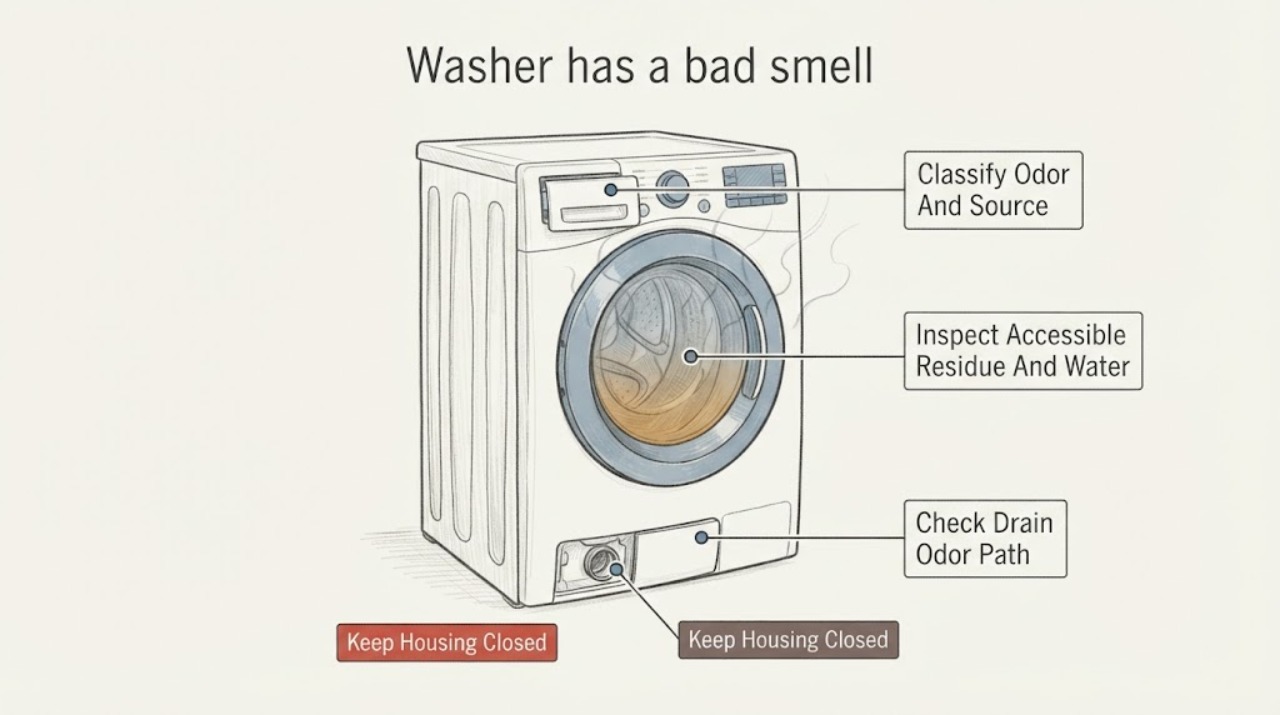
Work through in order
Diagnostic checks
Use only checks that match the exact appliance or system and its official guide.
-
Check 1
Stop the Whirlpool washer and, from a safe standing position after it is no longer hot or moving, identify whether the smell is musty or sour, sewage-like, detergent or bleach-like, hot plastic or burning, or accompanied by smoke, sparks, or water. Note whether the smell is strongest at the drum, door or lid, dispenser, drain hose, standpipe, or floor.
Expected result: The odor is a recurring musty smell with no visible hazard, or it is a drain/sewage, chemical, burning, smoke, sparking, or leak-related smell.
Next step: Continue to the accessible inspection only for a mild musty or residue odor. For burning, smoke, sparking, chemical fumes, a strong sewage or gas-like odor, or an active leak, leave the washer off and follow the safety stop and service branch.
Stop if: Do not run another cycle to test burning, melting, smoke, chemical fumes, gas-like odor, or an active leak; do not sniff inside a hot or moving tub.
Why this matters
Why: A musty odor supports a moisture, residue, seal, dispenser, or routine-cleaning investigation. Sewage or drain odor points toward drainage or plumbing. Chemical fumes and burning, smoke, sparks, or a leak are not routine washer-maintenance symptoms.
-
Check 2
With the washer stopped and cool, inspect the accessible drum, door or lid seal, detergent or fabric-softener dispenser, lower door edge, and nearby floor. Wipe or rinse only the parts the exact Whirlpool manual identifies as user-cleanable, using the manual's permitted mild soap, warm water, soft cloth, or soft brush.
Expected result: You find slime, lint, detergent buildup, mildew-like residue, a dirty dispenser, a damaged or wet seal, standing water, or no visible residue; record whether the smell is stronger outside the washer than inside it.
Next step: Clean and dry only the permitted accessible areas, then check the drain-path branch if water remains or the odor is strongest at the hose or standpipe. If a seal is torn, dispenser will not seat, or buildup is inaccessible, stop and arrange service rather than prying parts out.
Stop if: Do not remove cabinet panels, pry a door seal or dispenser, reach into a pump opening, use abrasive or harsh chemicals, or handle a wet electrical connection.
Why this matters
Why: Residue and retained moisture in seals, dispensers, and the interior can sustain musty odor. A wet floor or damaged seal adds a leak investigation. A clean interior with odor concentrated at the drain or standpipe makes a household plumbing source more likely.
-
Check 3
Check for more than the small amount of water your model describes as normal after a cycle, and inspect the visible drain hose and standpipe area for a kink, backup, loose connection, or odor source. Do not disconnect plumbing or pour drain cleaner into the washer; check only from outside the appliance.
Expected result: Water remains in the tub, the hose is kinked or damaged, the standpipe or nearby drain smells or backs up, the floor is wet, or the washer drains normally and the odor stays inside the tub.
Next step: Correct only an obvious external hose kink if the installation manual allows it, and use plumbing service for a slow or backed-up household drain. If the washer leaves water despite a clear external path, leave it off and arrange appliance service for the pump or internal drain path.
Stop if: Do not disconnect a pressurized or water-filled connection, tip the washer, use drain chemicals, reach into an internal pump, or continue operating with a leak or standing contaminated water.
Why this matters
Why: Standing water, a backed-up standpipe, or a hose problem can keep odor-producing water in or near the washer. Normal drainage with odor confined to the tub shifts the likelihood back to residue, moisture habits, seal, dispenser, or hidden buildup.
-
Check 4
For a mild musty or residue odor only, empty the washer and run one Clean Washer cycle exactly as the Whirlpool owner's manual directs. Use one permitted method, such as an affresh tablet or model-approved liquid chlorine bleach when allowed; put the product where the manual says, and do not add detergent or any other chemical.
Expected result: The odor clears, improves but returns after the washer sits closed, the washer cannot complete or drain the cleaning cycle, or a chemical, burning, smoke, leak, or error symptom appears.
Next step: If the odor improves, wipe or dry the permitted areas and leave the door or lid open when the model allows. If it returns, use the recurrence branch and arrange service when drainage or hidden areas are implicated; stop immediately for a hazardous symptom.
Stop if: Never mix bleach, affresh, detergent, vinegar, ammonia, or other cleaners; do not use liquid chlorine bleach in a Whirlpool All-in-One unless its exact manual permits it; stop for fumes, smoke, burning, leak, or error.
Why this matters
Why: Improvement after one approved empty cycle supports removable soil or residue. Quick recurrence suggests retained moisture, incorrect detergent amount, incomplete drainage, or buildup beyond the accessible surfaces. A failed cycle or new hazardous symptom is not evidence that more cleaner is needed.
-
Check 5
After cleaning, use only the recommended HE detergent amount, remove wet clothing promptly, dry the accessible seal and dispenser, and leave the door or lid open when safe and permitted. Record when the smell returns, the load and cycle, detergent used, drain result, and exact model before deciding whether service is needed.
Expected result: The odor stays away with drying and correct detergent use, or it returns despite a clean seal and dispenser, a completed approved Clean Washer cycle, normal drainage, and no idle wet load.
Next step: Arrange qualified appliance service for persistent odor, inaccessible buildup, damaged seal, repeated standing water, or any internal repair. Use plumbing service when the smell or backup is at the standpipe or household drain. Provide the recorded symptom pattern and safety observations.
Stop if: Do not repeat chemical treatments, open the cabinet, access energized parts, bypass a safety feature, or operate the washer when water damage, electrical risk, smoke, or a hazardous odor remains.
Why this matters
Why: Improvement with drying and correct detergent supports retained moisture or residue. Persistent odor after those checks makes a hidden drain, pump, seal, dispenser, plumbing, or other model-specific fault more likely.
Use your observations
Decision map
Find the observation that best matches what you see, then follow the next safe action.
-
PATH 01Safety boundary
What you see
The odor is musty, sour, earthy, or like wet laundry; residue or moisture is visible at the seal, dispenser, or tub; drainage is otherwise normal.
Do this next
Clean the permitted seal, dispenser, and interior areas, run one model-approved empty Clean Washer cycle, remove wet loads promptly, and leave the door or lid open when permitted. Arrange service if it returns despite those measures.
Why this path and its safety boundary
Why it matters: Retained moisture, detergent residue, or soil is more likely than an immediate component failure.
Safety stop: Stop if cleaning exposes a torn seal, leak, inaccessible buildup, electrical damage, or a new burning or chemical odor.
-
PATH 02Safety boundary
What you see
The smell follows heavy suds, excess detergent, a detergent or bleach smell, a dirty dispenser, or repeated use of more than one cleaning product.
Do this next
Stop adding products, ventilate if there are fumes, follow the exact model and product label, and use only the recommended HE detergent amount on future loads. If cleaners were mixed or symptoms occur, leave the area and seek poison guidance.
Why this path and its safety boundary
Why it matters: Residue or incompatible chemical use is more likely than a need for stronger cleaner. Non-HE or excess detergent can also worsen suds and drainage behavior.
Safety stop: Never mix bleach with detergent, ammonia, acids, vinegar, affresh, or another disinfectant; do not keep operating with eye, throat, breathing, headache, or dizziness symptoms.
-
PATH 03Safety boundary
What you see
The odor is sewage-like or strongest at the standpipe, drain hose, floor, or nearby plumbing, especially when water remains or the household drain backs up.
Do this next
Inspect only the visible hose and drain area, correct an obvious accessible kink if the installation manual allows it, and use plumbing service for a slow or backed-up standpipe. Arrange appliance service if the washer still retains water with a clear household drain.
Why this path and its safety boundary
Why it matters: A drain restriction, incorrect hose arrangement, backup, or household plumbing source is more likely than ordinary tub residue.
Safety stop: Do not pour drain cleaner into the washer, disconnect a water-filled hose, reach into the pump, or continue operation with a leak or contaminated standing water.
-
PATH 04Safety boundary
What you see
The smell is hot plastic, burning insulation, or electrical, or it comes with smoke, sparks, a hot cord or receptacle, melted material, or an unusual mechanical noise.
Do this next
Stop the cycle and keep the washer off. If it is safe to do so from a dry location, isolate power at the plug or breaker without touching wet equipment; arrange qualified appliance service, and use emergency help for fire or active smoke.
Why this path and its safety boundary
Why it matters: This may be an electrical, motor, heater, wiring, or mechanical fault and is outside routine odor cleaning.
Safety stop: Do not restart to reproduce the smell, open the cabinet, touch a hot or wet cord, spray cleaner into the appliance, or perform live electrical testing.
-
PATH 05Safety boundary
What you see
The smell is strong bleach, solvent, ammonia, or another unknown fume, or anyone develops eye, nose, throat, breathing, headache, dizziness, or other exposure symptoms.
Do this next
Leave the area, ventilate only if this can be done without exposure, and contact poison or emergency services for exposure advice. Do not return to clean or run the washer until the area and appliance are judged safe.
Why this path and its safety boundary
Why it matters: Mixed or concentrated cleaning-product fumes can be dangerous; the source cannot be safely diagnosed by running the washer.
Safety stop: Never mix household cleaners or add another product to neutralize the odor; do not use the washer while fumes or symptoms persist.
-
PATH 06Safety boundary
What you see
The odor returns after a correct model-approved cleaning cycle and drying routine, or the odor accompanies a damaged seal, wet floor, repeated standing water, error, or an inaccessible source.
Do this next
Leave the washer off if there is water or a safety symptom and arrange qualified appliance service; use plumbing service when the source is the household drain. Give the technician the model, odor type and location, cleaning method, detergent, drain result, and recurrence timing.
Why this path and its safety boundary
Why it matters: A hidden pump, drain, seal, dispenser, plumbing, control, or other model-specific fault is more likely than a surface-cleaning issue.
Safety stop: Do not keep cycling the washer, remove the cabinet, bypass a lock, or attempt internal repair while the cause is unconfirmed.
Helpful context
Understand the symptom
Classify the smell before cleaning
A musty, sour, earthy, or wet-sock smell usually follows retained moisture, detergent residue, or soil in the tub, seal, dispenser, or drain path. A sewage-like smell points more toward the standpipe, drain hose, pump path, or household drain. A bleach or solvent smell requires chemical caution, while hot plastic, burning insulation, smoke, or sparks is an electrical or mechanical stop condition. Smell from a safe standing position; do not put your face inside a running or recently heated washer.
Whirlpool cleaning is model-specific
Whirlpool's washer guidance calls for an empty Clean Washer cycle at about monthly or every 30 wash cycles, but the permitted product and controls depend on the model. Some instructions use an affresh tablet or liquid chlorine bleach; other Whirlpool configurations have different restrictions. Use one method exactly as the owner's manual states, never add detergent or other chemicals to that cycle, and do not transfer an All-in-One instruction to an ordinary washer.
Moisture control prevents the odor from returning
After a cycle, remove wet clothes promptly, dry the accessible seal and dispenser area, and leave a front-load door or top-load lid open when safe and permitted. Use only HE detergent and the amount the model recommends; excess or non-HE detergent can leave residue and create suds or drainage problems. A clean interior that still smells should shift attention to drainage, a connected standpipe, or a hidden component rather than repeated chemical treatments.
A leak or hazardous odor changes the decision
Do not use the washer to test a burning, melting, smoke-related, chemical, or active-leak symptom. If fumes are unknown or cause eye, throat, breathing, headache, or dizziness symptoms, leave the area and seek poison or emergency guidance. If water is near the receptacle or cord, isolate power only from a dry, safe location; do not touch a wet plug or pull the washer through water.
Safety boundary
Stop conditions
- Stop immediately for smoke, fire, sparks, a hot or melted cord or receptacle, burning insulation or hot-plastic odor, violent mechanical behavior, or an active leak; isolate power only from a dry, safe location and arrange qualified help.
- If bleach, ammonia, acid, vinegar, detergent, or another cleaner was mixed or unknown fumes cause irritation, coughing, breathing trouble, headache, or dizziness, leave the area and seek poison or emergency guidance; never mix cleaners.
- Do not force a door or lid, bypass a lock, open the cabinet, perform live electrical testing, handle a wet plug, disconnect pressurized plumbing, or reach into a pump or moving tub.
- Do not use drain cleaner, solvents, harsh abrasives, or repeated chemical cycles in the washer. Follow the exact Whirlpool model and cleaner instructions, including model-specific bleach restrictions.
- Arrange qualified appliance service for odor that persists after one correct cleaning and normal drainage, a damaged seal or dispenser, repeated standing water, or any internal component or wiring concern; use plumbing service for a backed-up or sewage-smelling household drain.
Only after diagnosis
Potential parts
- Whirlpool washer door seal or gasket
Consider this category only when a front-load seal is visibly torn, deformed, persistently wet, or leaking and the exact model parts information identifies it as the matching component.
Confirm the complete model number and washer type; seals are not universal and installation can require service access. - Whirlpool washer dispenser drawer or insert
Consider this category only when the dispenser or insert is cracked, missing, cannot be cleaned or seated, and residue or leaking follows that finding.
Match the exact model and dispenser configuration before ordering; top-load, front-load, and all-in-one layouts differ. - Whirlpool washer drain hose, pump, or model-accessible filter
Consider this category only after standing water or drain odor is confirmed and the visible hose and household drain are clear, or when the model manual or technician identifies a damaged or blocked component.
Drain-pump and filter access varies by model; confirm the exact model and have hidden or energized drain work performed by qualified service.
When checks do not resolve it
Need a professional?
Arrange qualified Whirlpool appliance service when a musty odor returns after a model-approved Clean Washer cycle, dry seal and dispenser, correct HE detergent use, and normal drainage; when water remains, a seal is damaged, the dispenser will not seat, or the odor source is inaccessible; or when the smell is burning, electrical, accompanied by smoke, sparks, a hot cord, an error, or an active leak. Use plumbing service when the odor is strongest at a standpipe or household drain or the drain backs up. For mixed-cleaner or unknown fumes, leave the area and seek poison or emergency guidance before touching the washer.
Safety scope: This article supports odor classification, cool external inspection, model-approved cleaning, moisture control, and visible drain-path observations. It does not authorize cleaner mixing, drain-chemical use, cabinet disassembly, live electrical testing, pressurized plumbing work, lock bypass, wet-plug handling, or operation after a burning, smoke, chemical-fume, or active-leak symptom.
Common questions
FAQ
Why does my Whirlpool washer smell musty after a load?
Moisture, detergent residue, or soil can remain in the tub, door seal, dispenser, or drain path. Remove wet clothes promptly, dry the accessible seal and dispenser, leave the door or lid open when permitted, use the recommended HE detergent amount, and run the model-approved Clean Washer cycle.
Can I use bleach and detergent together to clean a smelly Whirlpool washer?
No. Use only the single cleaning method permitted by the exact Whirlpool manual, and do not add detergent or another product to a Clean Washer cycle. The CDC warns that bleach must never be mixed with other cleaners or disinfectants because dangerous vapors can result. Some Whirlpool All-in-One instructions specifically prohibit liquid chlorine bleach.
What if my Whirlpool washer smells like sewage or a drain?
Check from outside the appliance for standing water, a visible drain-hose problem, or an odor or backup at the standpipe. A normal tub with the strongest smell at the household drain points toward plumbing service; water that remains despite a clear household drain points toward appliance service. Do not pour drain cleaner into the washer or disconnect a water-filled connection.
Should I keep using the washer if it smells like burning plastic?
No. Stop the cycle and keep the washer off. If smoke, sparks, a hot cord or receptacle, or fire is present, move away and seek emergency help; otherwise isolate power only from a dry, safe location and arrange qualified appliance service. Do not restart it to reproduce the odor or open the cabinet.
Read the exact guide
Official sources
- Removing Odors and Smells - All-In-One Washer DryerWhirlpool Product Help · Whirlpool All-in-One washer-dryer odor cycle, drying, bleach restriction, and drain-filter guidance
- What’s that smell?: Identifying unknown fumes in your homePoison Control - National Capital Poison Center · Unknown fumes, mold and drain odor clues, burning odor, symptoms, and leave-area guidance
- How to Clean a Front Load Washer Dispenser (Drawer)Whirlpool Product Help · Whirlpool front-load washer dispenser drawer and insert cleaning
- Cleaning and Disinfecting with BleachCenters for Disease Control and Prevention · Household bleach mixing, ventilation, label, and protective-equipment safety
- Removing Odors or Smells - Front Load WasherWhirlpool Product Help · Whirlpool front-load washer odor, door-open drying, dispenser, HE detergent, and model-specific cleaning guidance
- Removing Odors from the Interior of a WasherWhirlpool Product Help · Whirlpool washer Clean Washer maintenance, odor removal, detergent, and drying guidance
- Cleaning a Front Load Washer Door SealWhirlpool Product Help · Whirlpool front-load washer door-seal odor, residue, leak, and drying guidance
Community feedback
Share a repair observation
Share a plain-text repair observation. Accepted observations are published automatically; this page may take a moment to update.