
On this page
Start here
Quick answer
First identify the odor rather than masking it. A damp, sour, or mildew smell usually points to wet laundry left in the basket, moisture in a front-load door seal, detergent or fabric-softener residue, or an overdue Clean Washer cycle. A sewage or drain odor that is strongest at the hose or standpipe needs an exterior drain-path and hose-installation check, not repeated chemical cleaning. A hot-plastic, scorched, ozone, smoke, or electrical smell is a stop-use condition: end the cycle, keep away from water and damaged wiring, and arrange service. Amana recommends HE detergent at the maker's measured amount, prompt unloading, regular cleaning of the dispenser and seal where fitted, and a Clean Washer cycle about monthly or every 30 washes; use only one cleaner procedure allowed by the exact model and never combine bleach, washer cleaner, detergent, or other chemicals.
Before you begin
Safety first
- This article supports odor classification, ordinary-access inspection, model-approved cleaning, and visible drain-hose checks only. It does not authorize chemical mixing, panel removal, live electrical testing, handling wet wiring, pressurized plumbing work, door-lock bypass, or operation after a fire, gas, water, chemical, or electrical hazard.
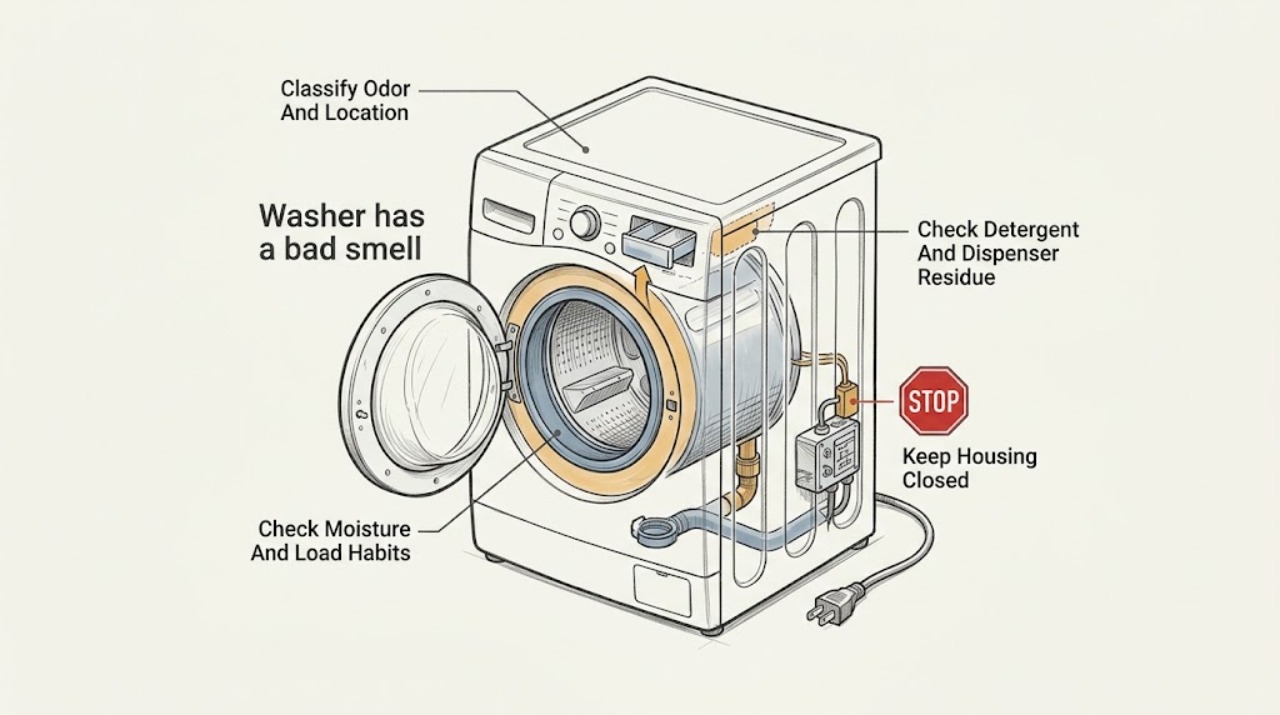
Work through in order
Diagnostic checks
Use only checks that match the exact appliance or system and its official guide.
-
Check 1
Stop the current cycle normally if it is safe, remove clothing only if the door or lid can be opened without force, and describe the odor as damp or mildew-like, drain or sewage-like, detergent or chemical, hot plastic or scorched, ozone or electrical, or another distinct smell.
Expected result: Record whether the odor is strongest inside the basket, in the front-load seal fold, at the dispenser, near the drain hose or standpipe, at the outlet or control area, or throughout the room; note smoke, heat, water, or a tripped breaker.
Next step: Photograph visible residue, standing water, a damaged seal, or a leak without moving the appliance; follow the matching branch below and keep the washer out of service for any hot, scorched, smoky, or electrical odor.
Stop if: Stop immediately for smoke, flame, sparking, hot plastic, ozone, burning insulation, a damaged cord, repeated breaker trips, or water at the outlet, controls, or wiring.
Why this matters
Why: The location and character separate moisture or residue checks from drain-path checks and from an immediate electrical or fire-safety response. A vague odor with no location should not be treated as proof that the tub alone is dirty.
-
Check 2
For a damp, sour, or mildew-like odor, inspect ordinary-access moisture points: wet laundry left after a cycle, the basket or tub, the front-load door-gasket folds if fitted, and the lid or door that remains closed between loads.
Expected result: Record wet clothing, pooled water, lint or soil in seal folds, a damp dispenser area, visible mildew-like residue, or a dry and clean interior despite the odor.
Next step: Remove wet clothing promptly, dry accessible surfaces with a clean cloth, leave the lid or door open when the washer is not in use, and continue to the cleaning or drain check only if there is no leak or electrical hazard.
Stop if: Do not force a locked door, reach into a moving drum, use the washer if water is leaking onto electrical parts, or scrub a damaged gasket as if it were intact.
Why this matters
Why: Amana says wet clothes left in the basket can lead to mildew and odor, and that leaving the lid or door open helps evaporate moisture. A dry interior with no residue makes a drain, concealed component, or room-source investigation more important.
-
Check 3
Inspect the detergent or fabric-softener dispenser from ordinary access and review the product used in recent loads; follow the Amana manual for removing and cleaning the dispenser without forcing it.
Expected result: Record sticky film, standing liquid, visible soil, undissolved product, non-HE detergent, or a measured HE dose that matches the detergent instructions.
Next step: Clean the dispenser only as the exact owner manual allows, switch to the correctly measured HE detergent specified for the model, and do not add extra product to overpower the smell.
Stop if: Do not mix detergent, bleach, washer cleaner, descaler, or other chemicals in the dispenser or tub, and do not use an unapproved solvent or abrasive on the dispenser or seal.
Why this matters
Why: Amana states that non-HE detergent or more than the recommended amount can leave film or excess suds that contribute to odor, leaks, draining concerns, or poor rinsing. Residue in a dispenser can keep reintroducing odor even when the basket looks clean.
-
Check 4
When the odor is damp, sour, or residue-like and there is no leak, smoke, or electrical warning, run the exact model's empty Clean Washer cycle using one approved method from its manual: a washer-cleaner product or the manual's separate liquid-chlorine-bleach alternative.
Expected result: Record whether the cycle completes, whether the odor improves, whether residue or excess suds appear, and whether the smell returns after the next normal load.
Next step: Do not interrupt the procedure unless the manual allows it; if interrupted, follow the manual's rinse instruction. Leave the lid or door open afterward and arrange service if the odor persists or the cycle leaks or faults.
Stop if: Never combine the washer cleaner, bleach, detergent, or another chemical in one cleaning cycle; stop for fumes, a chemical reaction, excessive suds, a leak, abnormal heat, or a damaged seal.
Why this matters
Why: Amana says the Clean Washer cycle uses higher water volumes with a washer cleaner or a separate bleach procedure to control odor-causing soil and detergent accumulation. Improvement supports interior residue or moisture as a contributor; no improvement or rapid recurrence points toward a seal, drain, concealed buildup, or service issue.
-
Check 5
For a sewage-like odor, odor at the drain hose or standpipe, or a smell that returns after draining, inspect only the visible drain-hose routing and nearby standpipe or laundry-tub area; do not seal the hose, pull the appliance apart, or open a wall.
Expected result: Record a kinked or clogged hose, a hose pushed unusually far into the standpipe, water visibly returning, a blocked laundry drain, gurgling during drain, or an odor that is strongest in the household drain rather than inside the washer.
Next step: Use the exact installation instructions to correct only an obvious, accessible hose-routing issue; otherwise stop and request appliance or plumbing service with the odor location and drain observations.
Stop if: Do not pour chemicals into an unknown household drain blockage, tape or seal the drain hose, disconnect pressurized water, move a wet appliance, or access concealed plumbing without qualified help.
Why this matters
Why: Amana notes that an incorrectly positioned drain hose can permit siphoning or water to return to the washer, while a blocked or poorly draining path can leave a persistent wet or drain-related condition. A strong odor from the household standpipe may require plumbing diagnosis instead of washer cleaning.
-
Check 6
For hot-plastic, scorched, ozone, smoke, or electrical odor, stop the washer and keep clear of the appliance; isolate power only from a dry, safe location and only if doing so does not require touching water, a damaged cord, or exposed conductors.
Expected result: Record smoke, a scorch mark, hot outlet or plug, buzzing, repeated breaker operation, a damaged cord, water near the receptacle or controls, or an odor that disappears after the washer is isolated.
Next step: Leave the washer out of service and arrange qualified appliance and, when appropriate, electrical inspection; provide photos only from a safe distance and do not restart to see whether the smell returns.
Stop if: Do not touch wet electrical parts, open panels, test live voltage, replace a breaker with a larger rating, use an extension cord, or continue operating after smoke, sparking, scorch, or burning odor.
Why this matters
Why: These observations are not consistent with ordinary tub freshness. They can indicate an electrical supply, cord, control, motor, pump, or water-contact hazard that cannot be safely diagnosed by cleaning or repeated power cycles.
-
Check 7
After one completed model-approved cleaning or visible hose correction, compare the odor with the washer empty and after the next normal load, while recording whether the smell returns and where it is strongest.
Expected result: Classify the result as gone, reduced but recurring, unchanged, accompanied by a leak or drain problem, or unsafe to retry; note whether clothes also smell after washing.
Next step: Give the technician the model, odor description and location, cleaning method, detergent, drain observations, photos, and exact timeline; do not order a pump, seal, or control part based on smell alone.
Stop if: Keep the washer out of service if the odor is hot, electrical, smoky, chemical, or accompanied by water, abnormal noise, a failed cycle, or a breaker trip.
Why this matters
Why: A stable improvement supports moisture, detergent residue, or routine maintenance as the contributor. Recurrence, odor in clean clothes, persistent drain odor, a damaged seal, or any safety symptom points toward concealed residue, pump or drain, seal, control, motor, or household plumbing diagnosis.
Use your observations
Decision map
Find the observation that best matches what you see, then follow the next safe action.
-
PATH 01Safety boundary
What you see
The smell is damp, sour, or mildew-like; wet clothes, moisture in a seal or dispenser, residue, or a closed lid or door is present, and there is no leak or electrical warning.
Do this next
Remove laundry promptly, clean accessible seal and dispenser areas according to the manual, use correctly measured HE detergent, and run one approved empty Clean Washer cycle.
Why this path and its safety boundary
Why it matters: Moisture and soil or detergent residue are plausible contributors. Amana specifically links wet clothes, residue, and missed Clean Washer maintenance to washer odor.
Safety stop: Stop if the seal is torn, water leaks, fumes appear, or the smell becomes hot, scorched, smoky, or electrical.
-
PATH 02Safety boundary
What you see
The odor is strongest at the drain hose, standpipe, or laundry tub, returns after draining, or occurs with gurgling, slow drainage, or water that appears to return.
Do this next
Check only visible hose routing and the exact installation guidance; request appliance or plumbing service when the drain remains blocked, the odor is in the standpipe, or the hose cannot be corrected without moving or disconnecting the washer.
Why this path and its safety boundary
Why it matters: A drain-hose routing, siphoning, blockage, or household drain issue becomes more likely than a simple tub-surface odor, although the appliance may also retain moisture or residue.
Safety stop: Do not seal the drain hose, pour mixed chemicals into the drain, disconnect plumbing under pressure, or move a water-filled appliance.
-
PATH 03Safety boundary
What you see
The smell began after a cleaner, bleach, detergent, softener, or other product was added, or fumes and unusual suds appear during a cleaning cycle.
Do this next
Stop adding products, ventilate the room without placing yourself in fumes, follow the exact manual's safe interruption and rinse guidance, and request service or poison-control guidance if exposure or a reaction occurred.
Why this path and its safety boundary
Why it matters: The immediate concern is an incompatible or excessive chemical load, not proof that more cleaner is needed. Amana's procedure says to use one method and not add detergent or other chemicals with it.
Safety stop: Do not mix bleach with washer cleaner, detergent, acids, ammonia, descaler, or another chemical; stop for strong fumes, heat, skin or eye exposure, or a reaction.
-
PATH 04Safety boundary
What you see
The odor is hot plastic, scorched, ozone-like, smoky, or electrical, or the washer has a hot plug, scorch mark, sparking, water near electrical parts, or repeated breaker operation.
Do this next
Stop use, isolate power only from a dry safe location if possible, keep clear of the appliance, and arrange qualified appliance or electrical inspection.
Why this path and its safety boundary
Why it matters: A supply, cord, control, motor, pump, or water-contact fault is possible and cannot be safely distinguished by a cleaning cycle. Continued operation can increase fire or shock risk.
Safety stop: Do not restart, open panels, touch wet wiring, test live parts, change breaker size, or use an extension cord to continue operation.
-
PATH 05Safety boundary
What you see
The correct HE detergent, accessible cleaning, and one model-approved Clean Washer cycle are complete, but the odor remains or returns in clean clothes; no obvious drain or electrical cause explains it.
Do this next
Arrange model-specific appliance service and provide the odor character, strongest location, model, cleaning method, detergent, drain observations, and recurrence timeline.
Why this path and its safety boundary
Why it matters: Concealed residue, a pump or drain path, damaged front-load seal, water-retention problem, or another component may be involved. Repeating chemicals or buying a generic part is unlikely to identify the cause.
Safety stop: Stop immediately if persistence is accompanied by a leak, abnormal heat, smoke, electrical odor, failed cycle, or repeated breaker trip.
Helpful context
Understand the symptom
The odor character changes the safe diagnosis
Damp, sour, or musty odor is most often approached through moisture and residue: wet laundry, a closed lid or door, a front-load seal fold, dispenser buildup, excess detergent, or a missed Clean Washer cycle. A drain or sewage-like odor should be compared at the appliance drain hose and standpipe and may involve stagnant or siphoned-back water or the household drain. A hot-plastic, burning, ozone, smoke, or electrical odor is not a cleaning problem; stop using the washer and arrange diagnosis.
Use the model's cleaning procedure exactly
Amana's odor guidance calls for a Clean Washer cycle about monthly or every 30 washes, prompt removal of wet clothing, appropriate HE detergent quantity, and leaving the lid or door open between uses. The detailed procedure allows a washer-cleaner tablet or a separate liquid-chlorine-bleach alternative, but says not to add detergent or other chemicals with either procedure. The exact owner manual controls the cycle name, cleaner, dispenser location, and any front-load seal or pump-access steps.
Do not turn a leak or electrical odor into a cleaning experiment
A wet floor, water near the outlet or controls, a damaged cord, tripping breaker, scorch mark, smoke, or hot electrical smell changes the response from cleaning to stop-use service. Do not pour more chemicals into a washer with an unknown mixture, do not reach behind a wet appliance, and do not open panels or test live parts. Preserve the odor description and the point where it was strongest for the technician.
Safety boundary
Stop conditions
- Stop using the washer for hot plastic, scorched, ozone, smoky, burning, or electrical odor; sparking; a hot plug; a damaged cord; repeated breaker trips; or water near the outlet, controls, or wiring.
- Do not mix bleach, washer cleaner, detergent, softener, descaler, ammonia, acids, or any other chemicals in the washer or dispenser; use one model-approved cleaning method only.
- Do not open panels, test live voltage, touch wet electrical parts, change breaker size, use an extension cord, bypass a door or lid lock, or move a wet appliance.
- Do not seal or tape the drain hose, pour chemicals into an unknown household drain blockage, or disconnect pressurized water or concealed plumbing as an odor fix.
- Stop and arrange service when the odor persists after the model-approved cleaning path, returns in clean clothes, comes from the standpipe, or is accompanied by a leak, failed cycle, abnormal noise, or damaged seal.
Only after diagnosis
Potential parts
- front-load door gasket or seal
Consider this category only when a front-load inspection finds a torn, deformed, leaking, or persistently contaminated seal and a technician confirms it is the odor or leak contributor.
Confirm the full Amana model, seal geometry, drain openings, and installation procedure; do not force a damaged seal back into service. - detergent dispenser assembly
Consider this category only when the dispenser is cracked, cannot be cleaned or seated correctly, leaks, or retains product after the manual-approved cleaning path.
Match the exact model and dispenser configuration; residue alone is not proof that the entire assembly needs replacement. - drain pump or drain hose
Consider this category only when service diagnosis confirms incomplete draining, return water, a blocked or damaged hose, or a pump fault after visible routing and approved access checks.
Confirm the exact model, pump or hose routing, and manufacturer's fit information; do not disconnect plumbing or replace a pump based on odor alone. - power cord or electrical control component
Consider this category only after a qualified inspection confirms a damaged cord, supply connection, control, motor, or related electrical fault associated with a hot or electrical odor.
Electrical parts require exact model and rating confirmation and may require qualified installation; never substitute a cord or control to defeat a safety symptom.
When checks do not resolve it
Need a professional?
Arrange qualified Amana appliance service when the odor persists or returns after one exact-model cleaning procedure, the smell is strongest at a drain or standpipe, the front-load seal or dispenser is damaged, the washer leaks or leaves water, the cycle fails, or diagnosis would require panels, electrical testing, pump or drain disassembly, or concealed plumbing work. Treat smoke, flame, hot-plastic or electrical odor, sparking, repeated breaker operation, water at electrical parts, a damaged cord, strong chemical fumes, or unsafe heat as immediate stop-use conditions.
Safety scope: This article supports odor classification, ordinary-access inspection, model-approved cleaning, and visible drain-hose checks only. It does not authorize chemical mixing, panel removal, live electrical testing, handling wet wiring, pressurized plumbing work, door-lock bypass, or operation after a fire, gas, water, chemical, or electrical hazard.
Common questions
FAQ
Why does my Amana washer smell musty or sour?
Amana links musty odor with wet clothing left in the basket, moisture retained in the tub or front-load seal, detergent or softener residue, and missed Clean Washer maintenance. Remove wet loads promptly, ventilate the washer, use correctly measured HE detergent, clean accessible areas as the manual allows, and run one approved Clean Washer cycle.
Can I use bleach and washer cleaner together to remove the smell?
No. Amana documents a washer-cleaner method and a separate liquid-chlorine-bleach alternative. Do not add detergent or other chemicals to either procedure, and follow the exact model manual.
What if the smell seems like sewage or comes from the drain?
Compare the odor at the drain hose, standpipe, or laundry tub and look only for visible routing, kinks, blockage, return water, or siphoning clues. Amana notes that drain-hose position can allow water to siphon back; a persistent standpipe odor or concealed blockage needs appliance or plumbing service rather than more chemicals.
Is a burning smell from an Amana washer normal?
Treat hot plastic, scorching, ozone, smoke, sparking, or electrical odor as unsafe. Stop using the washer, isolate power only from a dry safe location if possible, keep clear of water or damaged wiring, and arrange qualified appliance or electrical inspection.
When does an Amana washer odor need service?
Arrange service when odor persists or returns after the model-approved cleaning path, clean clothes also smell, a seal or dispenser is damaged, the drain smells or leaves water, the washer leaks or fails a cycle, or any diagnosis would require panels, live electrical access, pump work, or concealed plumbing.
Read the exact guide
Official sources
- Gurgling, Slurping or Humming Noise - Front Load Washer - Product Help | AmanaAmana · Official Amana front-load washer support article used for drain-path observations; it does not identify the cause of every odor or model.
- How to Reset a Washer - Product Help | AmanaAmana · Official Amana reset guidance; the exact owner's manual controls a particular washer's reset method and safety conditions.
- Not Draining - Washer - Product Help | AmanaAmana · Official Amana top-load washer drain guidance; use the exact model's installation and service instructions for a different configuration.
- Removing Odor or Smell - Washer - Product Help | AmanaAmana · Official Amana Product Help article for washer odor and smell; top-load paths and exact model instructions control where they differ.
- Removing Odors from the Interior of a Washer - Product Help | AmanaAmana · Official Amana washer maintenance procedure; the exact owner manual controls a particular washer's cycle, dispenser, and cleaner instructions.
- Removing Odors or Smells - Front Load Washer - Product Help | AmanaAmana · Official Amana front-load washer support article; seal and dispenser steps are not automatically applicable to top-load models.
- Tripping Breaker - Washer - Product Help | AmanaAmana · Official Amana washer electrical-supply guidance; it does not authorize live testing or panel repair by an ordinary user.
Community feedback
Share a repair observation
Share a plain-text repair observation. Accepted observations are published automatically; this page may take a moment to update.