
On this page
Start here
Quick answer
Classify the smell before cleaning a Kenmore washer. A musty or sour odor that is strongest at the door gasket, dispenser, lid rim, or drum often points to retained moisture, detergent residue, or biological growth; a sewage-like odor near the drain points more toward the drain hose, standpipe, trap, or backflow; a burning, melting-plastic, ozone, or electrical odor is a stop-use condition. Check only ordinary-access surfaces and the visible drain area, use the exact Kenmore manual for any washer-cleaning cycle, and never mix bleach, vinegar, ammonia, or other cleaning products. Leave the washer off and arrange qualified service for electrical odor, smoke, sparks, hot or damaged wiring, water near electrical parts, persistent odor after a manual-approved cycle, or a smell accompanied by leaking, poor draining, unusual noise, or an error.
Before you begin
Safety first
- This article supports dry ordinary-access observation, odor classification, visible drain-path checks, product-label review, and one exact-manual-approved maintenance cycle only when no hazard is present. Do not handle wet electrical areas, force a door or lid, move the washer, disconnect plumbing, open panels, test live parts, bypass an interlock, mix chemicals, or replace parts by smell alone.
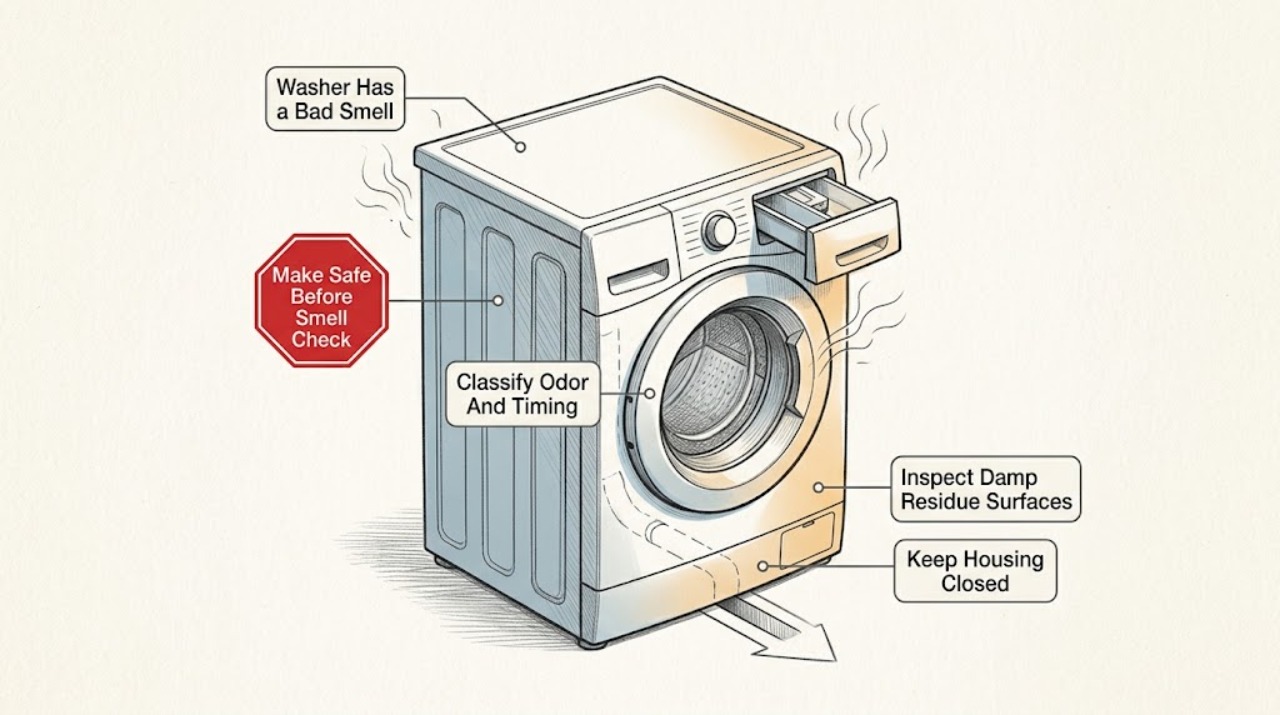
Work through in order
Diagnostic checks
Use only checks that match the exact appliance or system and its official guide.
-
Check 1
Stop the washer and look from a dry, ordinary-access position for smoke, sparks, a burning or melting-plastic odor, an ozone-like electrical odor, a hot or damaged cord or outlet, active leaking, or water near an electrical connection. Do not touch a wet cord, outlet, plug, or washer area.
Expected result: Record whether the odor is burning or electrical, whether smoke or heat is present, whether water is near the power connection, and whether a breaker or GFCI has tripped; otherwise record that no immediate hazard is visible.
Next step: For any smoke, fire, sparks, strong burning odor, hot or damaged outlet or cord, or water near electricity, leave the area when needed, keep the washer off, and obtain qualified electrical or appliance help from a safe location. Do not restore power just to repeat the smell test.
Stop if: Do not pull a plug from a wet area, handle a damaged cord, reset a tripped circuit repeatedly, remove an electrical panel, or continue operating the washer with a burning or electrical odor.
Why this matters
Why: A burning or electrical odor, smoke, heat, sparking, a damaged connection, or water in an electrical area can indicate an electrical or appliance fault and is not a routine washer-cleaning symptom. No visible hazard allows only a limited odor-location check; it does not prove the washer is safe internally.
-
Check 2
From safe access, identify whether the smell is musty or mildew-like, sour or detergent-like, sewage-like, or burning, melting-plastic, ozone-like, or electrical; note whether it is present before a cycle, during washing, during draining or spinning, or after the cycle ends.
Expected result: Write down the strongest location—door gasket and drum, dispenser, lid rim, drain hose or standpipe, rear cabinet, cord or outlet—and the timing relative to filling, tumbling, draining, and spinning.
Next step: Use the matching branch below and keep the written odor description for service; do not add a cleaner until the odor has been classified and no safety stop applies.
Stop if: Stop the check if the odor causes breathing or eye irritation, becomes stronger or hot, or is accompanied by smoke, sparks, a leak, or an abnormal sound.
Why this matters
Why: A musty smell focused at damp washer surfaces supports a moisture or residue lead. A sewage smell that tracks draining supports a drain-path or plumbing lead. A hot or electrical smell changes the case to stop use even if the odor is intermittent.
-
Check 3
With the washer idle and safely accessible, inspect visible surfaces only: the front-load door gasket and glass, top-load lid rim and tub opening, dispenser compartments, detergent residue, lint or debris, and any water left in the drum or around the base. Do not force a locked door or open a cabinet.
Expected result: Record whether surfaces are wet, slimy, visibly soiled, discolored, or clean and dry; note residue in the dispenser, a gasket fold that stays wet, water remaining after a completed cycle, or a floor leak.
Next step: After a cycle has completed and a door or lid is safely released, allow ordinary ventilation and drying as the exact manual permits; photograph residue, standing water, or leaks and move to service when they recur.
Stop if: Do not reach into a moving or hot drum, force the door or lid, remove panels, handle moldy material that is extensive or causing symptoms, or wipe water toward electrical connections.
Why this matters
Why: Retained moisture and residue can sustain a musty or sour odor, while water remaining in the tub or a leak adds a drain, pump, seal, or installation question. Clean, dry visible surfaces make an internal or drain-path cause more important, especially if the smell persists.
-
Check 4
From a dry, visible position, inspect the drain hose, standpipe or floor drain opening, nearby floor, and accessible rear or side area for a kink, displacement, wastewater residue, pooling, or odor that appears only when the washer drains. Do not move a heavy machine or disconnect plumbing.
Expected result: Record whether water drains normally, water remains in the washer, the standpipe or floor drain backs up, the hose is visibly kinked or out of position, or no drain-path abnormality is visible.
Next step: Keep the washer off and arrange appliance or plumbing assessment for wastewater, backflow, persistent standing water, slow draining, or an odor tied to draining; provide the timing and photos.
Stop if: Do not disconnect a hose, reach behind a wet appliance, use drain chemicals in the washer or standpipe, or continue cycles when wastewater is backing up or leaking.
Why this matters
Why: A sewage odor at the drain, backflow, or water left after a cycle makes drain hose, trap, standpipe, pump, or household plumbing more likely than a simple surface-residue problem. A normal visible drain path does not rule out a concealed or intermittent plumbing fault.
-
Check 5
Review the detergent, softener, bleach, washer cleaner, quantities, and recent cleaning history against the exact Kenmore manual and each product label; use ventilation and only one compatible, label-directed product if cleaning is appropriate.
Expected result: Record whether excess or wrong detergent was used, a product was placed in the wrong dispenser, a recent cleaner left a chemical odor, or two products were combined; record the product names without trying to neutralize them with another chemical.
Next step: Stop adding products, ventilate when safe, follow the product label's exposure guidance, and seek appropriate help for fumes or symptoms. For a nonhazardous residue concern, use only the exact manual's approved cleaning method once and observe the result.
Stop if: Never mix bleach, vinegar, ammonia, washer cleaner, detergent, or other cleaning products; do not pour a second product into the tub to counteract the first, and do not clean in an unventilated area.
Why this matters
Why: Detergent or cleaner residue can contribute to a sour or chemical smell, but a chemical odor after mixed products can be a vapor hazard rather than a cue to run another cycle. EPA warns that mixing cleaning products or adding bleach to other chemicals can create toxic vapors.
-
Check 6
Only when no stop condition is present and the washer otherwise fills, washes, drains, and spins normally, use the exact model's documented washer-cleaning or empty maintenance cycle; keep the area ventilated and follow the stated product, amount, and temperature directions.
Expected result: After the completed cycle and safe release of the door or lid, record whether the odor is gone, reduced, unchanged, or stronger; note any code, leak, poor drain, unusual noise, vibration, heat, or lock problem.
Next step: Do not repeat cleaner cycles as a substitute for diagnosis. If the odor persists or any abnormal washer behavior appears, leave the washer off and arrange qualified service with the model and observations.
Stop if: Do not run a maintenance cycle for a burning or electrical smell, active leak, wastewater backup, chemical fumes, damaged cord, repeated circuit trip, or a door or lid that will not safely release.
Why this matters
Why: A temporary improvement supports accessible residue or moisture as a contributor but does not prove that an internal source is repaired. No improvement or a returning odor raises the likelihood of a drain, pump, seal, motor, control, or concealed moisture issue.
-
Check 7
Gather the washer model and serial information if safely visible, the odor description, location and timing, cycle used, detergent history, drain observations, photos, and any display code before requesting service.
Expected result: Confirm whether the issue is isolated to odor or includes standing water, leaking, slow draining, vibration, unusual noise, heat, a tripped circuit, a locked door or lid, or an error code; record whether the odor returned after one manual-approved cycle.
Next step: Arrange appliance service for a persistent or recurrent odor, any odor with abnormal operation, or any internal diagnosis; arrange plumbing assessment for wastewater or backflow and electrical help for a hot, damaged, or tripping power connection.
Stop if: Do not open panels, test live wiring, bypass a door or lid lock, defeat a safety control, or order a part solely from the odor description.
Why this matters
Why: These distinctions help a technician separate accessible moisture or residue from drain plumbing, pump, seal, motor, wiring, or control faults without guessing a part from smell alone.
Use your observations
Decision map
Find the observation that best matches what you see, then follow the next safe action.
-
PATH 01Next step
What you see
The smell is musty, mildew-like, or sour; it is strongest at a damp gasket, dispenser, lid rim, or drum; and there is no smoke, electrical odor, active leak, wastewater backup, or abnormal operation.
Do this next
Follow the exact Kenmore manual's ordinary-access care and one approved cleaning-cycle procedure, dry visible moisture, and allow the safely released door or lid to ventilate afterward. Stop and arrange service if the odor returns, visible growth is extensive, or water remains.
-
PATH 02Next step
What you see
The odor is sewage-like and is strongest at the drain hose, standpipe, floor drain, or rear of the washer, especially when draining; water backs up, remains in the washer, drains slowly, or leaves wastewater residue.
Do this next
Keep the washer off and request appliance or plumbing assessment. Provide the drain timing, visible hose position, standing-water or backflow evidence, and photos; do not disconnect the hose or pour drain chemicals into the system.
-
PATH 03Next step
What you see
The smell is burning, melting plastic, ozone-like, or electrical, or it is accompanied by smoke, sparks, heat at the cord or outlet, a damaged connection, or a circuit trip.
Do this next
Stop using the washer, do not touch a wet or hot power connection, and obtain qualified appliance or electrical help from a safe location. Leave the area and use emergency assistance for fire or smoke risk.
-
PATH 04Next step
What you see
A sharp chemical smell followed use of detergent, bleach, vinegar, ammonia, or a washer cleaner, particularly when products were combined or ventilation is poor.
Do this next
Stop adding products or running cycles, leave the area if fumes or symptoms occur, ventilate only when safe, and follow the product label's first-aid or exposure guidance. Never add another chemical to neutralize the first.
-
PATH 05Next step
What you see
The odor persists after one exact-manual-approved maintenance cycle, returns quickly, or occurs with a leak, standing water, poor draining, vibration, a new noise, heat, an error, or a door or lid problem.
Do this next
Leave the washer off and arrange qualified appliance service. A technician should identify the source before replacing a gasket, pump, filter housing, motor, or control; use plumbing service too when wastewater backs up or the household drain is implicated.
Helpful context
Understand the symptom
The smell category changes the safe next step
Do not assume every washer odor is mold. A damp-cloth, mildew, or sour smell that returns after the door or lid stays closed is a different lead from a sewage odor that appears when the machine drains, and both differ from a hot-plastic, burning, ozone, or electrical smell. Note where the odor is strongest and when it appears before wiping or adding any product. If there is smoke, sparking, a hot outlet or cord, visible water at an electrical area, or a burning odor, stop using the washer and do not continue odor testing.
Use the model instructions for cleaning
Kenmore provides manuals by model and describes them as the source for use, care, and parts information. The manual for the exact washer controls which cleaning cycle, detergent quantity, dispenser care, door or lid handling, and accessible filter procedure apply. Do not pour an improvised chemical mixture into the tub, spray controls, force a locked door, or remove panels to find an odor. EPA guidance says to read labels, ventilate during and after cleaning, control moisture, and never mix cleaning products or add bleach to another chemical.
A drain odor is a plumbing clue, not proof of a dirty tub
If the odor is sewage-like and strongest at the standpipe, drain hose, floor drain, or rear of the washer, observe whether it appears during draining, whether water backs up, and whether the hose is visibly kinked or displaced. A drain setup, trap, backflow, or household plumbing issue can make the machine seem to smell bad. Keep the check to dry, visible areas; do not disconnect a hose, reach behind a wet machine, or open a wall. Water that remains in the washer, a slow drain, leaking, or repeated backflow warrants service.
Do not use a cleaning cycle to mask a hazardous odor
Only after the washer is cool, dry around its exterior, free of electrical or gas-like warning signs, and otherwise behaving normally should you consider one empty maintenance or washer-cleaning cycle that the exact manual specifies. Use only the product and amount allowed by that manual and its label. If the odor persists, returns quickly, or appears with poor draining, vibration, a new noise, a code, heat, or a leak, stop repeating cycles and arrange appliance service.
Safety boundary
Stop conditions
- Smoke, fire, sparks, a strong burning or electrical odor, a hot or damaged cord or outlet, or a repeated circuit or GFCI trip.
- Water, detergent solution, or wastewater is near an electrical connection, the floor is wet under the power area, or the washer is actively leaking.
- Sewage backflow, wastewater on the floor, water left in the washer with a slow or failed drain, or a drain hose or standpipe that cannot be safely observed without moving the machine.
- A door or lid will not safely release, the drum is moving or hot, or an interlock would need to be bypassed.
- Chemical fumes, eye or breathing irritation, an accidental mixture, or uncertainty about what products are in the tub; do not add another product.
- The odor persists or returns after the exact manual's approved maintenance procedure, or is accompanied by unusual noise, vibration, heat, a code, or another operating fault.
- Any need to open a cabinet, remove a panel, test energized wiring, access a pump or motor, or choose a replacement part without the exact model instructions.
When checks do not resolve it
Need a professional?
Arrange qualified Kenmore or appliance service when the odor is burning or electrical, persists or returns after one exact-manual-approved maintenance cycle, or accompanies leaking, standing water, poor draining, vibration, unusual noise, heat, a door or lid fault, a circuit trip, or an error code. Request plumbing assessment when wastewater backs up or the household drain appears involved. Treat smoke, sparks, strong chemical fumes, or fire risk as urgent and seek help from a safe location.
Safety scope: This article supports dry ordinary-access observation, odor classification, visible drain-path checks, product-label review, and one exact-manual-approved maintenance cycle only when no hazard is present. Do not handle wet electrical areas, force a door or lid, move the washer, disconnect plumbing, open panels, test live parts, bypass an interlock, mix chemicals, or replace parts by smell alone.
Common questions
FAQ
Why does my Kenmore washer smell musty?
A musty or sour smell strongest at a damp gasket, dispenser, lid rim, or drum can be consistent with retained moisture or residue. Check visible surfaces only, follow the exact model manual, and do not run a cleaning cycle if there is a leak, electrical odor, chemical fume, or other stop condition.
Why does the washer smell like sewage when it drains?
A sewage-like odor at the drain hose, standpipe, floor drain, or rear of the washer—especially with backflow, slow draining, or standing water—points toward the drain setup, trap, pump, hose routing, or household plumbing. Keep the washer off and request appliance or plumbing assessment rather than pouring drain chemicals into it.
What should I do if the Kenmore washer smells like burning plastic or electricity?
Stop using it. Do not touch a hot, damaged, or wet cord or outlet, do not reset the circuit repeatedly, and do not open the washer. Obtain qualified appliance or electrical help from a safe location; use emergency assistance for smoke or fire risk.
Can I use bleach and vinegar to remove a washer smell?
No. Never mix bleach, vinegar, ammonia, washer cleaner, detergent, or other cleaning products. EPA warns that mixed products can create toxic vapors. Follow each label, ventilate when safe, and use only a single product and procedure allowed by the exact Kenmore manual.
Should I leave the Kenmore washer door or lid open?
After a cycle completes and the door or lid is safely released, ordinary ventilation and drying can help reduce retained moisture. Do not force a locked door or lid, and follow the exact model manual if it gives different instructions or if the washer is leaking or unsafe.
When does a bad washer smell need service?
Request service for a persistent or returning odor, odor with standing water, poor draining, leaking, unusual noise, vibration, heat, an error, a door or lid fault, or a tripped circuit. Burning or electrical odor, smoke, sparks, strong chemical fumes, and water near electricity require immediate stop-use handling.
Read the exact guide
Official sources
- Biological Contaminants and Indoor Air QualityU.S. Environmental Protection Agency · Supports general moisture-control, ventilation, label-following, and cleaning-product safety. The Kenmore manual controls appliance-specific products and cycles.
- Customer Care & Support | Kenmore AppliancesKenmore · Use for Kenmore support, repair, safety, recall, and model-document routing; it is not a substitute for the exact washer manual or an on-site diagnosis.
- Should I use bleach to clean up mold?U.S. Environmental Protection Agency · Supports the chemical and ventilation boundary when a musty odor or visible growth is suspected; it does not authorize use of bleach or any product in a washer unless the exact manual and label allow it.
- Find Your Manual | Kenmore Appliance Manuals & GuidesKenmore · The exact model manual controls any washer-cleaning cycle, detergent guidance, access limits, and service procedure; this general lookup page does not identify a fault for every model.
- Washer Cycle Selector Switch Genuine Original Equipment Manufacturer (OEM) part | KenmoreKenmore · This is a model-specific part page, used only to support the boundary that parts and installation must be matched to the washer model; it does not diagnose odor.
Community feedback
Share a repair observation
Share a plain-text repair observation. Accepted observations are published automatically; this page may take a moment to update.