
On this page
Start here
Quick answer
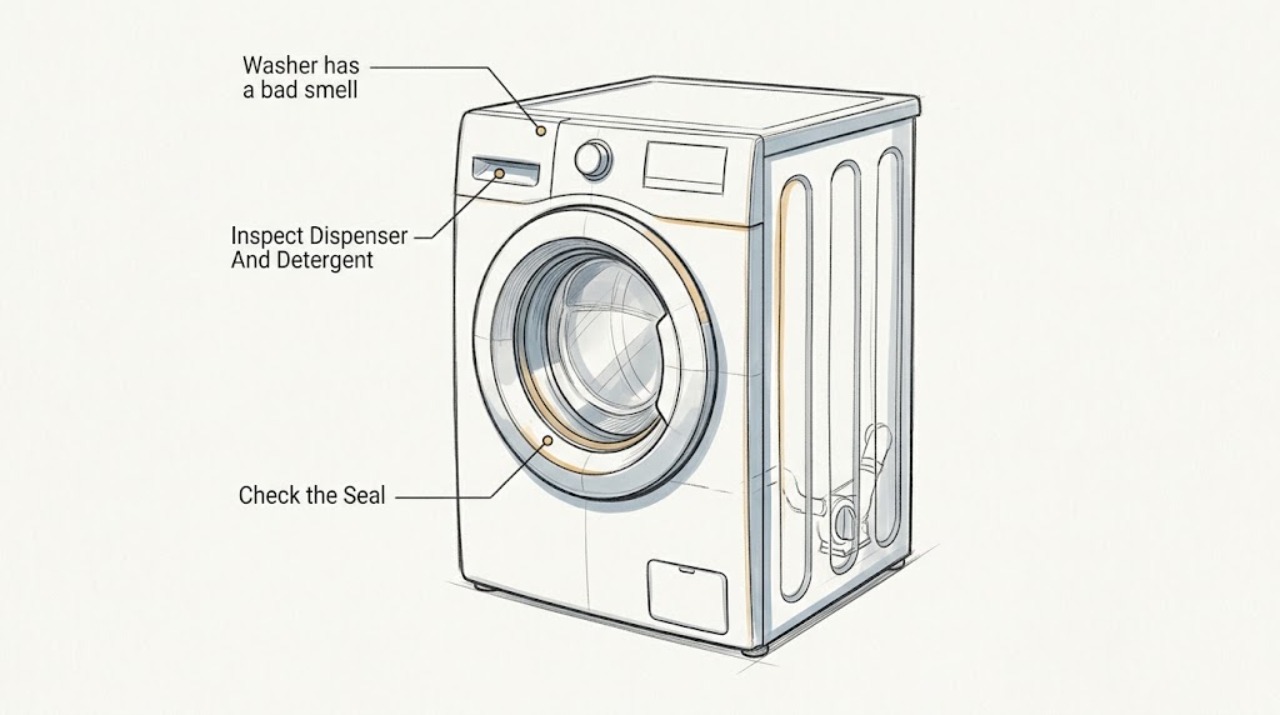
Classify the odor before trying to clean the washer. A musty smell concentrated at the door seal or dispenser usually points to trapped moisture or residue; a sewage-like smell with standing water or gurgling points to the drain path; and a burning, hot-plastic, chemical, or electrical smell is a stop-use condition. With no smoke, hot cord, leak near the outlet, or other hazard, inspect the visible door seal and dispenser, use only the Electrolux model's cleaning instructions, and use the correct amount of HE detergent. Never mix bleach, vinegar, acids, drain cleaner, or other chemicals. Do not open a pump filter with standing water or work inside the washer. If the odor persists after safe external checks, arrange model-specific appliance service.
Work through in order
Diagnostic checks
Use only checks that match the exact appliance or system and its official guide.
-
Check 1
Stop the washer and identify the odor from a safe position without opening panels: musty or sour, sewage-like, detergent or chemical, or burning, hot-plastic, or electrical. Look for smoke, a hot or damaged plug or cord, arcing, water near the outlet, or a continuing hot smell.
Expected result: The odor is non-burning and localized, the smell is strongest near a drain or standing water, or there is a burning or electrical symptom, smoke, chemical vapor, or water contacting electrics.
Next step: For any burning, smoke, arcing, hot or damaged cord, chemical vapor, or water near electrics, stop using the washer, keep clear, and arrange qualified service or emergency help as appropriate. Do not touch a wet plug or restart it to test. Otherwise continue with the odor-location checks.
Why this matters
Why: A localized damp or residue odor permits limited external observation only when no hazard is present. A drain-associated pattern changes the path to drainage. Burning, electrical, chemical, smoke, or wet-electrical symptoms are not a cleaning diagnosis.
-
Check 2
With the washer stopped and the drum still, inspect the visible door glass and rubber door boot or seal. Remove only loose hair, lint, or residue that can be reached without tools, and wipe the accessible surfaces according to the Electrolux model instructions; do not pull the seal from its groove.
Expected result: The smell is strongest at the seal, the seal or glass has visible residue or trapped debris, the seal is torn or deformed, or the area looks clean but the odor returns.
Next step: Clean and dry only the accessible surfaces allowed by the model guide, then reassess after the next safe maintenance cycle. If the seal is damaged, water leaks from the front, or the odor persists despite a clean seal, stop disassembly and arrange service.
Why this matters
Why: Residue at the seal is consistent with a localized musty odor and is a limited cleaning branch. A torn or deformed seal can also allow leaks and needs model-specific replacement diagnosis. A clean seal with a recurring odor makes the drawer, drain path, or an internal fault more likely.
-
Check 3
Remove the dispenser drawer only by the model's ordinary release method and inspect the drawer, compartments, and visible housing for wet residue, clumps, standing detergent, or a cracked part. Use HE detergent and stay below the marked maximum fill line; never combine bleach, vinegar, acids, drain cleaner, or other cleaners.
Expected result: Residue or pooled detergent is present, a detergent pack was placed in the drawer, the drawer or housing is damaged, or the dispenser is clean and the smell is unchanged.
Next step: Rinse and dry the drawer only as the Electrolux model instructions allow, correct the detergent amount and placement, and do not add a second chemical treatment. Arrange service for a cracked or warped drawer, cabinet leakage, or an odor that remains after the dispenser is clean.
Why this matters
Why: Residue, overfilling, or a detergent pack in the drawer can leave a localized detergent odor or contribute to poor rinsing. A damaged drawer can leak into the cabinet. An intact, clean dispenser shifts attention away from the dispenser and toward the seal or drain system.
-
Check 4
Without loosening hoses or opening the pump filter, check whether water remains in the drum after a completed drain, whether the smell is strongest at the drain hose or standpipe, and whether draining produces the normal gurgling or low pump hum described in the model guidance. Inspect only the visible hose for a kink or an unsecured connection.
Expected result: Standing water, a sewage-like odor, a loose or leaking hose connection, repeated drain failure, or unusual drain noise is present; or the drum drains and the smell is confined to the seal or drawer.
Next step: If there is a leak, close the water supply and isolate power only from a safe, dry location; do not touch wet electrical connections. Do not open a pump filter with water standing in the drum. If the drain symptom, wastewater odor, or standing water remains, arrange appliance or plumbing service.
Why this matters
Why: Standing water or odor at the drain makes a restricted drain path, hose, standpipe, or pump-filter issue more likely than a simple front-surface residue. A washer that drains normally with no drain odor makes the front seal or dispenser branch more likely.
-
Check 5
Review the last load and display for excessive suds, an oversuds alert, poor rinsing, or a cycle that stopped with water or foam. Do not add more detergent or cleaner while checking; record the exact display message and model.
Expected result: The washer shows the SU or dS oversuds condition, has heavy foam or detergent residue, or completes normally without foam while the odor continues.
Next step: Use the model guidance to cancel or complete the oversuds response, then use only the specified HE detergent amount on a future load. If the alert recurs, drainage remains poor, or the odor is burning or chemical, stop and arrange service rather than increasing detergent or adding chemicals.
Why this matters
Why: Electrolux uses SU or dS for too many suds and notes that extra rinses may be added until the suds clear. Excess detergent can therefore explain a detergent-like odor or residue, while a normal low-suds cycle shifts attention to the seal, drain, or service path.
-
Check 6
Find the washer's exact model number and use its Electrolux care instructions for any empty washer-cleaning or maintenance cycle, only when the washer has no leak, standing water, smoke, hot cord, or other hazard. Note the odor type, location, load, detergent, display, and whether the odor returns after the documented cycle.
Expected result: The odor clears after model-authorized care and correct detergent use, returns from the same location, or persists even though the visible seal, drawer, and drain observations are normal.
Next step: Keep the model information and observations for a qualified Electrolux appliance technician. Do not remove panels, test live wiring, open the pump area with retained water, or replace a part based only on odor.
Why this matters
Why: A one-time residue odor that clears supports a surface-care or detergent cause. A recurring localized odor, persistent drain symptom, or unexplained odor after safe care points to an internal seal, pump-filter, hose, or electrical/drive diagnosis that cannot be confirmed by observation alone.
Use your observations
Decision map
Find the observation that best matches what you see, then follow the next safe action.
-
PATH 01Next step
What you see
Do this next
Clean and dry only the accessible surfaces under the exact Electrolux model guidance, correct HE-detergent use, and reassess once. If the smell returns with a clean seal and drawer, arrange service rather than opening the cabinet.
-
PATH 02Next step
What you see
Do this next
Do not open the pump filter with standing water or loosen a wet connection. Stop for a leak, close the water supply when safe, and arrange appliance or plumbing service if the drain symptom persists.
-
PATH 03Next step
What you see
Do this next
Follow the model's oversuds guidance, clean the drawer as permitted, and use the specified HE detergent amount. Never mix cleaning chemicals or add drain cleaner to the washer; call service if oversudsing or odor repeatedly returns.
-
PATH 04Next step
What you see
Do this next
Stop using the washer immediately. Keep clear, do not touch a wet plug or restart the machine, and obtain qualified service or emergency help as appropriate. Do not use a chemical odor as a reason to ventilate by running another cycle.
-
PATH 05Next step
What you see
Do this next
Leave the cabinet closed, save the exact model number and symptom pattern, and arrange model-specific appliance service. Do not order a part until the technician or matching service documentation confirms the failed component.
Helpful context
Understand the symptom
The odor type changes the safe response
A damp or musty odor that is strongest at the front opening or drawer is a different pattern from a sewage-like odor that returns with standing water, and both are different from a hot-plastic, burning, solvent, or electrical odor. Do not run another cycle to mask an odor that smells burned or chemical. Keep the washer off for smoke, arcing, a hot or damaged cord, a leak reaching the outlet, or any other sign of fire or shock risk.
Use model-specific care for an Electrolux washer
Electrolux washer layouts and cleaning cycles vary. Identify the exact model before following a button sequence or removing a panel. The model number is typically on the door trim of a front-load washer or under the lid near the tub opening on a top-load washer. Follow that model's owner information for any washer-cleaning cycle; do not improvise a chemical treatment.
Detergent residue can mimic a drain problem
Too much detergent, the wrong detergent, or residue in a drawer can leave a sour or perfumed smell and excessive suds. Electrolux specifies HE detergent and says not to exceed the dispenser fill line. If the washer has an oversuds indication or repeatedly adds rinses, correct the detergent practice rather than adding more cleaner.
Only after diagnosis
Potential parts
- washer door boot seal
Consider this only if the model-specific diagnosis finds a torn, deformed, or leaking door seal after the accessible seal and glass have been cleaned.
Confirm the complete washer model and the manufacturer's fit information before ordering; odor alone does not establish fit or failure. - washer dispenser drawer
Consider this only if the drawer is cracked, warped, or cannot be cleaned or seated correctly and the model-specific service diagnosis links it to residue or leakage.
Drawer shape and inserts vary by model. Verify the complete model and the manufacturer's fit information before ordering. - washer pump filter
Consider this only after a qualified diagnosis of persistent standing water, drain failure, or a retained-debris problem; do not treat a smell by opening the filter with water present.
Filter access and serviceability vary by model. Confirm the complete model and service procedure before any part decision.
When checks do not resolve it
Need a professional?
Stop and arrange qualified service for smoke, burning or electrical odor, a hot or damaged cord, arcing, chemical vapor, a leak near electrics, standing water that cannot be safely addressed, repeated drain failure, or a persistent odor after the exact model's safe care steps. Do not mix chemicals, touch wet electrical connections, open a pump filter with standing water, or remove panels.
Common questions
FAQ
Why does my Electrolux washer smell musty?
If the smell is strongest at the door boot or dispenser and there is no leak or electrical symptom, accessible moisture or residue is more likely. Clean and dry only as the exact Electrolux model allows, correct HE-detergent use, and arrange service if the odor returns.
Could the drain cause a sewage smell in a washer?
Yes. A sewage-like odor together with standing water, poor draining, or draining noises points toward the hose, standpipe, retained water, or pump-filter path. Do not open a pump filter with water present; arrange appliance or plumbing service if the pattern persists.
How much detergent should I use in an Electrolux washer?
Use the HE detergent and amount specified for your model and load, and do not exceed the dispenser's maximum fill line. Electrolux places detergent packs directly in the drum rather than the dispenser.
Can I use bleach and vinegar together to remove the smell?
No. Never mix bleach, vinegar, acids, drain cleaner, or other cleaning chemicals, and do not add chemicals just to chase an unexplained odor. Follow the exact model's care instructions instead.
What does an SU or dS message mean on an Electrolux washer?
Electrolux uses SU dS for too many suds. The washer may add extra rinses until the suds clear. Correct detergent type and dose; if the condition recurs or the smell is burning or chemical, stop and arrange service.
Is a burning smell from a washer safe to ignore?
No. Stop using the washer for a burning, hot-plastic, or electrical smell, smoke, arcing, a hot or damaged cord, or water near electrics. Do not touch a wet plug or restart it; seek qualified or emergency help as appropriate.
Should I open the pump filter when the washer smells bad?
Not when water remains in the drum or the area is wet. Pump-filter access and draining steps vary by Electrolux model; a persistent standing-water or drain odor should be handled using the model procedure or by qualified service.
When should an Electrolux washer with a bad smell be serviced?
Arrange service for an odor that persists after safe external checks, a torn or leaking seal, repeated drain or oversuds symptoms, standing water, or any internal or electrical diagnosis. Stop immediately for smoke, burning or electrical odor, a hot cord, arcing, chemical vapor, or water near electrics.
Read the exact guide
Official sources
- Laundry Washers Noises GuideElectrolux · Electrolux washer sound descriptions during filling and draining
- Where can I find my model and serial number?Electrolux · Electrolux washer model and serial number locations
- How to Clean & Care For Your Front Load WasherElectrolux · Electrolux front-load washer cleaning and care reference
- Laundry front loading washer displaying Error Code SU dS too many suds.Electrolux · Electrolux front-load washer oversudsing indication and extra-rinse behavior
- Laundry front loading washer is leaking water.Electrolux · Electrolux front-load washer leak observations, door seal, dispenser drawer, hose, and standpipe checks
- Laundry Washers - Detergent GuideElectrolux · Electrolux washer detergent type, amount, dispenser compartments, and detergent-pack placement
Community feedback
Share a repair observation
Share a plain-text repair observation. Accepted observations are published automatically; this page may take a moment to update.