
On this page
Start here
Quick answer
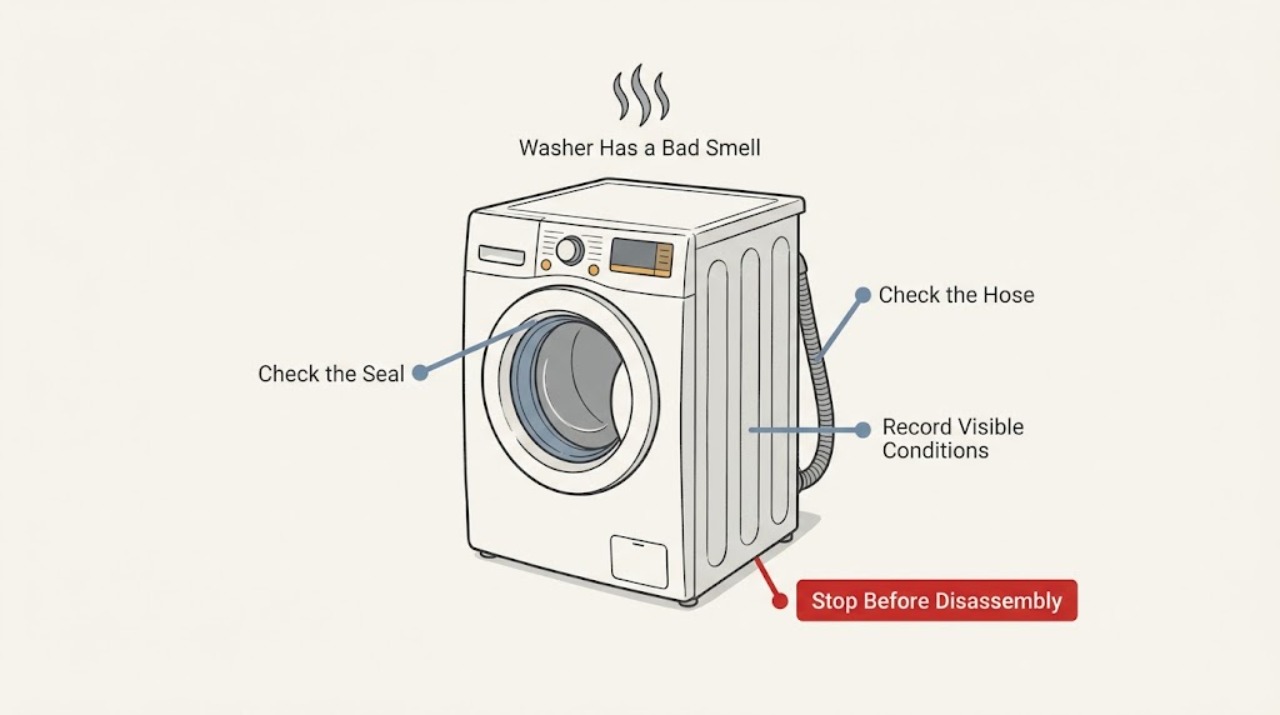
First classify the odor before cleaning: a musty or moldy smell usually points to damp residue in the tub, gasket, dispenser, or filter; a drain-like smell can follow standing water or an incorrectly routed drain hose; a burning-rubber or electrical odor is a stop condition until the source is ruled out. For a cool, dry, otherwise normal washer, remove laundry promptly, clean the accessible gasket and dispenser, check the model-specific drain-pump filter, and run the LG Tub Clean cycle with the cleaner and method specified for that model. Never mix bleach, acid, or other cleaners, and do not run a cleaning cycle if there is a leak, smoke, sparking, damaged cord, unusual heat, or a strong electrical odor. If the smell persists after appropriate Tub Clean cycles, or any burning/electrical odor returns, request qualified appliance service.
Work through in order
Diagnostic checks
Use only checks that match the exact appliance or system and its official guide.
-
Check 1
Identify and record the odor before opening or cleaning the washer: musty or mold-like, sour or drain-like, detergent or chemical, burning rubber, hot plastic, electrical, or another smell. Note when it occurs, whether it is strongest at the door, dispenser, drain area, rear, or outlet, and whether there is smoke, heat, sparking, a leak, or a damaged cord.
Expected result: The odor is musty, drain-like, chemical, burning-rubber or electrical, or accompanied by visible smoke, unusual heat, sparking, leaking water, or damaged electrical parts.
Next step: For burning/electrical odor or any smoke, sparking, heat, leak near electricity, or damaged cord, stop the washer, leave the area if needed, and use appropriate emergency or utility assistance. For a cool, normal washer with a musty or drain-like odor, continue with the matching external checks.
Why this matters
Why: Odor character and location separate residue and ventilation problems from retained water, cleaner exposure, or an electrical, motor, belt, heater, or wiring fault. Smoke, heat, sparking, or an electrical smell is not a routine cleaning problem.
-
Check 2
For a musty or mold-like odor, remove laundry promptly and inspect the accessible door gasket, inner door glass, tub opening, and detergent drawer for lint, hair, slime, detergent residue, or retained water. Wipe only accessible surfaces with the model-approved method while the washer is stopped, and leave the door and drawer open to ventilate afterward.
Expected result: Residue or moisture is trapped in the gasket or drawer, laundry was left inside, the door and drawer are usually closed between washes, or accessible surfaces are clean and dry.
Next step: Remove the residue using the manual-approved cleaner, reduce detergent or softener to the product and model guidance, and keep the door and drawer ajar. Do not spray liquid into control openings or remove panels.
Why this matters
Why: LG links trapped moisture, foreign material, excess detergent or softener, and poor ventilation with mold or musty odor. Clean, dry accessible surfaces with persistent odor make buildup deeper in the tub or filter, or another cause, more likely.
-
Check 3
If the odor is drain-like or the drum smells worse after a cycle, check for standing water and inspect the visible drain hose for a kink, crushing, or an installation route that does not match the model manual. On a front-load model, inspect the drain-pump filter only if the manual provides an owner procedure: isolate power, prepare for residual water, and do not force a stuck filter or reach into moving parts.
Expected result: Water remains in the drum, the hose is kinked or incorrectly routed, the pump filter contains foreign material, the drain path is clear and the drum is empty, or a pump/drain code is displayed.
Next step: Correct only an obvious external hose-routing issue and follow the exact filter instructions for the model. If water remains, the filter will not move, a leak appears, or the odor returns with poor draining, stop using the washer and arrange repair.
Why this matters
Why: LG says a clogged drain-pump filter can cause poor draining, retained water, and odor; an incorrectly routed hose can also contribute to drainage and odor concerns. A clear external path with retained water points to a pump, hose, sensor, or control issue that needs service.
-
Check 4
For a cool, otherwise normal washer with residue or musty odor, run the model's Tub Clean cycle with an empty drum and the cleaner specified by the owner's manual. Measure and place only the recommended product, ventilate the room, and do not add laundry. If the product label or manual specifies a different placement or cycle, follow that instruction instead of guessing.
Expected result: The Tub Clean cycle completes with less odor, the odor remains after one or more appropriate cleans, the machine leaks or foams excessively, or the display and controls do not match the manual.
Next step: If the odor improves, open the door and dispenser to dry and repeat only on the schedule appropriate to the model. If odor persists, a service technician should assess the tub, gasket, filter, drain path, or other components.
Why this matters
Why: LG says Tub Clean removes detergent residue and recommends regular use; persistent odor after multiple cleans requires service. A leak, excessive foam, or control mismatch means the cleaning routine is not a safe universal fix.
-
Check 5
Before using any bleach, oxygen cleaner, acidic product, descaler, or homemade mixture, read the LG manual and the product label. Use one approved product at its labeled amount only; never combine bleach or disinfectant with another cleaner, detergent, acid, or ammonia product. If products were already mixed or fumes are present, stop, leave the area, and seek appropriate poison or emergency guidance rather than running another cycle.
Expected result: The manual and cleaner agree on one product and method, the cleaner is not approved or the instructions conflict, multiple products were added, or fumes, throat/eye irritation, or breathing symptoms are present.
Next step: Use only the single model-approved method when the washer is normal and well ventilated. For mixed chemicals or symptoms, leave the area and contact poison or emergency services; for an unexplained odor after cleaning, keep the washer unused and arrange service.
Why this matters
Why: LG warns that chlorine or acidic cleaners can discolor or corrode some machines, while the CDC warns that mixing bleach or disinfectants with other cleaners can release dangerous vapors. Cleaner uncertainty is a reason to pause, not experiment.
-
Check 6
If the odor is burning rubber, hot plastic, or electrical, stop the cycle and compare the timing without deliberately running another test: note whether the washer is new, in a high-temperature or drying phase, under heavy load, or showing smoke, heat, a motor or heater code, or abnormal noise. Do not open the cabinet, inspect energized wiring, or keep running it to see whether the smell fades.
Expected result: The washer is new and the faint odor occurs only in the first permitted cycles, the smell occurs during a heater or drying function, debris is visible at an accessible gasket area, or the odor persists or is accompanied by smoke, heat, sparking, or abnormal operation.
Next step: For any persistent or strong burning/electrical odor, stop using the washer and request repair. If a small new-unit odor is fading and no danger signs exist, follow the model manual and LG guidance without adding chemicals or opening the appliance.
Why this matters
Why: LG notes that a new front-load unit can emit a temporary smell from motor coils or insulation and that a drying or high-temperature cycle can heat rubber or lint. Persistent or strong burning/electrical odor, smoke, heat, or abnormal operation requires professional assessment.
-
Check 7
After one complete, model-appropriate cleaning and drying routine, monitor the next normal load without adding extra detergent, softener, or fragrance. Record whether the smell is on the laundry, inside the tub, around the drain, at the rear, or at the outlet, and whether it returns immediately or only after the washer sits closed.
Expected result: The odor is gone, returns only after the door and drawer remain closed, returns with standing water, transfers to laundry despite a clean tub, or returns as a burning/electrical smell.
Next step: Keep the door and dispenser open between loads and use the recommended detergent amount if the odor is clearly moisture-related. For persistent odor, poor draining, damaged seals, leaks, or any burning/electrical return, stop and arrange qualified service.
Why this matters
Why: A smell that returns after closed storage supports a ventilation or residual-moisture issue; a drain-linked or laundry-transferred odor suggests remaining buildup or drain contamination. A returning burning/electrical smell is a separate service boundary.
Use your observations
Decision map
Find the observation that best matches what you see, then follow the next safe action.
-
PATH 01Next step
What you see
The smell is musty or mold-like, is strongest at the door or drawer, and there is visible moisture, residue, or laundry left in the drum.
Do this next
Damp residue, gasket or dispenser buildup, excess detergent/softener, or poor ventilation is more likely than an electrical fault.
-
PATH 02Next step
What you see
The smell is sour or drain-like and occurs with standing water, slow emptying, a drain code, or an abnormal drain hose route.
Do this next
Retained water or a drain-path problem is more likely; LG links a clogged drain-pump filter with water remaining and odor over time.
-
PATH 03Next step
What you see
The smell began after cleaner use, multiple products were added, or there is a sharp chemical odor, eye/throat irritation, or breathing difficulty.
Do this next
This is a chemical-exposure concern, not a reason to add another cleaner or run another cycle. Mixing bleach or disinfectants with other cleaners can release dangerous vapors.
-
PATH 04Next step
What you see
The smell is burning rubber, hot plastic, or electrical, especially with smoke, sparking, unusual heat, damaged cord, or abnormal drum operation.
Do this next
A motor, belt, heater, wiring, or other electrical fault may be involved. LG's temporary new-unit guidance does not make a strong, persistent, or dangerous odor safe to ignore.
-
PATH 05Next step
What you see
The smell decreases after accessible cleaning and one model-approved Tub Clean cycle, with no leak, code, poor draining, or abnormal operation.
Do this next
Detergent residue, gasket or dispenser moisture, and ventilation are more likely than an internal component failure.
-
PATH 06Next step
What you see
The odor returns after multiple appropriate Tub Clean cycles, transfers to laundry, occurs with a leak or poor draining, or its source cannot be localized.
Do this next
Deeper residue, a drain-pump or hose problem, gasket damage, mold contamination, or an unrelated mechanical/electrical fault may be involved; repeated chemical cleaning is not a diagnosis.
Helpful context
Understand the symptom
The smell itself changes the safe next step
Musty, sour, or mold-like odor that is strongest when the door opens usually follows damp residue or poor ventilation. A sewer-like or drain odor is more useful when paired with water left in the drum, a slow drain, or a drain hose that is routed incorrectly. Burning rubber or electrical odor should not be masked with cleaner: LG treats persistent burning odor as a reason to request repair, and a smell with smoke, heat, or sparking is an immediate stop condition.
Use only one model-appropriate cleaning method
LG's washer families differ in Tub Clean controls, cleaner placement, filter access, and whether a washer-dryer combination has a heater. Use the full model manual for the exact cycle and cleaner. A cleaning product is not a substitute for a blocked drain or an electrical diagnosis, and combining products can create dangerous vapors.
Safety boundary
Stop conditions
- Stop using the washer for smoke, sparking, burning or electrical odor, unusual heat, a damaged cord or outlet, a leak near electricity, or a strong chemical odor or breathing irritation.
- Do not mix bleach, disinfectant, acid, ammonia, detergent, or other cleaning products, and do not add another product to neutralize one already used.
- Do not spray water into controls, open the cabinet, test energized wiring, force a filter, or run a cleaning cycle with laundry inside unless the model manual specifically directs it.
- Request service if odor persists after multiple model-appropriate Tub Clean cycles, returns with poor draining or leakage, transfers to laundry, or cannot be safely localized.
Only after diagnosis
Potential parts
- door gasket or dispenser component
Consider only if inspection finds a torn gasket, retained-water path, or damaged dispenser that continues to hold residue after approved cleaning.
Confirm the complete LG model and service diagnosis; gasket and dispenser designs vary by washer family. - drain-pump filter or drain pump
Consider only when the model-specific filter and hose checks are clear or a technician confirms poor draining, retained water, or pump failure.
Use the model manual and technician's fitment identification; do not infer a pump replacement from odor alone. - tub-cleaning product
Consider only for a normal, dry washer with musty residue odor when the owner's manual permits the product and Tub Clean method.
Follow the LG model manual and cleaner label; never combine products or substitute an incompatible chlorine or acidic cleaner. - motor, belt, heater, or wiring component
Consider only after a qualified technician identifies a burning, electrical, heating, or drive fault rather than ordinary residue.
Internal electrical and heating parts require model-specific diagnosis and qualified installation; do not order from smell alone.
When checks do not resolve it
Need a professional?
Request qualified appliance repair for persistent or strong odor after appropriate cleaning, any odor with poor draining or leakage, a locked or damaged gasket/filter area, recurring odor from the rear or outlet, or burning-rubber/electrical odor that returns. Provide the exact LG model, washer type, odor description and location, when it occurs, products used, water or code symptoms, and photographs of accessible residue or leaks. Use emergency or utility assistance first for smoke, fire, sparking, dangerous fumes, or breathing symptoms.
Common questions
FAQ
Why does my LG washer smell musty or moldy?
LG links musty odor to moisture and detergent residue in the tub, gasket, or dispenser, laundry left in the drum, excess detergent or softener, and poor ventilation. Remove laundry promptly, clean accessible residue, leave the door and drawer open, and run the model-approved Tub Clean cycle.
What if the LG washer smells like a drain or sewer?
Check whether water remains in the drum and whether the drain hose is kinked, blocked, or routed differently from the model manual. LG says a clogged drain-pump filter can cause poor draining, retained water, and odor. If water remains or the odor returns with poor draining, request service rather than adding more cleaner.
Can I use bleach and vinegar together to remove LG washer odor?
No. Never mix bleach or disinfectant with vinegar, acid, ammonia, detergent, or another cleaner. CDC warns that dangerous vapors can result. Use only one cleaner and method approved by the LG model manual and product label, with ventilation.
Is a burning smell from an LG washer normal?
LG notes that a faint smell from a new unit's motor coils or insulation may fade after initial cycles, and that heat can create odor in some drying or high-temperature functions. A strong, persistent, returning, or electrical smell, especially with smoke, heat, sparking, or abnormal operation, is not a cleaning issue: stop using the washer and request repair.
How many Tub Clean cycles should I run for a musty smell?
Use the LG model manual for the exact cleaner and cycle. LG recommends regular Tub Clean and says persistent odor after multiple cleans requires service. Keep the drum empty during the cycle, ventilate afterward, and do not keep adding chemicals when the smell does not improve.
Read the exact guide
Official sources
- [LG Front Loader] How to Clean the TubLG USA Support · LG washer Tub Clean cycle, oxygen-based cleaner guidance, model variation, ventilation, and cleaner safety
- [LG Washing Machine] Troubleshooting Musty OdorsLG USA Support · LG washer musty odor causes, ventilation, drain-hose context, detergent use, and Tub Clean procedure
- Cleaning and Disinfecting with BleachCenters for Disease Control and Prevention · Household bleach and disinfectant mixing safety, ventilation, and label guidance
- LG Washer – Troubleshooting an Electrical or Burning Rubber SmellLG USA Support · LG washer electrical, burning-rubber, new-unit, debris, and repair guidance
- LG Washer - Troubleshooting Odor / BuildupLG USA Support · LG washer odor, detergent residue, gasket, dispenser, drain-pump filter, Tub Clean, and service guidance
Community feedback
Share a repair observation
Share a plain-text repair observation. Accepted observations are published automatically; this page may take a moment to update.