
On this page
Start here
Quick answer
First classify the odor before cleaning a GE washer. A musty or mildew smell usually points to retained moisture, detergent or fabric-softener residue, a dirty gasket or dispenser, a restricted pump filter, or drain-hose siphoning; GE's top-load and front-load guidance uses different access and cleaning procedures. A sewage-like smell makes the drain-hose position and standpipe connection important. A rubber smell limited to the fill phase of a new washer may come from new inlet hoses, but a sharp electrical, melting-plastic, smoke, or burning odor is a stop condition—not a reason to run another cleaning cycle. Photograph any leak or residue, identify top-load versus front-load and the exact model, disconnect power before maintenance, and use only the cleaning method stated for that model. Never mix chlorine bleach with vinegar, ammonia, or rust remover, and do not use the washer if water is reaching electrical parts, the plug, or the outlet.
Before you begin
Safety first
- This article supports odor classification and model-approved ordinary-access cleaning only. Disconnect power before maintenance when the connection is dry and safe, do not mix chemicals, and do not open panels, reach into moving or energized parts, force the door, tip the appliance, or work on plumbing or wiring.
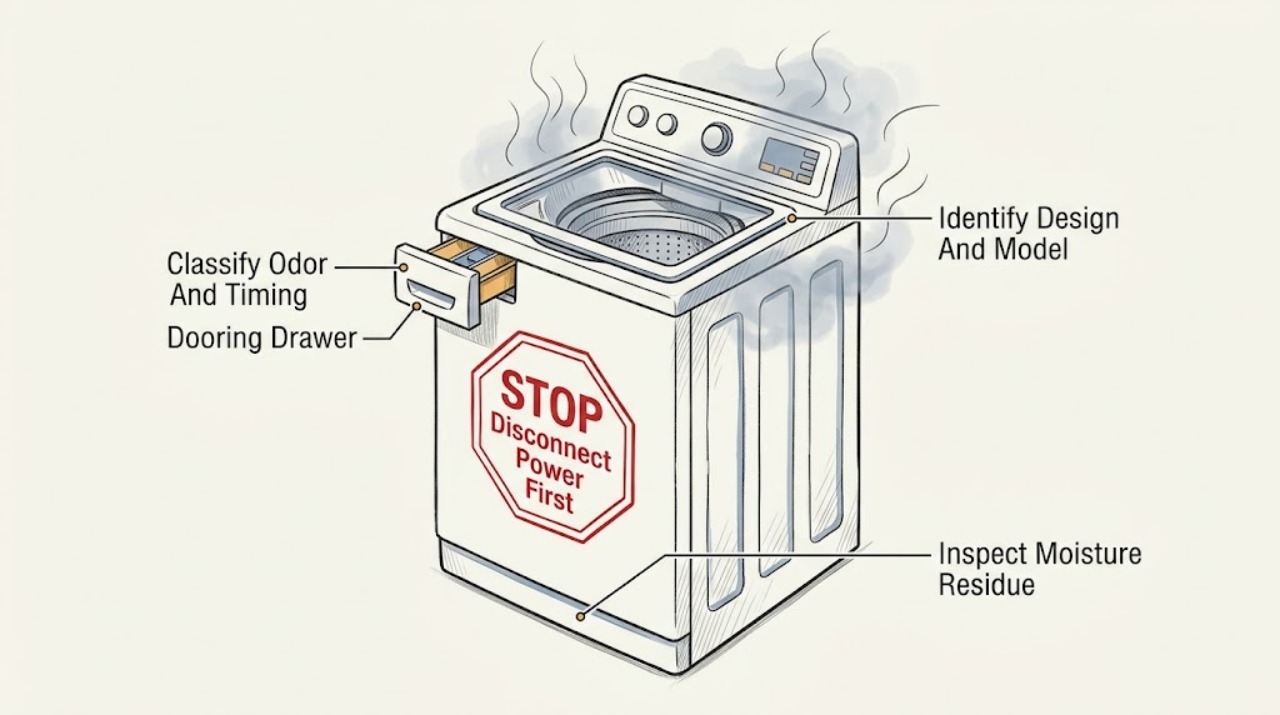
Work through in order
Diagnostic checks
Use only checks that match the exact appliance or system and its official guide.
-
Check 1
From outside the washer, identify the odor as musty/mildew, sewage/drain-like, detergent or sour residue, rubber/plastic, electrical/chemical, or smoke, and note when it appears.
Expected result: Record whether the smell is present with the washer idle, only when wet items sit inside, during fill, agitation, drain, spin, or a cleaning cycle; note whether it is a new machine and whether the odor comes from the basket, gasket, rear hose area, plug, or wall outlet.
Next step: Stop the washer for any electrical, chemical, smoke, or hot-plastic odor and follow the safety boundary; otherwise continue with the physical-design and odor branch.
Stop if: Do not run another cycle or handle the plug if there is smoke, sparking, a hot outlet, a sharp electrical smell, chemical fumes, or water at electrical parts.
Why this matters
Why: Musty or sour odor supports a moisture/residue/drain-path check. A sewage-like odor makes hose routing or drain connection more relevant. A rubber smell only during initial fill of a new washer can fit GE's inlet-hose guidance; electrical, chemical, smoke, or melting odor is not a cleaning branch.
-
Check 2
Identify whether the GE washer is top-load or front-load and record the model number from the rating label before opening a filter, starting a tub-clean cycle, or using a cleaner.
Expected result: Record whether the washer has a lid or front door, a BasketClean or Self Clean option, an accessible pump filter, a dispenser drawer, and a front door gasket; mark any feature as unknown rather than assuming it is present.
Next step: Use the model manual to select the matching clean cycle, filter access, gasket procedure, and cleaner placement.
Stop if: Do not pry the door or lid, remove a panel, or open a filter housing without the exact model procedure and a safe way to control any trapped water.
Why this matters
Why: GE gives different odor and cleaning instructions for top-load and front-load designs, and not every model has the same cleaning cycle or user-accessible filter. An unknown feature requires the exact manual, not a borrowed procedure.
-
Check 3
With the washer empty, cool, stopped, and disconnected from power for maintenance, inspect only visible ordinary-access areas: the basket or tub rim, lid or door gasket, dispenser, and any visible residue or trapped items.
Expected result: Record standing water, lint, detergent or softener film, slime, mold-like spotting, foreign material, a torn gasket, blocked gasket drain holes, or a clean and dry interior; note whether the odor is strongest in one area.
Next step: Remove only loose residue the model manual permits, wipe with the permitted mild method, and continue to the drain-hose check; arrange service for a damaged seal, persistent standing water, or inaccessible buildup.
Stop if: Do not scrape rubber aggressively, use abrasive or concentrated chemicals, reach into moving parts, or clean while the washer is connected to power.
Why this matters
Why: Moisture and residue in a gasket, dispenser, or tub can support a musty or sour odor. A torn seal, blocked path, standing water, or odor localized near an electrical area changes the issue from routine cleaning to service or leak diagnosis.
-
Check 4
From behind or beside the washer, observe the drain hose where it enters the standpipe or drain without disconnecting a pressurized supply line or moving an unstable appliance.
Expected result: Record whether the hose is pushed unusually far down, lacks the model-required air gap or support, is kinked, leaks, or sits in a drain that backs up; note whether the smell is sewage-like and whether water returns to the tub.
Next step: Restore only the hose position or support specified by the exact GE installation instructions, then observe one normal drain result; call service for a leak, recurring backflow, or inaccessible plumbing.
Stop if: Do not pull hard on hoses, open wall plumbing, tip the washer, or continue if water is pooling near the outlet, cord, or other electrical equipment.
Why this matters
Why: GE says a hose pushed too far into the standpipe can siphon drained water back into a washer and cause a musty odor. A backed-up drain, leak, or unknown installation requires the model installation instructions or plumbing service rather than guesswork.
-
Check 5
If the odor is musty or residue-related, the washer is dry and electrically safe, and the exact GE manual permits it, run the model's empty BasketClean, Self Clean, or other approved tub-cleaning procedure with one compatible cleaner only.
Expected result: Record the cycle selected, cleaner named by the manual or label, whether the cycle completes, and whether odor, foam, residue, leakage, or abnormal noise remains afterward.
Next step: Rinse or wipe only as the manual directs, remove wet items promptly, and leave the lid or door open or use the model's ventilation feature when safe; escalate a recurring or unsafe result.
Stop if: Never mix chlorine bleach with vinegar, ammonia, rust remover, or another cleaner; do not use unapproved solvents, abrasive cleaners, or a cleaner quantity copied from another model.
Why this matters
Why: A completed cycle with reduced odor supports removable moisture or residue as a contributor. A returning odor, excess foam, new leak, or incomplete cycle points to a drain, gasket, dispenser, pump, installation, or appliance fault—not permission to add stronger chemicals.
-
Check 6
Only if the exact GE model has an owner-accessible pump filter and its manual gives the procedure, disconnect power, prepare a shallow container and towels, and inspect the filter for lint or objects while controlling any residual water.
Expected result: Record whether the filter is blocked, damaged, missing a seal, unusually foul, or clean; note the amount and condition of water released and whether the machine had standing water, poor draining, or a door that stayed locked.
Next step: Clean and refit the filter only by the exact manual procedure, then verify a normal drain without repeating hot or long cycles; arrange service if odor or drain symptoms return.
Stop if: Do not force the filter, reach into a pump, use tools on the pump blade, or work with the appliance energized or with water approaching electrical parts.
Why this matters
Why: A restricted filter can retain foul water and contribute to odor, but filter design and access are model-specific. Damaged threads, a missing seal, uncontrolled water, or a filter that cannot be safely reached requires service.
-
Check 7
If the washer is new and the odor is rubber-like, compare the smell timing without dismantling anything: note whether it occurs only during the fill phase before agitation, or continues into motor, pump, spin, or dry operation.
Expected result: Record whether the odor is limited to new inlet hoses during fill, fades between cycles, or is accompanied by heat, smoke, melting, abnormal noise, a hot plug, or a breaker trip.
Next step: For a fill-only new-hose smell with no hazard, follow the model installation and service guidance and monitor without running unattended. For any electrical or worsening smell, stop, disconnect only when safe, and arrange service.
Stop if: Do not perform a deliberate fill or heat test when the odor is sharp, electrical, smoky, hot, or accompanied by water or breaker trouble.
Why this matters
Why: GE says a burning-rubber odor limited to the fill phase of a new washer may come from new inlet hoses and fade. Odor during motor or pump operation, a persistent or worsening smell, or any electrical symptom is not established as normal.
-
Check 8
After the approved cleaning or installation correction, remove wet laundry promptly and observe one normal cycle from a safe position, without opening panels or leaving the appliance unattended during a known odor condition.
Expected result: Record whether the smell is gone, reduced, or returns; whether the washer fills, drains, spins, and stops normally; whether water remains, the gasket leaks, the plug or outlet heats, or the breaker trips.
Next step: Keep the lid or door open only as the model and household safety allow, use the correct detergent amount, and provide the complete odor timeline and model details to qualified service if it returns.
Stop if: Stop immediately for smoke, electrical odor, abnormal heat, leakage near electrical parts, breaker trips, or any need for internal access.
Why this matters
Why: No recurring odor and normal water and power behavior support routine prevention. A returning smell, standing water, leak, abnormal heat, smoke, or power symptom means the underlying condition is unresolved.
Use your observations
Decision map
Find the observation that best matches what you see, then follow the next safe action.
-
PATH 01Safety boundary
What you see
The odor is musty, mildew-like, sour, or strongest in the basket, gasket, dispenser, or after wet items sat in a closed washer.
Do this next
Use the top-load or front-load GE branch that matches the model: ordinary-access inspection, model-approved tub clean, correct detergent quantity, prompt removal of wet laundry, and safe air-drying.
Why this path and its safety boundary
Why it matters: Retained moisture, detergent or softener residue, gasket/dispenser buildup, or a restricted drain path is more likely than an electrical fault.
Safety stop: Stop for a torn seal, standing water that cannot be safely drained, a leak, or odor near the plug or outlet.
-
PATH 02Safety boundary
What you see
The odor is sewage-like or returns soon after draining, especially when water backs up or the hose is pushed far into the standpipe.
Do this next
Check the hose position and air gap only against the exact GE installation instructions, then arrange plumbing or appliance service for backflow, leaks, or recurrence.
Why this path and its safety boundary
Why it matters: Drain-hose routing, siphoning, a backed-up standpipe, or retained drain water is more plausible than a basket-only odor.
Safety stop: Do not disconnect pressurized hoses, open wall plumbing, tip the washer, or use it when water is pooling near electrical equipment.
-
PATH 03Safety boundary
What you see
The washer is front-load and odor is strongest at the door gasket or pump/filter area, with residue, lint, poor draining, standing water, or a locked door.
Do this next
Follow the exact model manual for gasket and filter access with power disconnected and water controlled; arrange service for damage, uncontrolled water, or an odor that returns.
Why this path and its safety boundary
Why it matters: GE identifies the gasket, dispenser, and accessible pump filter as model-dependent odor and drainage checks; the filter or seal may need cleaning or professional repair.
Safety stop: Do not force the door, pry the gasket, force a filter, or reach into the pump.
-
PATH 04Safety boundary
What you see
The washer is new and the rubber odor occurs only while filling, before agitation, with no heat, smoke, leak, or electrical symptom.
Do this next
Follow the model installation guidance and monitor safely; contact service if the smell persists, worsens, or changes character.
Why this path and its safety boundary
Why it matters: GE says new inlet hoses can produce a rubber odor that may be mistaken for burning and can fade over time. This narrow timing does not normalize a smell during motor, pump, spin, or dry operation.
Safety stop: Do not run a deliberate test if the smell is electrical, smoky, hot, or accompanied by a hot plug, water, or breaker trip.
-
PATH 05Safety boundary
What you see
The odor is sharp electrical, melting plastic, chemical, smoky, or burning beyond the narrow new-hose fill scenario, or the plug, outlet, cord, or cabinet is hot or discolored.
Do this next
Stop the cycle, keep people away, disconnect power only if it can be done without touching a wet or damaged connection, and arrange qualified appliance or electrical service.
Why this path and its safety boundary
Why it matters: A power, wiring, motor, pump, heater, or chemical exposure may be present; routine cleaning cannot establish that the appliance is safe.
Safety stop: Do not reset a tripping breaker repeatedly, operate the machine, mix cleaners, or touch wet electrical parts.
-
PATH 06Safety boundary
What you see
There is water on the floor, a damaged hose or door seal, water near the outlet or plug, or odor appears together with a leak.
Do this next
Stop using the washer, close the water faucets if safe, keep away from wet electrical areas, and arrange qualified service or plumbing assessment.
Why this path and its safety boundary
Why it matters: The odor may be secondary to retained water or a mechanical leak, but water and electricity create a separate stop condition.
Safety stop: Do not unplug from a wet area, tip the appliance, continue a cleaning cycle, or open panels.
Helpful context
Understand the symptom
Classify the smell before choosing a cleaning step
Musty, mildew, or sour laundry odor usually stays close to the basket, gasket, dispenser, or drain path and tends to worsen when wet items sit in a closed washer. A sewage-like smell is more suggestive of a drain connection or siphoning problem, especially when the hose is pushed too far into the standpipe. A rubber odor on a new machine only during filling can be associated with new inlet hoses according to GE. A sharp electrical, melting-plastic, smoke, or hot-wire smell is a different safety problem and should not be diagnosed by repeating a cycle.
Top-load and front-load GE washers are not cleaned the same way
GE's top-load guidance focuses on leaving the lid open, a model-permitted tub-cleaning cycle or cleaner, and drain-hose placement. Its front-load guidance adds detergent quantity, the door gasket, dispenser drawer, and an accessible pump filter, while directing the owner to the exact manual. Use the branch for the physical design in front of you; do not remove a filter or pour cleaner into a location that belongs to another model.
Use one compatible cleaner and keep the washer electrically safe
Follow the model manual and the cleaner label. GE publishes bleach or a washer-cleaning product for some tub-cleaning cycles and identifies vinegar as an alternative in some guidance, but its safety manual explicitly prohibits mixing chlorine bleach with ammonia or acids such as vinegar or rust remover. Disconnect power before maintenance or cleaning, keep water away from the outlet and plug, and do not put fabrics contaminated with flammable liquids into a wash or dry process.
A clean basket does not prove the drain or appliance is safe
If the smell returns after an approved clean, inspect the drain-hose routing, filter or gasket only as the exact model permits, and note whether the washer drains fully. A lingering smell with standing water, a visible leak, a damaged seal, a repeated breaker trip, or a hot electrical odor needs service rather than stronger chemicals. GE's official pages also warn that model features and access vary, so keep the model number with the service request.
Safety boundary
Stop conditions
- Stop the washer for a sharp electrical, chemical, melting-plastic, smoke, or hot-wire odor; disconnect power only when the plug and surrounding area are dry and safe, then arrange qualified service.
- Do not operate when water is pooling near the cord, plug, outlet, cabinet wiring, or another electrical appliance; close the water faucets when safe and arrange service.
- Never mix chlorine bleach with vinegar, ammonia, rust remover, or another cleaner; use one model-approved product and follow its label and the GE manual.
- Do not force a door or lid, open panels, tip the washer, disconnect pressurized hoses, or reach into a pump or moving drum as an odor check.
- Do not treat a burning smell as normal except for the narrow GE-described new-inlet-hose fill-phase scenario; stop for any odor during motor, pump, spin, or drying operation or for heat, smoke, or a breaker trip.
- Stop and arrange service when the odor returns after the model-approved clean, a gasket or hose is damaged, standing water remains, draining is abnormal, or the exact model procedure is unavailable.
Only after diagnosis
Potential parts
- door gasket or lid seal
Consider this category only when the exact model inspection finds a torn, deformed, leaking, or odor-retaining seal after the model-approved cleaning procedure.
Confirm the GE model and seal configuration; do not operate with a leaking seal or substitute a generic seal by appearance. - pump filter or drain pump assembly
Consider this category only when the model has the relevant serviceable component and diagnosis confirms a damaged or blocked filter/pump after safe drain-path checks.
Confirm exact model access, filter, seal, pump, and water-control procedure; do not force a filter or replace a pump from odor alone. - inlet hose set
Consider this category only when inspection confirms a damaged or leaking hose, or a new-hose rubber odor does not fade within the model's expected installation context and service diagnosis supports replacement.
Confirm exact model connections, hose condition, and installation requirements; do not use a hose replacement to explain an electrical or smoke odor.
When checks do not resolve it
Need a professional?
Arrange qualified GE appliance service when the smell is electrical, chemical, smoky, melting, hot, persistent, or worsening; when water leaks or remains near electrical parts; when a door or lid will not safely open; when a gasket, hose, pump filter, plug, cord, or outlet is damaged; when odor returns after a model-approved clean; or when internal access would be required. Use plumbing service for a backed-up standpipe, drain connection, or recurring siphon that is not resolved by the exact installation instructions.
Safety scope: This article supports odor classification and model-approved ordinary-access cleaning only. Disconnect power before maintenance when the connection is dry and safe, do not mix chemicals, and do not open panels, reach into moving or energized parts, force the door, tip the appliance, or work on plumbing or wiring.
Common questions
FAQ
Why does my GE washer smell musty?
GE links musty or mildew odor to retained moisture, detergent or softener residue, gasket or dispenser buildup, a restricted pump filter on some front-load models, and drain-hose siphoning. Identify top-load versus front-load, use the matching manual procedure, and keep the lid or door open only as the model and household safety allow.
Can a GE washer smell like sewage?
A sewage-like smell can come from the drain connection or siphoning rather than the basket alone. GE says a drain hose pushed too far into the standpipe can siphon drained water back and contribute to musty odor. Check routing only against the exact installation instructions and arrange plumbing service for backflow or recurrence.
Can I use bleach and vinegar together to clean a GE washer?
No. GE's owner-manual safety warning says never to mix chlorine bleach with ammonia or acids such as vinegar or rust remover because toxic gas can result. Use one model-approved cleaner at a time, follow its label and the GE manual, and rinse only as directed.
Is a burning rubber smell in a GE washer normal?
Only a narrow scenario is described by GE: a new washer may smell like rubber from its inlet hoses when the odor occurs only during filling before agitation and no hazard is present. A smell during motor, pump, spin, or drying operation, or any smoke, heat, electrical odor, or breaker problem, requires stopping the appliance and arranging service.
Should I unplug a GE washer before cleaning it?
Yes, GE safety guidance says to unplug or disconnect power before maintenance or cleaning, but do not touch a wet or damaged plug or outlet. If water is near electrical parts, keep away, close the water faucets when safe, and arrange qualified service.
What if the smell comes back after a tub-clean cycle?
Do not add stronger or mixed chemicals. Recheck the model-specific gasket, dispenser, pump-filter, detergent-amount, and drain-hose guidance, and record whether water remains or the smell appears at drain, fill, or spin. A recurring odor, leak, damaged seal, abnormal drain, or electrical smell needs service.
Read the exact guide
Official sources
- GE Profile™ UltraFast Combo Washer/Dryer - OdorsGE Appliances · Official GE guidance for the specific UltraFast Combo Washer/Dryer family; used only as a model-specific example that drain-hose air gap and dry-out behavior must not be generalized to all GE washers.
- Top Load Washer - Odor in TubGE Appliances · Official GE support article for top-load washers; use only for that design and follow the exact model manual for cleaning.
- About the washer features.GE Appliances · Official GE owner manual for the named older washer models; used for general safety boundaries that should be checked against the current model manual.
- Front Load Washer - Cleaning the TubGE Appliances · Official GE front-load cleaning article; specific cycles and cleaner placement must be confirmed in the owner's manual.
- Washer - Burning or Rubber Odor in a New WasherGE Appliances · Official GE article for a new washer with a rubber odor limited to the fill phase before agitation; it does not normalize electrical, smoke, or persistent burning odors.
- Front Load Washer - Odor in TubGE Appliances · Official GE support article for front-load washers; access and cleaning features vary by model.
Community feedback
Share a repair observation
Share a plain-text repair observation. Accepted observations are published automatically; this page may take a moment to update.