
On this page
Start here
Quick answer
For a Whirlpool Duet front-load washer with a banging noise, first note whether the sound appears during spin and whether the load is bulky or uneven. Then check the external installation: shipping materials should have been removed, all four feet should contact a firm level floor, and the washer should not rock. Whirlpool's family-level guidance supports those checks but does not identify a bearing, damper, spider, or other internal part. If the washer still bangs with a normal load, moves severely, scrapes, leaks, or has an uncertain transport-bolt history, stop high-speed use and arrange model-specific service.
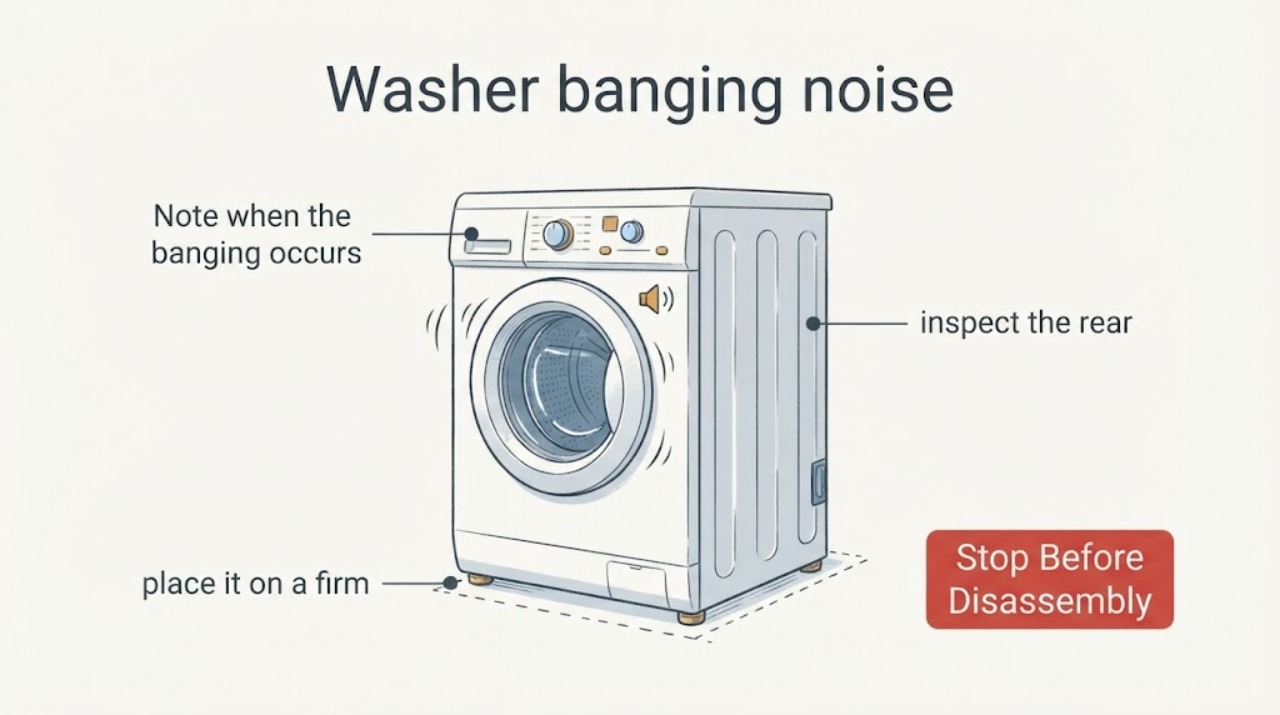
Work through in order
Diagnostic checks
Use only checks that match the exact appliance or system and its official guide.
-
Check 1
Note when the banging occurs without placing hands near the moving drum: during spin-up, at high spin, during wash/tumble, or throughout the cycle. After stopping safely, check whether the load was tightly packed, a single bulky item, or unevenly distributed.
Expected result: The noise appears mainly during spin with a bulky or uneven load, or it occurs with ordinary loads and during more than one part of the cycle.
Next step: For the load-related pattern, redistribute items loosely and avoid washing one bulky item alone. If the pattern persists with a normal load, continue with installation checks and do not infer a specific internal part.
Stop if: Stop operating if the washer moves violently, scrapes, leaks, or the noise is accompanied by visible damage.
Why this matters
Why: Whirlpool identifies unbalanced, overloaded, or single bulky loads as a front-load vibration/noise branch; a repeat noise outside that pattern is not explained by load balance alone.
-
Check 2
With the washer empty and off, place it on a firm floor and gently rock the cabinet from the top in both diagonal directions. Check whether all four feet visibly contact the floor and whether the cabinet rocks or the floor flexes.
Expected result: The washer rocks, a foot is not firmly planted, the floor flexes, or the machine is visibly out of level.
Next step: Follow the exact model's installation instructions to level the feet and secure any applicable jam nuts. If the floor or pedestal is unstable, correct that installation condition before another high-speed test.
Why this matters
Why: Whirlpool says a front-load washer must be level with all four feet in firm contact; rocking or a flexing floor can create vibration and noise.
-
Check 3
If the washer was recently moved or installed, inspect the rear from a safe standing position for transport-bolt hardware or confirm removal from the installation paperwork. Do not remove bolts or loosen rear hardware without the exact model's installation guide.
Expected result: The shipping-bolt status is unknown, bolts appear to remain, or the washer was operated after relocation before installation was completed.
Next step: Stop using the washer until the full model-specific installation instructions or a qualified installer confirm the transport hardware status. Do not substitute a generic Duet removal procedure.
Why this matters
Why: Whirlpool says shipping materials secure the tub during transport and must be removed for proper operation; leaving them in place can cause excessive noise and vibration.
-
Check 4
After the external checks, record whether the banging remains with a normally sized, evenly distributed load and whether the washer stays in place. Do not keep repeating high-speed cycles to identify an internal part.
Expected result: The noise stops after balancing/leveling, or it remains despite a stable installation and ordinary load; severe movement, scraping, or water may also be present.
Next step: If persistent, worsening, or accompanied by movement, scraping, or leakage, keep the washer out of high-speed use and arrange Whirlpool or qualified appliance service with the full model number.
Stop if: Do not open panels, test live wiring, pull the drum, or order bearings/dampers/support parts from the noise alone.
Why this matters
Why: Improvement after an external correction supports that installation or load conditions contributed. Persistent or worsening noise is outside the evidence for a particular internal component diagnosis.
Use your observations
Decision map
Find the observation that best matches what you see, then follow the next safe action.
-
PATH 01Next step
What you see
Banging occurs mainly during spin and follows a bulky, single, tightly packed, or uneven load.
Do this next
Stop the cycle safely, redistribute the items loosely, and avoid running one bulky item alone. Escalate if the same noise returns with an ordinary balanced load.
Why this path and its safety boundary
Why it matters: The observed pattern is consistent with Whirlpool's load-balance branch and does not establish an internal failure.
-
PATH 02Next step
What you see
The washer rocks, a foot is not firmly planted, or the floor/pedestal flexes.
Do this next
Level the washer only according to the exact model's installation instructions and confirm all feet are firm before testing again.
Why this path and its safety boundary
Why it matters: An unstable or unlevel installation can produce vibration, walking, and banging during front-load operation.
-
PATH 03Next step
What you see
The washer was moved or newly installed and the shipping-bolt status is unknown or bolts remain.
Do this next
Keep the washer off and have the exact installation guide or a qualified installer confirm and correct the transport hardware.
Why this path and its safety boundary
Why it matters: Transport hardware may still be restraining the tub; the family-level symptom does not justify borrowing a removal procedure from another Duet model.
-
PATH 04Next step
What you see
Banging persists with an ordinary load after the washer is stable and level, or the washer scrapes, leaks, moves severely, or shows damage.
Do this next
Stop high-speed use and arrange model-specific Whirlpool or qualified appliance service. Provide the full model number and describe the cycle and load when the sound occurs.
Why this path and its safety boundary
Why it matters: The official external checks have not identified a safe cause, and the symptom does not prove a bearing, damper, spider, motor, or other part.
Helpful context
Understand the symptom
Treat the Duet name as a family clue, not a parts diagnosis
The task does not include a full model number. Whirlpool's official front-load guidance supports family-level checks for installation and load balance, but the symptom alone cannot identify a bearing, suspension damper, rear support, motor, or other internal component. Use the model-specific installation guide before any work involving the rear of the machine.
Stop if movement is severe
A washer that walks, bangs violently, scrapes, leaks, or leaves the floor should not be repeatedly run at high spin while parts are guessed. Keep the checks external and arrange qualified service when the installation and load checks do not explain the noise.
Common questions
FAQ
Does a banging Whirlpool Duet washer mean the bearings are bad?
Not by itself. Whirlpool's front-load guidance first points to shipping materials, leveling, floor stability, load size, and bulky or uneven loads. A persistent symptom needs model-specific service rather than a guessed bearing or damper diagnosis.
Should I remove shipping bolts from a Whirlpool Duet washer using a generic online procedure?
No. Confirm the full model and use its installation guide. Whirlpool says shipping materials must be removed for proper operation, but the installation checklist also directs readers to the specific model instructions; do not loosen rear hardware from a family name alone.
Read the exact guide
Official sources
- Vibration, Walking or Off Balance - Front Load WasherWhirlpool Product Help · Official Whirlpool front-load guidance used at the family level because the task supplies Whirlpool and Duet but no full model. It supports load, shipping-material, floor, feet and leveling checks; it does not diagnose internal parts.
- Front Load Washer Installation ChecklistWhirlpool Product Help · Official Whirlpool front-load installation checklist used for shipping-bolt, level, floor, power and the instruction to consult the exact model guide. It does not establish Duet model-specific hardware or authorize internal repair.
Community feedback
Share a repair observation
Share a plain-text repair observation. Accepted observations are published automatically; this page may take a moment to update.