
On this page
Start here
Quick answer
Do not accept a bearing diagnosis from the word noise alone. Whirlpool Cabrio is a product family, so first record the complete model and separate the two symptoms: classify the sound by phase and check whether clothes are loaded loosely, the selected cycle fits the soil and fabric, both water supplies are open and correctly connected, and only the measured amount of HE detergent is used. A low-water top-load cycle can be normal, while adding extra water can reduce agitation and dilute detergent. If the noise is a continuous grind or scrape, the washer walks or strikes the cabinet, water leaks, metal debris appears, or a burning smell occurs, stop using it and arrange service. Do not dismantle the tub or order a bearing from this report.
Before you begin
Safety first
- Do not treat a noise report as confirmation of a bearing. Do not dismantle the tub, remove panels, reach beneath the washer, run with the lid or safety system defeated, test live wiring, or continue cycles after walking, impact, continuous scraping, smoke, burning odor, metal debris, or a leak.
Work through in order
Diagnostic checks
Use only checks that match the exact appliance or system and its official guide.
-
Check 1
Stop the washer normally and wait until all motion ends. From a dry, safe position, classify the sound as hum, whirl, click, rattle, knock, rub, grind, or squeal, and note whether it occurs during fill, sensing, agitation, drain, or spin. Do not run repeated cycles to make the sound easier to identify.
Expected result: The sound is brief and tied to one phase, follows basket speed, continues throughout agitation or spin, or is accompanied by walking, cabinet impact, smoke, burning odor, a leak, or a tub that does not stop.
Next step: Continue only with safe external checks when the floor is dry and there is no hazard. Leave the washer off and arrange qualified appliance service for continuous scraping or grinding, impact, walking, smoke, odor, leakage, or a tub that does not stop.
Stop if: Do not touch a moving basket, reach beneath the cabinet, tilt the washer, or open a panel.
Why this matters
Why: A phase-specific motor, direction-change, or pump sound can be normal on an applicable top-load model. Continuous metal noise or unsafe movement is not evidence of a particular bearing, but it does change the decision to stop and service.
-
Check 2
Photograph the complete rating-plate model and record which Cabrio control layout and cycle were used. Record the load type, whether the basket was packed tightly or contained one bulky item, and whether poor cleaning means visible soil, odor, pet hair, detergent residue, or dye transfer. Do not use another Cabrio model's cycle chart or service sequence.
Expected result: Only the word Cabrio is known, the full model is available, or the cleaning complaint is a specific residue/odor/soil result rather than a general dislike of the wash.
Next step: Keep the full model with the service record. Use only the matching owner's guide for cycle names, options, and any calibration or Clean Washer instruction; keep model-specific parts and procedures out of the user test.
Stop if: Stop if the next proposed step requires a service mode, cabinet access, or a part chosen only from the word bearing.
Why this matters
Why: Cabrio is a family, not enough identity for a bearing or control diagnosis. A specific cleaning result can be routed through Whirlpool's consumer checks without treating it as proof of a mechanical fault.
-
Check 3
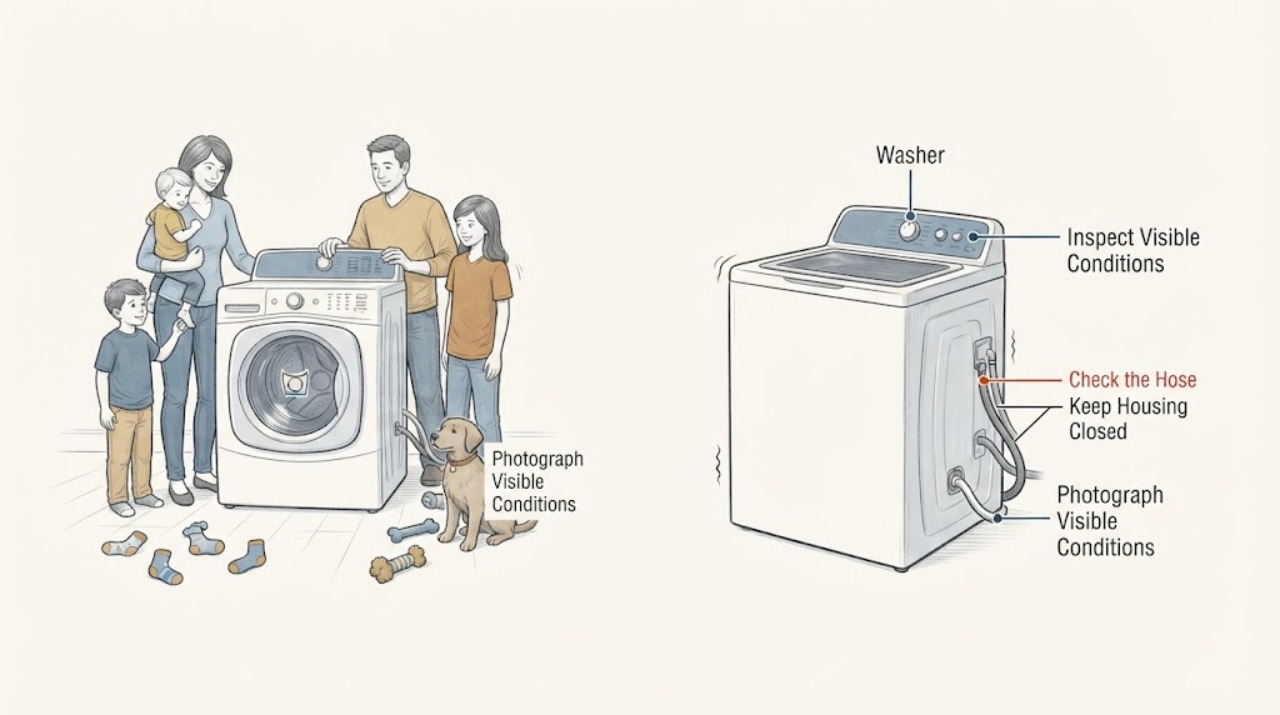
With the washer off, inspect only the outside for loose objects on top or leaning against the cabinet, and for inlet or drain hoses touching the rear. Check that the washer is stable and that the visible hoses are not being pulled or pinched. Secure or remove only an obvious external item as the exact installation guide permits.
Expected result: A rack, broom, container, hose, or other item contacts the cabinet, the washer rocks, a drain pan visibly rubs the underside, or the exterior is clear while the sound persists.
Next step: Remove the loose external item and, only if the model instructions allow, correct visible leveling on a dry stable floor. Stop and arrange service if the machine walks, strikes the cabinet, scrapes continuously, or would need to be moved in a way that strains hoses or the cord.
Stop if: Do not pull the washer across a wet floor, lift it, remove the drain pan, or reach under the tub.
Why this matters
Why: External contact and an unlevel or overloaded installation can transmit or amplify noise. A clear exterior does not prove a bearing; it means the next safe branch is load and service evaluation rather than disassembly.
-
Check 4
For one safe, normally loaded observation, distribute clothes in loose heaps around the agitator or washplate, avoid a tightly packed basket or one heavy item alone, and select the cycle and soil level that match the fabric and soil. Follow fabric labels. Do not add water to force a deeper fill.
Expected result: The load was packed, badly distributed, or too bulky; the noise is strongest during spin; cleaning improves after a suitable load and cycle; or clothes remain dirty while the load moves normally.
Next step: Use the exact model's load and cycle guidance for future loads. If the washer still makes the same severe noise with a suitable load, stop testing and arrange service; if cleaning alone remains poor, continue to detergent, temperature, and washer-care checks.
Stop if: Do not restrain a walking washer, hold the lid open during motion, or continue a cycle that strikes the cabinet.
Why this matters
Why: Whirlpool links free load movement and proper cycle selection with cleaning performance, noise, and vibration. A low visible water level on an HE top-load cycle can be normal; added water can float the load and dilute detergent.
-
Check 5
Check the accessible hot and cold faucets and hose connections without disconnecting a pressurized hose. Confirm both faucets are fully open, the hoses are not visibly kinked, and hot and cold are connected to the matching supplies. Use only measured HE detergent at the detergent maker's dose for the load and water conditions; do not add extra detergent to compensate for poor cleaning.
Expected result: A faucet is partly closed, a hose is kinked, hot and cold are reversed, detergent is non-HE or over-measured, or the connections and detergent practice are normal.
Next step: Correct only an obvious faucet position or visible hose arrangement when safe, and follow the exact model's detergent-dispenser instructions. If connections are normal and poor cleaning persists, record the result for service rather than opening the inlet system.
Stop if: Stop for a leaking connection, a valve that will not close, wet electrical equipment, or any need to remove an inlet screen or test a live valve.
Why this matters
Why: Whirlpool says supply temperature/connection and excess or unsuitable detergent can affect cleaning; excess suds can reduce spin and leave wet loads or error codes. These checks do not diagnose a bearing.
-
Check 6
If the complaint is residue, odor, or a level that seems lower than when the washer was new, follow the exact model guide for one Clean Washer cycle and washer-care routine; do not mix cleaners or scrub inside moving parts. Record whether the wash result changes while the noise remains or disappears.
Expected result: Cleaning improves after the documented washer-care cycle, residue persists, the noise is unchanged, or the noise worsens or becomes metallic.
Next step: Continue the model's documented care schedule only when there is no safety symptom. Arrange service for persistent poor cleaning with normal loading/supplies, or for any continuing severe noise; do not order a bearing from the symptom.
Stop if: Do not run a cleaning cycle if the washer leaks, walks, scrapes continuously, smells burnt, or has water near electrical parts.
Why this matters
Why: Whirlpool says routine cleaning can address buildup and can recalibrate water levels on applicable top-load models. Improvement in cleaning does not clear a severe mechanical noise; unchanged or worsening noise needs a separate service decision.
Use your observations
Decision map
Find the observation that best matches what you see, then follow the next safe action.
-
PATH 01Next step
What you see
Poor cleaning occurs with a tightly packed, single bulky, or poorly distributed load, and the noise is strongest during spin or the washer rocks or walks.
Do this next
Wait for motion to stop, use a suitable distributed load and the exact model's leveling method once if safe, and stop service testing if the washer still walks, impacts, scrapes, or leaks.
Why this path and its safety boundary
Why it matters: Load distribution and leveling are more actionable first explanations than a bearing label; Whirlpool links these conditions to movement, vibration, and noise.
-
PATH 02Next step
What you see
The washer is stable and the sound is brief or phase-specific, but clothes remain dirty, retain odor, show residue, or are not moving freely in the selected cycle.
Do this next
Use measured HE detergent, a cycle suited to the load, correct water connections, loose loading, and the exact model's documented washer-care cycle. Arrange service if poor cleaning remains after these checks.
Why this path and its safety boundary
Why it matters: The cleaning path is separate from a bearing diagnosis. Cycle choice, soil level, fabric, loading, temperature, detergent, and washer buildup should be checked first.
-
PATH 03Next step
What you see
The load, cycle, detergent, supplies, and visible installation are appropriate, but a continuous grind, scrape, new roar, repeated impact, or under-cabinet noise remains.
Do this next
Keep the washer off and arrange qualified Whirlpool appliance service with the full Cabrio model, sound recording only if made from a safe distance, phase, load, water result, and installation history.
Why this path and its safety boundary
Why it matters: An internal drive, tub, pump, suspension, foreign-object, or other model-specific condition remains possible. The sound cannot safely select a bearing or any other part.
-
PATH 04Next step
What you see
Smoke, burning odor, sparks, a hot plug or outlet, water near electrical parts, uncontrolled leakage, metal debris, violent movement, or a tub that does not stop appears.
Do this next
Stop immediately. Isolate water or power only from a safe dry location and arrange qualified appliance/electrical service; use emergency help for active smoke or fire.
Why this path and its safety boundary
Why it matters: This is an electrical, fire, water, or injury hazard, not a routine cleaning or noise adjustment.
Helpful context
Understand the symptom
A family-size load and dog hair can make poor cleaning noticeable, but neither the household description nor a noise label identifies a bearing. Cabrio models vary, so photograph the rating plate before using a manual or asking for a part. The safe first decision is whether the noise and the cleaning result change together or are separate problems.
Whirlpool's top-load cleaning guidance points to water temperature and hose connections, cycle and soil selection, HE detergent amount, loose loading around the washplate, and routine washer cleaning. Whirlpool also explains that many HE cycles intentionally use a low-water system and that adding water can prevent clothing from moving correctly.
Whirlpool's noise guidance says grinding or rubbing can occur during agitation or spin as the motor changes direction, but an unlevel or overloaded machine can make noise worse. A persistent scrape, severe grind, impact, walking, leak, or odor is a service boundary, not an invitation to run more cycles or open the tub.
When checks do not resolve it
Need a professional?
Call qualified Whirlpool appliance service for persistent severe noise, poor cleaning after the documented consumer checks, a missing complete model identity before any model-specific diagnosis, or any internal inspection. Use electrical or emergency service for electrical/fire hazards and plumbing service for an external supply or drain leak.
Safety scope: Do not treat a noise report as confirmation of a bearing. Do not dismantle the tub, remove panels, reach beneath the washer, run with the lid or safety system defeated, test live wiring, or continue cycles after walking, impact, continuous scraping, smoke, burning odor, metal debris, or a leak.
Have this ready
- Provide the complete rating-plate model, Cabrio control layout, sound description and phase, load and cycle, soil/cleaning result, detergent type and amount, hot/cold supply observations, level and external-contact checks, washer-care result, and any leak, odor, metal debris, or movement.
Common questions
FAQ
Does a loud Whirlpool Cabrio washer mean the bearings need replacement?
No. Whirlpool documents phase-specific motor and gear sounds, and says overload, an unlevel washer, loose external items, or a drain pan can increase noise. A continuous grind or scrape needs service, but the sound does not select a bearing.
Is a low water level why my Cabrio washer cleans poorly?
Not necessarily. Whirlpool top-load HE washers sense the load and may leave clothing partly above the water. Adding water can make clothes float and dilute detergent. Check the cycle, load movement, temperature, supplies, HE detergent amount, and washer-care guidance before assuming a fill or mechanical fault.
Should I buy a bearing or run the washer until the noise gets worse?
No. Cabrio is not a complete model identity, and a symptom does not establish part compatibility or failure. Stop for severe noise or any hazard, record the exact model and phase, and arrange qualified service instead of reproducing the sound or opening the tub.
Read the exact guide
Official sources
- Owner's Manual - W11042232 Rev AWhirlpool Corporation · Opened Whirlpool Cabrio guide used only for family-level context: Cabrio interface/cycle selection, HE detergent, loose loading around the washplate, and small-object precautions. It is not treated as the exact manual for every Cabrio model.
- Water Levels by Cycle - WasherWhirlpool Product Help · Opened official Whirlpool guidance used only to explain low-water sensing, cycle-dependent fill, and why adding water can impair movement and dilute detergent; exact Cabrio cycle availability remains model-dependent.
- Grinding or Rubbing NoiseWhirlpool Product Help · Opened official Whirlpool top-load guidance used to distinguish phase-specific motor/gear sounds from noise worsened by overload, unlevel installation, or drain-pan contact; it does not diagnose a bearing.
- Not Cleaning ClothingWhirlpool Product Help · Opened official Whirlpool top-load guidance used for cycle, temperature, water-supply connection, HE detergent, loading, and Clean Washer observations. It does not establish a Cabrio bearing or exact-model part diagnosis.
- Knocking or Thumping - NoiseWhirlpool Product Help · Opened official Whirlpool top-load guidance used for external contact, load distribution, walking, cabinet impact, and all-four-feet observations.
Community feedback
Share a repair observation
Share a plain-text repair observation. Accepted observations are published automatically; this page may take a moment to update.