
On this page
Start here
Quick answer
Stop using the Whirlpool WFC7500VW2 if the cycle-selector knob or the shaft behind it has broken. Disconnect power before any external inspection, do not force the selector, glue the shaft, run a cycle to test it, or remove the control panel. The supplied incident reports a dryer slipping while being lifted off the washer and breaking the selector switch and part of its shaft; that report does not prove which control-panel component must be replaced. With power off, look only at whether the removable knob is damaged or whether the visible shaft/control area is damaged, then use Whirlpool's model support path to obtain the exact documentation and arrange service. Do not force a locked door or reach into a washer that contains water.
Before you begin
Safety first
- Do not move the washer with water or laundry inside, force the door, glue or force the selector, turn the shaft with pliers, remove the control panel, probe wiring, or order a knob, switch, shaft or control assembly without model-matched documentation and qualified service guidance.
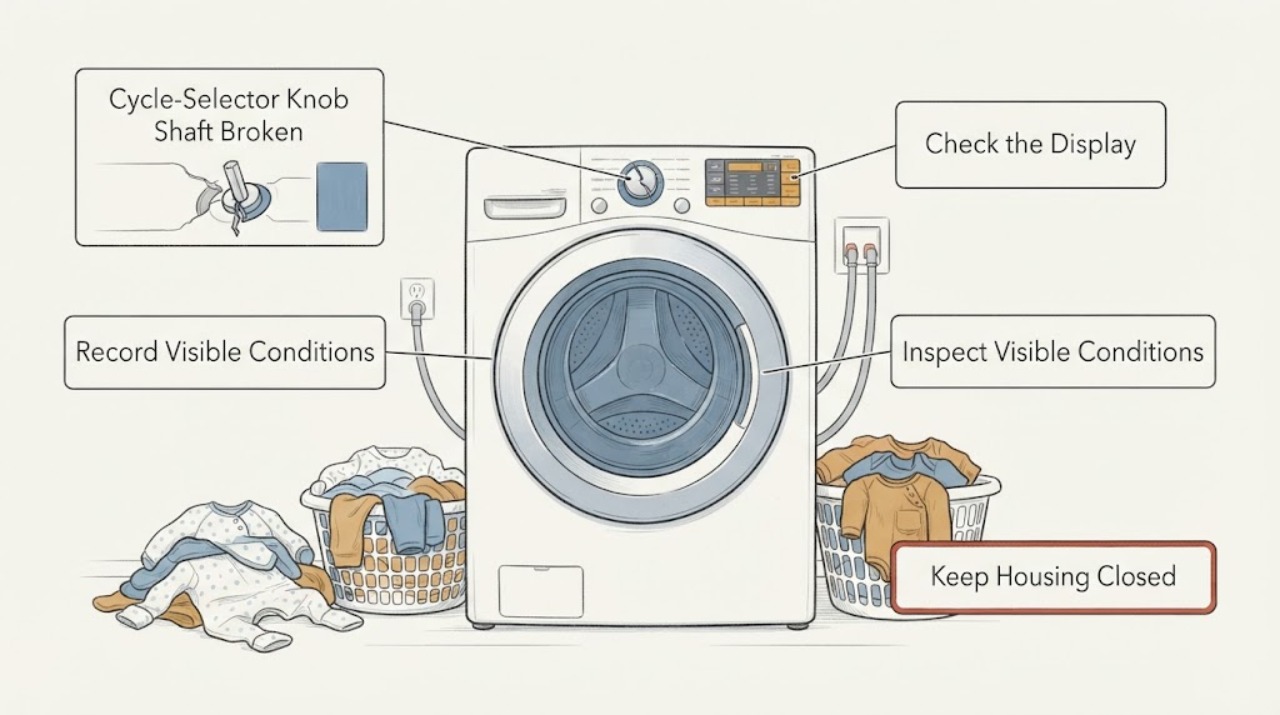
Work through in order
Diagnostic checks
Use only checks that match the exact appliance or system and its official guide.
-
Check 1
Stop selecting cycles and disconnect the washer from power at the accessible plug before inspecting the control area. If the washer is running and the controls cannot safely stop it, use only a safe, accessible power disconnect; do not reach into the drum, force the door, or move the appliance with water or laundry inside.
Expected result: The washer is already idle and empty, a cycle stopped with water or laundry inside, or the door remains locked after power is removed.
Next step: Keep the washer disconnected and give the technician the drum, water and door state. Do not reconnect it just to see whether a damaged selector will work.
Why this matters
Why: An idle empty washer is suitable for an external inspection. Water, laundry or a locked door creates a separate containment and access issue; the broken selector does not authorize forcing the door or dismantling the cabinet.
-
Check 2
With the washer disconnected, look at the selector from the front without removing the control panel. Record whether the outer knob is missing or cracked, whether a short shaft is visibly broken at the panel, whether the selector is loose or turns without engaging, and whether the panel or surrounding trim is cracked or displaced.
Expected result: Only the removable knob is damaged, the visible shaft or panel is damaged, the knob is present but does not engage, or the damage cannot be seen without opening the panel.
Next step: Take clear photos with the washer unplugged and stop there. Do not pry the knob, glue the shaft, turn the selector with tools, or remove the panel to distinguish internal parts.
Why this matters
Why: These observations describe the visible damage boundary; none identifies the correct replacement part. A shaft or panel break keeps the control assembly in scope, while an intact exterior does not rule out hidden damage from the impact.
-
Check 3
Read the full model and serial label and compare it with Whirlpool's WFC7500VW owner-support record. Save the exact model suffix, the damage photos, and a short description of what happened; do not treat the base WFC7500VW page or a similar-looking washer as proof of a WFC7500VW2 control-panel fit.
Expected result: The label confirms WFC7500VW2, the label differs, or the label cannot be read.
Next step: Use the confirmed label information to request Whirlpool documentation or qualified service. If the model cannot be confirmed, provide the photos and label details before anyone orders a part.
Why this matters
Why: A confirmed suffix lets Whirlpool or a qualified technician select the correct service documentation. A different or unreadable identity makes any knob, shaft, switch or panel compatibility claim unsafe.
-
Check 4
Only if the washer is safely empty, the door is closed without force, there is no visible electrical or cabinet damage, and Whirlpool support or the exact manual directs a reset, keep it disconnected for the documented interval before reconnecting once. Do not use a reset as a test of a physically broken selector and do not start a wash cycle afterward.
Expected result: The controls remain unresponsive after the documented power reset, or the selector is still visibly broken or mechanically loose.
Next step: Disconnect power again and arrange service. Do not repeat resets, use glue, or substitute a knob or panel without model-matched documentation.
Why this matters
Why: A reset can clear a temporary control state but cannot restore a broken shaft or physically displaced knob. Persistence after the reset leaves the mechanical control assembly or related panel damage for service assessment.
Use your observations
Decision map
Find the observation that best matches what you see, then follow the next safe action.
-
PATH 01Next step
What you see
The knob is visibly cracked or missing, but the panel-mounted selector shaft and surrounding control face appear intact.
Do this next
Leave the washer unplugged and have Whirlpool or a qualified technician confirm the exact part and fit. Do not glue the knob or run a cycle with improvised control.
Why this path and its safety boundary
Why it matters: The visible knob may be the only damaged item, but the impact and model suffix still need to be checked before any replacement is selected.
-
PATH 02Next step
What you see
The shaft is visibly broken, the selector spins without engaging, or the control panel/trim is cracked or displaced.
Do this next
Do not remove the panel or order a control assembly by appearance. Keep power disconnected and arrange model-matched service.
Why this path and its safety boundary
Why it matters: The damage extends beyond a simple loose knob in the visible control area; the exact assembly cannot be confirmed from the symptom or an image alone.
-
PATH 03Next step
What you see
The washer stopped with water or laundry inside, or the door remains locked after power is disconnected.
Do this next
Do not force the door, drain through an improvised opening, or move the machine. Tell the technician the water level, door state and model label.
Why this path and its safety boundary
Why it matters: The washer has an access or containment condition in addition to the broken selector, and forcing the door could cause injury or a spill.
Helpful context
Understand the symptom
A broken selector is a physical control problem, not a setting problem
The original report describes impact damage while a dryer was being lifted from the washer. That explains why the selector may no longer turn or register a cycle, but it does not identify whether only the outer knob broke, the shaft attached to the control failed, or the control panel behind it was damaged. Those possibilities cannot be separated safely by forcing the knob or opening the panel.
Keep the washer isolated until the control is assessed
A selector that no longer gives reliable cycle selection should not be used for repeated laundry cycles. Disconnect power from an accessible outlet before looking at the outside of the control. If the washer stopped with water inside or the door remains locked, do not force the door; tell the technician the drum status and leave the machine isolated.
Use the exact model record for documentation and service
Whirlpool's owner page identifies the WFC7500VW compact front-load family and links to product help, manuals and service resources. The page does not expose a verified user procedure for this broken shaft. Use the full model and serial information from the rating label when requesting the correct documentation and service assessment; do not choose a knob, switch, control panel or shaft by appearance or a third-party listing.
When checks do not resolve it
Need a professional?
Arrange service before using the washer when the selector knob or shaft is broken, the selector spins without engaging, the panel is displaced, the door remains locked, water is inside, or the model suffix cannot be confirmed. Whirlpool's official support path provides model documentation and service routing, but the opened public pages do not establish a safe user-level control-panel repair procedure.
Safety scope: Do not move the washer with water or laundry inside, force the door, glue or force the selector, turn the shaft with pliers, remove the control panel, probe wiring, or order a knob, switch, shaft or control assembly without model-matched documentation and qualified service guidance.
Have this ready
- Provide the full WFC7500VW2 model and serial information, front and side photos of the selector with power disconnected, whether the knob or panel shaft broke, whether the selector still engages, the impact history, and whether the drum contains water or laundry.
Common questions
FAQ
Can I glue the broken cycle-selector shaft or knob?
Do not glue or force it. The original report does not establish whether the outer knob, the panel-mounted shaft or the control behind it is damaged, and an improvised repair may leave the cycle selection unreliable. Keep the washer unplugged and obtain a model-matched service assessment.
How can I tell whether only the knob broke?
With power disconnected, look only from the front for a cracked or missing knob versus visible shaft or panel damage. Do not remove the control panel or use tools to test the shaft. A technician can identify the assembly from the full model and photos.
Will a five-minute power reset fix the broken selector?
A Whirlpool control reset can address some unresponsive-control states, but it cannot restore a physically broken shaft or displaced knob. Use a reset only when Whirlpool's exact instructions apply and the washer is safely empty; do not reconnect it to run a wash-cycle test.
What if the washer door is locked or there is water inside?
Do not force the door or move the washer. Keep power disconnected and tell the technician the water level, door state and model information so the access and control damage can be handled safely.
Read the exact guide
Official sources
- How to Reset a WasherWhirlpool Product Help · Opened Whirlpool's official reset guidance. It supports a single model-appropriate power-cycle check and directs readers to the exact owner's manual; it cannot repair or identify a physically broken selector shaft and is not used to justify repeated cycle tests.
- Broken whirlpool Washer Cycle select Knob ShaftReddit r/appliancerepair · Opened the exact Reddit post. It identifies the reported unit as Whirlpool WFC7500VW 2 and says the rear of a dryer slipped while being lifted from the washer, breaking the cycle-selector switch and part of its shaft. Community comments are not used to establish a replacement part, panel procedure or diagnosis.
- WFC7500VW | WhirlpoolWhirlpool · Opened Whirlpool's official owner page. It identifies the WFC7500VW compact front-load family to which the assigned WFC7500VW2 variant belongs, and exposes product-help, manuals and service links. It does not provide a user-level shaft or control-panel repair sequence, so it is used for family identity and escalation only.
- Controls are Not Working - Washer - Product HelpWhirlpool Product Help · Opened Whirlpool's general washer control-support article. Its control-lock and touch-control examples are not transferred to this model's physical selector; the article supports only the bounded points that a model manual should be consulted, a power reset may address a temporary control state, and service is the next step when controls remain unreliable.
Community feedback
Share a repair observation
Share a plain-text repair observation. Accepted observations are published automatically; this page may take a moment to update.