
On this page
Start here
Quick answer
Do not use urethane, silicone, epoxy, tape, or improvised fasteners to carry the load of a Whirlpool washer's glass lid or hinge. Stop using the washer if the glass is cracked, the hinge or mount is detached or loose, the lid is unstable, the lid cannot close or latch, or it strikes the cabinet. Whirlpool's top-load safety instructions limit repair and replacement work to manufacturer-recommended instructions and parts; the official material reviewed here does not approve a generic adhesive repair. Record the exact model, use the matching Whirlpool manual and parts information, and arrange model-specific or qualified appliance service.
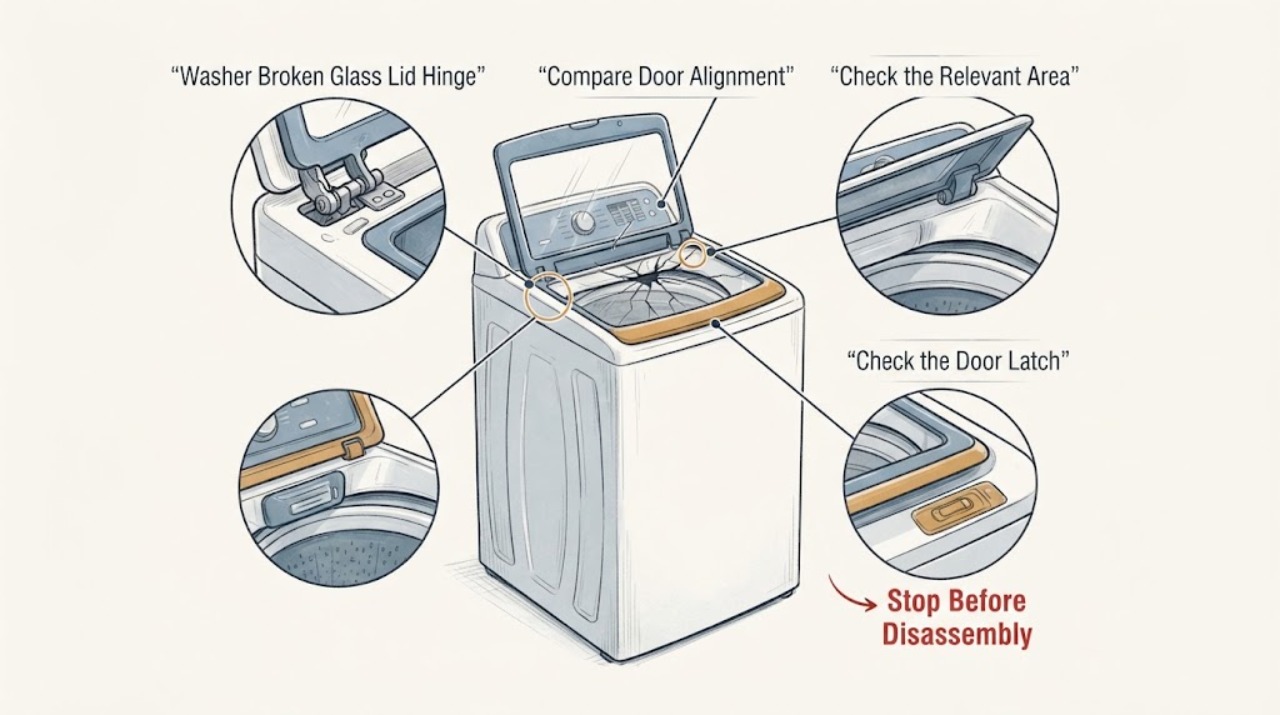
Work through in order
Diagnostic checks
Use only checks that match the exact appliance or system and its official guide.
-
Check 1
Leave the washer idle and document the exact model and the lid condition from the outside. Look for cracked or chipped glass, a hinge pulled away from the lid or cabinet, a loose mounting area, distortion, sharp edges, or a lid that sags.
Expected result: The glass or hinge is visibly damaged, the lid is unstable or misaligned, or the outside appears intact and stable.
Next step: For any crack, loose hinge, unstable lid, sharp edge, or distortion, keep the washer off and move to service identification. Do not repeatedly open and close the lid to test it.
Stop if: Do not touch loose glass fragments, force a sagging lid, or carry the lid by a damaged hinge.
Why this matters
Why: Visible glass, hinge, or mount damage is a structural failure risk and is different from a washer that merely pauses or fills slowly. An intact exterior does not prove that hidden hinge hardware is sound.
-
Check 2
Do not apply urethane, silicone, epoxy, tape, a 3D-printed substitute, or an improvised fastener to the hinge or glass. Compare the proposed repair with the exact Whirlpool manual's user-maintenance and repair instructions before doing any work.
Expected result: The exact manual explicitly describes an approved user repair, or it does not describe the adhesive or structural repair being considered.
Next step: If the manual does not specifically approve the repair, leave the washer out of service and arrange model-specific or qualified appliance service. Do not infer approval from a different Whirlpool model.
Stop if: Do not drill the lid, remove hinge hardware, separate the glass, or bypass the lid lock as an experiment.
Why this matters
Why: Whirlpool's owner guidance permits repair or replacement only where the instructions recommend it and advises against non-recommended replacement parts. The absence of an exact model approval means the proposed adhesive repair has not been established as safe.
-
Check 3
With the washer powered off, inspect only the accessible closed-lid position without forcing it. Check whether the lid meets the cabinet evenly, the strike lines up with the lock, and the lid can close and latch normally; do not reach into the tub.
Expected result: The lid closes and latches normally, the lid will not latch, the strike or lock is misaligned, or the lid must be forced.
Next step: If the lid will not close or latch, keep the washer off and arrange service. If only loose lint or detergent is visibly preventing closure, remove that accessible residue without touching damaged glass, then follow the model reset guidance once.
Stop if: Do not insert tools into the lock, bypass it, pry the lid, or run a cycle with an unstable or unlatched lid.
Why this matters
Why: Whirlpool describes the lid lock as a safety feature and notes that a lid condition or visible obstruction can prevent the applicable operation. A damaged hinge can create a lock alignment problem even when the lock itself is not the original failure.
-
Check 4
Identify the model before selecting any replacement. Check the inside of the lid or the rear area for the model label, then use the matching Whirlpool manual and parts information to determine which repair category the model recognizes.
Expected result: The full model number is readable and has matching documentation, or the label is missing, incomplete, or does not match the washer.
Next step: Use only the exact model documentation and manufacturer-recommended parts route. If the model cannot be confirmed, give the label location, photographs, and symptom details to Whirlpool or a qualified technician instead of guessing a part.
Stop if: Do not select a hinge or lid from a similar-looking washer, and do not assume a part fits from a brand name alone.
Why this matters
Why: Whirlpool places washer model information in more than one possible location, and its manual portal uses the model number to provide the correct literature. Hinge, lid, strike, and lock designs can differ across model families.
-
Check 5
Prepare a service handoff without running another cycle: record the model, whether the glass is cracked, where the hinge separated, whether the lid sags or strikes the cabinet, whether it can latch, and whether any fragments or water are present.
Expected result: The technician has the model and a clear description or photographs, or the damage cannot be safely photographed or the washer presents a glass, electrical, or water hazard.
Next step: Use Whirlpool's support or a qualified appliance technician for model-specific evaluation. If there is broken glass, an exposed electrical area, leaking water, smoke, or a falling lid, keep people away and leave the washer isolated until help is arranged.
Stop if: Do not energize the washer, start a cycle, or perform cabinet or live electrical work to gather more evidence.
Why this matters
Why: These observations distinguish a lid or hinge structural repair from a lid-lock symptom and help service identify the correct assembly without a risky test. A hazard takes priority over collecting more detail.
Use your observations
Decision map
Find the observation that best matches what you see, then follow the next safe action.
-
PATH 01Next step
What you see
The glass is cracked or chipped, the hinge or mount is detached, the lid is unstable, or the lid has a sharp or falling edge.
Do this next
Stop using the washer, keep people away from the lid, and arrange qualified appliance service. Do not glue, clamp, drill, or run a cycle.
Why this path and its safety boundary
Why it matters: The washer has a structural lid hazard. An adhesive patch cannot be assumed to carry the repeated load or contain damaged glass.
-
PATH 02Next step
What you see
The glass looks intact, but the lid sags, hits the cabinet, will not close, or will not latch after the hinge damage.
Do this next
Leave the washer off and have the exact model's hinge, lid, strike, and lock arrangement evaluated. Do not force the lid or operate it with a misaligned latch.
Why this path and its safety boundary
Why it matters: The hinge geometry or lid-lock alignment may be out of specification. A latch that does not engage is a safety boundary, not a reason to bypass the lock.
-
PATH 03Next step
What you see
The lid closes and latches normally, the hinge and mount are firm, and there is only a superficial mark with no crack, movement, or operating symptom.
Do this next
Compare the exact model's manual and arrange an inspection if the mark is near the hinge or glass edge. Do not apply adhesive to change the lid's movement or strength.
Why this path and its safety boundary
Why it matters: The observation does not establish a broken hinge, but a mark near glass edges or mounting hardware can worsen. Appearance alone cannot confirm that a lid is safe under repeated use.
-
PATH 04Next step
What you see
The model cannot be confirmed, the proposed part is from another Whirlpool model, or the manual does not describe the proposed urethane or adhesive repair.
Do this next
Stop the repair decision and provide the model label and damage details to Whirlpool support or a qualified technician. Use manufacturer-recommended parts only after the exact model is confirmed.
Why this path and its safety boundary
Why it matters: The repair compatibility and safety evidence are missing. Brand-level similarity is not enough to establish a hinge, lid, or adhesive fit.
When checks do not resolve it
Need a professional?
Arrange Whirlpool or qualified appliance service for cracked or chipped glass, a detached or loose hinge, an unstable or distorted lid, a lid that will not close or latch, a misaligned strike or lock, unknown model information, or any repair that requires lid removal or structural fasteners. Stop using the washer immediately for falling-lid or pinch risk, sharp glass, exposed electrical parts, leaking water, smoke, or sparks.
Common questions
FAQ
Can I use urethane to reattach a broken Whirlpool glass washer lid hinge?
Do not use urethane as a structural repair unless the exact Whirlpool model instructions explicitly approve that method. The official top-load safety guidance reviewed here limits repair and replacement work to manufacturer-recommended instructions and parts, and it does not establish a generic adhesive repair. Keep the washer out of service and arrange model-specific evaluation.
Should I replace only the hinge or the whole Whirlpool washer lid?
The phrase broken hinge is not enough to select a part. The correct repair may depend on the lid glass, hinge mount, lid assembly, strike, and lock design for the exact model. Confirm the model and use Whirlpool's matching parts and manual information before selecting anything.
Can I keep using the washer if the glass lid is cracked?
No. Do not run the washer with cracked or chipped glass, an unstable lid, sharp edges, or a hinge that cannot hold the lid safely. Keep people away from the damaged area and arrange qualified service.
Where can I find the Whirlpool washer model number?
Whirlpool's contact guidance lists possible washer model-label locations including inside the washer lid, at the right bottom corner, or on the back behind the control panel or near the baseframe. Use the full model number when retrieving the manual or contacting support.
Read the exact guide
Official sources
- Kitchen And Laundry Appliance Manuals | WhirlpoolWhirlpool · Official Whirlpool manual portal used to establish that the exact appliance model is needed to retrieve the matching manual and instructions.
- TOP LOAD WASHER OWNER'S MANUALWhirlpool · Official Whirlpool top-load washer manual used for the limits on user repair and replacement parts, moving-tub and service boundaries, and safe disconnection guidance; the exact model manual controls when models differ.
- Reach Out To Whirlpool: Contact Us | WhirlpoolWhirlpool · Official Whirlpool contact page used for washer model-label locations and the requirement to provide model and serial information when seeking support.
- Lid Locking on a Top Load High Efficiency WasherWhirlpool · Official Whirlpool support guidance used for the safety role of the lid lock, closed-lid operation, visible obstructions, and escalation for a persistent lock issue.
- Home Appliance Parts & Accessories | WhirlpoolWhirlpool · Official Whirlpool parts page used only for the manufacturer parts route; it does not establish compatibility for a hinge or lid without the exact model.
Community feedback
Share a repair observation
Share a plain-text repair observation. Accepted observations are published automatically; this page may take a moment to update.