
On this page
Start here
Quick answer
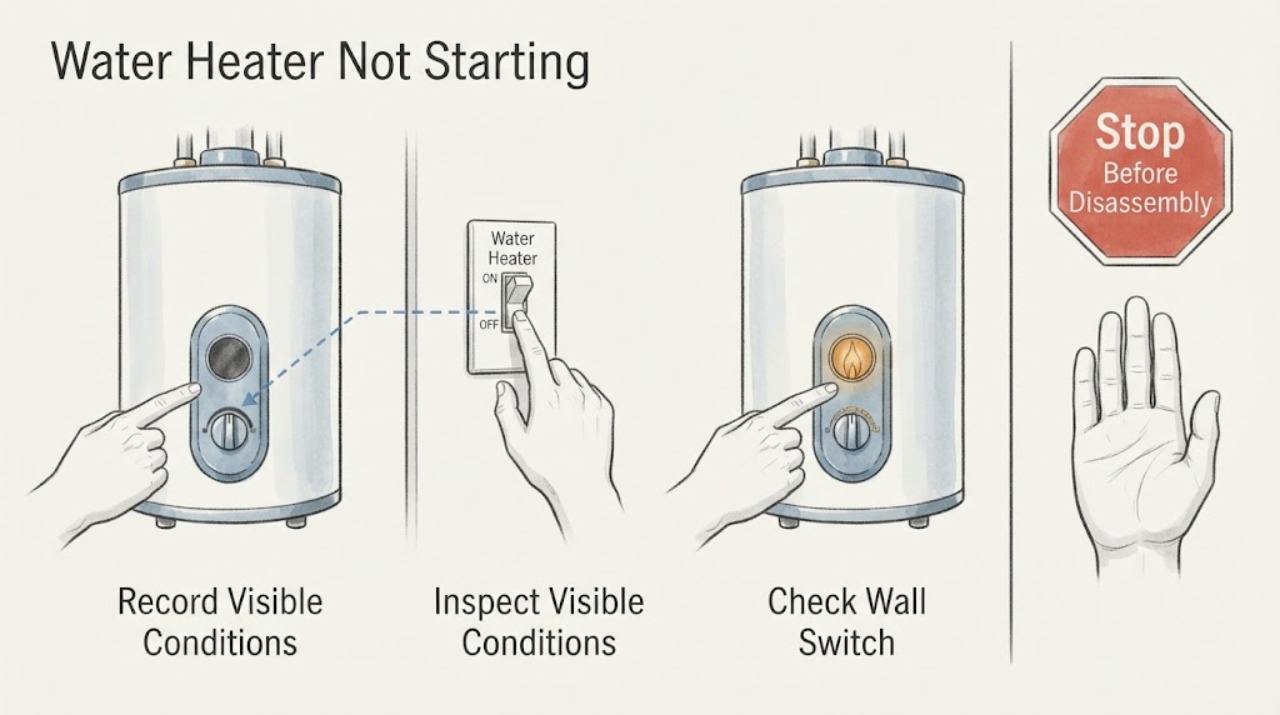
A Whirlpool water heater that is not starting must first be separated by fuel type: electric and gas models use different controls and checks. Identify the fuel and exact model from the rating label, then make only external observations. For an electric unit, look for the dedicated breaker or control indication without opening the access panels; for a gas unit, confirm the gas supply valve and visible pilot or status indication only as the model label directs. If there is a gas smell, smoke, a leak, repeated tripping, or no recovery after the model instructions, stop and use qualified service.
Work through in order
Diagnostic checks
Use only checks that match the exact appliance or system and its official guide.
-
Check 1
Read the rating plate and controls from outside the heater. Record whether the unit is electric or gas, the model information, whether any status light or display is visible, and whether the complaint is no heat, no burner, or no indicator at all.
Expected result: The heater is clearly electric, clearly gas, or the fuel and control state cannot be identified.
Next step: Use the exact printed manual or Whirlpool model lookup before any model-specific check.
Why this matters
Why: Fuel identification selects the safe troubleshooting branch; an unidentified control state is not evidence for a failed element, igniter, thermostat, or gas valve.
-
Check 2
For an electric heater, look at the dedicated water-heater breaker and any external control indication. Do not remove access covers or perform electrical measurements; if the breaker is off or the control is dark, note it and arrange qualified electrical or appliance help rather than repeatedly cycling protection.
Expected result: The breaker is visibly on and an indicator is present, the breaker is off, or the indicator remains dark with the breaker on.
Next step: Follow the exact model instructions and keep the heater out of service if protection trips again.
Why this matters
Why: A visible power interruption can explain a no-start symptom, while a dark control with an apparently live supply needs qualified diagnosis; neither observation identifies a specific element or thermostat by itself.
-
Check 3
For a gas heater, inspect the gas supply valve position and the visible pilot or status light without removing the burner cover. Follow only the lighting sequence printed on the heater; if you smell gas, stop, avoid flames and switches, leave the area, and contact the gas utility or emergency service.
Expected result: The gas valve is off, the pilot or status light is absent or abnormal, the pilot is visibly lit, or a gas smell is present.
Next step: If the valve is on but the pilot will not light or stay lit, stop model-independent attempts and arrange qualified gas-appliance service.
Why this matters
Why: Whirlpool identifies a turned-off gas supply as a common reason a new gas heater does not work; pilot and status behavior are model dependent. Gas odor is an immediate safety boundary.
-
Check 4
Check hot water at more than one faucet after allowing the heater the model-specified recovery time. Note whether every outlet is cold or only one fixture is affected, and whether a newly installed electric tank was powered before the tank was full.
Expected result: All faucets are cold, one fixture is cold while others are hot, or the issue began after a new installation.
Next step: Do not energize a newly installed electric tank until the model instructions confirm it is full. Have a qualified person diagnose a no-heat condition or suspected dry-fire.
Why this matters
Why: Cold water everywhere supports a heater-side or supply issue; one cold fixture can be a failed mixing control. Whirlpool warns that powering an electric tank before it is full can dry-fire the upper element.
Use your observations
Decision map
Find the observation that best matches what you see, then follow the next safe action.
-
PATH 01Next step
What you see
The fuel type is electric and the dedicated breaker or external control is dark.
Do this next
Do not open energized covers; keep protection from repeated cycling and arrange a qualified electrician or appliance technician.
Why this path and its safety boundary
Why it matters: A supply or control-power problem is more likely than a proven heating-element failure.
-
PATH 02Next step
What you see
The fuel type is gas, the gas valve is off, and there is no gas odor.
Do this next
Follow the exact model start instructions once the supply issue is safely corrected; if the pilot will not light or stay lit, use qualified gas service.
Why this path and its safety boundary
Why it matters: The shutoff position can explain a gas heater that does not start, but this does not prove the rest of the ignition system is sound.
-
PATH 03Next step
What you see
Every faucet is cold, the unit has power or gas, and the symptom persists after the model recovery or start procedure.
Do this next
Keep the model and observations, stop repeated testing, and arrange qualified water-heater service.
Why this path and its safety boundary
Why it matters: The fault may be in the heating, ignition, thermostat, control, or plumbing path, and the generic symptom cannot identify a part.
-
PATH 04Next step
What you see
You smell gas, see smoke or a leak, hear abnormal combustion, or a safety device trips repeatedly.
Do this next
Leave the area for gas odor, avoid ignition sources and switches, shut down only if the model safety instructions permit, and use qualified emergency or gas-appliance help.
Why this path and its safety boundary
Why it matters: This is an immediate safety boundary, not a normal starting check.
Helpful context
Understand the symptom
“Not starting” can mean no display or heat on an electric tank, or a gas burner and pilot that do not ignite. Do not transfer an electric element or breaker procedure to a gas heater. Read the rating label and the printed installation instructions first.
When checks do not resolve it
Need a professional?
Use qualified service for a heater that remains inactive after the correct fuel-specific checks, for suspected dry-fire, pilot failure, abnormal status codes, leaks, repeated electrical trips, smoke, or combustion problems. If gas is smelled, leave the area and contact the gas utility or emergency service; do not troubleshoot ignition in place.
Common questions
FAQ
Can I use the electric Whirlpool water-heater steps on a gas model?
No. Whirlpool publishes separate electric and gas procedures. Identify the fuel and follow the exact heater label and manual before checking controls.
Why will a newly installed Whirlpool electric heater not start?
Whirlpool identifies lack of power and dry-fire from energizing an incompletely filled tank as common installation causes of no hot water. A qualified person should handle access-panel or electrical diagnosis.
What if the Whirlpool gas water-heater pilot will not light?
Confirm the model instructions and gas-supply state. Whirlpool notes that a turned-off gas supply can prevent operation, but a pilot that will not light or remain lit requires model-specific qualified service, especially if gas odor is present.
Read the exact guide
Official sources
- Whirlpool Gas Water Heater Troubleshooting and RepairWhirlpool Water Heaters · Whirlpool standard gas water-heater pilot and gas-supply troubleshooting
- Whirlpool Electric Water Heater Troubleshooting - No Hot WaterWhirlpool Water Heaters · Whirlpool water-heater model-specific instruction and qualified-person boundary
- Electric Water Heater Repair and Troubleshooting | WhirlpoolWhirlpool Water Heaters · Whirlpool standard electric water-heater no-hot-water and power troubleshooting
Community feedback
Share a repair observation
Share a plain-text repair observation. Accepted observations are published automatically; this page may take a moment to update.