
On this page
Start here
Quick answer
A Whirlpool water heater normally stores water in a tank, so “freezing” usually means the tank or connected pipes are exposed to freezing conditions while the heater is shut down or unprotected. Identify whether the unit is electric or gas and whether only a supply pipe is frozen. If the heater was drained, do not restore power until it is completely full and air has been purged; use the exact model manual or a qualified technician for draining and restart.
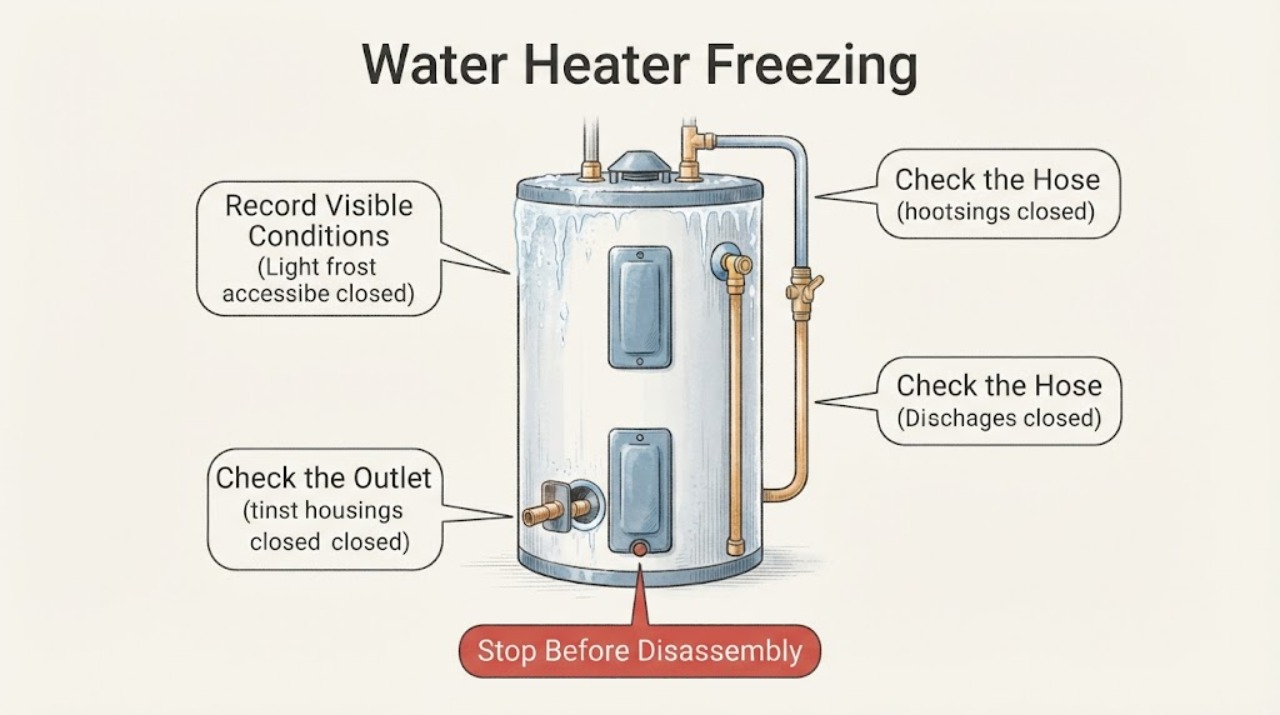
Work through in order
Diagnostic checks
Use only checks that match the exact appliance or system and its official guide.
-
Check 1
From outside, identify whether the heater is electric or gas and record the model, location, ambient exposure, insulation, and which taps have no flow or no hot water. Do not remove covers or disturb gas controls.
Expected result: No hot water with normal cold flow suggests a heating or control issue; no flow at one or more fixtures points more toward a frozen pipe. Frost or ice on the tank or piping is an exposure finding, not proof that the tank itself is safe to thaw.
Next step: If gas odor, a damaged flue, leaking tank, or ruptured pipe is present, stop and use qualified plumbing/gas service. Use the model manual for any model-specific freeze procedure.
Why this matters
Why: This observation narrows the likely cause but does not identify an internal part by itself.
-
Check 2
With the heater off and accessible, inspect only visible inlet, outlet, drain, and relief piping for ice, bulging, split insulation, leaks, or water on the floor. Never apply a torch or open a relief valve to thaw it.
Expected result: A frozen or split pipe can leak when it thaws; a leaking tank or relief discharge needs service rather than a restart. No visible ice does not rule out a concealed freeze.
Next step: Shut off water and fuel/power only if safe and arrange a qualified plumber or gas/electrical technician for leaks, bulges, or concealed piping.
Why this matters
Why: This observation narrows the likely cause but does not identify an internal part by itself.
-
Check 3
If the heater was intentionally drained or must be drained for freezing protection, follow the Whirlpool sequence: disconnect power, let hot water cool, close the cold inlet, connect a hose to a safe drain, and drain/flush as directed.
Expected result: Water that drains confirms the tank is not fully blocked at the drain, but it does not establish that a frozen or damaged tank can be safely reused.
Next step: Use the exact model manual and qualified help if the drain will not flow, ice or damage is present, or the unit is gas-fired and you are unsure of the procedure.
Why this matters
Why: This observation narrows the likely cause but does not identify an internal part by itself.
-
Check 4
Before any restart, open a hot-water faucet, refill the tank fully through the cold inlet, and purge air according to the manual. Confirm steady water flow and no leak before restoring power; never energize an empty or partly filled electric tank.
Expected result: Steady flow without leaks indicates the tank has refilled; sputtering, no flow, or leakage indicates trapped air, a frozen line, or damage.
Next step: Do not power the heater if filling cannot be confirmed. Have a qualified technician inspect it instead of repeating a freeze/thaw test.
Why this matters
Why: This observation narrows the likely cause but does not identify an internal part by itself.
-
Check 5
After the immediate risk is controlled, inspect accessible insulation and the room’s freeze exposure, and keep the area protected according to local plumbing practice. Do not assume adding insulation repairs a split pipe or substitutes for the manual’s shutdown procedure.
Expected result: A protected room and intact insulation reduce recurrence risk; recurring freezing despite protection suggests a building or plumbing condition needing diagnosis.
Next step: Ask a qualified plumber to address exposed piping, drainage, or freeze protection, and keep the model information for the service visit.
Why this matters
Why: This observation narrows the likely cause but does not identify an internal part by itself.
Use your observations
Decision map
Find the observation that best matches what you see, then follow the next safe action.
-
PATH 01Next step
What you see
Only a short section of inlet or outlet pipe is iced, the tank is intact, and water returns after safe thawing with no leak.
Do this next
Keep heat gentle and indirect, monitor for leaks, and call a plumber if flow does not return or the pipe bulges.
Why this path and its safety boundary
Why it matters: A pipe restriction is more likely than a confirmed tank freeze, but thawing can reveal a split.
-
PATH 02Next step
What you see
The heater was drained or shut down during freezing weather, and the tank can be safely refilled with steady flow and no leak.
Do this next
Refill and purge air before restoring power, following the exact manual; use qualified help if any step is uncertain.
Why this path and its safety boundary
Why it matters: The documented freeze-protection sequence may apply; restart safety still depends on a completely full tank and model-specific instructions.
-
PATH 03Next step
What you see
The tank, relief piping, or connections are split, leaking, bulging, or still frozen, or a gas odor is present.
Do this next
Shut off the relevant supply only if safe, keep away from gas controls, and arrange qualified plumbing/gas service.
Why this path and its safety boundary
Why it matters: This pattern indicates damage or a fuel/plumbing hazard that home thawing cannot establish as safe.
-
PATH 04Next step
What you see
The tank fills normally but there is still no hot water after a safe restart.
Do this next
Leave covers and gas controls untouched and arrange qualified appliance service with the model and freeze history.
Why this path and its safety boundary
Why it matters: Freezing is not confirmed; the heating element, burner, thermostat, or control may need model-specific diagnosis.
Helpful context
Understand the symptom
Freezing risk depends on exposure, shutdown state, insulation, and connected piping. A symptom such as no hot water does not prove the tank froze; the inlet, outlet, drain, or condensate/relief piping may be the only frozen section.
Gas and electric models have different controls and service boundaries. The manual’s drain/refill sequence is a safety procedure, not a reason to open gas controls or energize an empty tank.
When checks do not resolve it
Need a professional?
Call a qualified plumber or Whirlpool water-heater technician for a frozen or split pipe, leaking tank, relief-valve discharge, failed drain/refill, gas odor, or no-hot-water condition after safe filling. Provide the model, fuel type, shutdown history, temperatures/exposure, and any leak location.
Common questions
FAQ
Can I turn on a Whirlpool electric water heater to thaw it?
Do not energize it while empty or partly filled. Fill completely, purge air, check for leaks, and follow the exact model manual; use qualified service when freezing or damage is suspected.
Does no hot water prove the tank froze?
No. A frozen inlet or outlet pipe, a heating/control fault, and a drained tank can produce similar symptoms. Check flow and exposure from outside and arrange service when uncertain.
What if the water heater is gas-fired?
Use the gas model documentation and keep the gas control and burner compartment closed. Gas odor, damaged venting, leaks, or a failed restart require qualified gas service.
Read the exact guide
Official sources
- 318686-001 (WhirlPool Energy Smart).inddWhirlpool Water Heaters · Whirlpool water-heater drain, refill, freeze-protection, and service instructions, including disconnecting power before draining and never energizing an empty tank.
- 316934-003 Gas Water Heater ManualWhirlpool Water Heaters · Whirlpool gas water-heater temperature and gas-control safety; qualified service boundary and freeze-risk context.
- Whirlpool Water Heater ManualsWhirlpool Water Heaters · Whirlpool owner-center manual lookup and product documentation for model-specific procedures.
Community feedback
Share a repair observation
Share a plain-text repair observation. Accepted observations are published automatically; this page may take a moment to update.