
On this page
Start here
Quick answer
If a Whirlpool water heater is not working, first identify the exact model and whether it is gas or electric. Check only the external supply and control conditions listed for that model. Whirlpool says its water heaters are no longer available, so persistent no-heat, leak, gas, venting, or electrical faults require qualified service.
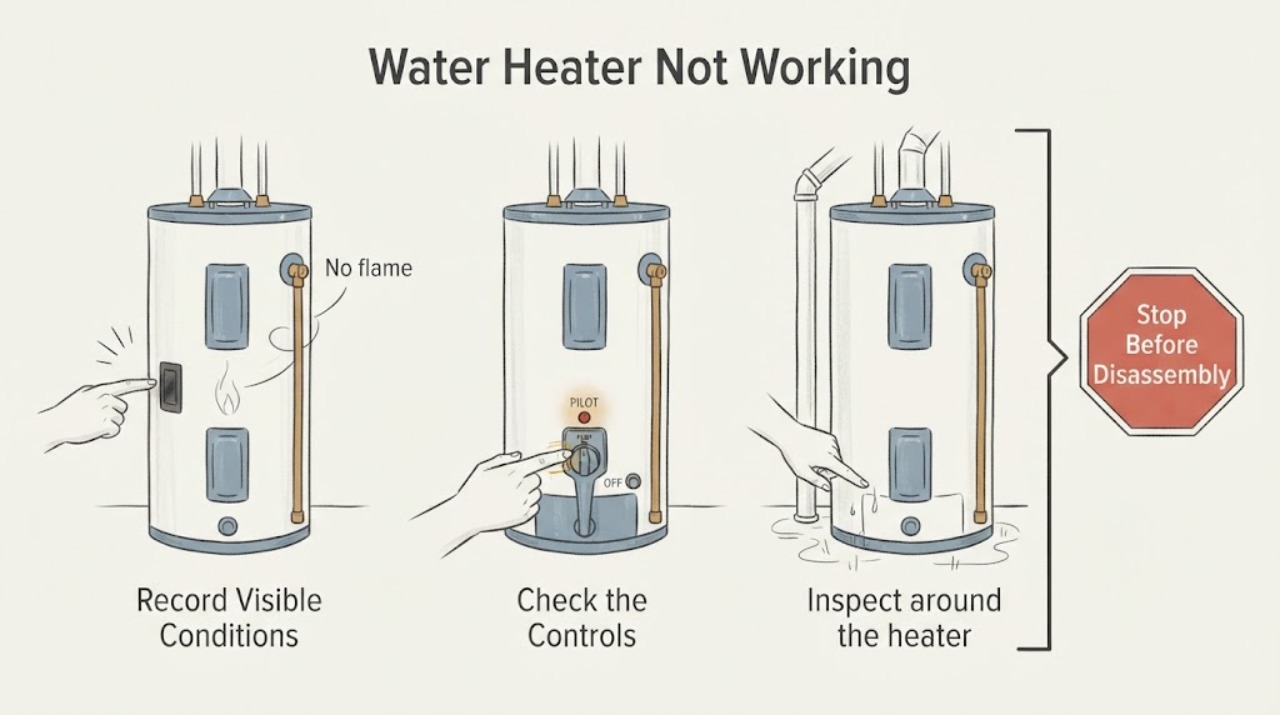
Work through in order
Diagnostic checks
Use only checks that match the exact appliance or system and its official guide.
-
Check 1
Read the rating label and record the model, fuel type, display state, and whether any hot water is available at a nearby tap.
Expected result: The unit is gas or electric, and the display or indicator is active or blank.
Next step: Use the exact model manual before any reset; do not guess a gas or electric procedure.
Why this matters
Why: Fuel type determines which external checks are relevant; a blank display on an electric model and a no-heat gas symptom need different diagnosis.
-
Check 2
For an electric model, check the dedicated breaker and any accessible service switch; for a gas model, verify the external gas shutoff is open only if there is no gas odor and the manual calls for that check.
Expected result: A breaker is tripped, the switch is off, the gas supply is unavailable, or the external supplies appear normal.
Next step: Restore only an obviously switched-off supply once when safe; do not repeatedly reset a tripping breaker or work on gas controls.
Why this matters
Why: A supply interruption can explain no heat; a breaker that trips again or normal supplies with no heat indicates a deeper fault.
-
Check 3
Inspect around the heater for water, scorch marks, damaged wiring, blocked venting, or unusual sounds without removing covers.
Expected result: A leak, scorching, damaged wiring, vent concern, or unusual sound is present, or the exterior is dry and intact.
Next step: Shut off water or utilities only when safe and call qualified service for any hazard or continuing no-heat condition.
Why this matters
Why: A visible hazard or leak takes priority over diagnosis; an intact exterior does not rule out thermostat, element, burner, or control failure.
-
Check 4
After one model-approved external correction, run one normal hot-water test and record recovery, temperature behavior, and any code.
Expected result: Hot water returns normally, or the fault persists or returns.
Next step: Give the technician the model, fuel type, supply result, and code instead of replacing a component by symptom.
Why this matters
Why: Recovery supports the corrected supply or control condition; recurrence needs model-specific testing.
Use your observations
Decision map
Find the observation that best matches what you see, then follow the next safe action.
-
PATH 01Next step
What you see
The breaker trips again, gas odor is present, a leak is active, or venting or wiring appears unsafe.
Do this next
Leave the unit off, move away from gas odor, and obtain qualified service or emergency utility help as appropriate.
Why this path and its safety boundary
Why it matters: This is a safety stop rather than a reset problem.
-
PATH 02Next step
What you see
The correct external supply is present but the heater still provides no hot water.
Do this next
Arrange model and fuel-specific diagnosis.
Why this path and its safety boundary
Why it matters: A thermostat, element, burner, ignition, sensor, or control fault is possible, but the symptom does not identify which one.
-
PATH 03Next step
What you see
Hot water returns after one documented supply or setting correction and no hazard is present.
Do this next
Monitor one normal demand cycle and keep the model record for future service.
Why this path and its safety boundary
Why it matters: The external condition was the leading cause.
Helpful context
Understand the symptom
Whirlpool water heaters use different gas and electric service paths. A no-heat report without the model and fuel type cannot establish whether the cause is a breaker, gas supply, ignition, thermostat, or another component.
Whirlpool directs owners to its support resources because the water-heater line is no longer available. Use the exact manual or qualified technician for fuel-specific reset and testing instructions.
Only after diagnosis
Potential parts
- model-specific heating, ignition, thermostat, or control component
Consider a part only after a qualified diagnosis identifies the failed component for the exact model and fuel system.
Gas and electric water heaters use different components; the symptom does not establish fit.
When checks do not resolve it
Need a professional?
Contact Whirlpool support or a qualified water-heater technician when external supply checks do not restore heat, a breaker trips again, a gas or venting issue appears, or the unit leaks.
Common questions
FAQ
Can I use one reset procedure for every Whirlpool water heater?
No. Whirlpool water heaters may use different gas or electric systems. Confirm the model and follow its manual or qualified service instructions.
Are Whirlpool water heaters still available?
Whirlpool’s water-heater product page states that the line is no longer available and directs owners to support. Existing units still need model-specific service information.
Read the exact guide
Official sources
- Whirlpool Water HeatersWhirlpool Water Heaters · Opened official Whirlpool Water Heaters support site; model and fuel-specific instructions are required.
- Water HeatersWhirlpool · Opened official Whirlpool product page; it states Whirlpool water heaters are no longer available and directs owners to support.
Community feedback
Share a repair observation
Share a plain-text repair observation. Accepted observations are published automatically; this page may take a moment to update.